
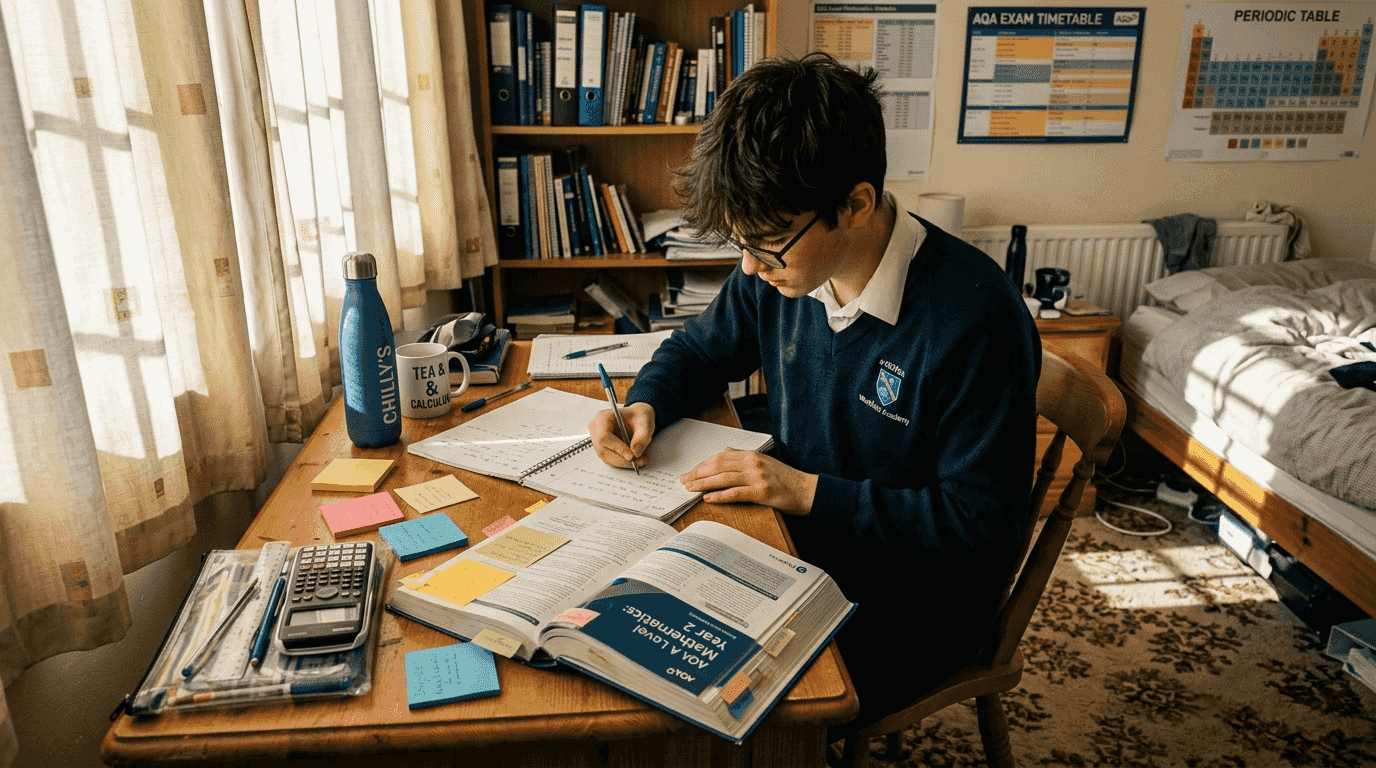
Understanding how AQA A Level mathematics is structured can transform your revision strategy. Did you know that Pure maths accounts for 66% of total marks whilst Applied topics make up the remaining 34%? This guide breaks down the qualification’s structure, exam format, and proven revision techniques to help you tackle every paper with confidence. You’ll discover what examiners assess, common pitfalls to avoid, and how targeted practice sharpens your exam readiness.
Table of Contents
Key takeaways
| Point | Details |
| Qualification scope | AQA A Level mathematics combines Pure maths (66% of marks) with Mechanics and Statistics (34% combined). |
| Exam structure | Three two-hour papers: Paper 1 (Pure), Paper 2 (Pure + Mechanics), and Paper 3 (Pure + Statistics). Calculators are required for all three papers. |
| Assessment focus | Examiners test knowledge recall, problem-solving, reasoning, and communication across all topics. |
| Common error | Neglecting Applied maths or underestimating time per paper limits your final grade potential. |
| Revision advantage | Filtering past papers by topic and difficulty, then tracking confidence levels, accelerates improvement. |
Introduction to AQA A Level mathematics
AQA A Level mathematics is a UK qualification designed to develop advanced mathematical reasoning and problem-solving skills. It’s widely recognised by universities and employers, particularly in STEM fields. The syllabus divides into three core domains: Pure mathematics, Mechanics, and Statistics. AQA A Level mathematics covers Pure maths, Mechanics, and Statistics as core topics, ensuring you build both theoretical understanding and practical application skills.
Pure mathematics forms the largest portion, addressing topics like calculus, algebra, trigonometry, and proof. Mechanics explores motion, forces, and vectors, bridging maths with physics concepts. Statistics teaches data analysis, probability, and hypothesis testing, essential for real-world decision-making. Each domain complements the others, creating a rounded mathematical toolkit.
AQA, as the exam board, sets the curriculum, writes assessments, and maintains consistent standards. Understanding this framework helps you align revision with what examiners prioritise. Key areas include:
-
Calculus (differentiation and integration)
-
Algebra (quadratics, sequences, binomial expansion)
-
Trigonometry (identities, graphs, solving equations)
-
Mechanics (kinematics, forces, projectile motion)
-
Statistics (data representation, probability distributions, hypothesis tests)
Focusing revision on these topics ensures you cover the full breadth of the specification. Many students find pure mathematics papers particularly challenging because they require deep conceptual understanding alongside procedural fluency. Starting with a clear topic map prevents gaps that could cost marks under exam pressure.
Exam format and structure
The exam consists of three 2-hour papers, all of which require a calculator. According to the AQA specification (section 5.9), a calculator is required for use in all assessments. Paper 1 covers Pure mathematics topics (proof, algebra, coordinate geometry, sequences, trigonometry, exponentials, differentiation, integration, and numerical methods). Paper 2 covers the same Pure content as Paper 1, plus Mechanics topics (vectors, quantities and units in mechanics, kinematics, forces and Newton's laws, and moments). Paper 3 covers the same Pure content as Paper 1, plus Statistics topics (statistical sampling, data presentation and interpretation, probability, statistical distributions, and hypothesis testing).
| Paper | Content | Calculator | Marks | Duration |
| 1 | Pure maths | Yes | 100 | 2 hours |
| 2 | Pure maths + Mechanics | Yes | 100 | 2 hours |
| 3 | Pure maths + Statistics | Yes | 100 | 2 hours |
Each paper carries 100 marks, totalling 300 across the qualification. Pure maths content appears across all three papers, but Mechanics topics are only examined on Paper 2, and Statistics topics only on Paper 3. This means neglecting either applied area risks losing marks on an entire paper. Balancing your study time across all three papers maximises grade potential.
Understanding calculator use is important. According to AQA, a calculator is required for all three papers. You must still show full working to earn method marks, and should not rely solely on calculator output. Key points to remember:
-
All papers: use your calculator effectively for numerical methods, statistical functions, and checking algebraic work
-
Paper 2 (Mechanics): vectors, kinematics, forces — apply mechanics alongside pure topics
-
All papers: clear presentation, logical steps, accurate final answers
Allocating two hours per paper means roughly one mark per minute plus buffer time for checking. Efficient time management starts with recognising question difficulty and adjusting your pace accordingly.

Assessment criteria and grading system
Assessment focuses on use of standard techniques, reasoning, and problem-solving. AQA evaluates three assessment objectives (AOs) across all papers — these are set by Ofqual and are the same across all A-level Mathematics specifications. AO1 covers using and applying standard techniques, including selecting and carrying out routine procedures and accurately recalling facts, terminology, and definitions. AO2 covers reasoning, interpreting, and communicating mathematically — this includes constructing proofs, making deductions, assessing argument validity, explaining reasoning, and using mathematical language correctly. AO3 covers solving problems within mathematics and in other contexts, including translating problems into mathematical processes and using mathematical models.
These objectives carry specific weightings according to the official AQA specification. AO1 represents 50% of total marks — the largest share — rewarding your ability to apply standard techniques fluently. AO2 accounts for 25% of marks, covering reasoning, interpretation, and mathematical communication. AO3 accounts for the remaining 25%, covering problem-solving in mathematical and real-world contexts. Understanding this distribution shapes effective revision:
-
Memorise core formulae and definitions (AO1)
-
Practise multi-step problems combining topics (AO2)
-
Work through proof questions and justifications (AO3)
-
Write clear, structured solutions with annotations — mathematical communication is assessed under AO2, not a separate AO4
Pro Tip: AO1 (standard techniques) accounts for 50% of marks, so strong procedural fluency is essential. AO2 and AO3 together account for 50%, so also invest time in explaining your reasoning and tackling unfamiliar problems — not just drilling routine procedures.
Grades span A* to E. The exact grade boundary for A* varies each year and is set by senior examiners after marking — it is not a fixed figure. Each AO contributes to your overall mark, meaning you can't ignore technique (AO1) or reasoning and communication (AO2) and still achieve top marks. Reviewing mark schemes from the exam questions database reveals how examiners allocate points for method, accuracy, and clarity. This insight helps you identify which skills need strengthening before exam day.
Types of questions and content to expect
Questions include problem-solving, proofs, and applied maths covering calculus, algebra, statistics, and mechanics. Expect a mix of short-answer problems worth 3-5 marks and extended questions spanning 10-15 marks. Worked problems test your ability to execute standard techniques like differentiation or solving equations. Proofs require you to demonstrate why a statement holds true, often using algebraic manipulation or logical deduction. Applied context questions embed mathematics in real scenarios, such as analysing data trends or modelling projectile motion.
Main topics distribute across papers as follows:
| Topic area | Coverage % | Key concepts |
| Calculus | 25-30 | Differentiation, integration, rates of change |
| Algebra | 20-25 | Quadratics, sequences, binomial expansion, proof |
| Trigonometry | 10-15 | Identities, solving equations, graphs |
| Mechanics | 15-20 | Kinematics, forces, vectors, projectiles |
| Statistics | 15-20 | Data analysis, probability, hypothesis testing |
Questions often integrate multiple topics within a single problem. For example, a mechanics question might require calculus to find maximum height, whilst a statistics task could involve algebraic rearrangement of probability formulae. Recognising these connections builds flexibility and confidence.
How to approach different question types effectively:
-
Read the question twice to identify what’s given and what you must find.
-
Sketch diagrams or label variables for applied problems.
-
Write down relevant formulae before substituting values.
-
Show each algebraic step clearly, even for calculator papers.
-
Check units and interpret results in context for applied questions.
-
Allocate time proportional to marks: 1 mark per minute as a rough guide.
Practising core pure further mathematics questions exposes you to advanced techniques that occasionally appear in standard A Level papers. Familiarising yourself with these formats reduces exam anxiety and speeds up your response under timed conditions.
Common misconceptions about AQA A Level mathematics
Many students believe focusing solely on Pure maths guarantees a top grade. Whilst Pure content dominates mark distribution, ignoring Applied topics means surrendering up to 34% of available marks. Mechanics and Statistics test different reasoning skills, and questions often carry high-value marks for integrated problem-solving. Balanced preparation across all three domains is essential.
Another misconception is underestimating time pressure. Two hours feels generous until you face multi-step proofs, complex integrations, and data interpretation tasks. Students who don’t practise under timed conditions frequently run out of time on exam day, leaving high-value questions incomplete. Simulating exam timing during revision builds speed and prioritisation skills.
Some learners focus exclusively on procedural questions, drilling standard techniques without developing reasoning. This approach collapses when examiners present unfamiliar contexts or ask for justifications. Higher-grade questions reward conceptual understanding, not just mechanical execution. Key errors to avoid:
-
Neglecting pure mathematics papers whilst overemphasising Applied topics (or vice versa)
-
Skipping past paper practice under strict time limits
-
Memorising solutions without understanding underlying principles
-
Ignoring mark scheme feedback on communication and reasoning
Pro Tip: Allocate revision time proportionally to mark distribution (roughly two-thirds Pure, one-third Applied) and practise all question types regularly to build versatility.
Correcting these misconceptions early prevents last-minute panic and ensures your preparation aligns with examiner expectations.
Effective revision strategies and tools
Using past papers filtered by topic and difficulty sharpens your focus on weaker areas. Instead of working through entire papers randomly, isolate specific topics like calculus or probability. This targeted approach lets you identify patterns in question styles and common pitfalls. Adaptive revision plans adjust based on your performance, prioritising topics where you score lowest. This personalised method maximises improvement per hour spent revising.
Timed practice simulates exam conditions, training you to manage pressure and pace yourself. Set a timer for two hours and attempt a full paper without breaks. Review your answers against mark schemes, noting where you lost marks for unclear communication or missed steps. Digital tracking tools record your confidence ratings and results over time, highlighting progress and persistent weak spots. Benefits include:
-
Immediate feedback on accuracy and method
-
Visual progress charts showing improvement trends
-
Filtered question banks targeting your needs
-
Automatic saving of attempted questions for later review
Pro Tip: Combine pure mathematics past papers with concept reviews after each attempt to reinforce understanding, not just rote memorisation.
Adaptive revision tools adjust question difficulty as your confidence grows. Start with foundational problems to build fluency, then tackle harder multi-step questions requiring integration of topics. Platforms offering adaptive revision resources personalise your study path, ensuring you spend time where it matters most. Regular practice with pure mathematics practice questions embeds techniques into long-term memory, reducing exam-day stress.
Revision checklist for maximum efficiency:
-
Schedule daily practice sessions, mixing topics to maintain variety
-
Use question filters to focus on low-confidence areas
-
Review mark schemes immediately after attempting questions
-
Track progress weekly to adjust your revision plan
-
Simulate full exam conditions at least once per week
Combining these strategies with consistent effort transforms your exam readiness and builds genuine mathematical proficiency.
Ready to master AQA A Level mathematics with targeted practice?
You’ve seen how understanding exam structure, assessment criteria, and common pitfalls transforms your revision approach. Quextro provides a pure mathematics question database with over 13,955 past paper questions filtered by topic, difficulty, and mark value. This lets you focus precisely on areas needing improvement without wading through entire papers.
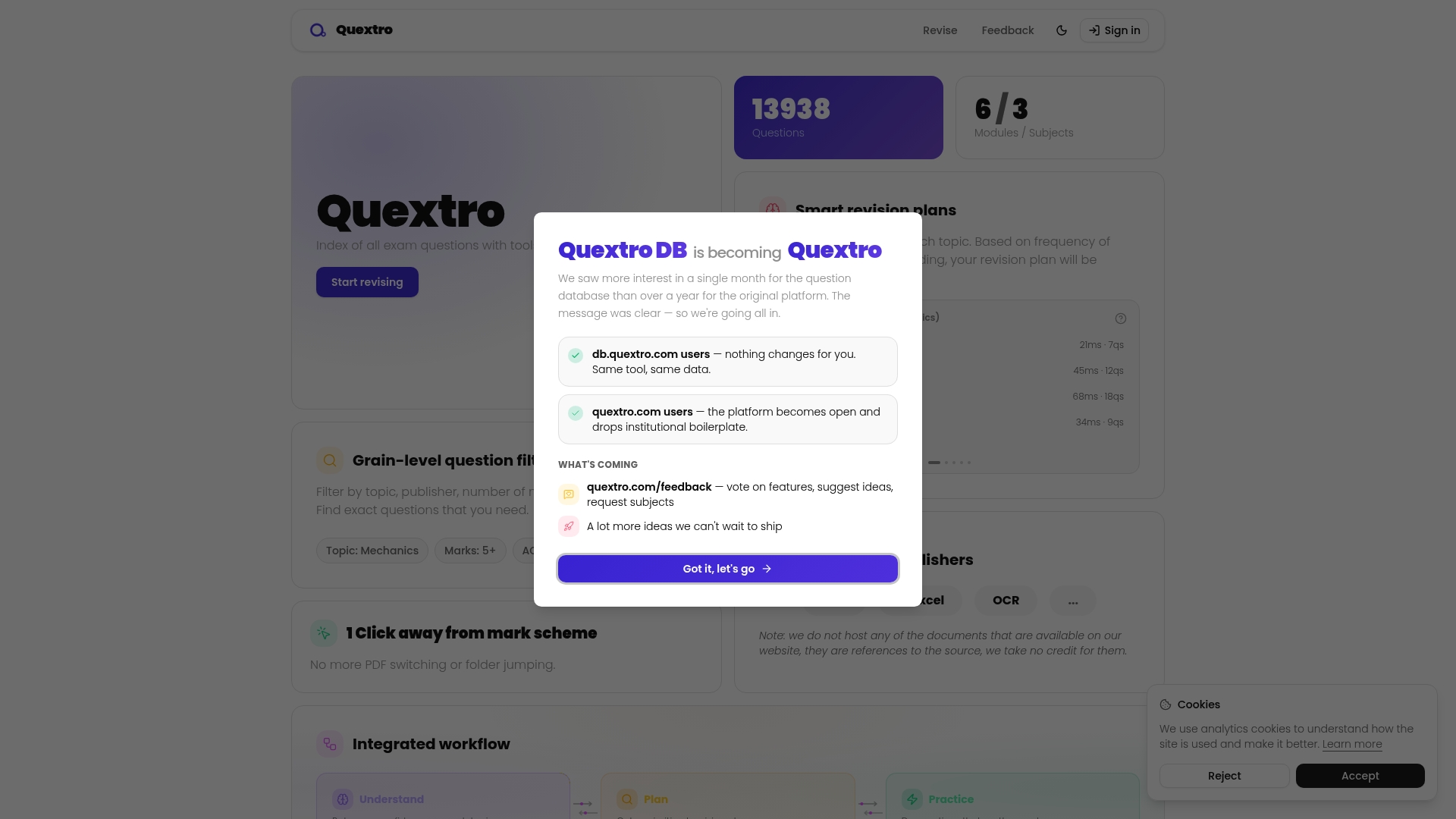
Adaptive revision plans adjust to your confidence ratings, prioritising weaker topics automatically. Track your progress with digital notebooks that save attempted questions and highlight patterns in your performance. Practise directly on the platform, eliminating the hassle of external PDFs whilst building exam-ready skills. Explore the exam questions database to start refining your revision strategy today.
FAQ
What is the format of AQA A Level mathematics exams?
Three two-hour papers assess your knowledge, all requiring a calculator: Paper 1 covers Pure mathematics, Paper 2 covers Pure mathematics plus Mechanics, and Paper 3 covers Pure mathematics plus Statistics. Each paper carries 100 marks, totalling 300 across the qualification.
How can targeted practice improve my AQA A Level maths revision?
Targeted practice helps you focus revision on weaker areas efficiently, saving time and boosting confidence. Filtering questions by topic and difficulty lets you address specific gaps rather than repeating content you’ve already mastered. Platforms offering targeted practice with pure maths questions personalise your study path for faster improvement.
What common mistakes should I avoid when preparing for AQA A Level maths?
Avoid neglecting Applied maths topics like Mechanics and Statistics, as they contribute 34% of total marks. Don’t underestimate the time needed for each exam paper; practise under timed conditions to build speed. Ensure you develop reasoning and communication skills, not just procedural fluency, to access higher-grade marks.