

Revising for A Level maths can feel overwhelming when faced with vast archives of past papers. Many students struggle to identify which AQA exam questions will actually strengthen their exam performance. This article explores specific AQA exam question examples across pure maths, mechanics, and statistics, helping you target your revision effectively and avoid common pitfalls that cost marks.
Table of Contents
- Criteria For Selecting Effective AQA Exam Questions
- Examples Of Common AQA Exam Question Types By Topic
- Comparison Of AQA Question Types And Common Pitfalls
- Making The Most Of AQA Exam Questions For Your Revision
- Explore AQA Maths Exam Questions With Quextro
- Frequently Asked Questions
Key takeaways
| Point | Details | |-------|---------|| | High frequency topics | Calculus, algebra, and statistics appear consistently in AQA exams year after year. | | Common student errors | Algebraic manipulation mistakes and conceptual misunderstandings in mechanics and statistics cost the most marks. | | Question selection matters | Choosing questions that target your weak areas and match exam board focus improves revision efficiency significantly. | | Mark scheme analysis | Understanding how examiners allocate marks reveals exactly where students gain or lose points. | | Conceptual understanding wins | Grasping underlying principles outperforms rote formula memorisation for achieving higher grades. |
Criteria for selecting effective AQA exam questions
Choosing the right exam questions transforms your revision from random practice into targeted skill building. Not all past papers offer equal value for your preparation time.
Start by identifying topics that dominate AQA papers. Analysis of past AQA papers from 2018 through 2023 reveals consistent emphasis on calculus, algebra, and statistics. These core areas deserve priority in your revision schedule. Focus your energy where examiners consistently test understanding.
Select questions that develop problem solving abilities rather than simple formula recall. Multi-step problems requiring you to connect different mathematical concepts mirror actual exam challenges. Single-step questions have their place for building confidence, but pushing yourself with complex scenarios prepares you better for exam day pressure.
Consider questions that expose typical student errors. Practising problems where most candidates struggle helps you recognise and avoid these pitfalls yourself. Examiner reports highlight specific question types where marks are commonly lost, making these ideal revision targets.
Mark schemes reveal the examiner's expectations at each step. Use them to understand exactly how points are awarded and where partial credit is available. This knowledge shapes how you structure your written solutions and manage your time during the actual exam.
Align your question selection to your specific modules. Pure maths, mechanics, and statistics each demand distinct skills and knowledge. Working through the Quextro exam questions database allows you to filter by module and topic, ensuring your practice matches your exam specification precisely.
Pro Tip: Create a revision log tracking which question types you find challenging. Return to similar questions after a week to test whether your understanding has solidified or needs further work.
Examples of common AQA exam question types by topic
Understanding the typical formats you'll encounter helps you approach exam papers with confidence. Each topic area has characteristic question styles that appear repeatedly.
Pure maths questions frequently test calculus and algebraic manipulation in combination. You might face a differentiation problem requiring you to find stationary points, then apply the second derivative test to classify them. Algebra questions often involve simplifying complex rational expressions or solving simultaneous equations with one non-linear equation. Integration questions may ask you to evaluate definite integrals or find areas between curves, demanding both technique and careful arithmetic.
Mechanics problems commonly focus on impulse, momentum, and circular motion scenarios. A typical question might present a collision between two particles, asking you to apply conservation of momentum and the impulse-momentum relationship. Examiner reports highlight common student difficulties with mechanics topics like impulse, momentum, and circular motion. Circular motion questions often involve resolving forces and applying Newton's second law in radial and tangential directions.
Statistics questions frequently involve interpretation and application rather than pure calculation. You might analyse a probability distribution, calculate expected values, or conduct hypothesis tests. These questions test your ability to select appropriate statistical methods and interpret results in context. Many students lose marks by correctly performing calculations but failing to state conclusions properly or relate findings back to the original scenario.
Questions requiring combined knowledge from different topic areas represent the highest mark opportunities and greatest challenges. Success demands seeing connections between mathematical concepts rather than treating each topic in isolation.
Typical questions blend formula application with mathematical reasoning. Simply knowing formulas is insufficient. You must recognise which techniques apply to novel situations and explain your reasoning clearly. Students frequently lose marks through misinterpreting question wording, applying formulas to inappropriate scenarios, or omitting essential justification steps.
Exploring mechanics mathematics examples and statistics revision examples exposes you to these patterns before exam day.
Comparison of AQA question types and common pitfalls
Different topics present distinct challenges and error patterns. Recognising these differences focuses your revision on areas needing most attention.
| Topic area | Question length | Common errors | Mark scheme focus |
|---|---|---|---|
| Pure maths | Medium to long, 6-12 marks | Algebraic manipulation mistakes, sign errors in calculus | Showing clear working, correct notation |
| Mechanics | Variable, 4-10 marks | Incorrect force diagrams, misapplied principles | Physical reasoning, diagram accuracy |
| Statistics | Short to medium, 3-8 marks | Terminology confusion, context interpretation failures | Correct statistical language, contextualised conclusions |
Algebraic errors dominate pure maths mark losses. Simple mistakes like incorrect sign handling when expanding brackets or errors in fraction manipulation cascade through multi-step problems. These aren't conceptual failures but careless execution under time pressure. Practising with full written solutions, not just mental arithmetic, builds accuracy habits.

Mechanics questions expose conceptual gaps more than computational errors. Students who memorise formulas without understanding underlying physics struggle when problems present unfamiliar scenarios. Careful attention to detail and application of mechanics principles proves crucial for success. Drawing clear diagrams showing all forces and choosing appropriate coordinate systems prevent common mistakes.
Statistical questions challenge students in interpretation and precise language. Calculating a test statistic correctly but stating the wrong conclusion about the null hypothesis loses marks. Confusing technical terms like independent and mutually exclusive events leads to incorrect method selection. Context matters enormously. Your answer must address the specific scenario described, not provide generic statistical statements.
Awareness of these pitfall patterns allows targeted practice. If algebra trips you up, dedicate sessions to algebraic manipulation drills. If mechanics diagrams cause problems, practise drawing and labelling force diagrams for varied scenarios. Statistical terminology confusion requires deliberate vocabulary study alongside problem practice.
Exploring pure maths exam papers and statistics exam papers with mark schemes reveals exactly where your preparation needs strengthening.
Pro Tip: After completing a past paper section, immediately mark it using the official scheme. Note not just wrong answers but specifically where in your working the error occurred. Patterns in your error types guide your next revision focus.
Making the most of AQA exam questions for your revision
Strategic use of past questions and mark schemes accelerates your exam preparation beyond passive reading or watching solutions.
Work through questions topic by topic rather than attempting full papers initially. This focused approach builds confidence in individual areas before testing your ability to switch between topics under time pressure. Master integration techniques thoroughly before moving to differential equations. Solid foundations in simpler material make complex problems manageable.
Regularly consult mark schemes, but use them actively rather than passively reading model answers. Attempt each question fully before checking the scheme. Compare your method and working to the examiner's expectations step by step. Students should use mark schemes to identify mistakes and understand how marks are allocated. This identifies gaps in your knowledge or presentation.
Focus revision time on identified weak areas rather than repeatedly practising comfortable topics. It feels satisfying to correctly solve familiar question types, but exam success requires competence across all specification areas. Track which topics consistently cause difficulty and dedicate extra sessions to these challenges.
Practice timing to simulate exam conditions as your preparation progresses. Early revision can proceed at your own pace, but building speed becomes essential closer to exams. Set realistic time targets based on mark allocations. A six mark question deserves roughly six minutes. Training yourself to move on when stuck prevents time management disasters.
Balance conceptual understanding with varied question practice. Understanding why integration reverses differentiation matters more than memorising integration formulas. Deep comprehension lets you tackle novel problems confidently. However, understanding alone isn't sufficient. Applying concepts accurately under exam pressure requires repeated practice across different question styles.
The AQA exam question resources at Quextro provide structured access to thousands of past questions, letting you implement these strategies efficiently without hunting through scattered PDF files.
Pro Tip: Schedule regular full paper attempts under strict exam conditions, including no phone, timed sections, and proper breaks. This builds mental stamina and reveals whether your topic knowledge translates to exam performance.
Explore AQA maths exam questions with Quextro
Finding effective practice materials shouldn't slow down your revision momentum. Quextro's comprehensive collection of AQA exam questions gives you instant access to targeted practice across all mathematics modules.
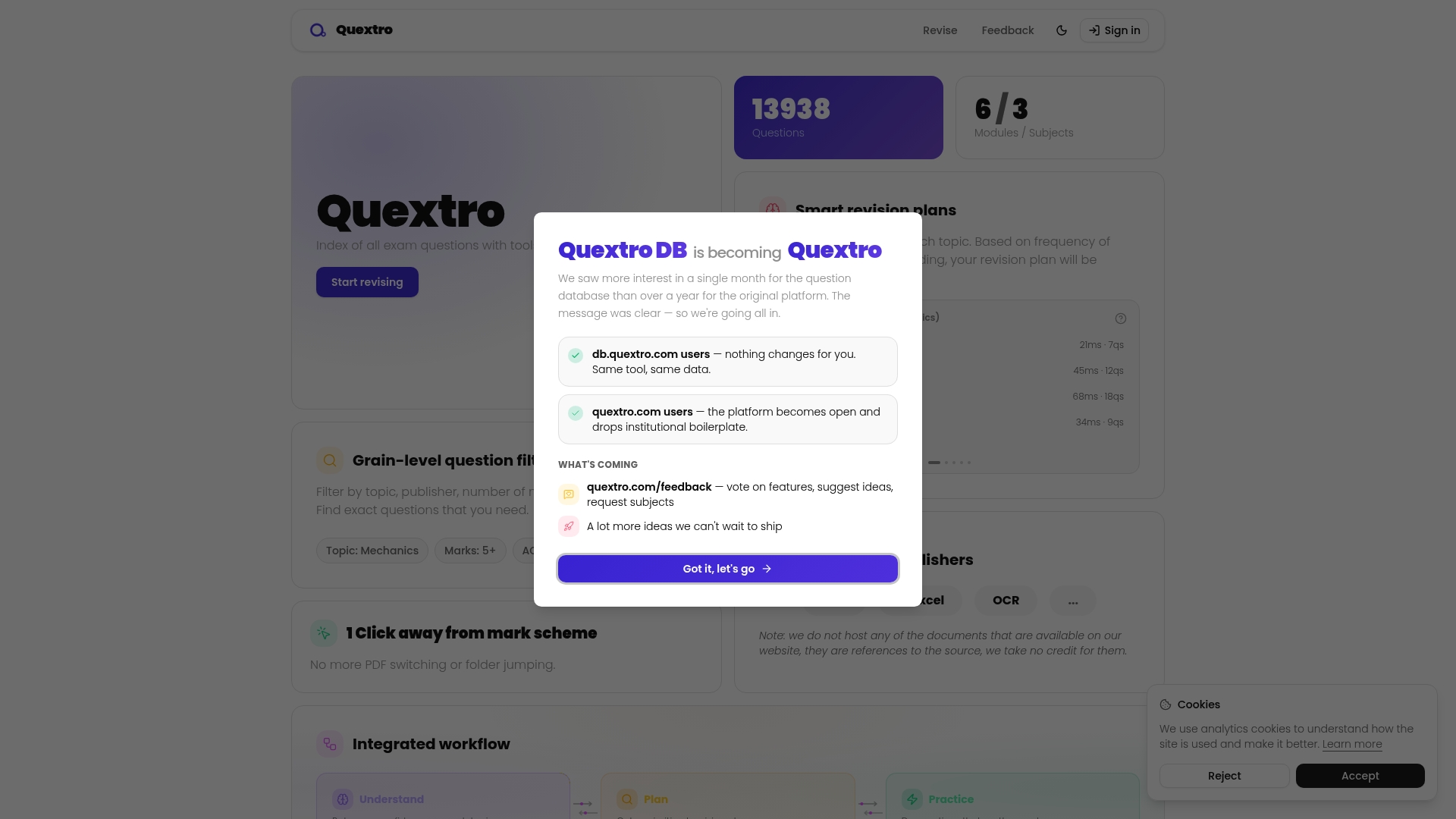
The platform houses over 13,955 past exam questions from AQA and other major exam boards, all organised by topic, difficulty, and mark allocation. Filter questions to match your current revision needs, whether you're strengthening pure maths skills, tackling mechanics challenges, or refining statistical analysis.
Quextro eliminates the frustration of managing scattered PDF files and lost mark schemes. Answer questions directly on the platform, track your progress automatically, and build personalised question notebooks for topics needing extra attention. Smart revision plans adapt based on your confidence ratings and question frequency, ensuring your practice time targets genuine weak areas.
Explore the exam questions database to access pure mathematics papers and mechanics mathematics papers alongside integrated mark schemes and examiner guidance. Transform your A Level maths revision from overwhelming to organised.
Frequently asked questions
What are the best types of AQA exam questions to revise?
Focus on questions targeting frequently tested topics like calculus, algebra, and statistics where examiners consistently assess understanding. Select problems with available mark schemes so you can self-assess accurately and learn from mistakes. Include a balanced mix of pure maths, mechanics, and statistics aligned to your specific exam modules. Practice both shorter questions building fundamental skills and complex multi-step problems developing exam-level problem solving. Review examiner reports to identify typical pitfalls and concentrate effort on question types where students commonly struggle.
How can I use mark schemes to improve my exam technique?
Use mark schemes to compare your solution steps with examiner expectations, revealing exactly where marks are gained or lost. This comparison identifies whether you're losing points through incorrect methods, computational errors, or insufficient justification. Focus subsequent practice on the specific skills the mark scheme reveals as weak. Learn the level of detail examiners expect in working and how partial credit is awarded, shaping how you structure solutions under time pressure.
Which mechanics topics should I focus on for AQA further maths paper 3?
Prioritise practising impulse, momentum, and circular motion questions, as these topics show lower average scores in Paper 3 mechanics. Understand the underlying principles deeply rather than memorising formulas superficially, helping you avoid common conceptual mistakes. Work through varied scenarios for each topic, ensuring you can draw accurate diagrams, select appropriate equations, and apply Newton's laws correctly. Supplement your practice with mechanics revision resources that provide structured question progressions.
How often should I practise past AQA exam questions before my maths A Level exams?
Aim for regular weekly practice sessions targeting different topics throughout your revision period. This consistent exposure builds familiarity with question formats and maintains skills across all specification areas. Increase practice frequency as exams approach, incorporating full timed papers to simulate actual exam conditions. The final month before exams should include at least two or three complete papers weekly, building mental stamina and time management skills essential for peak performance.