

Struggling to make meaningful progress in A Level maths revision often boils down to one simple mistake: randomly selecting practice questions without a clear strategy. Research on deliberate, targeted practice consistently shows that focusing revision on specific weak areas and difficulty levels leads to significantly better topic mastery than unstructured question selection. This guide walks you through exactly how to choose and use exam questions effectively, transforming inefficient revision into focused, results-driven preparation that builds both confidence and exam readiness.
Table of Contents
Key takeaways
| Point | Details |
| Target weak topics first | Focusing on areas with low confidence accelerates improvement and fills knowledge gaps faster. |
| Balance difficulty strategically | Start with manageable questions and progressively increase complexity to build skills without frustration. |
| Use confidence tracking | Rating your topic mastery helps personalise practice and ensures revision stays targeted. |
| Mix exam board styles | Exposure to AQA, Edexcel, OCR (and CIE for international students) questions broadens problem-solving approaches and reduces exam surprises. |
| Leverage digital tools | Platforms like Quextro simplify filtering by topic, difficulty, and marks, saving hours of manual sorting. |
Prerequisites for selecting exam questions
Before diving into question selection, you need solid foundations and the right resources. Start with basic algebra, calculus, and trigonometry from GCSE and early A Level modules. These form the building blocks for more advanced topics. Without fluency in foundation mathematics questions, tackling higher-level content becomes unnecessarily difficult.
Access to a categorised question bank is non-negotiable. Sorting through hundreds of PDFs wastes precious revision time. You need a system that organises questions by topic, difficulty, exam board, and mark allocation. Platforms like Quextro provide exactly this structure, offering over 13,955 past exam questions from AQA, Edexcel, OCR, and CIE (Cambridge International) in one searchable database.
Familiarity with your exam board’s syllabus and question styles matters more than students realise. Each board phrases questions differently and emphasises certain content areas. Spend time reviewing past papers from your specific board to understand what examiners prioritise. This knowledge helps you select questions that mirror actual exam conditions.
Finally, establish a tracking system for confidence and progress. Whether digital or manual, you need a method to record which topics feel solid and which need more work. Without tracking, you risk practising topics you’ve already mastered whilst neglecting weaker areas. A simple spreadsheet or notebook works, but integrated tools within platforms streamline this process significantly.
Essential resources checklist:
-
GCSE and early A Level revision notes for algebra, calculus, and trigonometry
-
Access to a categorised question bank organised by topic and difficulty
-
Your exam board’s syllabus and recent past papers
-
A confidence tracking system (digital platform or manual notebook)
-
Calculator and formula booklet aligned with exam regulations
| Resource Type | Purpose | Recommended Source |
| Question bank | Organised practice by topic and difficulty | Quextro, exam board websites |
| Syllabus documents | Understanding content scope and exam weighting | Official exam board sites |
| Tracking tools | Monitoring progress and confidence levels | Quextro platform, spreadsheets |
| Formula sheets | Quick reference for standard results | Exam board formula booklets |
For students tackling advanced modules, ensure you have access to core pure further mathematics questions to practise complex proofs and abstract concepts that appear in Further Maths exams.
Understanding exam board question styles and requirements
Each exam board brings distinct characteristics to A Level maths questions. Different exam boards emphasise varying question styles and content areas; mixing questions from multiple boards broadens familiarity and reduces exam-day surprises. AQA tends towards straightforward problem statements with clear mark schemes. Edexcel follows a consistent and predictable structure each year, with formulaic question formats and a greater emphasis on modelling in Mechanics. OCR A favours more challenging algebraic manipulation and multi-step problems, while OCR B (MEI) incorporates context-based questions and a unique Comprehension Paper. CIE (Cambridge International Examinations) is an international qualification — not a domestic UK A Level board — and typically demands precise mathematical communication alongside rigorous working.
Pure mathematics questions form the core of most exams, testing algebra, calculus, trigonometry, and proof. These typically carry the highest mark allocations and require deep conceptual understanding. Mechanics questions apply mathematical principles to physical scenarios involving forces, motion, and energy. Statistics questions focus on probability, distributions, hypothesis testing, and data analysis.
Practising exclusively from one exam board creates blind spots. A student comfortable with AQA’s direct questioning style might struggle with OCR’s interconnected problems. Exposure to multiple boards develops adaptable problem-solving skills. You learn to recognise the same mathematical concept presented in different formats, which strengthens understanding far more than repetitive practice of identical question types.
Mark allocations signal question difficulty and time investment. A 2-mark question requires a quick calculation or straightforward application. An 8-mark question demands multi-step reasoning, potentially including proofs or complex manipulations. Use mark values to balance your practice sessions, ensuring you develop both speed on routine questions and stamina for extended problems.
Exam board characteristics:
-
AQA: Clear, direct questions with structured mark schemes ideal for building foundational confidence
-
**Edexcel:**Consistent, predictable exam structure with formulaic question formats and stronger emphasis on applied Mechanics modelling
-
**OCR:**OCR A: algebra-heavy, multi-step problems with rigorous algebraic manipulation; OCR B (MEI): context-based questions and a Comprehension Paper testing real-world mathematical thinking
-
**CIE:**CIE (Cambridge International — international students only): emphasis on precise mathematical communication and rigorous structured working
Core steps for selecting exam questions
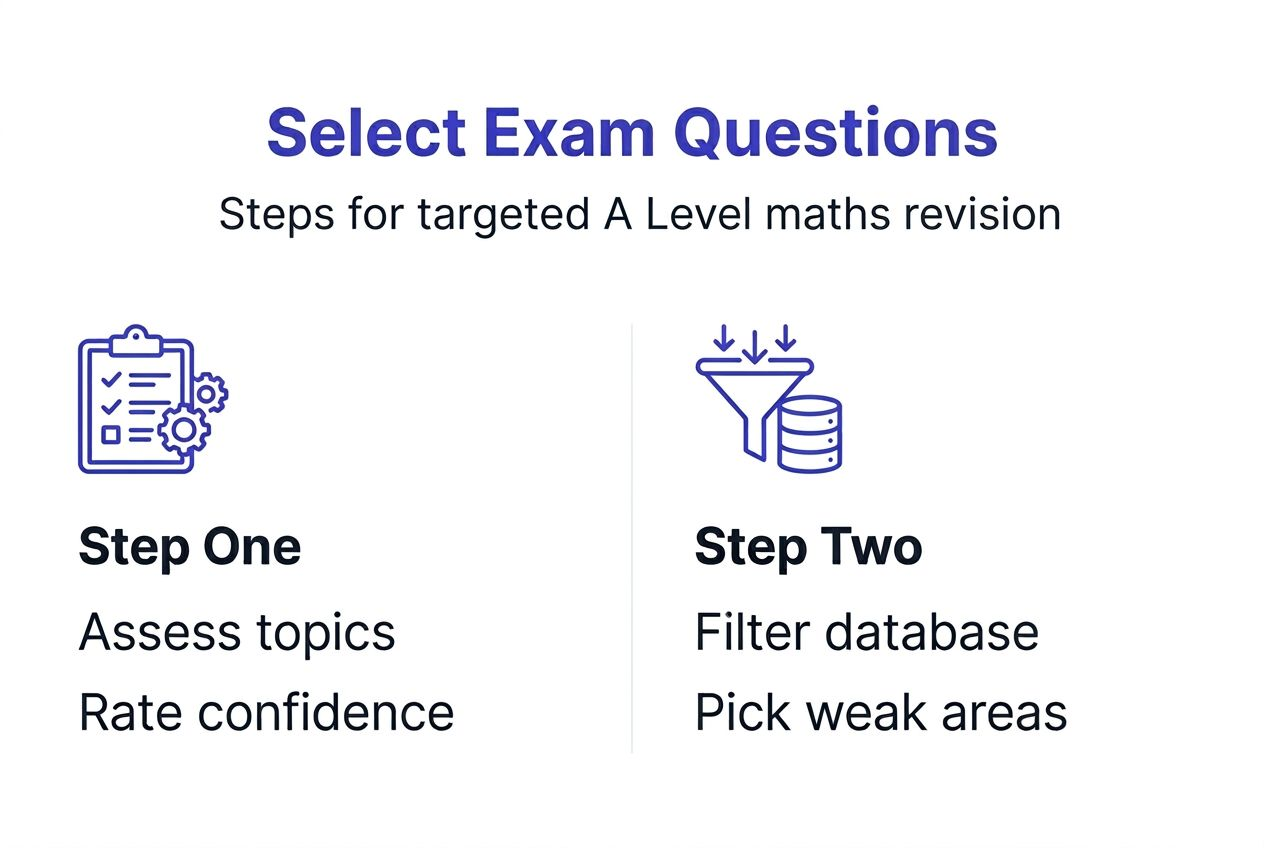
Start by assessing your confidence across all topics on your syllabus. Rate each area on a simple scale: strong, moderate, or weak. This honest self-evaluation directs your question selection towards maximum impact. Weak topics deserve the most practice time because improvement here yields the biggest gains.

Select grouped questions starting from weak areas. If coordinate geometry feels shaky, filter your exam questions database to show only coordinate geometry problems. Begin with easier questions (those worth 2-4 marks) to rebuild confidence before attempting harder challenges. This progressive approach prevents the frustration that comes from tackling 8-mark problems when basic techniques aren’t solid.
Progressive increase in question difficulty during practice sessions improves problem-solving skills and exam readiness. Once you’re consistently solving easier questions correctly, move to intermediate difficulty (4-6 marks). Only when intermediate questions feel comfortable should you attempt the most challenging problems. This staged progression builds skills systematically.
Balance question marks and types to simulate exam conditions. Real exams mix quick calculations with extended reasoning. Your practice should mirror this. Dedicate some sessions to rapid-fire 2-3 mark questions building fluency. Other sessions should focus on tackling full 8-10 mark questions requiring sustained concentration and multi-step planning.
Use filtering tools to automate selection and save time. Manual searching through PDFs for specific topics wastes hours. Platforms with built-in filters let you instantly find, for example, all 6-mark higher mathematics questions on integration from Edexcel. This efficiency means more time actually practising.
Incorporate mixed question sets to simulate exam conditions. After targeted topic practice, create practice papers combining statistics mathematics questions, pure mathematics questions, and mechanics mathematics questions in random order. This trains your brain to switch between different mathematical modes quickly, exactly what exams demand.
Pro Tip: Track every practice session in a revision log noting the topic, number of questions attempted, accuracy rate, and confidence level afterwards. Review this log weekly to identify patterns and adjust your question selection accordingly.
Question selection process:
-
Complete a full syllabus confidence audit, rating every topic
-
Identify the three weakest topics requiring immediate attention
-
Filter questions for the weakest topic, starting with 2-4 mark problems
-
Complete 10-15 questions at this difficulty level over 2-3 sessions
-
Assess accuracy; if above 80%, move to next difficulty tier
-
Repeat the process for second and third weak topics
-
Schedule mixed-topic practice sessions weekly to maintain breadth
-
Gradually increase the proportion of harder questions as confidence grows
| Practice Stage | Question Difficulty | Marks Range | Session Focus | Success Indicator |
| Foundation | Low | 2-4 | Building technique | 80%+ accuracy |
| Development | Medium | 4-6 | Applying methods | 70%+ accuracy |
| Advanced | High | 6-10 | Extended reasoning | 60%+ accuracy |
| Exam Simulation | Mixed | 2-10 | Time management | Completing in exam time |
Common mistakes to avoid when selecting practice questions
Random selection wastes valuable revision time. Avoiding random, unstructured question selection prevents wasted revision time and maximises progress. Clicking on whatever question appears next or working through papers chronologically ignores your specific needs. You might spend an hour on topics you’ve already mastered whilst neglecting areas that desperately need attention.
Skipping confidence tracking leads to poor focus. Without recording which topics feel comfortable and which don’t, you lose the ability to target practice effectively. Many students assume they’ll remember their weak spots, but memory is unreliable under exam pressure. Systematic tracking removes guesswork and ensures every practice session addresses real gaps.
Practising too many high-difficulty questions too early causes frustration and stagnation in progress. Students often jump straight to past paper questions worth 8-10 marks, then feel demoralised when they can’t solve them. Building competence requires starting at an appropriate difficulty level. Master the fundamentals before attempting complex multi-step problems.
Focusing exclusively on one exam board’s style limits adaptability. Whilst you should prioritise your actual exam board, never practising questions from other boards means missing valuable problem-solving perspectives. Different boards often test the same concept using varied approaches. Exposure to these variations deepens understanding and makes you more versatile.
Not reviewing progress reduces learning gains. Attempting questions without analysing mistakes means repeating errors. After each practice session, review incorrect answers carefully. Identify whether mistakes stemmed from calculation errors, conceptual misunderstandings, or time pressure. This reflection transforms practice from mere repetition into genuine learning.
Pro Tip: Schedule a 30-minute review session every Sunday to analyse the week’s practice. Calculate your accuracy rate for each topic, identify recurring error patterns, and adjust next week’s question selection based on what the data reveals.
Revision pitfalls to avoid:
-
Selecting questions randomly without considering weak topics or difficulty progression
-
Neglecting to rate and track confidence levels for different syllabus areas
-
Attempting hardest questions first before mastering foundational techniques
-
Limiting practice to only your exam board’s past papers
-
Failing to review mistakes and identify patterns in errors
-
Practising topics in isolation without mixed-question sessions
-
Ignoring mark allocation when planning practice time
Leveraging digital tools and platforms
Quextro transforms question selection from a time-consuming manual process into an efficient, targeted operation. The platform allows filtering by topic, difficulty, exam board, and mark allocation simultaneously. Need all 4-6 mark integration questions from AQA? A few clicks deliver exactly that. This precision eliminates hours spent flipping through PDFs or textbooks searching for relevant practice.
Integrated confidence rating helps personalise revision automatically. As you complete questions on the platform, you rate your confidence for each topic. The system uses these ratings to suggest practice areas, directing you towards topics needing more work. This adaptive approach means your revision plan evolves based on actual performance, not static schedules created weeks earlier.
Adaptive revision plans adjust to your learning needs in real time. Unlike traditional study plans that follow fixed sequences, platforms like Quextro respond to your progress. Struggling with a particular topic triggers additional practice recommendations. Mastering an area reduces its appearance in future sessions. This flexibility mirrors how effective tutors adjust teaching based on student needs.
Digital notebook features support progress tracking and motivation seamlessly. Every question you attempt gets saved automatically. You can review previous attempts, track improvement over time, and identify topics showing consistent progress versus those remaining problematic. Seeing tangible evidence of improvement provides powerful motivation during challenging revision periods.
The platform saves significant time compared to managing PDFs or paper question banks. Traditional revision involves downloading papers, printing questions, manually checking answers against mark schemes, and organising materials. Digital platforms handle all this infrastructure automatically, freeing your mental energy for actual learning rather than administrative tasks.
“The question filtering tools let me focus exclusively on my weakest topics without wasting time searching through random papers. Within two weeks of targeted practice, my confidence in trigonometric identities went from barely passing to consistently scoring full marks.”
Digital platform advantages:
-
Instant filtering by topic, difficulty, exam board, and mark value
-
Automatic confidence tracking and adaptive practice recommendations
-
Integrated answer checking and progress saving
-
Digital notebooks replacing scattered paper notes
-
Question history showing improvement trends over time
-
Mobile access enabling practice anywhere
Expected outcomes and how to measure your progress
Aim to increase confidence ratings by 20% within four weeks of targeted practice. This represents moving from “weak” to “moderate” confidence in 2-3 major topics. Track confidence using numerical scales (1-5) rather than vague feelings. Record ratings weekly in a spreadsheet or platform dashboard. Consistent upward trends validate your revision strategy.
Reduce errors in weak topics by 30% with sustained targeted practice. Calculate error rates by dividing incorrect answers by total attempts for each topic. If you initially score 50% on calculus questions, targeted practice should lift this to 65-70% within 3-4 weeks. Smaller improvements signal the need to adjust your approach, perhaps starting with easier questions or seeking additional explanation.
Complete mixed question sets within exam time limits as a critical benchmark. Real exams impose strict time constraints. Practice papers should match exam duration precisely. If Paper 2 allows 2 hours for 100 marks, practice completing 100-mark question sets in 2 hours. Initially you’ll run over time. With practice, you’ll develop pacing instincts and speed.
Tracking confidence for each topic and adjusting question selection accordingly enhances personalised learning and exam preparation. Practice exam scores can realistically improve by 15-25% through strategic question selection and focused practice. A student scoring 60% on initial practice papers can reach 75-85% by addressing weak topics systematically rather than random practice.
Use progress metrics to refine question difficulty and focus continuously. If accuracy on medium difficulty questions exceeds 85% for two consecutive weeks, shift more practice time to harder questions. Conversely, if accuracy drops below 50% on a topic, return to easier questions to rebuild foundations. Let data drive decisions, not assumptions.
Monitor both accuracy and speed for comprehensive exam readiness. High accuracy with slow completion still fails exams. Track time per question during practice. Aim to complete 1-mark questions in under 2 minutes, 4-mark questions in 6-8 minutes, and 8-mark questions in 12-15 minutes. Speed without accuracy is equally useless, so balance both dimensions.
| Metric | Baseline | 4-Week Target | 8-Week Target | Measurement Method |
| Weak topic confidence (1-5 scale) | 2.0 | 3.0 | 4.0 | Weekly self-rating |
| Error rate on targeted topics | 40% | 25% | 15% | Incorrect ÷ total attempts |
| Practice paper score | 60% | 72% | 80% | Full papers under exam conditions |
| Questions completed per hour | 8 | 12 | 15 | Timed practice sessions |
Progress indicators to track:
-
Weekly confidence ratings for each syllabus topic
-
Accuracy percentages by topic and difficulty level
-
Time taken per question compared to mark allocation
-
Number of topics moved from “weak” to “moderate” or “strong”
-
Improvement in mixed-topic practice paper scores
-
Completion rate for timed practice sessions
Explore Quextro to optimise your A Level maths practice
Quextro provides exactly the structured question database and tracking tools this guide recommends. With over 13,955 past exam questions from AQA, Edexcel, OCR, and CIE (Cambridge International), you gain instant access to categorised practice covering every syllabus topic. Filter by difficulty, marks, and exam board to target your weakest areas precisely.
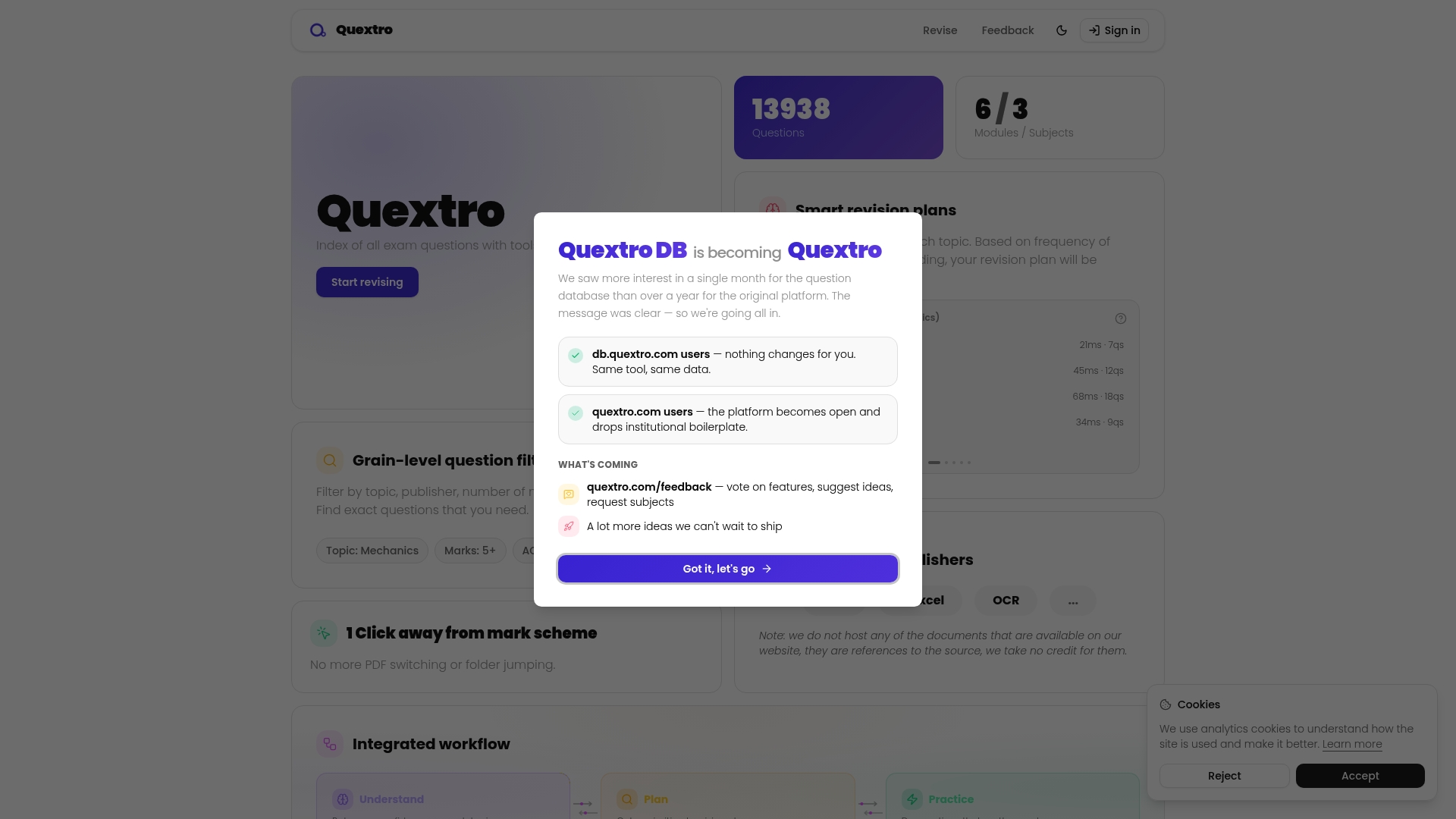
The platform’s integrated confidence tracking and adaptive revision plans take the guesswork out of what to practise next. Rate your confidence as you work, and the system suggests questions aligned with your current skill level. Digital notebooks save every attempt automatically, letting you review progress and identify improvement patterns. Explore higher mathematics question sets for advanced pure maths, mechanics mathematics practice for applied topics, or pure mathematics question bank for core concepts. Streamline your revision with tools designed specifically for targeted exam preparation.
Frequently asked questions
What criteria should I use to select A Level maths exam questions?
Choose questions focusing on your weakest topics first, as identified through confidence ratings or past performance. Balance difficulty by starting with 2-4 mark questions to build technique before progressing to harder 6-10 mark problems. Consider question mark allocations to ensure your practice mirrors actual exam weighting across pure maths, mechanics, and statistics.
How can confidence ratings improve question selection?
Confidence ratings highlight specific weaker areas requiring concentrated practice, enabling you to target revision efficiently rather than practising random topics. By rating each syllabus area honestly (weak, moderate, strong), you create a personalised revision map. Regular re-rating tracks improvement and shifts focus as weaker topics strengthen, ensuring practice time delivers maximum impact.
Why include questions from multiple exam boards?
Including questions from AQA, Edexcel, and OCR broadens your problem-solving approaches by exposing you to varied question phrasings and presentation styles. If you are studying a Cambridge International (CIE) qualification rather than a UK domestic A Level, CIE papers are also worth practising. Different boards emphasise different aspects of the same mathematical concept, which deepens understanding. This variety reduces surprises on exam day, as you've encountered diverse ways of testing the same material.
What are common mistakes when choosing practice questions?
Random question selection without targeting weak topics wastes revision time on areas you’ve already mastered. Starting with overly difficult questions before consolidating fundamentals causes frustration and stagnation. Ignoring progress tracking means repeating mistakes without learning from them. Limiting practice to one exam board’s style creates blind spots. Neglecting mixed-topic sessions fails to develop the switching skills exams demand.