

Preparing for A Level maths exams can feel overwhelming when you're juggling multiple topics, past papers, and revision strategies. Many students struggle to know where to start or how to structure their study time effectively. This comprehensive checklist provides a proven, step-by-step approach to organising your revision from January through to exam day in 2026. You'll discover evidence-based strategies for mastering content, practising efficiently, and avoiding common pitfalls that cost marks. Whether you're tackling pure mathematics, statistics, or mechanics, this guide will help you build confidence and maximise your exam performance.
Table of Contents
- Setting Up Your Exam Preparation: Prerequisites And Mindset
- Your Structured Step-By-Step Revision Plan
- Executing Effective Revision Sessions
- Verifying Your Preparation And Exam-Day Checklist
- Explore Quextro's A Level Maths Resources For 2026
Key takeaways
| Point | Details |
|---|---|
| Start early and structure time | Begin revision in January with 5-7 hours weekly to build consistent progress and reduce stress. |
| Use diverse resources | Combine textbooks, videos, worksheets, and past papers to deepen understanding across different learning styles. |
| Practise under timed conditions | Complete full exam papers within strict time limits to build stamina and improve time management. |
| Focus on weak areas | Identify struggling topics and dedicate extra practice to these areas for maximum score improvement. |
Setting up your exam preparation: prerequisites and mindset
Before diving into revision content, you need to establish a solid foundation. Start by identifying your exam board, whether that's AQA, Edexcel, OCR, or CIE. Each board has unique specifications, question styles, and marking schemes. Review the official specification document to understand exactly which topics will be assessed and the depth of knowledge required. Mastering the exam board's specification is key to focusing your efforts where they matter most.
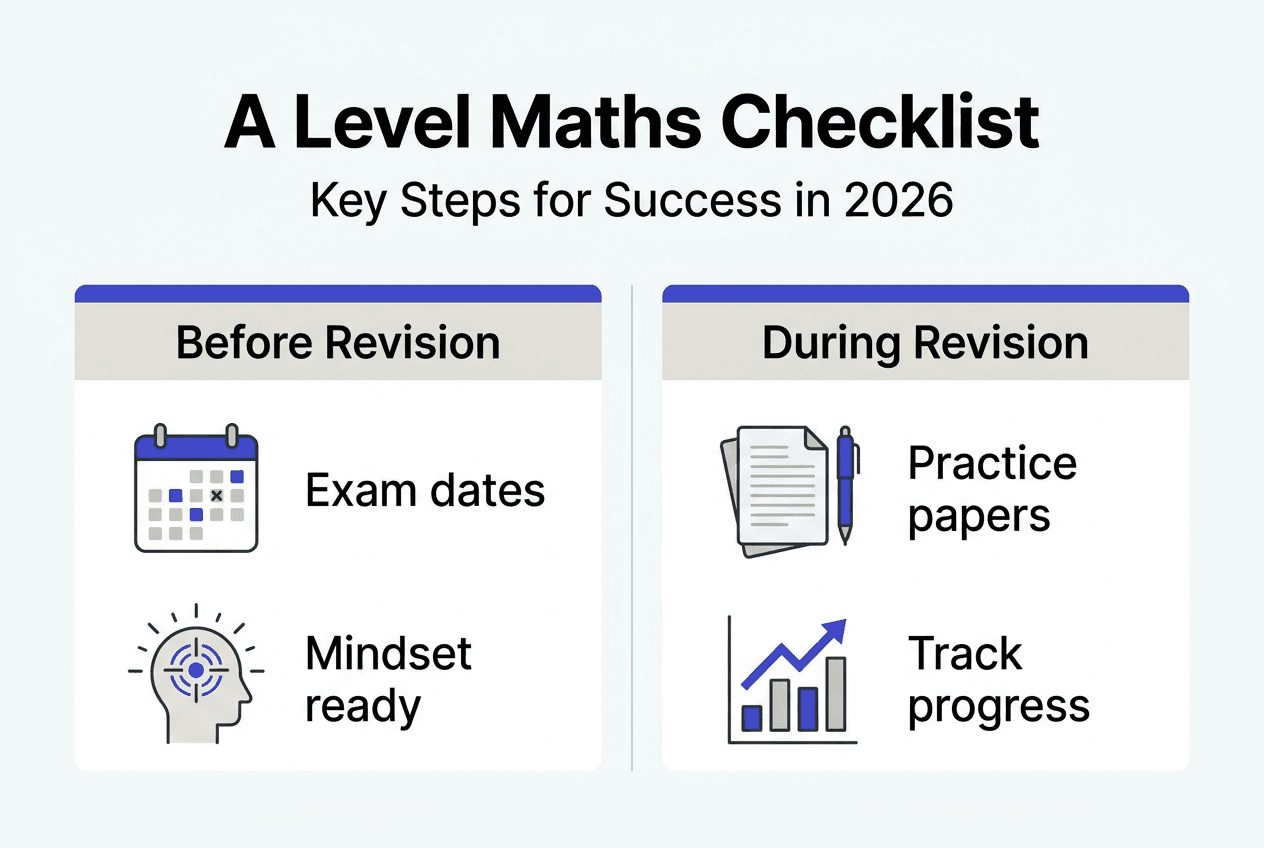
Next, note all your exam dates and deadlines for 2026. Create a revision calendar working backwards from these dates, allowing time for multiple practice runs and topic reviews. Knowing your timeline prevents last-minute cramming and helps you pace your learning effectively. Mark key milestones like mock exams, coursework deadlines, and topic completion targets.
Gather your study materials early. You'll need your core textbook, supplementary worksheets, video tutorials, and access to past papers from recent years. Having everything organised in one place, whether physical folders or digital files, saves time and keeps you focused. Consider using an AQA A Level mathematics revision guide tailored to your specific exam board for targeted support.
Pro Tip: Adopt a growth mindset from day one. View challenging problems as opportunities to strengthen understanding rather than obstacles. This mental shift transforms frustration into productive learning, helping you persist through difficult topics like integration or probability distributions.
Your mindset matters as much as your materials. Approach revision with curiosity about understanding concepts deeply, not just memorising formulas. Ask yourself why methods work, how different topics connect, and where you might apply these skills. This deeper engagement builds lasting knowledge that performs under exam pressure. Focus on mastering reasoning and problem-solving processes, as these transfer across question variations and help you tackle unfamiliar scenarios with confidence.
Your structured step-by-step revision plan
A successful revision plan starts early and maintains consistency. Students starting revision in January and dedicating 5-7 hours per week see significant score improvement compared to those who begin later. This early start gives you time to cover all topics thoroughly, identify weak areas, and complete multiple rounds of practice without rushing.
Structure your revision into weekly themes aligned with syllabus topics. For example, dedicate one week to differentiation, another to trigonometry, and a third to statistical distributions. This focused approach allows deep engagement with each topic before moving forward. Within each week, follow this pattern:
- Review theory and key formulas from your textbook or notes.
- Work through example problems to understand application.
- Complete topic-specific practice questions from worksheets or question banks.
- Attempt past paper questions on that topic under timed conditions.
- Review mistakes and identify gaps in understanding.
Integrate full past papers into your schedule regularly. Start with one complete paper every two weeks in early months, increasing to weekly papers as exams approach. Time yourself strictly, simulating real exam conditions. This builds stamina, improves time management, and familiarises you with question formats and difficulty levels.
| Month | Focus | Weekly Hours | Practice Type |
|---|---|---|---|
| January-February | Core algebra and calculus | 5-6 hours | Topic questions and short exercises |
| March-April | Statistics, mechanics, and integration | 6-7 hours | Mixed topic questions and monthly papers |
| May | Full paper practice and weak areas | 7-8 hours | Complete timed papers and targeted revision |
Review your performance after each practice session. Identify topics where you consistently lose marks and allocate extra time to these areas. Use targeted exam questions filtered by difficulty and topic to address specific weaknesses efficiently. This focused improvement strategy yields better results than simply repeating content you already understand well.

Pro Tip: Create a revision tracker spreadsheet listing all syllabus topics. Rate your confidence in each area from 1-5 after practice sessions. This visual overview helps you prioritise time and ensures nothing gets overlooked as exams approach.
Executing effective revision sessions
How you revise matters as much as what you revise. Always aim to understand the reasoning behind formulas and solutions rather than memorising steps blindly. When you encounter a new method, ask yourself why it works and how it connects to concepts you already know. This deep understanding helps you adapt techniques to unfamiliar questions and reduces the cognitive load during exams.
Practise with full exam past papers within strict timed sessions. Timed practice is essential to build exam stamina and manage time effectively during A Level maths exams. Set a timer, remove distractions, and work through papers exactly as you would in the exam hall. This simulation trains your brain to perform under pressure and helps you develop automatic time awareness.
Show all your working clearly on every question. Method marks often account for 60-70% of total marks in maths exams, meaning you can earn substantial credit even if your final answer is incorrect. Write out each step logically, label diagrams, and include units where appropriate. Practising this habit during revision ensures it becomes automatic on exam day.
"Success in A Level maths comes from consistent practice, clear working, and learning from mistakes. Every error is a teaching moment that strengthens your understanding."
Avoid common mistakes that cost marks unnecessarily. Never rely on your calculator for simple arithmetic without checking the result makes sense. Always read questions carefully, highlighting key information and checking what the question actually asks for before starting calculations. Many students lose marks by answering a different question than the one posed or missing crucial details in the wording.
Develop strong time awareness to avoid spending too long on single questions. If you're stuck after two minutes on a problem, mark it and move forward. Return to challenging questions at the end when you've secured marks on easier items. This strategic approach maximises your total score by ensuring you attempt everything accessible before tackling the hardest problems.
Pro Tip: After completing each practice paper, spend equal time reviewing your work. Analyse every mistake to understand whether it was a conceptual misunderstanding, a careless error, or a time management issue. This reflection turns practice into genuine learning.
Practise with resources that mirror real exam conditions. Use Higher Mathematics papers and questions that match your exam board's style and difficulty level. Familiarity with question formats reduces anxiety and helps you recognise problem types quickly during the actual exam.
Verifying your preparation and exam-day checklist
As exams approach, verify your readiness with a comprehensive final review. Complete practice with the most recent exam papers and mark schemes available. These latest resources reflect current examiner expectations and question trends. Students focusing on past papers and weak areas score an average 15% higher than those using generic revision alone.
Prepare your exam day equipment checklist well in advance:
- Scientific or graphical calculator with fresh batteries
- Multiple black pens and sharp pencils
- Ruler, protractor, and compass for geometry questions
- Authorised formula sheet if your exam board permits one
- Clear pencil case meeting exam regulations
- Student ID and exam confirmation details
Plan your exam day routine to minimise stress. Know your arrival time, allowing extra buffer for unexpected delays. Prepare breakfast or snacks that provide sustained energy without causing discomfort. Lay out clothes and equipment the night before. These simple preparations free mental energy for the exam itself.
Recognise and correct common pitfalls that cost marks. Common mistakes include not showing working, incorrect calculator use, and failing to read questions carefully. Review your practice papers to identify your personal error patterns. Do you rush and make arithmetic mistakes? Do you misread negative signs? Do you forget to convert units? Awareness of your tendencies helps you catch these errors during the actual exam.
| Preparation Area | Verification Method | Target Completion |
|---|---|---|
| Content coverage | Complete syllabus checklist with confidence ratings | Two weeks before exams |
| Exam technique | Three full timed papers with improving scores | One week before exams |
| Weak areas | Focused practice showing measurable improvement | Three days before exams |
| Equipment and logistics | Packed exam bag and confirmed venue details | Night before exam |
Understand how strategic focus boosts overall scores. Rather than trying to achieve perfection across all topics, identify the 20% of content areas where you lose 80% of your marks. Concentrated effort on these weak spots yields disproportionate score improvements. Use Higher Mathematics questions filtered by your struggling topics to practise efficiently in your final revision days.
Mental preparation matters as much as academic readiness. Practise relaxation techniques like deep breathing or brief meditation to manage exam anxiety. Visualise yourself working calmly through the paper, applying methods confidently. This mental rehearsal builds genuine confidence and reduces performance anxiety on exam day.
Access comprehensive resources through Quextro's exam questions database to verify your preparation across all topics. The platform's filtering options let you target specific areas and track your progress systematically. Regular practice with varied questions builds the flexibility and confidence needed for exam success.
Explore Quextro's A Level maths resources for 2026
Quextro offers an extensive database of over 13,955 past exam questions specifically designed for A Level maths students. The platform covers all major exam boards including AQA, Edexcel, OCR, and CIE, ensuring you practise with questions that match your actual exam format and difficulty level.
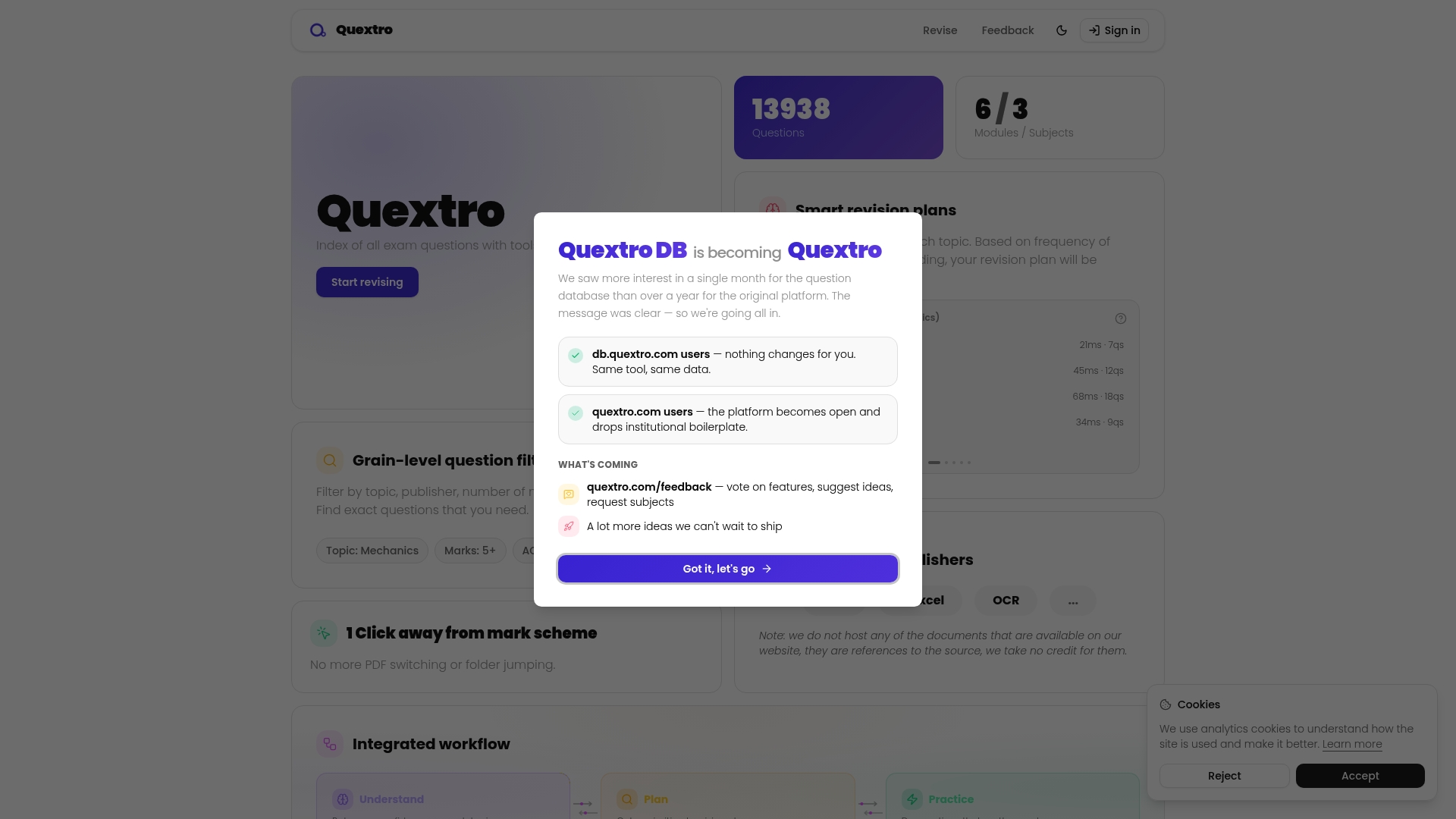
You can filter questions by topic, difficulty, publisher, and marks, allowing targeted practice on exactly the areas where you need improvement. Whether you're strengthening your skills in pure mathematics or building confidence in statistics mathematics, Quextro's organised question banks make efficient revision straightforward. The platform's smart revision plans adapt based on your confidence ratings and question frequency, creating personalised learning pathways that address your unique needs. Explore the complete question database to transform your revision approach and maximise your exam performance in 2026.
How early should I start revising for A Level maths exams in 2026?
Start your revision in January 2026 for best results. Students who begin revision early and consistently study see significantly improved grades compared to those who delay. This early start provides sufficient time to cover all topics thoroughly, complete multiple practice papers, and address weak areas without last-minute stress.
What are the best resources for targeted A Level maths revision?
Combine multiple resource types for comprehensive preparation. Effective revision uses a balance of worksheets, videos, topic questions, and exam-style practice to address different learning styles. Use your core textbook for theory, video tutorials for visual explanations, and past papers for exam familiarity. Consider specialised resources like an AQA A Level mathematics revision guide for board-specific support.
How can I avoid common mistakes during the A Level maths exam?
Always show your working clearly to earn method marks even if your final answer is incorrect. Common pitfalls include not showing working, calculator misuse, and misreading questions. Read each question twice, highlighting key information before starting calculations. Check your calculator is in the correct mode and verify answers make logical sense in context.
How many past papers should I complete before my A Level maths exam?
Aim to complete at least 10-15 full past papers under timed conditions. Start with one paper every two weeks in early revision, increasing to weekly papers as exams approach. This volume builds familiarity with question formats, improves time management, and helps identify recurring topics. Review each paper thoroughly, analysing mistakes and practising similar questions until you master the concepts.
Should I focus more on pure maths or applied maths topics?
Balance your revision across all examined components according to their weighting in your specification. Pure mathematics typically carries more marks, but applied topics like statistics and mechanics still contribute significantly to your final grade. Identify which areas you find most challenging and allocate extra time there, regardless of whether they're pure or applied. Strong performance across all sections maximises your overall score.