

Many capable A Level maths students lose marks not because they lack understanding, but because they make avoidable mistakes under exam pressure. Sign errors, misread questions, and forgotten working steps cost precious points that could mean the difference between grades. Reviewing past papers strategically helps you identify these weaknesses before they appear in your actual exams. This guide walks you through preparing your materials, executing a systematic review process, and verifying your progress to build confidence and improve your exam technique throughout 2026.
Table of Contents
- Prepare Effectively Before Reviewing Papers
- Execute A Step-By-Step Review Of Past Papers
- Verify Your Progress And Avoid Recurring Mistakes
- Enhance Your A Level Maths Revision With Quextro Resources
- Frequently Asked Questions
Key takeaways
| Point | Details |
|---|---|
| Avoidable errors cost marks | Most students lose points through preventable mistakes rather than gaps in mathematical knowledge. |
| Mark schemes guide learning | Understanding how examiners allocate marks helps you target your revision and show proper working. |
| Systematic review works | Preparation, step-by-step problem solving, and answer checking form an effective review cycle. |
| Track recurring mistakes | Logging common errors helps you refine exam technique and avoid repeating the same problems. |
Prepare effectively before reviewing papers
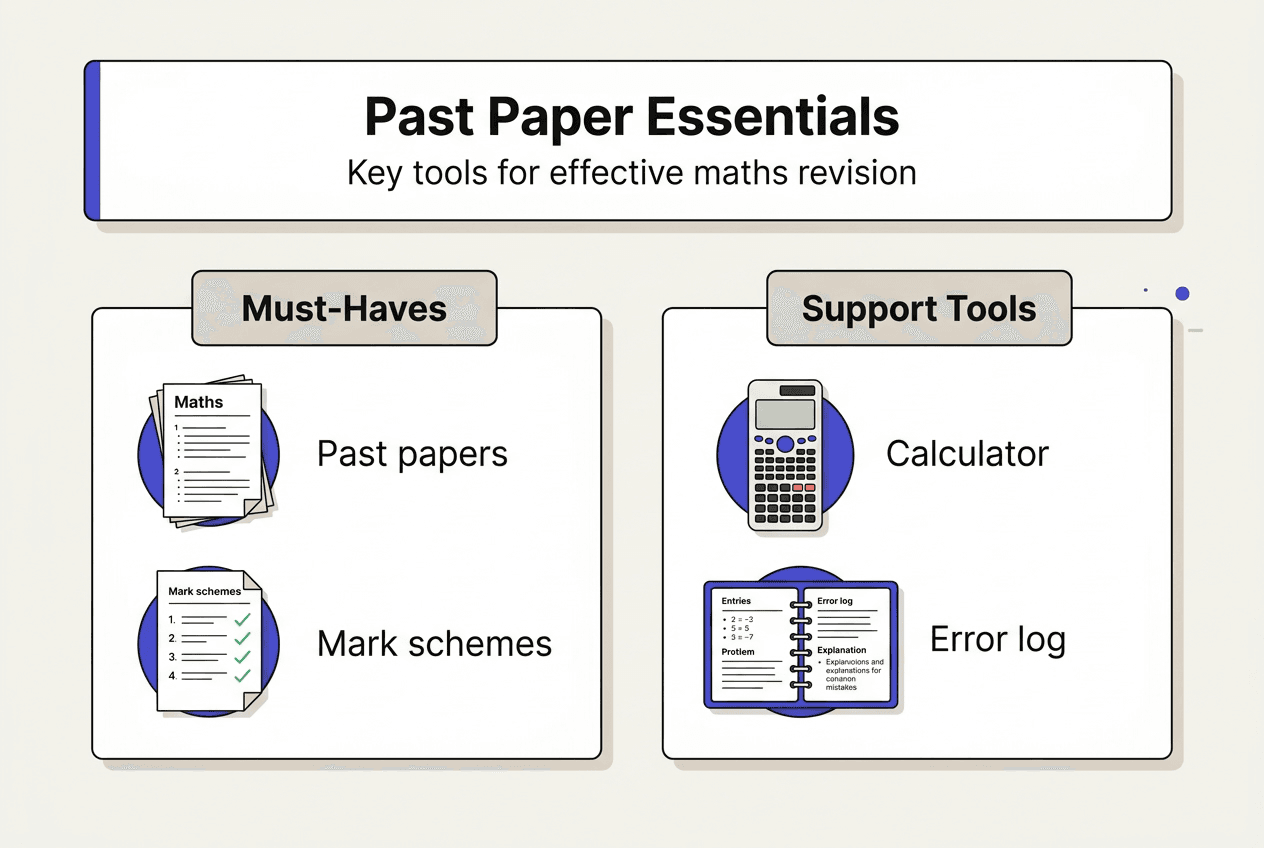
Gathering the right materials and creating an optimal study environment sets the foundation for productive past paper review. Start by collecting official past papers and mark schemes from your exam board, whether that's AQA, Edexcel, OCR, or CIE. These documents contain the exact question styles and marking criteria you'll face in your actual exams. Download several papers covering the topics you need to revise, ensuring you have both the question papers and corresponding mark schemes readily accessible.
Your study space matters more than you might think. Find a quiet, well-lit area free from distractions where you can spread out your materials and focus completely. Keep essential stationery within reach: pens, pencils, a ruler, a calculator approved for your exam board, and plenty of paper for working. Having everything prepared prevents interruptions that break your concentration and waste valuable revision time.
Familiarising yourself with marking criteria transforms how you approach questions. Pay close attention to the mark scheme to understand how marks are awarded for each step and the specific requirements for full credit. Examiners often allocate method marks for showing your working, even if your final answer contains an error. This knowledge helps you prioritise what to write down during timed practice.
Schedule your review sessions strategically rather than cramming randomly. Plan regular weekly sessions that increase in frequency as your exams approach, balancing past paper practice with learning new content. Setting realistic goals for each session keeps you motivated and prevents burnout. You might aim to complete one full paper per week initially, then increase to two or three papers weekly in the final month before exams.
| Material | Purpose |
|---|---|
| Official past papers | Practise authentic exam questions |
| Mark schemes | Understand marking criteria and check answers |
| Approved calculator | Ensure familiarity with exam-day tools |
| Error log notebook | Track recurring mistakes for targeted improvement |
| Timer | Simulate exam conditions accurately |
Pro Tip: Before starting any past paper, quickly scan through all questions to gauge difficulty and plan your time allocation, just as you would in the actual exam.
Developing self-assessment techniques for exam performances helps you evaluate your readiness objectively. Rate your confidence in each topic before beginning your review, then track how this confidence changes as you practise. This metacognitive approach ensures you focus revision time where it matters most, rather than repeatedly practising topics you've already mastered.
Execute a step-by-step review of past papers
Working through past papers systematically reveals patterns in your mistakes and builds exam stamina. Begin each session by setting a timer matching the actual exam duration, then attempt the paper under realistic conditions without referring to notes or textbooks. This simulation helps you develop time management skills and identifies which question types slow you down. Resist the temptation to check answers mid-paper, as this undermines the authentic exam experience.
Write down all your working clearly, even for questions that seem straightforward. Examiners award method marks for correct processes, meaning you can earn points even when arithmetic errors lead to wrong final answers. Showing your steps also makes it easier to identify exactly where mistakes occur during your review. Use proper mathematical notation and label your working logically, as you would in the actual exam.
- Set up your workspace with all materials and start the timer
- Read each question carefully, underlining key information and requirements
- Plan your approach before writing, especially for multi-step problems
- Show all working clearly, including intermediate calculations
- Check units, signs, and rounding throughout your solutions
- Review your answers if time permits before the timer ends
- Stop immediately when time expires, marking where you reached
After completing the paper, use the mark scheme to check every answer, including intermediate steps. Thousands of students lose marks due to avoidable mistakes rather than lack of mathematical ability. Compare your working against the model solutions, noting where your method differs or where you made errors. Award yourself marks honestly according to the scheme, including partial credit for correct methods with calculation mistakes.
Common errors to watch for include:
- Sign errors when manipulating equations or expanding brackets
- Incorrect rounding or premature rounding in multi-step calculations
- Misreading scales, axes, or graph labels
- Forgetting to show sufficient working for method marks
- Mixing up similar formulae or applying them incorrectly
- Calculation mistakes from rushed working under time pressure
- Not answering the actual question asked
Pro Tip: Circle every error you find in a distinctive colour, then categorise each mistake as either conceptual (didn't understand the maths), procedural (knew the method but applied it wrong), or careless (simple slip under pressure).
Analysing your mistakes reveals whether you need to revisit underlying concepts or simply slow down and check your working more carefully. Conceptual errors require going back to your notes or textbook to strengthen understanding. Procedural errors suggest you need more practice with that specific technique. Careless errors often decrease naturally as you complete more papers and develop better exam habits.
"The difference between a good grade and an excellent grade often comes down to attention to detail and systematic checking, not advanced mathematical ability."
Selecting appropriate questions for focused practice accelerates improvement in weak areas. Rather than always completing full papers, sometimes practise specific question types where you consistently struggle. This targeted approach, combined with exam question selection for maths revision, helps you address weaknesses efficiently without wasting time on topics you've already mastered.
Verify your progress and avoid recurring mistakes
Tracking your errors systematically transforms random practice into strategic improvement. Create a dedicated error log where you record every mistake, categorising them by topic, question type, and error category. This log becomes increasingly valuable as patterns emerge, showing you exactly which areas need additional focus. Review this log weekly to ensure you're actively working on your most common weaknesses rather than hoping they'll magically disappear.

Your error log should capture specific details that help you understand and prevent future mistakes. Note the paper and question number, the topic tested, what you did wrong, what you should have done, and which category of error it represents. Over time, you'll notice certain topics or mistake types appearing repeatedly, signalling where to concentrate your revision efforts.
| Date | Topic | Error Type | Frequency | Action Taken |
|---|---|---|---|---|
| 15 Jan 2026 | Differentiation | Sign error | 3rd occurrence | Extra practice on chain rule |
| 18 Jan 2026 | Trigonometry | Misread question | 1st occurrence | Slow down, underline key words |
| 22 Jan 2026 | Integration | Forgot constant | 5th occurrence | Add checklist reminder |
| 25 Jan 2026 | Vectors | Calculation slip | 2nd occurrence | Show more working steps |
Regularly revisiting tricky question types builds confidence and reduces anxiety about challenging topics. Schedule focused practice sessions where you attempt multiple questions on your weakest areas, using the mark scheme immediately after each attempt to reinforce correct methods. This spaced repetition approach helps cement proper techniques in your memory, making them automatic during exam pressure.
Before considering any practice session complete, work through this verification checklist:
- Have I checked every answer against the mark scheme?
- Did I identify and log all mistakes in my error log?
- Can I explain why each error occurred?
- Have I attempted at least one similar question correctly?
- Did I note any new formulae or techniques to remember?
- Have I updated my confidence ratings for each topic?
Pro Tip: After marking each paper, immediately rework every question you got wrong without looking at the mark scheme, testing whether you've truly understood the correct method or just memorised the model answer.
Common mistakes include sign errors, incorrect rounding, misreading scales and graphs, and failure to show working, but these patterns vary between students. Your personal error log reveals your unique weaknesses rather than generic advice. Some students consistently struggle with algebraic manipulation, whilst others lose marks through rushed working or misreading questions. Identifying your specific patterns allows targeted improvement rather than unfocused revision.
Measuring progress motivates continued effort and shows whether your revision strategies work effectively. Track your raw scores and percentages across multiple papers, looking for upward trends over time. Don't expect linear improvement, as some papers naturally prove harder than others. Instead, focus on whether your average performance increases and whether specific error types decrease in frequency.
Combining systematic review with review strategies for maths past papers creates a comprehensive approach to exam preparation. Regular practice under timed conditions, careful marking using official schemes, detailed error logging, and targeted follow-up practice form a cycle that continuously improves your exam technique. This process requires discipline and honesty, but the results speak for themselves in improved confidence and higher grades.
Enhance your A Level maths revision with Quextro resources
Applying these systematic review strategies becomes even more effective when you have access to comprehensive, organised past paper resources. Quextro offers a specialised database of over 13,955 past exam questions from AQA, Edexcel, OCR, and CIE, filtered by topic, difficulty, and marks. This targeted approach lets you practise specific question types where your error log shows recurring weaknesses, rather than working through entire papers hoping to encounter relevant questions.
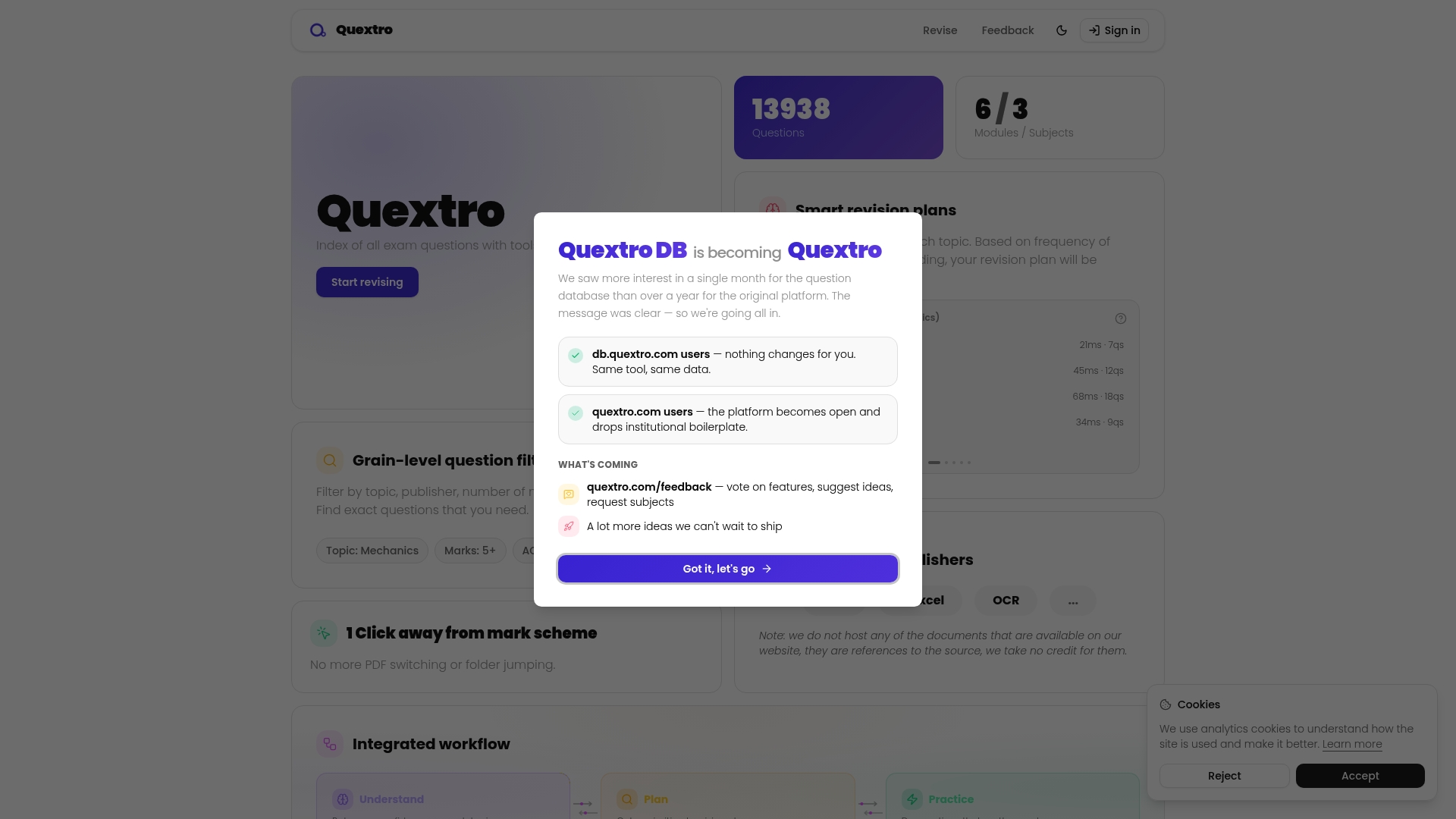
The platform's smart revision plans adapt based on your confidence ratings and question frequency, ensuring you spend time where it matters most. You can answer questions directly on the site, track your progress automatically, and build question notebooks for topics needing extra attention. Whether you're focusing on higher mathematics papers and questions, statistics mathematics revision materials, or pure mathematics past papers, having organised resources supports the structured review approach outlined in this guide.
Frequently asked questions
How often should I review past papers for A Level maths?
Start with one complete past paper per week from January onwards, increasing to two or three papers weekly in the final month before your exams. This gradual increase builds stamina without causing burnout. Balance past paper practice with learning new content, dedicating roughly 60% of your time to papers and 40% to consolidating understanding as exams approach. Regular weekly sessions prove more effective than intensive cramming, as they allow time to address weaknesses between attempts.
What are the most common errors to watch for when reviewing past papers?
Common mistakes include sign errors, incorrect rounding, misreading scales and graphs, and failure to show working. Examiners' reports consistently highlight these issues across different exam boards and topics. Sign errors often occur when expanding brackets or rearranging equations, whilst rounding mistakes happen when students round intermediate values too early in multi-step calculations. Carefully reading each question and methodically showing your working helps catch these errors before they cost marks. Use the mark scheme after every practice session to identify which specific mistakes appear in your work.
How can I use mark schemes effectively during paper review?
Break down each question using the mark scheme to understand exactly what examiners want to see at each stage. Pay close attention to how marks are awarded for each step and the specific requirements for full credit. Method marks reward correct processes even when final answers contain errors, so always show your working clearly. Compare your solution against the model answer step by step, noting where your approach differs and whether alternative methods receive credit. This detailed analysis helps you write solutions that maximise your marks in actual exams.
What should I do if I keep making the same mistakes in past paper reviews?
Keep a detailed error log categorising recurring mistakes by topic and type, then schedule focused practice sessions targeting these specific weaknesses. If certain errors persist despite practice, seek help from your teacher or study group to identify underlying misconceptions. Sometimes the issue isn't mathematical understanding but exam technique, such as working too quickly or not reading questions carefully. Be patient with yourself, as eliminating ingrained habits takes time and conscious effort. Track your error frequency over weeks to confirm that targeted practice actually reduces specific mistake types, adjusting your approach if progress stalls.