

Flicking through random past papers and hoping for the best is one of the most common revision mistakes A Level mathematics students make. It feels productive, but without structure, you end up practising the same comfortable topics repeatedly while your weak areas stay hidden. Organised past paper databases change that entirely. By filtering questions by topic, difficulty, and exam board, you can target exactly what needs work, track your progress, and build genuine confidence before exam day. This article explains why targeted practice works, how databases make it easier, and how to use them without falling into the over-reliance trap.
Table of Contents
- Why targeted past paper practice works
- How past paper databases organise revision
- Balancing past paper practice with conceptual learning
- Strategies to maximise outcomes using past paper databases
- Find the right database for your A Level maths revision
- Frequently asked questions
Key Takeaways
| Point | Details |
|---|---|
| Targeted practice boosts confidence | Focused question practice in databases helps identify and strengthen weak areas ahead of exams. |
| Organisation saves revision time | Databases allow quick filtering and progress tracking, making revision more efficient. |
| Balance improves long-term outcomes | Combining database practice with conceptual study ensures deeper mathematical understanding. |
| Self-monitoring drives improvement | Tracking your performance within database tools makes it easier to adjust your revision strategy. |
| Quextro offers tailored resources | Students can access subject-specific past paper databases on Quextro, aiding both exam technique and knowledge. |
Why targeted past paper practice works
Past paper questions are not just practice exercises. They are written to test the specific style of thinking your exam board rewards. When you work through questions from AQA, Edexcel, OCR, or CIE, you are training your brain to recognise question structures, apply methods under time pressure, and present working in the way examiners expect. That is a very different skill from simply understanding a concept in your textbook.
Targeted practice also acts as a diagnostic tool. If you attempt a set of statistics maths questions and consistently struggle with hypothesis testing but breeze through probability, you have just identified exactly where to focus next. That kind of clarity is hard to get from reading notes alone.
Repeated exposure to specific question types builds a kind of muscle memory for exam technique. You start to spot the keywords that signal which method to use, and you stop wasting time second-guessing yourself. The benefits of this approach include:
- Faster recognition of question types and required methods
- Reduced exam anxiety through familiarity with format and style
- Clearer identification of knowledge gaps before they cost you marks
- Stronger time management from practising under realistic conditions
- Better retention of methods through active recall rather than passive reading
That said, there is an important caveat. Student perspectives from university forums reveal a recurring concern worth taking seriously:
"GCSE and A Level study practices made students feel unprepared for university, with over-reliance on past papers cited as a key factor in hindering deep understanding."
Past papers are a powerful tool, but they work best when paired with genuine conceptual understanding. We will come back to that balance shortly. For now, the key point is that targeted practice, done well, is one of the most efficient revision methods available to you.
How past paper databases organise revision
Now that we have covered the value of targeted practice, let us look at how past paper databases make aiming your revision much easier. The traditional approach involves downloading PDFs, printing papers, hunting for mark schemes, and manually sorting through years of questions. It is time-consuming and disorganised. A well-built database removes all of that friction.
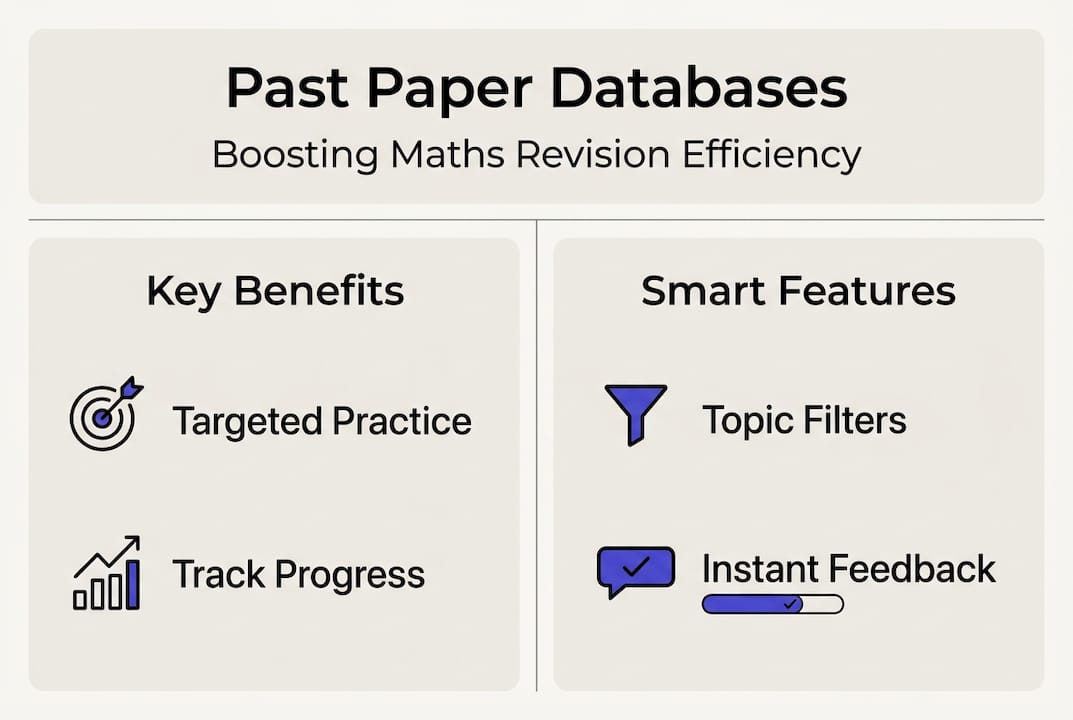
Digital past paper databases categorise questions by topic, difficulty level, year, and exam board. Want to practise integration questions from Edexcel at higher difficulty? Filter for exactly that. Need to work through decision maths papers from a specific year? Done in seconds. This kind of precision is simply not possible with a folder of downloaded PDFs.

Here is a direct comparison of the two approaches:
| Feature | Traditional revision | Database-driven revision |
|---|---|---|
| Question selection | Manual, time-consuming | Instant filtering by topic and difficulty |
| Progress tracking | Self-managed, often inconsistent | Automatic, built into the platform |
| Identifying weak areas | Guesswork or trial and error | Data-driven, based on performance |
| Access to solutions | Separate PDF required | Integrated alongside questions |
| Revision flexibility | Limited by paper format | Fully customisable by need |
The numbered steps for getting started with a database are straightforward:
- Set a clear goal for each session, such as completing ten questions on a specific topic.
- Use filters to select questions that match your current focus area.
- Attempt questions without looking at solutions first.
- Review solutions immediately after each question, not at the end.
- Note any recurring errors and flag those topics for follow-up.
You can also explore foundation maths resources to consolidate core skills before moving to harder questions. Building upward from a solid foundation is far more effective than jumping straight to the most challenging material.
Pro Tip: Use the filter functions in your database to sort by your lowest-confidence topics first. Spending the majority of your session on areas where you feel least secure will produce faster overall improvement than reinforcing what you already know well.
The university transition challenges highlighted by students who felt underprepared after A Levels often trace back to revision that was efficient on the surface but lacked depth. Databases help you be efficient and thorough, provided you use them with intention.
Balancing past paper practice with conceptual learning
With the efficiency of databases established, it is crucial to discuss how to avoid the most common mistake: over-dependence. Past papers are brilliant at sharpening exam technique, but they can quietly mask gaps in your understanding if you are not careful. You might learn to answer a question correctly without truly understanding why the method works. That is fine for a C3 exam, but it becomes a serious problem at university.
Study practice feedback from students who struggled in their first year of university consistently points to the same issue: they could answer exam questions but could not adapt their knowledge to unfamiliar problems. The solution is not to do fewer past papers. It is to combine them with deliberate conceptual study.
The benefits of a balanced approach include:
- Deeper retention of mathematical principles, not just procedures
- Greater ability to tackle unfamiliar or multi-step problems
- Stronger preparation for university-level mathematics
- More flexible thinking when questions are worded differently from expected
- Reduced risk of blanking on a topic you thought you knew
In practice, this means that after a database session focused on, say, economics past papers or further statistics papers, you should return to your notes or textbook to revisit the underlying theory behind any question you found difficult. Do not just mark it wrong and move on.
Pro Tip: At the end of every database revision session, spend five minutes writing down two things: what you understood well today, and one concept you are still unsure about. That single habit will transform how quickly you close your knowledge gaps.
Strategies to maximise outcomes using past paper databases
To round off, here are practical strategies for extracting maximum value from past paper databases. Having the right tool is only half the job. Knowing how to use it deliberately is what separates students who improve steadily from those who spin their wheels.
Follow these steps for each revision session:
- Set a specific goal. Decide before you open the database what topic and difficulty level you are targeting. Vague sessions produce vague results.
- Select questions by topic. Use filters to pull questions from your chosen area. Avoid the temptation to jump between topics in a single session.
- Attempt questions under timed conditions. Even informal time pressure improves exam readiness significantly.
- Review solutions critically. Do not just check whether you got the right answer. Understand every step of the model solution, especially where your working differed.
- Reflect on errors. Categorise mistakes as either conceptual gaps or careless errors. Each type needs a different response.
- Track your progress. Use the database's built-in tracking tools to monitor which topics are improving and which still need attention.
For subjects beyond maths, the same approach applies. Physics past papers and decision further maths past papers benefit from exactly the same structured method.
Here is a summary of the core strategies and their purpose:
| Strategy | Purpose | Frequency |
|---|---|---|
| Topic-filtered question sets | Focus effort on weak areas | Every session |
| Timed practice attempts | Build exam-condition familiarity | At least twice per week |
| Solution review and error log | Identify and address recurring mistakes | After every session |
| Conceptual review after practice | Prevent surface-level learning | Weekly |
| Progress tracking | Monitor improvement over time | Ongoing |
It is worth noting that exam preparation feedback from students who felt underprepared for university frequently describes revision that was high in volume but low in reflection. Doing more questions is not the goal. Doing the right questions, reviewing them properly, and connecting them back to underlying concepts is what drives real improvement.
Find the right database for your A Level maths revision
If you are ready to put these strategies into practice, Quextro gives you access to over 13,955 past exam questions organised by topic, difficulty, exam board, and marks. No more hunting through PDFs or losing track of where you left off.
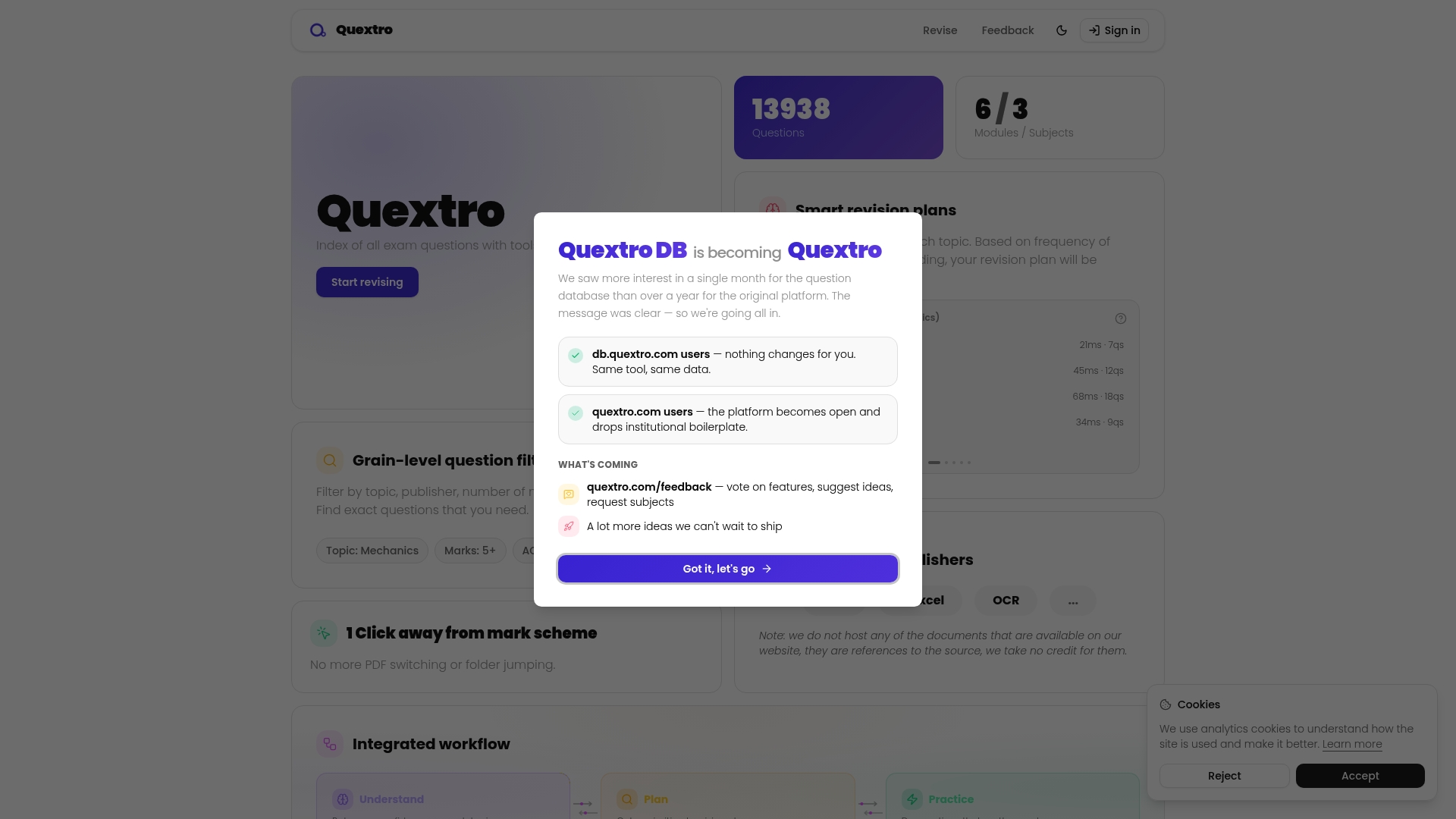
You can explore the statistics mathematics database to sharpen your skills in one of the most commonly tested A Level topics, or use the foundation maths database to build confidence from the ground up. Students who prefer applied topics will find the decision maths database equally well organised and easy to navigate. Quextro's smart revision plans adapt to your confidence ratings, so every session is targeted to where you need it most.
Frequently asked questions
How can past paper databases improve my A Level maths revision?
They provide organised, targeted access to thousands of questions filtered by topic and difficulty, so you spend less time searching and more time practising. Built-in progress tracking means you can see exactly where you are improving and where to focus next, making each session far more efficient than working through random papers.
Should I rely exclusively on past paper databases?
No. Mixing database practice with conceptual study is essential because exclusive reliance on past papers can leave gaps in your deeper understanding, which becomes a real problem at university level and when facing unfamiliar problem types.
What features should I look for in an ideal past paper database?
Prioritise advanced filtering by topic, difficulty, and exam board, alongside integrated solutions and progress tracking tools. A clean, intuitive interface that lets you answer questions directly on the platform, without switching between PDFs, will save you significant time during revision.
Can past paper databases be useful for other subjects as well?
Absolutely. The structured, filtered approach works just as well for sciences, economics, and further mathematics, giving students in those subjects the same targeted access to exam-style questions that maths students benefit from.
What is a common pitfall when using past paper databases?
The most frequent mistake is focusing so heavily on exam technique that you neglect the underlying concepts, which hinders deep understanding needed for long-term learning and university-level study. Always pair database sessions with conceptual review to avoid this trap.