

Many students spend hours rereading notes and highlighting textbooks, believing this will secure top marks in their A Level maths exams. Research shows this passive approach delivers far weaker results than actively practising past exam questions. When you engage with real exam questions, you're not just testing yourself, you're training your brain to recall, apply, and explain mathematical concepts under pressure. This guide explores why practising past exam questions is the single most effective strategy for A Level maths success, and how you can integrate this approach into your revision plan.
Table of Contents
- How Past Papers Reveal Exam Patterns And Examiners' Expectations
- Retrieval Practice: How Answering Questions Improves Memory And Understanding
- Why Past Papers Are Vital For Mechanics And Statistics Sections
- Best Practices For Integrating Past Exam Questions Into Your Study Plan
- Boost Your A Level Maths Practice With Quextro's Exam Question Database
Key takeaways
| Point | Details |
|---|---|
| Exam pattern recognition | Past papers reveal frequently tested topics and examiner expectations for mark allocation |
| Memory retention boost | Retrieval practice through questions increases retention rates up to 80% compared to 35% for rereading |
| Partial marks strategy | Step-by-step working in mechanics and statistics secures marks even when final answers are incorrect |
| Active learning advantage | Engaging with questions and mark schemes builds deeper understanding than passive revision methods |
| Strategic study cycles | Combining past paper practice with targeted topic revision fixes weaknesses most effectively |
How past papers reveal exam patterns and examiners' expectations
When you work through past exam questions systematically, you start noticing patterns that passive revision simply cannot reveal. Core topics like differentiation, integration, and probability appear repeatedly across exam papers, often framed in similar ways. Understanding these patterns gives you a strategic advantage because you know where to focus your deepest preparation efforts.
Past papers reveal exam patterns, recurring topics, and examiner expectations for mark allocation and working shown. You'll notice how examiners consistently allocate marks for specific steps in your working, not just final answers. This insight transforms how you approach questions during actual exams. Instead of rushing to an answer, you learn to show every logical step clearly, maximising your mark potential even if you make a calculation error.
Exam boards also test certain mathematical concepts more frequently than others. A quick analysis of recent papers shows differentiation and integration dominate pure maths sections, whilst probability and statistical distributions feature heavily in statistics papers. Here's how core topics typically distribute across recent exam papers:
| Topic area | Frequency in papers | Average marks allocated |
|---|---|---|
| Differentiation | 85% of papers | 12-18 marks |
| Integration | 80% of papers | 10-16 marks |
| Probability | 75% of papers | 8-14 marks |
| Trigonometry | 70% of papers | 6-12 marks |
| Sequences and series | 60% of papers | 6-10 marks |
Pro Tip: Create a tracking sheet noting which topics appear in each past paper you complete. After five or six papers, you'll spot clear patterns showing where examiners focus their attention, allowing you to prioritise high-frequency topics in your revision.
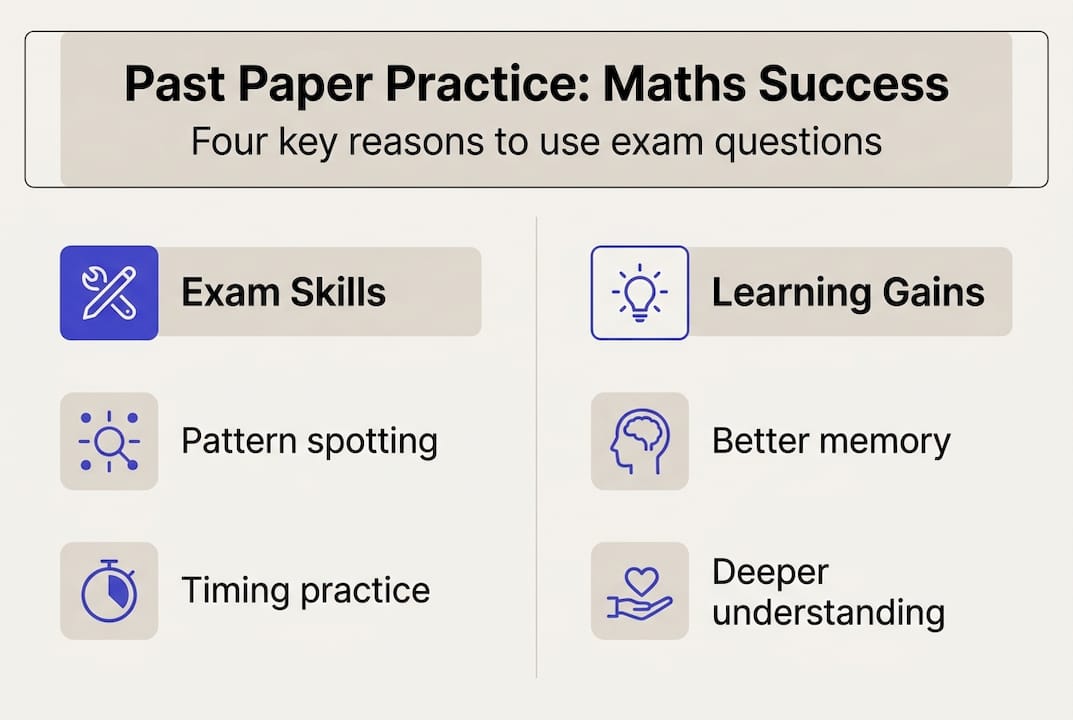
Time management becomes clearer through using past papers under timed conditions. You'll discover which question types consume most of your time and where you can work more efficiently. Mark schemes provide additional insights into examiner thinking, showing you exactly what level of detail and explanation they expect for different mark values. A two-mark question requires less explanation than a five-mark question, and past papers teach you these nuances through direct experience.
Retrieval practice: how answering questions improves memory and understanding
The cognitive science behind practising exam questions is compelling and well-established. When you actively retrieve information from memory by answering questions, you strengthen the neural pathways associated with that knowledge. This process, called retrieval practice, creates far more durable learning than passive reviewing ever could.
Retrieval practice from exam questions enhances long-term retention of mathematical knowledge, outperforming re-studying. Studies consistently demonstrate that students who test themselves retain information significantly better than those who simply reread material. The difference is dramatic. Practice testing boosts retention 80% versus 35% for re-study after one week, effective even for complex maths problems.
Meta-analyses examining hundreds of studies show a strong testing effect for mathematics, with effect sizes around g=0.50 for topics like Number Theory. This means students who regularly practise retrieval through questions perform approximately half a standard deviation better than students who don't. In practical terms, this could mean the difference between a B and an A grade.
"The testing effect demonstrates that retrieval practice produces superior long-term retention compared to repeated studying. For mathematics students, this means regular engagement with past exam questions creates more durable understanding than rereading notes or worked examples multiple times."
Integrating retrieval practice into your study routine requires deliberate planning:
- Schedule specific times each week dedicated solely to answering past exam questions without notes
- Start with individual topic questions before progressing to full mixed papers
- Wait at least 24 hours after studying a topic before testing yourself on it for optimal memory consolidation
- Vary the types of questions you practise to build flexible understanding rather than pattern recognition
- Review your answers thoroughly, focusing on understanding why you made mistakes rather than just noting correct answers
Pro Tip: After completing a question, explain your solution process aloud as if teaching someone else. This active explanation forces deeper processing than silently checking an answer, revealing gaps in your understanding that passive review would miss. If you cannot explain a step clearly, you don't truly understand it yet.
The key distinction between effective and ineffective practice lies in engagement depth. Quickly glancing at a question, checking the answer, and moving on provides minimal benefit. Instead, attempt every question seriously, struggle with difficult parts, and only then consult mark schemes to review past papers effectively. This productive struggle is where genuine learning happens.
Why past papers are vital for mechanics and statistics sections
Mechanics and statistics present unique challenges that make past paper practice especially valuable for these sections. These topics consistently form around one-third of most A Level maths courses, yet students frequently underestimate their difficulty until exam day arrives. The pressure of timed conditions often causes students to make errors they would never make during relaxed revision.

For mechanics and statistics, past papers catch underestimation; practise step-by-step working for partial marks. Unlike pure maths questions where a wrong turn often leads nowhere, mechanics and statistics questions reward clear working even when your final answer is incorrect. Understanding how to structure your solutions to maximise these partial marks can significantly boost your overall grade.
Here's how to effectively practise mechanics and statistics using past papers:
- Identify your weakest subtopics within mechanics and statistics by attempting a diagnostic set of mixed questions
- Focus initial practice on these weak areas using topic-specific question sets rather than full papers
- Practise drawing clear diagrams for mechanics problems, as examiners award marks for accurate force diagrams and motion sketches
- For statistics, show all probability calculations and statistical test steps explicitly, even when they seem obvious
- Time yourself on individual questions first, then progress to timed full sections once accuracy improves
- Review mark schemes specifically noting where partial marks are awarded for method, not just correct answers
Mechanics and statistics questions differ substantially in structure and common pitfalls:
| Aspect | Mechanics questions | Statistics questions |
|---|---|---|
| Common mistakes | Sign errors in force directions, incorrect unit conversions | Misidentifying distributions, calculation errors in hypothesis tests |
| Diagram importance | Essential for most questions, often worth marks | Less critical except for probability trees and Venn diagrams |
| Partial mark opportunities | High, awarded for correct equations even with calculation errors | High, awarded for stating hypotheses, test choice, and method |
| Time pressure | Moderate, but diagram drawing takes time | High, especially for lengthy data analysis questions |
Practising these sections builds confidence that transforms exam performance. When you've successfully solved projectile motion problems or conducted hypothesis tests dozens of times in practice, the exam versions feel familiar rather than intimidating. This familiarity reduces stress and allows you to think more clearly under pressure. Regular practice with statistics past papers ensures these crucial marks don't slip away due to exam nerves or time pressure.
Best practices for integrating past exam questions into your study plan
Effective exam preparation requires more than simply completing past papers randomly. The most successful students create structured study cycles that alternate between past paper practice and targeted topic revision, using each to inform and strengthen the other.
Past papers are rehearsal, not just test; combine with mark schemes for examiner insight, but fix gaps via topic practice before repeating. When you identify a weakness through past paper practice, immediately switch to focused topic study addressing that specific gap. Only after strengthening your understanding should you return to exam questions testing that topic.
Here's how to build an effective study cycle incorporating past exam questions:
- Begin each study week by attempting a mixed set of questions covering recently studied topics
- Mark your work honestly using official mark schemes, noting not just wrong answers but partially correct attempts
- Analyse errors to identify whether mistakes stem from conceptual misunderstanding, calculation errors, or time pressure
- Dedicate focused study sessions to topics where you scored below 70%, using textbooks and worked examples
- Reattempt similar past paper questions on those topics after 48 hours to verify improvement
- Schedule one full timed paper every two weeks to build exam stamina and time management skills
- Keep a detailed mistakes log recording each error, its cause, and the correct approach for future reference
Pro Tip: Create a mistakes log in a dedicated notebook where you write out each question you got wrong, the correct solution, and a brief note explaining your error. Review this log weekly, and you'll notice certain mistake patterns emerging. Addressing these patterns prevents repeated errors that cost marks in actual exams.
Mark schemes deserve careful attention beyond simply checking answers. They reveal how examiners think about questions and what they value in responses. Notice the specific wording examiners use for method marks versus accuracy marks. Understanding this distinction helps you structure answers that maximise marks even when you're uncertain about the final answer.
Avoid the temptation to complete past papers too quickly without deep reflection. Rushing through ten papers superficially provides less benefit than thoroughly analysing five papers, understanding every mistake, and addressing underlying weaknesses. Quality trumps quantity in exam preparation. Set realistic weekly goals that balance breadth and depth, perhaps three focused topic question sets plus one full paper, allowing time for thorough review and targeted follow-up study.
Using past paper practice strategies systematically throughout your revision period builds the skills, confidence, and exam technique needed for top performance. Start this practice early, maintain consistency, and adjust your approach based on what your results reveal about your strengths and weaknesses. The students who excel aren't necessarily the most naturally talented; they're the ones who practise most strategically and learn most effectively from their mistakes. Following the review past papers guide ensures you extract maximum value from every practice session.
Boost your A Level maths practice with Quextro's exam question database
Transforming your exam preparation from passive revision to active practice requires access to comprehensive, well-organised past exam questions. Quextro offers a vast, searchable database of over 13,955 past exam questions covering all key A Level maths topics from major exam boards including AQA, Edexcel, OCR, and CIE.
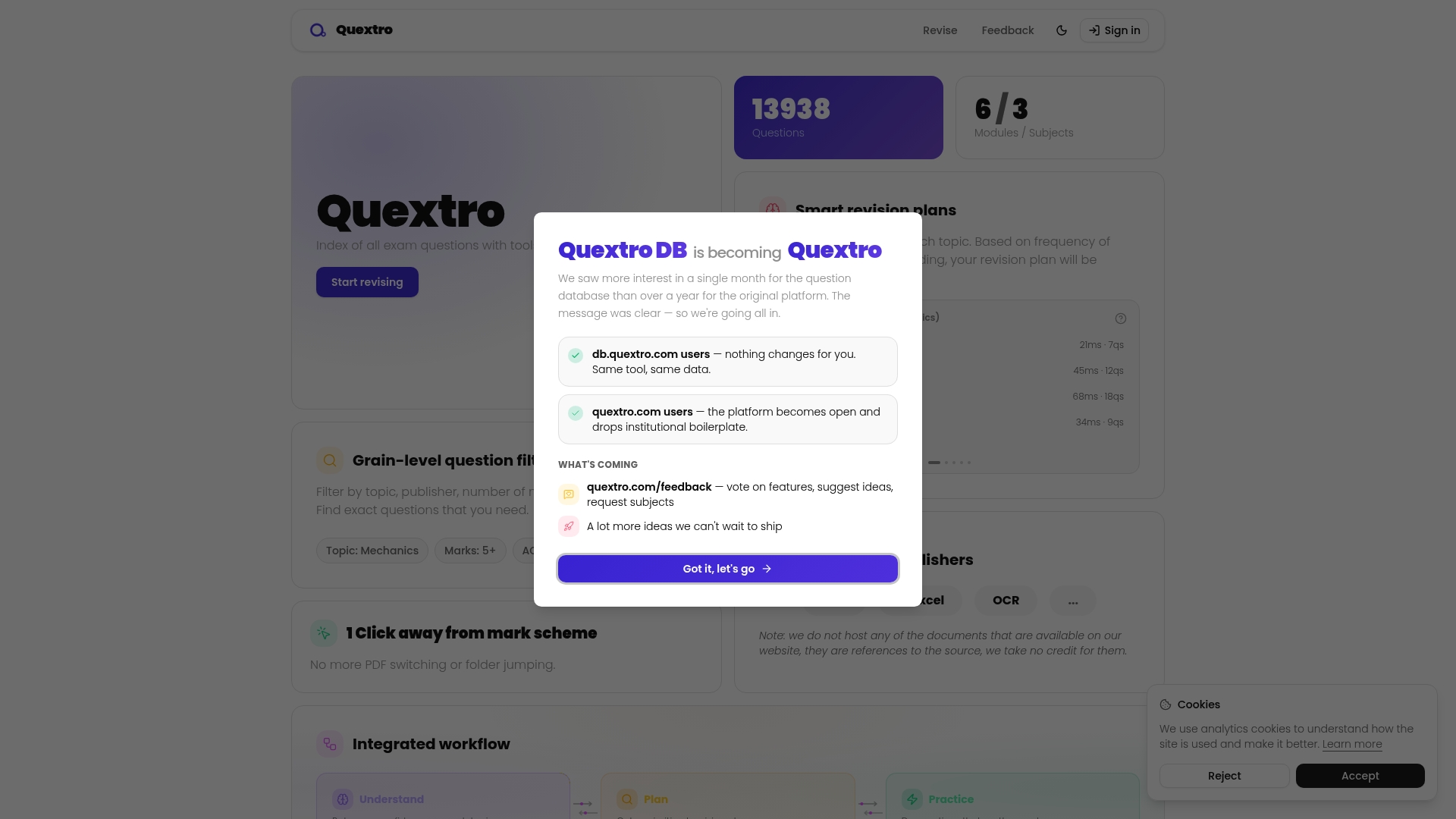
You can focus your practice on specific areas like mechanics, statistics, or pure maths using targeted modules that filter questions by topic, difficulty, and mark allocation. This precision allows you to address your exact weaknesses rather than wasting time on topics you've already mastered. Each question comes with detailed mark schemes and expert solutions, helping you understand not just what the correct answer is, but why that approach works and how examiners award marks. The platform tracks your progress automatically, building a personalised question notebook that highlights areas needing more attention. Using the Quextro exam question database helps you embed regular, focused practice aligned with exam patterns and examiner expectations. Whether you need concentrated work on statistics mathematics papers or comprehensive mixed practice, Quextro provides the structured support that transforms exam preparation from overwhelming to manageable.
FAQ
Why is practising past exam questions better than rereading notes?
Practising past exam questions forces active retrieval of information from memory, which strengthens neural pathways and creates more durable learning than passive rereading. Research shows retention rates of 80% with practice testing versus only 35% with rereading after one week. Questions also reveal exactly how you'll need to apply knowledge under exam conditions, building both understanding and technique simultaneously.
How often should I do past paper questions in my study plan?
Aim to incorporate past paper questions into your study routine at least three to four times weekly, balancing individual topic questions with occasional full timed papers. Start each study week with a mixed question set to identify weaknesses, dedicate midweek sessions to targeted topic practice, and complete one full timed paper every two weeks to build exam stamina. Consistency matters more than volume, so regular shorter practice sessions outperform occasional marathon sessions.
What should I do if I get a question wrong practising past papers?
First, attempt to identify your specific error without immediately checking the mark scheme, as this reflection deepens learning. Then review the mark scheme carefully, noting where you went wrong and what the correct approach requires. Record the question and your mistake in a dedicated mistakes log, explaining the error's cause and the correct method. Finally, reattempt a similar question on the same topic after 48 hours to verify you've genuinely understood and corrected the misunderstanding.
Is it useful to time myself when practising exam questions?
Timing yourself is essential for building exam technique and identifying time management issues, but not every practice session needs strict timing. Begin with untimed practice when learning new topics, focusing on accuracy and understanding. Once comfortable with question types, introduce timing to simulate exam pressure and reveal which questions consume disproportionate time. Regular timed practice reduces exam anxiety and helps you develop intuition for how long different mark-value questions should take.
Can I rely on mark schemes alone without doing full past papers?
Mark schemes are valuable learning tools but cannot replace the experience of attempting full papers under timed conditions. Reading mark schemes without attempting questions first is passive learning that provides minimal retention benefit. Always attempt questions seriously before consulting mark schemes, using them to understand examiner expectations and identify mistakes rather than as shortcuts to answers. Full timed papers remain essential for building exam stamina, time management skills, and the ability to maintain focus across lengthy exams.