

Facing a mountain of past A Level maths papers can feel overwhelming. You know practising exam questions is crucial, yet attempting every single one wastes precious revision time and leaves you exhausted. Strategic filtering transforms this chaos into a targeted approach that sharpens your skills where they matter most. This guide walks you through a proven process to select the right questions, prioritise high-impact topics, and build a revision plan that delivers measurable improvements in your exam performance.
Table of Contents
- Understanding The Problem: Why Filter A Level Exam Questions?
- Preparing To Filter: What You Need Before Starting
- Executing The Filter: Step By Step Guide To Selecting Optimal Questions
- Review And Adjust: Verifying Your Filtered Question List For Maximum Benefit
- Discover Quextro's Curated A Level Maths Question Modules
- FAQ
Key takeaways
| Point | Details |
|---|---|
| Strategic filtering boosts scores | Students who prioritise aligned questions achieve 15-20% improvement in exam results. |
| Focus on high-frequency topics | Calculus and trigonometry appear in over 80% of A Level maths exams. |
| Recent papers reflect current standards | Prioritise questions from the past three to five years for syllabus alignment. |
| Self-assessment guides difficulty | Regularly evaluate your confidence to tailor question selection to your needs. |
| Consistent review strengthens retention | Revisiting filtered questions throughout your revision cycle improves long-term memory. |
Understanding the problem: why filter A level exam questions?
A Level mathematics encompasses hundreds of exam questions spanning multiple topics, difficulty levels, and exam boards. Without a clear strategy, you might spend hours working through questions that barely align with your weaknesses or the exam's focus areas. This scattergun approach drains energy, creates frustration, and rarely translates into meaningful score improvements.
Strategic filtering focuses your efforts on high-impact questions tailored to your specific gaps. Instead of blindly attempting every past paper, you identify which topics appear most frequently, which question types challenge you most, and which papers reflect the current syllabus. This targeted method transforms revision from a marathon of repetition into a precision tool for exam success.
Research confirms this approach works. Students who prioritise questions aligned with weaknesses achieve 15-20% improvement compared to those using random selection. The difference lies in intentionality. When you filter questions by topic relevance, difficulty, and exam frequency, every practice session builds directly towards your exam goals.
Consider these benefits of strategic filtering:
- Reduces wasted time on irrelevant or overly easy questions
- Builds confidence by addressing specific knowledge gaps
- Aligns practice with exam board priorities and weighting
- Creates measurable progress through focused repetition
"Effective revision isn't about quantity of questions attempted, but quality of practice aligned with exam demands and personal weaknesses."
The volume problem is real. Major exam boards like AQA, Edexcel, OCR, and CIE collectively offer thousands of past questions. Attempting all of them is neither practical nor beneficial. Filtering lets you extract maximum value from minimum input, ensuring every question you tackle serves a clear purpose in your revision strategy.
Preparing to filter: what you need before starting
Before diving into question selection, gather the right materials and establish a clear understanding of your current position. Preparation prevents the common mistake of filtering questions based on guesswork rather than evidence.
Start by collecting recent past papers from your specific exam board. Focus on papers from the past three to five years, as these best reflect current syllabus requirements and question styles. Download mark schemes alongside each paper, as understanding how examiners award marks reveals what they prioritise in answers.

Next, identify every topic and subtopic in your A Level maths specification. Your exam board publishes detailed specification documents listing all content areas. Create a simple list or spreadsheet with columns for topic name, your current confidence level, and space to record questions you'll attempt. This becomes your filtering framework.
Regular review throughout your course proves essential for success. Set up a tracking system now, whether a spreadsheet, notebook, or digital tool. Record each question's topic, source paper, difficulty rating, and your performance. This data guides future filtering decisions and reveals patterns in your strengths and weaknesses.
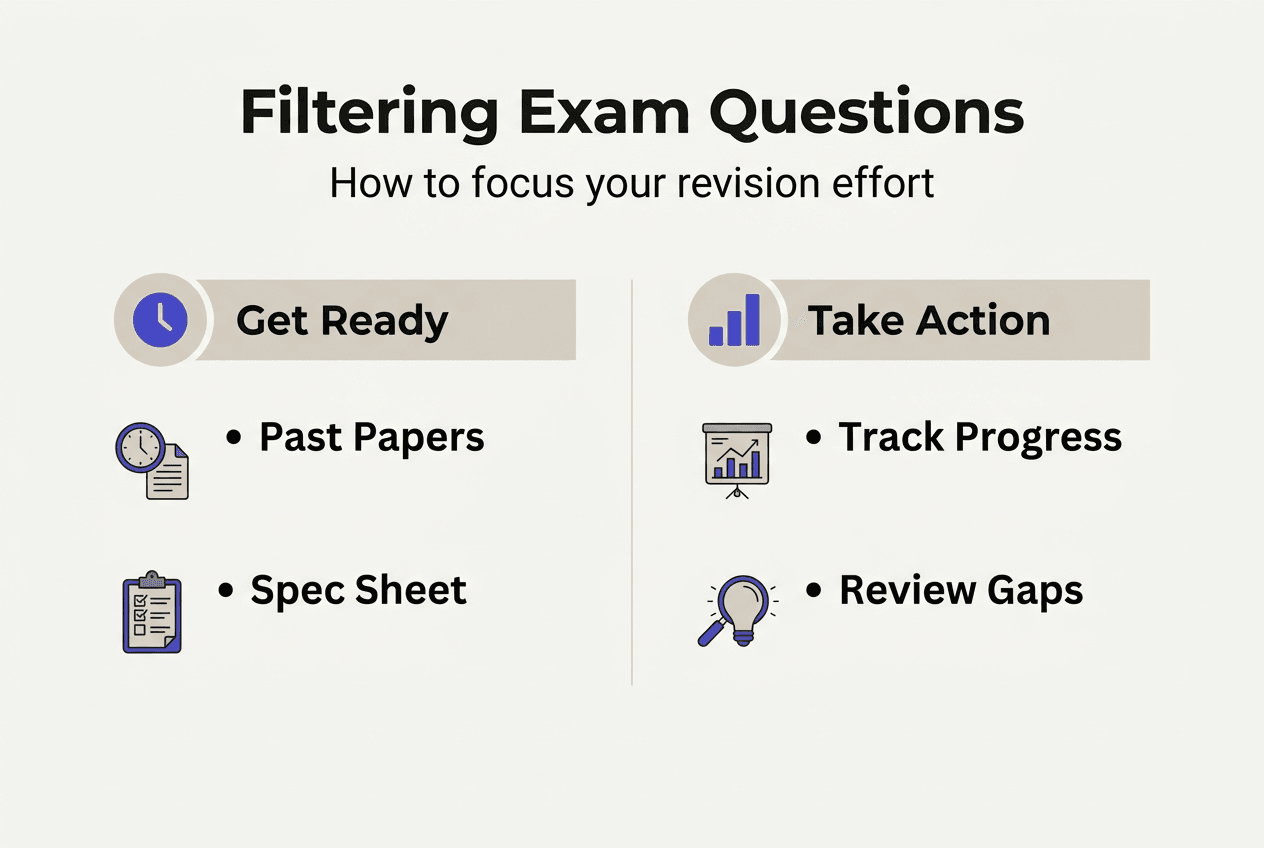
Honest self-assessment forms the foundation of effective filtering. Rate your confidence in each topic on a simple scale: strong, moderate, or weak. Be brutally honest. Overestimating your abilities leads to practising comfortable questions whilst neglecting areas that need attention. Underestimating creates unnecessary stress and wastes time on basics you've already mastered.
Essential preparation checklist:
- Past papers from your exam board covering the last three to five years
- Corresponding mark schemes for every paper collected
- Detailed syllabus specification listing all topics and subtopics
- Tracking system to record question details and performance
- Self-assessment of confidence levels across all topics
- Access to worked solutions or support resources for difficult questions
Pro Tip: Create a master spreadsheet with tabs for each major topic area. Within each tab, list questions by subtopic, difficulty, and year. This structure makes it easy to identify gaps and track progress as you work through your filtered selection.
Ensure you have reliable solutions available. Practising questions without understanding mistakes wastes the opportunity to learn. Whether through mark schemes, textbooks, online resources, or teacher support, confirm you can access detailed explanations for every question you attempt. This transforms practice from mere repetition into genuine skill development.
Executing the filter: step by step guide to selecting optimal questions
With your materials assembled and tracking system ready, follow this systematic process to build your filtered question bank. Each step refines your selection, ensuring you focus on questions that deliver maximum revision value.
-
Sort all collected questions by topic and subtopic according to your syllabus specification. Group similar question types together, such as differentiation problems, trigonometric identities, or statistical hypothesis tests.
-
Analyse question frequency across recent years. Note which topics appear in nearly every paper and which show up occasionally. Calculus and trigonometry appear in over 80% of exams, making them priority areas regardless of your confidence level.
-
Apply personal difficulty filtering. For each topic, select a mix weighted towards your weaker areas whilst including some moderate questions for confidence building. A typical distribution might be 60% weak areas, 30% moderate, 10% strong.
-
Prioritise recent papers. Questions from the past three years reflect current examiner expectations and syllabus emphasis. Older questions can supplement practice but shouldn't dominate your filtered selection.
-
Create your tracking table to maintain organisation and measure progress:
| Topic | Question Source | Year | Difficulty | Frequency | Status |
|---|---|---|---|---|---|
| Differentiation | AQA Paper 1 Q7 | 2025 | Moderate | High | Pending |
| Trigonometry | Edexcel Paper 2 Q12 | 2024 | Hard | High | Complete |
| Statistics | OCR Paper 3 Q8 | 2025 | Easy | Medium | Pending |
- Balance your selection across all specification areas. Even if you excel at algebra, ensure you've filtered sufficient geometry and statistics questions to maintain breadth. Exams test the full syllabus, and neglecting any area creates vulnerability.
Pro Tip: Use colour coding in your tracking system. Green for completed and understood, amber for attempted but requiring review, red for not yet attempted. This visual system quickly shows where to focus next.
Regularly update your filtered list based on ongoing self-assessment. After completing a set of questions on a particular topic, reassess your confidence. If you've mastered differentiation, reduce the number of basic differentiation questions and add more complex applications. If trigonometric identities still confuse you, increase the proportion of practice in that area.
The filtering process isn't static. As your understanding evolves, your question selection should adapt. Schedule weekly reviews of your tracking system to identify topics needing more attention and areas where you've achieved competence. This responsive approach ensures your revision remains targeted throughout your preparation period.
Consider using structured question banks that pre-organise questions by topic and difficulty. These resources save filtering time whilst still allowing you to apply personal difficulty judgements and frequency priorities. The key is maintaining control over which questions you attempt based on your specific needs.
Strategic question selection transforms random practice into purposeful skill building. By following this systematic approach, you ensure every question contributes meaningfully to your exam readiness.
Review and adjust: verifying your filtered question list for maximum benefit
Filtering questions is just the beginning. Regular review and adjustment ensure your selection continues serving your evolving needs throughout your revision period. Without verification, common pitfalls can undermine even well-intentioned filtering efforts.
The most frequent mistake is gravitating towards comfortable questions. It feels satisfying to breeze through problems you understand, but this creates false confidence whilst leaving weak areas unaddressed. Students often spend excessive time on understood questions and neglect struggling topics, precisely the opposite of effective revision.
Implement weekly self-assessment checks. After completing a batch of filtered questions, rate your actual performance against your initial difficulty prediction. Did questions you thought would be moderate turn out easy? Did supposedly hard questions prove manageable? These discrepancies reveal where your self-awareness needs calibration.
Use this comparison framework:
| Assessment Type | Easy Topics | Moderate Topics | Hard Topics |
|---|---|---|---|
| Predicted difficulty | Algebra, basic calculus | Trigonometry, statistics | Proof, complex integration |
| Actual performance | Consistent success | Mixed results | Struggling |
| Adjustment needed | Reduce quantity | Maintain focus | Increase practice |
Compare targeted filtering against random selection to validate your approach. Track your scores on filtered questions versus unfiltered practice tests. Effective filtering should show measurably better performance on topics you've prioritised, with gradual improvement in previously weak areas.
Consistency matters more than intensity. Attempting twenty filtered questions weekly with thorough review beats cramming fifty questions in one session. Regular self-assessment and strategy adjustment build sustainable progress and stronger retention.
Common adjustment triggers:
- Consistently scoring below 60% on a topic despite practice
- Finding filtered questions too easy or too hard
- Discovering exam board emphasis has shifted based on recent papers
- Completing all filtered questions in a topic area
When you identify these situations, revisit your filtering criteria. Add more challenging questions if your current selection feels comfortable. Introduce foundational questions if you're struggling with advanced problems. Shift focus to newly emphasised topics if exam board priorities have changed.
Pro Tip: Schedule a comprehensive review every month where you analyse your tracking data, identify patterns, and make strategic adjustments to your filtered question bank. This prevents drift and ensures your revision stays aligned with exam demands.
Don't forget to celebrate progress. When a previously difficult topic becomes manageable, acknowledge this achievement before moving focus elsewhere. This positive reinforcement maintains motivation through the challenging revision period.
Use your exam preparation checklist alongside your filtered questions to ensure comprehensive readiness. Filtering optimises question practice, but complete preparation includes timing practice, formula memorisation, and exam technique development.
The verification process closes the feedback loop. Filter questions strategically, attempt them purposefully, review performance honestly, and adjust selection accordingly. This cycle transforms static revision into dynamic skill development tailored precisely to your needs.
Discover Quextro's curated A level maths question modules
Applying strategic filtering principles becomes significantly easier with organised resources designed specifically for targeted revision. Quextro provides comprehensive question modules aligned with major exam boards, saving you hours of manual sorting whilst maintaining the filtering principles discussed throughout this guide.
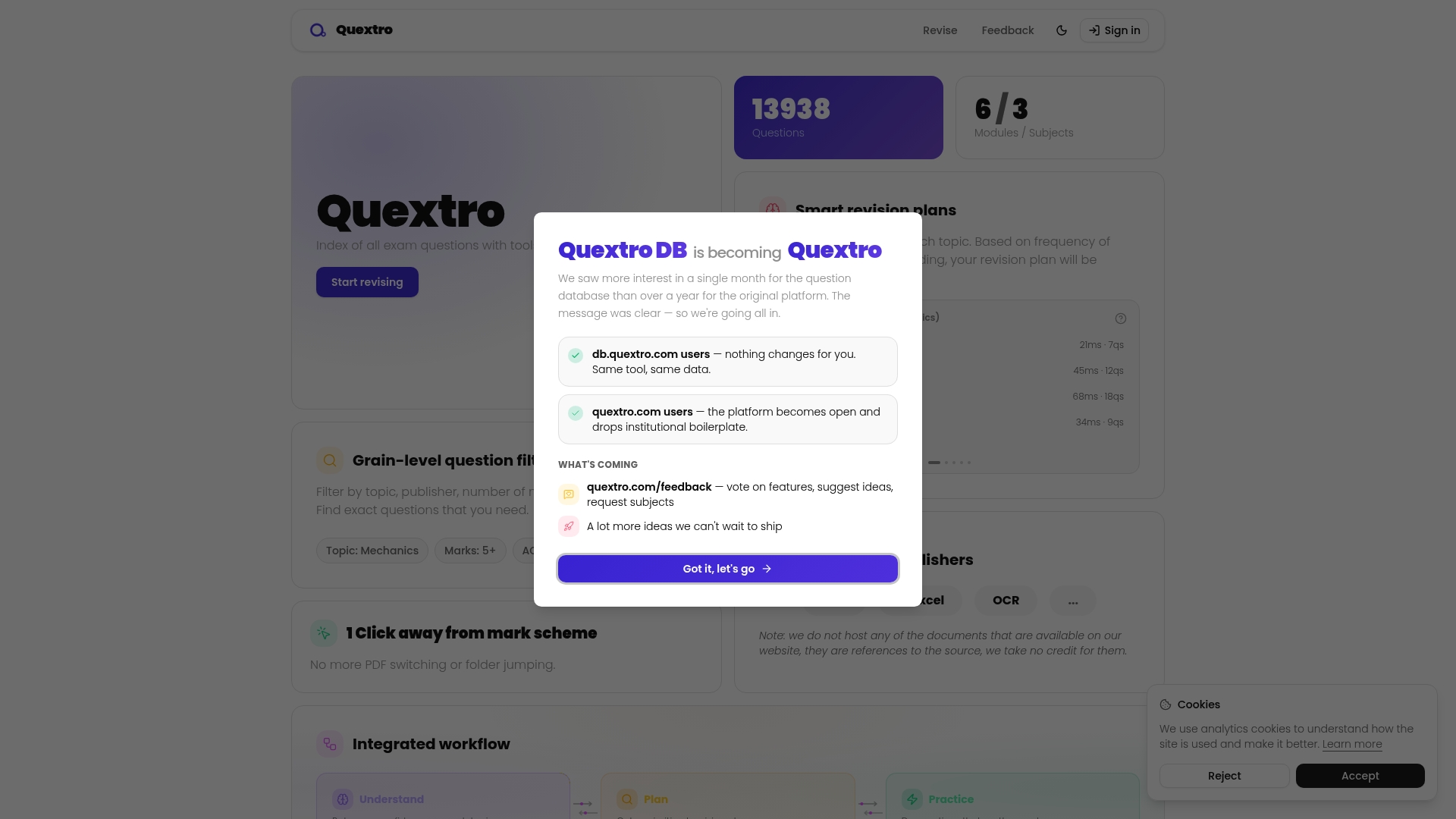
Our platform offers over 13,955 past exam questions pre-organised by topic, difficulty, publisher, and marks. Whether you're focusing on foundation mathematics, core pure further mathematics, or pure mathematics, you'll find structured modules that implement the filtering strategies covered here. Rate your confidence, track progress automatically, and let smart revision plans adapt to your performance. This integrated approach eliminates manual tracking whilst keeping you focused on high-impact practice that directly improves your exam results.
FAQ
How do i identify which topics are most important to filter?
Focus on high-frequency topics like calculus and trigonometry, which appear in over 80% of A Level maths exams. Review your exam board's specification and past paper analysis to determine which areas carry the most marks. Cross-reference this with your personal weaknesses to create a priority list that balances exam importance with your development needs.
Should i focus more on recent or older past exam questions?
Recent papers from the past three to five years better reflect current syllabus requirements and examiner expectations. Prioritise questions from recent past papers reflecting the current syllabus, as these align most closely with what you'll face in your exam. Older questions can supplement practice for additional exposure to question styles, but shouldn't dominate your filtered selection.
How can i assess the difficulty of exam questions effectively?
Difficulty assessment should be personal and based on your own understanding rather than generic ratings. Attempt a sample question from each topic and honestly evaluate your confidence and accuracy. Regularly reassess as your skills develop, adjusting your filtered selection to maintain appropriate challenge levels that push your abilities without causing overwhelm.
What common mistakes should i avoid when filtering exam questions?
Students often spend excessive time on questions they already understand whilst neglecting weaker areas. Avoid this trap by forcing yourself to allocate at least 60% of practice time to uncomfortable topics. Don't filter out all difficult questions in pursuit of confidence, as challenging problems build the resilience and problem-solving skills essential for exam success.