

TL;DR:
- Most students struggle not because they work too little but because their practice lacks structure for long-term understanding.
- A successful revision workflow involves gathering specific resources, setting targeted goals, and tracking progress through error logs and regular reviews.
- Structured, spaced, and interleaved practice, combined with feedback and self-assessment, significantly improves exam performance beyond mere hours invested.
You put in the hours. You sit down, work through problems, and feel like you're making progress. Then you get your mock back and the score barely moves. If that sounds familiar, you're not alone. Most A Level maths students struggle not because they're working too little, but because the way they're practising isn't structured to actually build long-term understanding. This guide lays out a clear, evidence-based workflow that takes you from gathering the right resources all the way through to tracking real improvement so that every hour you invest counts.
Table of Contents
- What you need before you start
- Step 1: Plan your revision sessions
- Step 2: Active practice – doing past papers with purpose
- Step 3: Reviewing, adjusting and tracking your progress
- Common pitfalls and how to avoid them
- Why most revision workflows fail – and what actually works
- Your next steps: find top resources for your practice workflow
- Frequently asked questions
Key Takeaways
| Point | Details |
|---|---|
| Start early and plan | Spaced, consistent preparation yields better results than last-minute cramming. |
| Practise actively | Use past papers with review and targeted follow-up for the greatest score gains. |
| Track and adapt | Keep an error log and adjust your workflow based on recurring mistakes and improvements. |
| Avoid common pitfalls | Don’t just re-read notes; mix question types and review your performance often. |
What you need before you start
Before you write a single equation, you need the right tools in place. Trying to practise without them is like running a race without knowing the route. Here is what you need at a minimum:
- Past papers from your specific exam board (AQA, Edexcel, OCR, or CIE). Don't mix boards unless you're deliberately broadening your exposure late in revision.
- Mark schemes for every paper you attempt. Without these, reviewing your answers is guesswork.
- A formula booklet that matches your exam. Get familiar with its layout now, not the night before.
- An error notebook. This is a plain notebook or digital document where you log every question you get wrong, why you got it wrong, and whether you've since fixed it.
- A quiet, consistent workspace and a timer.
The temptation is to gather resources passively and feel productive just by having them. That feeling is misleading. Spaced practice and active recall support long-term retention of methods and definitions, not re-reading your notes.
| Resource | Purpose |
|---|---|
| Past papers | Simulate exam conditions and expose topic gaps |
| Mark schemes | Show exact method expected and acceptable alternatives |
| Error notebook | Track mistakes and measure whether you've fixed them |
| Formula booklet | Build familiarity so you're not hunting for formulas under pressure |
| Timer | Manage pacing and practise working under realistic conditions |
Many teachers structure their classes using a similar approach, and you can see how that translates to student-facing preparation in this teacher workflow guide. The point is this: professional educators don't sit students down and say "just do more papers." They provide structure. You need to give yourself the same structure.
Pro Tip: Start with sessions of 25 to 30 minutes, not marathon three-hour blocks. Short, regular, focused sessions beat occasional cramming every time, particularly for mathematics where your brain needs time to consolidate methods between sessions.
Step 1: Plan your revision sessions
With your tools ready, next you'll design a revision timetable that actually works. Not a colour-coded chart you abandon by week two, but a practical schedule built around how learning actually happens in mathematics.
Follow these steps when setting up your plan:
- Set specific goals for each session. Don't write "do maths." Write "complete Edexcel 2023 Paper 1 Section A questions on trigonometry and log every incorrect answer." Specific goals create accountability.
- Pace one full past paper per week in your final two to three months before the exam. Research confirms that regular past-paper practice across the final months boosts retention considerably more than cramming.
- Mix topics deliberately. If Monday's session focuses on integration, don't also do integration on Wednesday. Use Wednesday for vectors or proof. This is called interleaving, and it mirrors what happens in an actual exam where topics do not appear in neat blocks.
- Schedule rest days. These are not optional. Your brain consolidates information during rest, particularly during sleep. A student who practises five days a week with rest days outperforms one who practises seven days straight.
- Build in a weekly review slot. Set aside 20 minutes at the end of every week to look back at your error notebook and score progression. This alone separates students who improve from those who plateau.
"Consistent, phased exam practice over several weeks, rather than concentrated effort in the final days, is what distinguishes students who improve their marks from those who stay stuck."
Pro Tip: Use spaced practice and interleaving rather than blocking all your time on one topic. Interleaving feels harder in the moment, but that difficulty is exactly what makes the learning stick. If it feels easy, you're probably not being challenged enough.
Step 2: Active practice – doing past papers with purpose
With your schedule set, it's time to look at how to do past-paper practice so it's both active and targeted. Doing a paper is not the goal. Getting better is the goal. Those are two very different things.
Here's a proven step-by-step method for each practice session:
- Do the paper. Work through questions in the given time if you're doing a timed session, or without time pressure if you're doing a learning session. Don't look at the mark scheme mid-paper.
- Mark your own work using the mark scheme. Be honest. A misunderstanding marked as correct doesn't help you. Give yourself partial marks only where the mark scheme would.
- Log every wrong or uncertain answer in your error notebook. Write down the question number, topic, and a one-line note on why you made the mistake. Was it a misread question? A calculation slip? A gap in understanding a concept?
- Look up the worked solution for every question where you weren't fully confident, not just the ones you got wrong. A correct answer reached by the wrong method won't hold up under exam conditions.
- Focus your next session on weak areas. If you kept dropping marks on implicit differentiation, that's what you practise next, not a topic you're already comfortable with.
As noted across reviewing past papers strategies, the real value comes from the review, not the attempt itself.
Here's how timed and untimed practice compare:
| Approach | Best used for | Key benefit |
|---|---|---|
| Timed practice | Later revision, full-paper simulations | Builds exam pacing and pressure tolerance |
| Untimed practice | Earlier revision, topic-specific work | Allows deeper thinking and method exploration |
| Mixed approach | Throughout the revision period | Balances skill development with performance readiness |
Reviewing mock tests without just repeating them is significantly more effective. Target weaker sub-skills, review full explanations, and don't call a topic "done" just because you got one question right.

Active recall combined with varied question types improves retention measurably compared to simply re-doing questions from memory without variation. Mixing mechanics questions with pure maths within the same session, for instance, produces better long-term results than doing 30 integration questions in a row.
Pro Tip: Keep your error notebook beside you every time you practise and review it at the start of each new session. This primes your brain to watch out for the same mistakes. Students who review their logs weekly consistently find they stop repeating the same errors far faster than those who don't.
Step 3: Reviewing, adjusting and tracking your progress
After completing each practice session, the real gains come from purposeful review and adjustment. Most students skip this step entirely. They finish a paper, feel vaguely good or bad about it, and move on. That approach means you're flying blind.
Here's how to build a proper feedback loop:
- Track your score after every paper. Write it down in a simple table: date, paper name, score. Over time you'll see a trend. If your score is flat across three consecutive papers, something in your approach needs to change.
- Analyse errors by topic. Don't just count how many you got wrong. Group them. If six out of eight errors are in statistics, that tells you exactly where to focus next.
- Track question frequency. Note which question types keep appearing across multiple exam papers. These are high-priority topics. If binomial expansion appears in every paper you've done, it deserves more of your time.
- Mark each error log entry as "fixed" once you can do a similar question correctly without notes. This is a key milestone. It closes the loop and prevents you from over-revising topics you've already mastered.
Here is an example of what an error log might look like in practice:
| Paper name | Question | Topic | Error cause | Fixed? |
|---|---|---|---|---|
| Edexcel 2022 P2 | Q7b | Integration by parts | Forgot to apply chain rule to inner function | Yes |
| AQA 2021 P3 | Q4 | Binomial expansion | Used wrong value for n | No |
| OCR 2023 P1 | Q9 | Vectors | Misread direction of force | Yes |
| Edexcel 2021 P1 | Q11c | Proof by contradiction | Didn't show all required steps | No |
"Focusing practice on the areas where you have improved least, rather than repeating your strengths, is what separates students who genuinely improve from those who stay stuck at the same grade."
Focusing on weaker areas and maintaining a structured error log is measurably more effective than simply repeating full papers without targeted review. Progress in A Level maths is not random. It is a direct result of systematic error analysis.
Common pitfalls and how to avoid them
While a workflow is powerful, some habits can undermine your progress. Recognising them early means you can correct course before they cost you marks.
- Re-reading notes as revision. This feels productive but produces almost no learning benefit in isolation. Your brain mistakes familiarity for understanding. If you can recognise a method when you see it but can't reproduce it from scratch, you haven't learned it.
- Over-confidence from repeating the same question types. Doing 20 integration questions of the same style makes you brilliant at those specific questions but doesn't prepare you for variations. Examiners deliberately introduce unfamiliar presentations of familiar methods.
- Leaving weak topics too late. Many students avoid their weakest areas because working on them feels uncomfortable and slow. But those are precisely the topics with the most room for score improvement. A topic you're scoring 40% on can become 70% with targeted work. A topic you're already scoring 85% on might only reach 90%.
- Ignoring the mark scheme until it's too late. Mark schemes reveal exactly what examiners want. Understanding the language of the mark scheme is itself a skill worth practising.
- Skipping rest and review. Both are where learning is consolidated. Treating them as luxuries is one of the most common mistakes students make.
Short, regular sessions combined with a mix of topics consistently outperform long cramming sessions or passive re-reading, according to established revision research.
You can also read about specific exam prep pitfalls in more depth, including patterns that teachers observe in students who plateau.
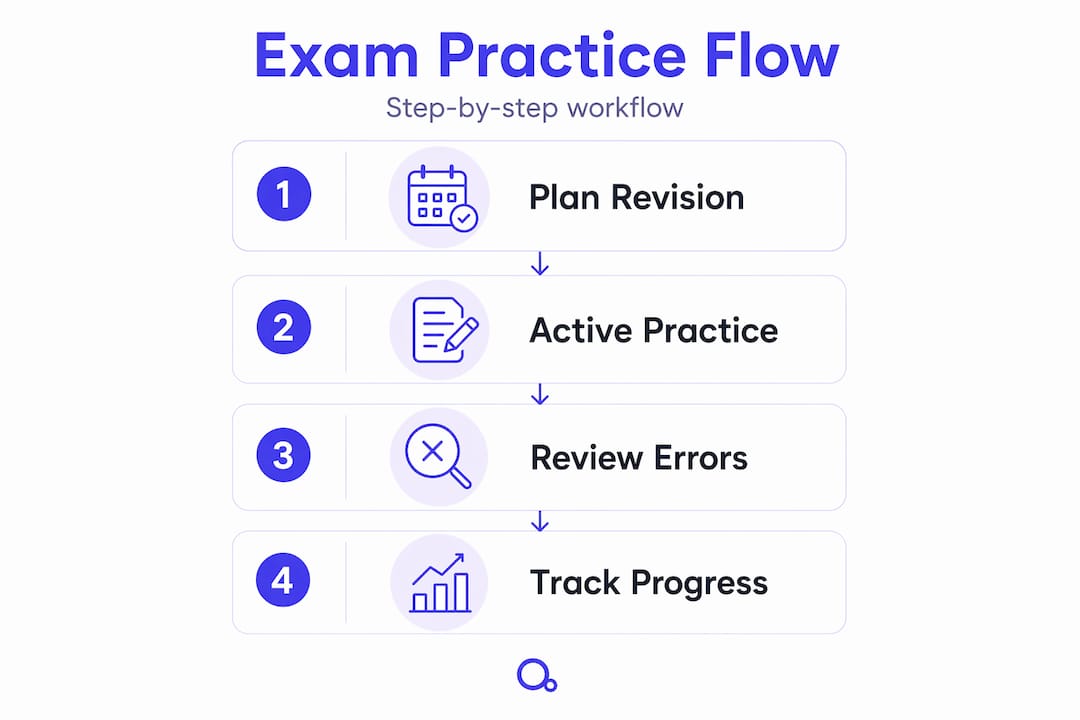
Pro Tip: Rotate topics every two to three sessions and log any repeated errors in your notebook. If the same mistake appears more than twice, dedicate a full focused session to that concept, using fresh questions from different papers, not the same one you already got wrong.
Why most revision workflows fail – and what actually works
Here's something worth saying plainly: most students believe that putting in more hours automatically means better results. That belief is understandable but wrong.
What actually happens is this. Students spend the most time on topics they already understand, because working on known material feels productive and comfortable. They avoid unfamiliar or difficult topics. They repeat past papers without analysing mistakes. Then they're surprised when their marks don't reflect the hours invested.
The fix isn't working harder. It's working with feedback. Every session needs to tell you something useful about your performance. If you finish a practice session and you can't answer the question "what specific thing do I now know that I didn't before?", the session may not have been as useful as it felt.
Teacher insights on revision consistently show that the students who improve most aren't necessarily the most naturally talented. They're the ones who track their errors, act on what the data shows, and adjust their approach week by week. Exam success at A Level is far less about intelligence than it is about the consistency of your feedback loop.
Interleaving is uncomfortable. Error logs take discipline to maintain. Timed practice is stressful. These things feel harder precisely because they're working. Revision that feels easy usually isn't doing much.
Your next steps: find top resources for your practice workflow
If you're ready to put this workflow into action, the right resources make all the difference.
Quextro is built specifically to support this kind of structured, targeted exam practice. The practice question database gives you access to over 13,955 past exam questions from AQA, Edexcel, OCR, and CIE, all filterable by topic, difficulty, marks, and year.
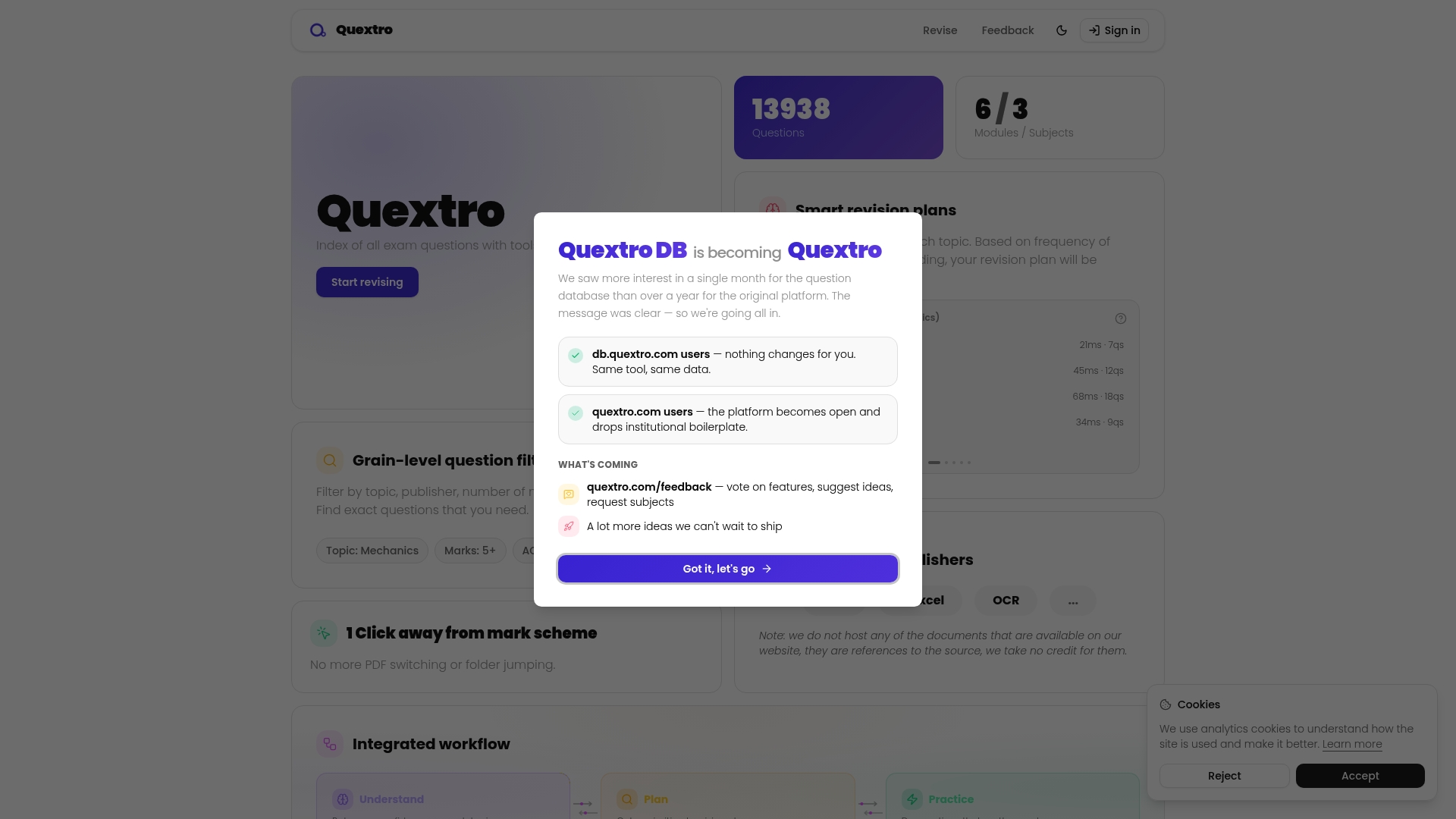
You can begin with foundation maths papers to build confidence in core skills, then progress to harder questions as your revision deepens. Smart revision plans adapt based on your confidence ratings and question history, so the platform effectively builds your error log and prioritises your weak areas for you. Set up your first session on Quextro today and turn your revision workflow from guesswork into a structured, measurable process.
Frequently asked questions
How many past papers should I do each week?
Aim for at least one full past paper each week in the final months before your exam. One paper per week in the lead-up period aligns with revision schedules that produce the strongest retention, with volume increasing as you identify weaker areas.
Is it better to do exam practice with or without a timer?
Combine both approaches: use untimed sessions for deeper learning and concept exploration, then move to timed practice as the exam draws closer. Mixing timed and untimed practice gives you full coverage of both skill development and exam performance.
What's the most effective way to learn from mistakes in maths revision?
Keep a structured error log and review it regularly, focusing your next practice sessions on topics where you made mistakes. Maintaining an error notebook and reviewing worked explanations significantly increases what you gain from each practice session.
Should I focus on one topic at a time or mix subjects?
Mix topics using interleaving. Interleaving mixed question sets outperforms blocked topic practice for long-term retention because it mirrors the unpredictable structure of the actual exam.