

TL;DR:
- Success in A Level maths exams depends on following a consistent process rather than rushing to answers.
- Careful planning, showing all working, and checking answers are crucial steps to gain marks and build confidence.
- Regular practice with structured methods, guided by exam strategies and error tracking, improves reliability and performance.
Many A Level students walk into exams well-prepared, yet still lose marks on questions they genuinely understand. The problem is rarely a gap in knowledge. It is almost always a gap in process. Rushing past key details, skipping working, or misreading what the question actually asks can cost you marks on every single paper. This guide walks you through a proven, repeatable method for tackling A Level maths exam questions from start to finish. Follow these steps consistently and you will not only answer questions more accurately, you will also build the kind of exam confidence that holds up under pressure.
Table of Contents
- Gather your tools and understand the question
- Break down the question and plan your steps
- Solve methodically and show all working
- Check, interpret, and learn from your solution
- Why mastering the process beats rushing for the answer
- Take your exam preparation further with Quextro
- Frequently asked questions
Key Takeaways
| Point | Details |
|---|---|
| Preparation matters | Starting with the right tools and understanding the question prevents basic mistakes. |
| Plan before you solve | Breaking down each problem and mapping out steps leads to more marks and less stress. |
| Clarity equals marks | Showing all your working and structuring answers methodically maximises your scores even if you slip up. |
| Review and learn | Checking solutions and reflecting on errors transforms each attempt into progress for the next exam. |
Gather your tools and understand the question
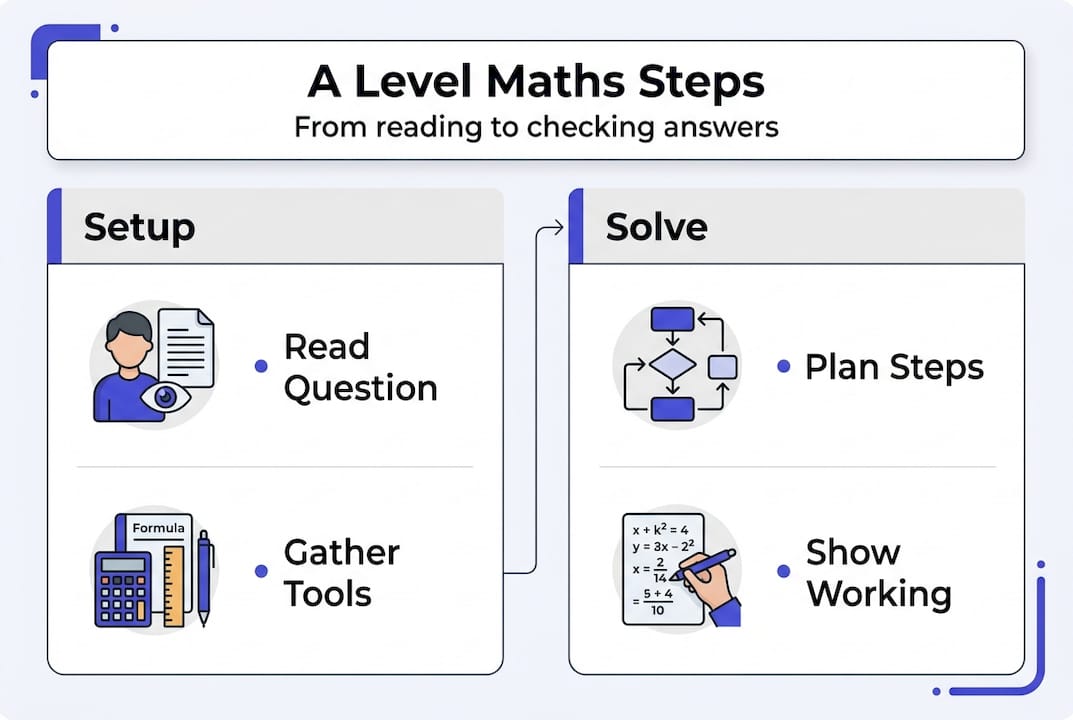
Before you write a single number, make sure you have everything you need in front of you. It sounds obvious, but many students waste precious minutes searching for a calculator or realising they have not opened their formula booklet. Starting organised means starting strong.
Here is a quick reference for the essential tools and what each one is for:
| Tool | Purpose |
|---|---|
| Scientific calculator | Numerical computation and function evaluation |
| Formula booklet | Reference for identities, formulae, and constants |
| Ruler | Accurate graph drawing and geometric diagrams |
| Pencil and eraser | Drafting diagrams and working before committing in pen |
| Pen (black or blue) | Final written answers and working |
Once your tools are ready, your next job is to read the question properly. Not skim it. Read it. Interpreting exam questions correctly is one of the most underrated skills in A Level maths, and it is something you can practise deliberately.
Pay close attention to command words. "Show that" means you must demonstrate every step. "Hence" means you must use the result from the previous part. "Find" gives you more freedom in method. These distinctions matter enormously for how you structure your response.
Common tools students forget or misuse:
- Formula booklet: open it early and know where key formulae are located
- Calculator: check the mode (degrees vs radians) before every trigonometry question
- Pencil: use it for diagrams so you can correct errors cleanly
- Rough paper: use it to plan before committing to your answer space
Thoroughly reading and deconstructing what the exam question is asking is vital for correct answering. Rushing past the question stem to get to calculations is one of the most common reasons students lose easy marks.
Pro Tip: Underline key words, values, and constraints directly in the question. Circling what you are being asked to find keeps your focus sharp and prevents you from solving for the wrong thing entirely.
For broader best exam practices, reviewing guidance from exam bodies can sharpen your awareness of what markers are looking for.
Break down the question and plan your steps
With your tools ready and the question fully understood, it is time to break it into logical, manageable steps. Think of this as building a route before you start driving. You would not set off without knowing the direction.

Reread the question a second time and identify three things: the data you are given, the operation or process required, and any constraints (such as a specific domain or form for the answer). Write these down briefly in your margin or on rough paper.
Different planning approaches suit different question types:
| Planning method | Best used for | Why it helps |
|---|---|---|
| Bullet plan | Short, single-part questions | Fast and clear for straightforward problems |
| Numbered timeline | Multi-step or multi-part questions | Keeps sequence visible under pressure |
| Mini mind-map | Proof or contextual problems | Shows connections between ideas |
Students who spend a minute planning their approach make fewer errors and gain higher marks. That one minute is not wasted time. It is invested time.
Here is a numbered sequence to follow before you write your first equation:
- Identify all given values and label them clearly
- State what you are being asked to find or prove
- Decide which topic area or formula applies
- Note any constraints or special conditions
- Sketch a rough plan of your solution route
For compound questions with multiple parts, treat each part as its own mini-problem. Use exam technique strategies that break large questions into smaller, manageable chunks. This prevents the feeling of being overwhelmed and keeps your method marks safe even if you make an error later.
You can also use Quextro's tools to filter question types by topic and difficulty, which helps you practise planning across a wide variety of question structures.
For additional maths question breakdown tips, external revision resources can complement your planning approach.
Pro Tip: For multi-step problems, jot a quick numbered timeline in your margin before you begin. Seeing the full route laid out keeps you on track when the pressure builds mid-question.
Solve methodically and show all working
Having carefully planned your approach, the next priority is executing your method clearly and systematically. This is where marks are won and lost in the most visible way.
Follow this sequence when solving each part of a question:
- Write down the formula or rule you are applying
- Substitute values clearly and in the correct order
- Simplify one step at a time, showing each line of working
- State intermediate results before moving to the next stage
- Write your final answer clearly, including units where required
Showing all calculations improves clarity and earns method marks even if the final answer is incorrect. This is one of the most important things to understand about A Level marking. Method marks (M marks) are awarded for using the correct process. Accuracy marks (A marks) depend on getting the right answer. Working marks (B marks) are given for specific correct statements. If you skip steps, you risk losing all three.
"Examiners cannot award marks for work they cannot see. Every step of your reasoning is evidence of your understanding. Show it." (AQA A Level Mathematics Examiner Report)
Common errors to avoid during calculation:
- Copying values incorrectly from the question to your working
- Forgetting to apply a negative sign when differentiating or integrating
- Rounding intermediate values too early, which distorts the final answer
- Confusing degrees and radians in trigonometric calculations
- Omitting units from answers that require them (speed, area, volume)
For more effective answering methods and worked example solutions, reviewing annotated past paper responses helps you see exactly what a full-mark answer looks like.
For further guidance, the examiner tips published by AQA offer direct insight into what markers reward and what they penalise.
Check, interpret, and learn from your solution
Once your answer is written out, there is one more crucial step to maximise your marks and learning from every question attempted. Checking is not just about catching arithmetic slips. It is about making sure your answer actually answers the question.
Run through this checklist after completing every question:
- Does the numerical value seem reasonable given the context?
- Have you included units where the question requires them?
- Does your answer satisfy any constraints stated in the question?
- Have you answered every part, including those labelled (i), (ii), or (iii)?
- Can you substitute your answer back into the original equation to verify it?
Regular self-checking and learning from errors have a direct correlation with improved marks. Students who review their work consistently outperform those who move on immediately after writing a final answer.
When practising at home, always compare your solution against the mark scheme. Do not just check whether you got the right answer. Look at the structure of the model solution and ask yourself whether your working matched the expected method. This is where real learning happens.
Pro Tip: Keep a dedicated errors log. After each practice session, write down any mistake you made, why it happened, and what you will do differently. Reviewing this log before an exam is one of the most efficient revision strategies available.
Use reflection questions to extract maximum value from every attempt. Ask yourself: which part of the process did I rush? Did I misread anything? Was my plan clear enough before I started calculating? These questions turn a single practice question into a genuine learning experience.
For further question practice tips and guidance on practising exam questions effectively, structured reflection is the habit that separates improving students from those who plateau. Additional revision advice from STEM learning resources can also support your checking habits.
Why mastering the process beats rushing for the answer
Here is something most revision guides will not tell you directly. The students who consistently score highest in A Level maths are not always the fastest. They are the most reliable. There is a real difference.
Many students believe that speed is the mark of ability. They rush through questions, skip steps, and treat working as optional. Then they wonder why they dropped marks on a question they "knew how to do." The answer is always the same: the process broke down.
Consistent use of a process, even when pressed for time, improves results. This is not just advice. It is what the data from examiner reports shows year after year. Marks are lost at the execution stage far more often than at the knowledge stage.
The deeper point is this: when you practise a methodical approach repeatedly, it becomes automatic. You stop having to think about the process and can focus entirely on the mathematics. That is when your performance becomes truly robust. The importance of regular practice is not about volume alone. It is about practising the right way, with the right habits, every single time.
Take your exam preparation further with Quextro
Putting this step-by-step process into practice requires the right questions to work with. That is exactly what Quextro provides.

Quextro gives you access to over 13,955 past exam questions from AQA, Edexcel, OCR, and CIE, all organised by topic, difficulty, and mark allocation. You can work through A Level maths practice papers that match your syllabus exactly, or explore the Further maths question bank for more advanced practice. Every question you attempt is saved automatically, so your progress is always tracked. Apply the method you have learned here with questions built for your specific exam board and start seeing the difference a structured process makes.
Frequently asked questions
How many steps should I use when solving exam questions?
Most A Level maths questions break down into 3 to 5 logical steps, though multi-part problems may need more. Planning clear steps before you begin reduces errors and protects your method marks.
Why is showing all my working important?
Showing working helps you gain method marks even if the final answer is wrong. Method marks are awarded for clear, logical steps, regardless of whether the final calculation is correct.
How do I check if my final answer makes sense?
Reread the question, substitute your answer back in, and check for unreasonable or inconsistent results. Checking and reflecting on your answers leads to better performance over time.
Should I attempt past questions under timed conditions?
Yes. Timed practice simulates real exam pressure and improves both speed and readiness for the actual paper.
How do I avoid repeating my mistakes in future exams?
Keep a log of errors and review it regularly before each exam session. Reflection and error tracking turn repeated mistakes into reliable learning opportunities.