

Struggling with A Level maths exam questions can feel overwhelming, especially when you know the material but lose marks through poor technique. Many students find that misreading questions causes 25-30% of lost marks, highlighting how critical proper exam strategy is alongside subject knowledge. This guide provides practical, evidence-backed methods to tackle exam questions effectively, manage your time wisely, and maximise your marks in the 2026 exams. By applying these proven strategies, you can transform your exam performance and approach papers with genuine confidence.
Table of Contents
- Understanding Exam Questions: Decoding Requirements Accurately
- Mastering Exam Technique: Planning, Working Logically, And Time Management
- Preparing Thoroughly: Past Papers, Exam Format, And Calculator Use
- Avoiding Common Mistakes And Applying Strategies For Top Marks
- Boost Your A Level Maths Practice With Quextro
- Frequently Asked Questions
Key takeaways
| Point | Details |
|---|---|
| Effective exam technique increases marks by up to 20% | Mastering question interpretation and showing clear working significantly boosts scores beyond subject knowledge alone. |
| Understanding questions prevents losing 30% of marks | Careful reading and identifying command verbs ensures you answer what's actually asked. |
| Starting with easier questions improves time management | Securing quick marks early builds confidence and leaves more time for challenging problems. |
| Practising past papers boosts familiarity and accuracy | Regular timed practice improves speed, reduces errors, and familiarises you with exam formats. |
| Clear working earns marks even with incorrect answers | Method marks reward logical steps, making detailed working essential for maximising scores. |
Understanding exam questions: decoding requirements accurately
The foundation of excellent exam performance lies in correctly interpreting what each question asks. Rushing through questions or encountering unfamiliar terminology leads many students to answer something entirely different from what examiners expect. This wastes valuable time and costs marks unnecessarily.
To decode questions effectively, read each one completely before starting your answer. Highlight key words that indicate what the question requires, such as specific values, conditions, or constraints. Command verbs are particularly important as they tell you exactly what action to take. For example, "show" means you must prove something step by step, "calculate" requires a numerical answer with working, and "prove" demands a logical mathematical argument.
Familiarity with common mathematical terms and exam formats dramatically improves comprehension. When you regularly select exam questions to boost your A Level maths revision, you encounter these patterns repeatedly until they become second nature. This exposure helps you recognise question types instantly and recall the appropriate methods.
Breaking complex questions into manageable steps prevents overwhelm and ensures systematic answering. Start by identifying what information you're given, what you need to find, and which mathematical concepts connect the two. This structured approach transforms intimidating multi-part questions into a series of straightforward tasks.
Key strategies for accurate question interpretation include:
- Read the entire question twice before beginning your answer
- Circle or underline numerical values, variables, and specific conditions
- Identify the command verb and understand exactly what it requires
- Note the mark allocation as it indicates the depth of answer expected
- Check whether answers need specific units or formats
Pro Tip: For geometry and trigonometry problems, always draw a clear diagram even if one isn't provided. Visual representations help you spot relationships between elements and often reveal the solution pathway immediately.
Mastering exam technique: planning, working logically, and time management
Once you understand what questions ask, executing answers effectively becomes your priority. Strategic planning and logical presentation maximise marks whilst efficient time management ensures you attempt every question. Showing all steps and double-checking answers can increase marks by 15-20%, making clear working one of your most powerful tools.
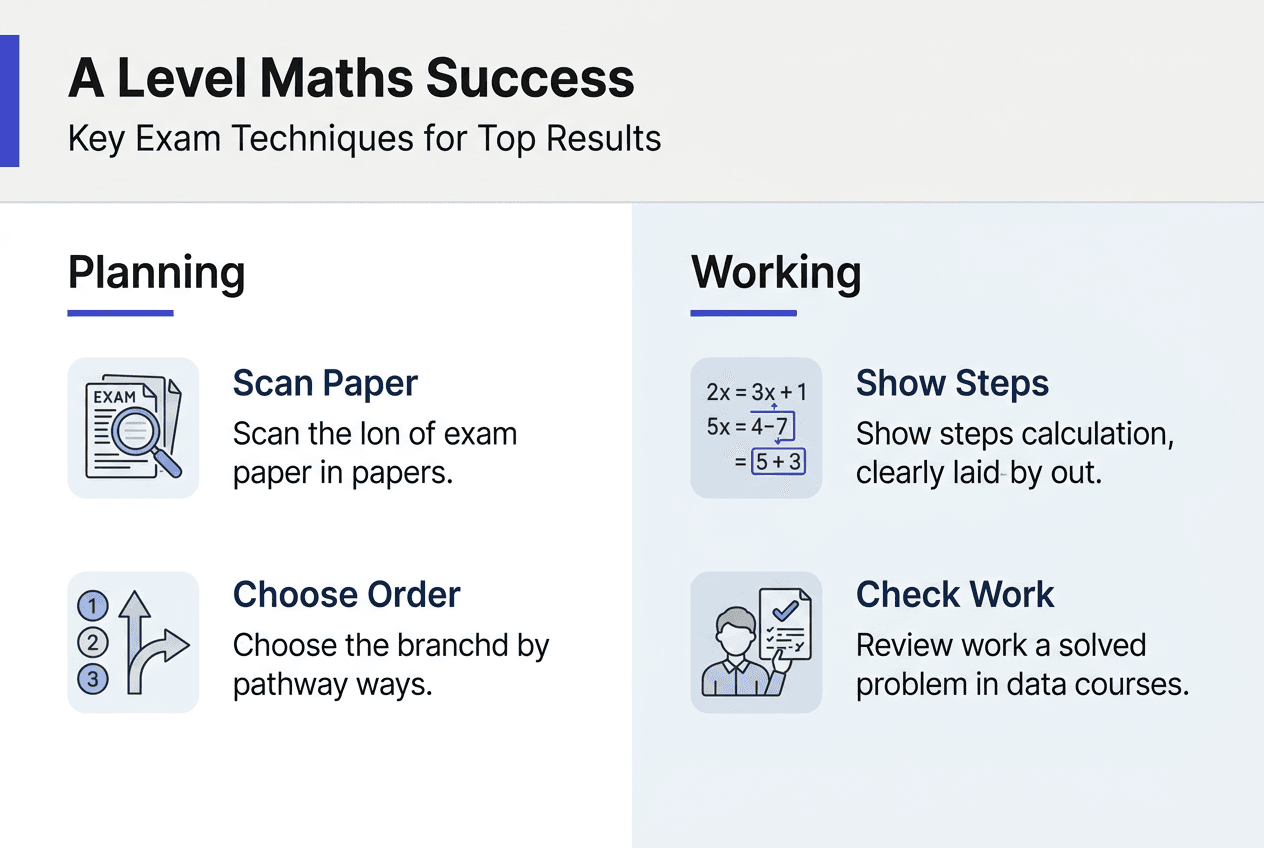
Begin each exam by scanning the entire paper quickly. Identify questions you can answer confidently and start with these to secure marks early. This approach builds momentum and reduces anxiety, allowing you to tackle harder questions with a clearer mind. Attempting easier questions first also means you've already earned substantial marks before facing challenging problems.
Showing all working clearly is absolutely essential. Examiners award method marks for correct approaches even when final answers contain errors. Write each step on a separate line, clearly showing how you progress from one stage to the next. Never skip algebraic manipulations or intermediate calculations, as these demonstrate your understanding and earn marks independently of your final answer.

Double-checking calculations catches careless errors that cost marks unnecessarily. After completing a question, quickly verify your arithmetic and ensure your answer makes sense in context. Does a probability exceed 1? Is a length negative? These obvious impossibilities signal errors that quick checks reveal.
Allocate time based on mark values to ensure you attempt higher-scoring questions. A rough guide is spending one to two minutes per mark available. For a six-mark question, aim to complete it within 10 minutes, leaving time for review. If you get stuck, move on rather than wasting precious minutes on a single problem.
Effective exam execution follows these steps:
- Scan the paper and identify easier questions to attempt first
- Read each question carefully and plan your approach before writing
- Show every step of your working clearly and logically
- Write your final answer clearly, underlining or boxing it if appropriate
- Check your arithmetic and verify answers make contextual sense
- Return to skipped questions with remaining time
- Review all answers if time permits, focusing on high-mark questions
Pro Tip: Wear a watch or use a visible clock to track time throughout the exam. Set mental checkpoints, such as completing the first half of questions within 45 minutes of a 90-minute paper, to maintain appropriate pace and avoid rushing at the end.
For comprehensive preparation strategies, review your A Level maths exam preparation checklist for 2026 to ensure you've covered all essential areas before exam day. Understanding A Level maths success factors also provides valuable context for what distinguishes top performers.
Preparing thoroughly: past papers, exam format, and calculator use
Thorough preparation transforms exam technique from theory into instinctive practice. Understanding your exam structure, practising extensively with past papers, and mastering calculator use are fundamental preparation elements that directly improve performance.
A Level maths typically consists of three papers: two pure mathematics papers and one applied paper covering statistics and mechanics. Each paper has specific content coverage and mark allocation, so familiarising yourself with these structures helps you anticipate question types and allocate revision time appropriately.
Regularly practising past papers under timed conditions is perhaps the single most effective preparation strategy. Practising past papers and timed conditions improves scores by up to 30%, as it builds familiarity with question styles, improves speed, and highlights areas needing further study. Complete entire papers in one sitting to develop stamina and time management skills.
Using mark schemes after completing practice papers reveals exactly how examiners award marks. Study these carefully to understand which steps earn method marks and where marks are commonly lost. This insight helps you structure answers to maximise mark capture. Identify patterns in your errors, whether they're conceptual misunderstandings or careless mistakes, and address these systematically.
Graphing calculators are powerful tools when used correctly. They help verify answers, visualise functions, and solve equations quickly. However, always show detailed working to earn full marks, as calculator outputs alone receive minimal credit. Use calculators to check rather than replace manual working.
| Exam component | Content coverage | Typical marks | Key preparation focus | | --- | --- | --- | | Pure Maths Paper 1 | Algebra, calculus, trigonometry | 100 | Algebraic manipulation, differentiation, integration techniques | | Pure Maths Paper 2 | Advanced pure topics | 100 | Sequences, binomial expansion, parametric equations | | Applied Paper | Statistics and mechanics | 100 | Probability distributions, forces, projectiles |
Essential preparation activities include:
- Complete at least 10 full past papers under timed conditions
- Review mark schemes thoroughly to understand marking criteria
- Practise calculator functions relevant to your exam board
- Create a formula sheet for quick reference during revision
- Identify weak topics and focus additional practice there
Prepare a checklist of exam essentials well before exam day. This includes pens, pencils, ruler, protractor, compass, calculator with fresh batteries, and any permitted formula sheets. Knowing your calculator's functions, particularly for statistical calculations and equation solving, saves time during exams.
Learn how to review past papers for A Level maths success in 2026 to maximise the value of your practice sessions and ensure you're addressing weaknesses effectively rather than simply repeating comfortable questions.
Avoiding common mistakes and applying strategies for top marks
Understanding frequent pitfalls helps you avoid them whilst reinforcing proven strategies ensures you consistently apply techniques that maximise marks. Many students lose marks not through lack of knowledge but through preventable errors and poor exam habits.
Common mistakes that cost marks include:
- Misreading questions and answering something different from what's asked
- Over-relying on calculators without showing sufficient working
- Skipping algebraic steps, making it impossible to award method marks
- Leaving answers in inappropriate forms when specific formats are required
- Poor time management leading to incomplete papers
Deep understanding of mathematical principles consistently outperforms rote memorisation of formulas. Top students score 15-20% higher by understanding principles rather than memorising formulas, as they can adapt their knowledge to unfamiliar question formats. Focus on why methods work rather than just how to apply them mechanically.
Partial marks are awarded generously for clear methods even when final answers contain errors. This is particularly true in mechanics and statistics where multi-step problems allow examiners to credit each correct stage independently. Never leave a question blank because you're unsure of the final answer. Write down your approach and attempt each step, as you'll likely earn substantial marks for correct methodology.
| Aspect | Poor strategy | Effective strategy |
|---|---|---|
| Question reading | Skim quickly, start immediately | Read twice, highlight key information |
| Working shown | Minimal steps, jump to answer | Every step clearly written |
| Calculator use | Rely on calculator, minimal working | Use to verify, show all manual steps |
| Time management | Spend too long on hard questions | Answer easy questions first, return later |
| Checking | Skip review, assume correctness | Verify arithmetic, check answer reasonableness |
Essential tips for achieving top marks:
- Understand questions thoroughly before beginning answers
- Show comprehensive working for every calculation
- Manage time strategically based on mark allocation
- Practise regularly with varied question types
- Review mistakes systematically to prevent repetition
Pro Tip: Mix questions from different topics during practice sessions rather than focusing on one area at a time. This improves your ability to identify which methods each question requires, mirroring actual exam conditions where topics appear in varied orders.
For targeted revision support, explore the AQA A Level mathematics revision guide for 2026 which provides exam-board-specific strategies. Understanding broader A Level maths success factors also helps contextualise how different preparation approaches contribute to overall performance.
Boost your A Level maths practice with Quextro
Applying the strategies outlined in this guide becomes significantly easier when you have access to comprehensive, organised practice materials. Quextro offers an extensive exam questions database with over 13,955 A Level maths questions from major exam boards including AQA, Edexcel, OCR, and CIE.
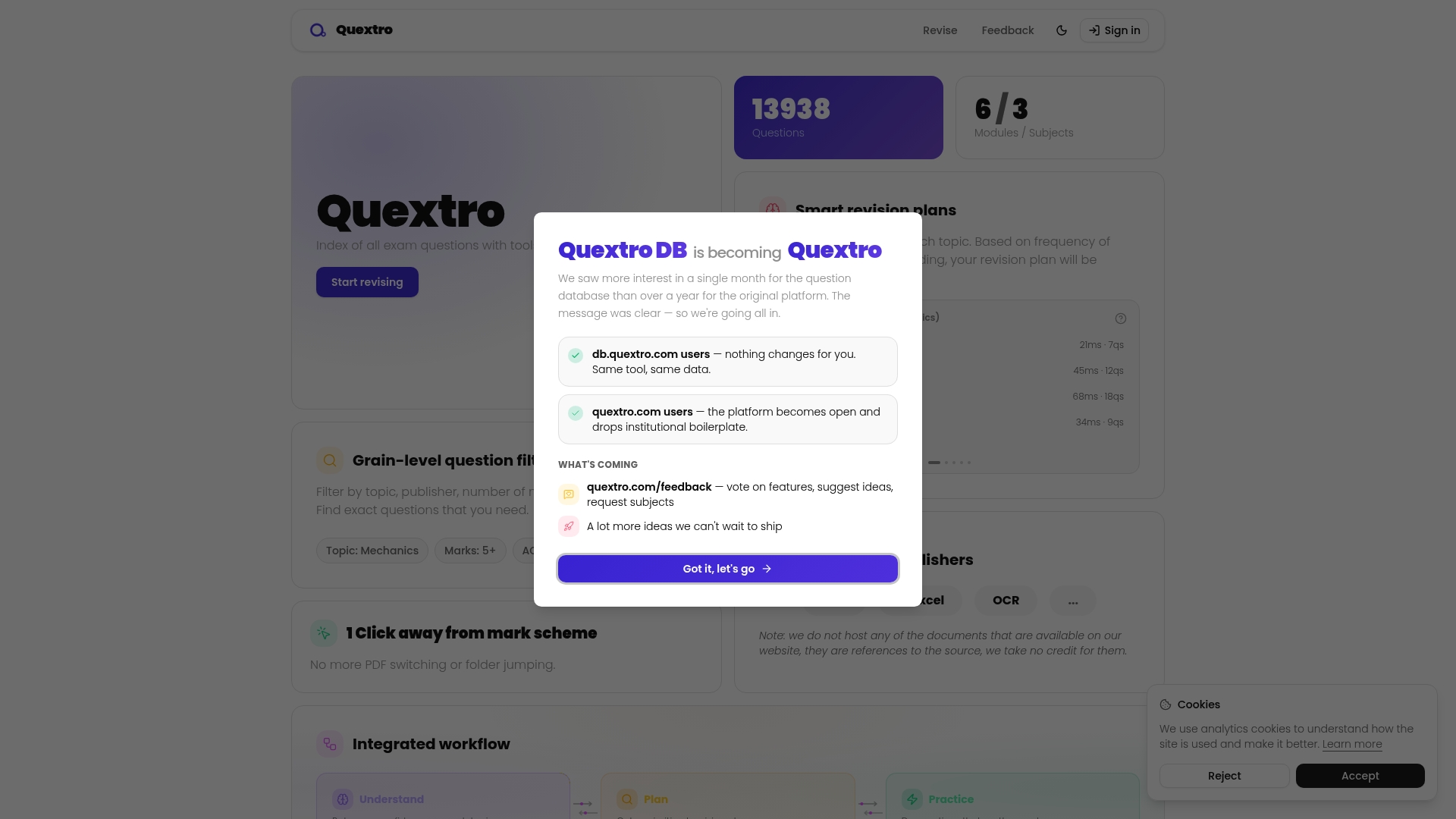
The platform allows you to filter questions by topic, difficulty, publisher, and mark value, letting you focus precisely on areas where you need improvement. Whether you're strengthening your understanding of higher mathematics concepts or developing skills in statistics, targeted practice builds the familiarity and confidence that transform exam performance. Smart revision plans adapt based on your confidence ratings, ensuring you spend time efficiently on topics that matter most.
Frequently asked questions
How can I quickly improve my exam question reading skills?
Focus on reading the entire question carefully without skipping any words, as crucial details often appear throughout. Highlight command words like "show", "calculate", or "prove", and underline important numbers or conditions that affect your answer. Practising this systematic approach with past papers trains you to spot key information automatically.
Is it better to use a calculator or do maths by hand during the exam?
Use calculators to check results and visualise graphs, but always show all working steps clearly in your written answers. Relying solely on calculators costs method marks, as examiners need to see your mathematical reasoning. Calculators are verification tools, not replacements for demonstrated understanding.
How important is practising past papers before the exam?
Practising past papers is essential for familiarising yourself with exam format, question styles, and time pressures. Working under timed conditions improves speed, accuracy, and confidence whilst revealing weak areas needing additional revision. Aim to complete at least 10 full papers before your exam.
What is the best way to handle difficult questions during the exam?
Attempt easier questions first to secure marks early and build confidence before tackling challenging problems. Return to harder questions later once you've maximised marks elsewhere. If completely stuck, write down any relevant formulas or approaches you know, as partial credit rewards correct methodology even without complete solutions.