

Choosing the right A Level maths exam board can feel overwhelming when you're trying to focus on revision and exam success. Different boards have distinct exam styles, question formats and content emphases that can significantly impact your preparation strategy. This article lists key exam boards and practical resources to help you prepare effectively, giving you clear examples and actionable advice. You will learn how to compare and decide the best fit for your study needs, ensuring you maximise your potential in the exams.
Table of Contents
- Key takeaways
- Key criteria to evaluate A Level maths exam boards
- Exploring the main A Level maths exam boards
- Comparing mechanics content and exam styles
- Where to find official past papers and revision resources
- Explore A Level maths past papers and questions on Quextro
- Frequently asked questions
Key Takeaways
| Point | Details |
|---|---|
| Main UK boards | AQA Edexcel OCR WJEC Eduqas CCEA are the principal UK A Level maths boards with distinct emphases and assessment styles. |
| Exam style differences | Boards vary in style from direct and structured to algebra heavy or applied modelling, so practising the right question types is essential. |
| Content weighting | Pure maths typically forms around two thirds of the course, with mechanics and statistics sharing the rest. |
| Past papers access | Official exam board sites and popular revision platforms provide past papers and examiner reports to guide revision. |
Key criteria to evaluate A Level maths exam boards
When selecting an A Level maths exam board, you need to understand the main factors that will shape your revision experience and exam performance. Each board has a unique approach to testing mathematical knowledge, so knowing what to look for helps you make an informed choice.
First, examine exam style and question format differences. Exam styles differ: AQA direct/structured; Edexcel predictable/applied; OCR algebra-heavy (A)/context-modelling (B). Some boards favour straightforward, clearly worded questions, whilst others test your ability to apply concepts in unfamiliar contexts. Understanding these distinctions early on allows you to practise the right question types.
Next, check content focus and weighting. Pure maths typically accounts for two thirds of the course, with mechanics and statistics splitting the remaining third. However, the depth and breadth of topics within each strand vary. Some boards include more challenging mechanics content like two-dimensional moments, whilst others keep mechanics applications more standard.
Consider your school's preferred board and the support it provides. Schools often choose a specific board based on teaching resources, staff expertise and historical results. If your school has a strong track record with a particular board, you benefit from tailored teaching and proven strategies.
Review availability of past papers and revision resources. Official exam board sites offer past papers, mark schemes and examiner reports. Third-party platforms like the exam questions database provide filtered access to thousands of questions, making targeted revision easier.
Finally, balance difficulty level and your own strengths in maths topics. If you excel in algebraic manipulation, an algebra-heavy board might suit you. If you prefer applied problem solving, look for boards emphasising modelling and interpretation.
Pro Tip: Download and attempt one full past paper from each board you're considering. This hands-on comparison reveals which question styles feel most natural to you and where your strengths lie.
Exploring the main A Level maths exam boards
Understanding the profiles of the primary A Level maths exam boards helps you see how they meet or vary in the criteria outlined above. Main UK A Level exam boards are AQA, Edexcel (Pearson), OCR, WJEC/Eduqas, CCEA. Each board offers a distinct curriculum structure and assessment approach.
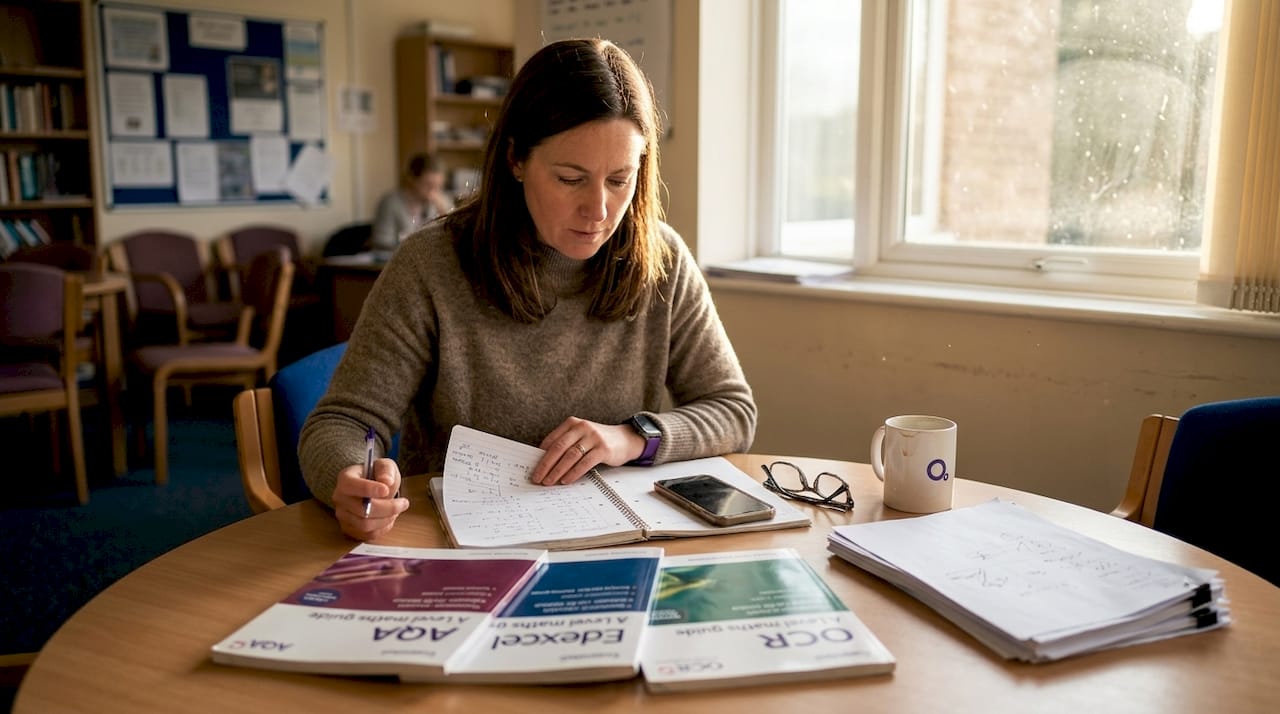
AQA (Assessment and Qualifications Alliance) uses code 7357 for A Level Mathematics. AQA's mechanics focus includes standard topics like one-dimensional moments, projectiles and motion on inclined planes. The exam style is generally direct and structured, with questions clearly signposting the methods required. Pure maths content is comprehensive, covering calculus, algebra, trigonometry and sequences.
Edexcel (Pearson) offers code 9MA0. Edexcel's exam style is predictable with applied problems that test your ability to use maths in real-world scenarios. The mechanics section covers forces, projectiles and connected particles, with a consistent format across past papers. Many students find Edexcel's question wording familiar once they've practised a few papers.
OCR A uses code H240. This board is algebra-heavy, requiring strong manipulation skills. Mechanics content includes two-dimensional moments, such as ladder problems, making it more challenging than some other boards. OCR A suits students who enjoy rigorous algebraic problem solving and want to develop deep technical skills.
OCR B (MEI) uses code H640. This board emphasises modelling and interpretation in mechanics, with questions that require you to set up and solve problems from contextual descriptions. The MEI (Mathematics in Education and Industry) approach integrates mathematical reasoning with practical applications, appealing to students who prefer understanding concepts through real-world examples.
WJEC/Eduqas and CCEA are additional options with regional importance, primarily used in Wales and Northern Ireland respectively. Both boards follow similar content frameworks to AQA and Edexcel but may have subtle differences in question style and paper structure.
For A Level Mathematics, primary boards: AQA (7357), Edexcel (9MA0), OCR A (H240), OCR B MEI (H640). Core content: 2/3 Pure, 1/6 Stats, 1/6 Mechanics. This consistent content split ensures all boards cover essential mathematical topics, but the depth and presentation vary.
Exploring foundation maths past papers and further maths past papers across different boards gives you practical insight into these differences.
Comparing mechanics content and exam styles
Mechanics is where A Level maths boards show the most variation, both in content difficulty and question approach. Understanding these differences helps you prepare effectively for the specific challenges your chosen board presents.
AQA mechanics features straightforward, physics-inspired questions. AQA Mechanics: standard applications including 1D moments, projectiles, inclined planes. Paper 3 combines Pure + Mechanics. You'll encounter problems involving forces, motion under constant acceleration and energy conservation. Questions typically provide clear diagrams and step-by-step prompts, making it easier to identify the required method.
OCR A mechanics is more challenging. OCR A Mechanics: Forces, connected particles, 2D moments (ladders). Mechanics combined with Pure on Paper 3. The inclusion of two-dimensional moments means you'll solve problems involving ladders leaning against walls or rods in equilibrium at angles. These questions demand stronger visualisation skills and more complex algebraic manipulation.
OCR B (MEI) mechanics takes a different approach. OCR B (MEI) Mechanics: focus on modelling and interpretation. Mechanics is examined alongside Pure on Paper 1. Rather than presenting pre-formulated problems, MEI questions often describe real situations and ask you to construct the mathematical model yourself. This tests your ability to translate words into equations and choose appropriate assumptions.
| Board | Mechanics focus | Typical topics | Question style |
|---|---|---|---|
| AQA | Standard applications | 1D moments, projectiles, inclined planes | Direct, structured |
| Edexcel | Predictable format | Forces, connected particles | Applied, consistent |
| OCR A | Algebra-heavy | 2D moments, ladders, equilibrium | Challenging, technical |
| OCR B MEI | Modelling emphasis | Contextual problems, interpretation | Problem-solving, open-ended |
Practical tips for preparing mechanics questions according to board:
- For AQA, practise identifying force diagrams and applying Newton's laws systematically
- For Edexcel, familiarise yourself with the standard problem formats to build speed and confidence
- For OCR A, strengthen your algebraic skills and work through two-dimensional vector problems
- For OCR B MEI, focus on translating word problems into mathematical statements and justifying your modelling choices
Pro Tip: Create a mechanics formula sheet specific to your board, including only the relationships and techniques that appear regularly in past papers. This focused revision saves time and builds automaticity.
Exploring further mechanics past papers across boards reveals these stylistic differences in action.
Where to find official past papers and revision resources
Having explored exam content and styles, you need to know where to practise and revise effectively. Reliable resources make the difference between scattered revision and focused, efficient preparation.
Official exam board sites provide the most authoritative past papers, mark schemes and examiner reports. AQA's All About Maths portal offers comprehensive resources for code 7357, including specimen papers and teaching materials. Edexcel's website hosts past papers for 9MA0 with detailed mark schemes showing how examiners allocate marks. OCR provides sample assessment materials for both H240 and H640, giving you insight into question formats and difficulty levels.
Trusted revision websites complement official resources. Practice resources include official sites like AQA All About Maths, Edexcel past papers, plus SaveMyExams, PhysicsAndMathsTutor, and MrBartonMaths updated for 2026 exams. SaveMyExams offers topic-by-topic questions with video solutions, helping you target weak areas. PhysicsAndMathsTutor organises past papers by module and topic, making it easy to find specific question types. MrBartonMaths provides diagnostic quizzes and worked examples across all boards.
Advise checking resource updates to match 2026 exam specifications. Exam boards occasionally revise content or assessment formats, so ensure the materials you use reflect current requirements. Most official sites clearly label specimen papers for the latest specification.
Using mixed past papers based on your chosen exam board builds familiarity with question styles whilst preventing over-reliance on memorised solutions. Rotate between full papers for timed practice and topic-specific questions for targeted revision.
Combining official and third-party materials gives you the best of both worlds: authoritative content from exam boards and accessible explanations from revision platforms. Official mark schemes teach you exactly what examiners want, whilst third-party video solutions show you how to think through problems step by step.
Key resources to bookmark:
- AQA All About Maths for official papers and teaching resources
- Edexcel's past paper archive for 9MA0 materials
- OCR's sample assessment materials for H240 and H640
- SaveMyExams for topic-organised questions and video solutions
- PhysicsAndMathsTutor for past papers sorted by module
- MrBartonMaths for diagnostic quizzes and worked examples
Exploring pure maths past papers and statistics past papers on dedicated platforms streamlines your revision workflow and keeps all your practice materials in one place.
Explore A Level maths past papers and questions on Quextro
Now that you understand the exam boards and where to find resources, consider how Quextro can streamline your revision process. Quextro offers a comprehensive database of over 13,955 past exam questions from major boards including AQA, Edexcel, OCR and CIE, all organised for efficient study.
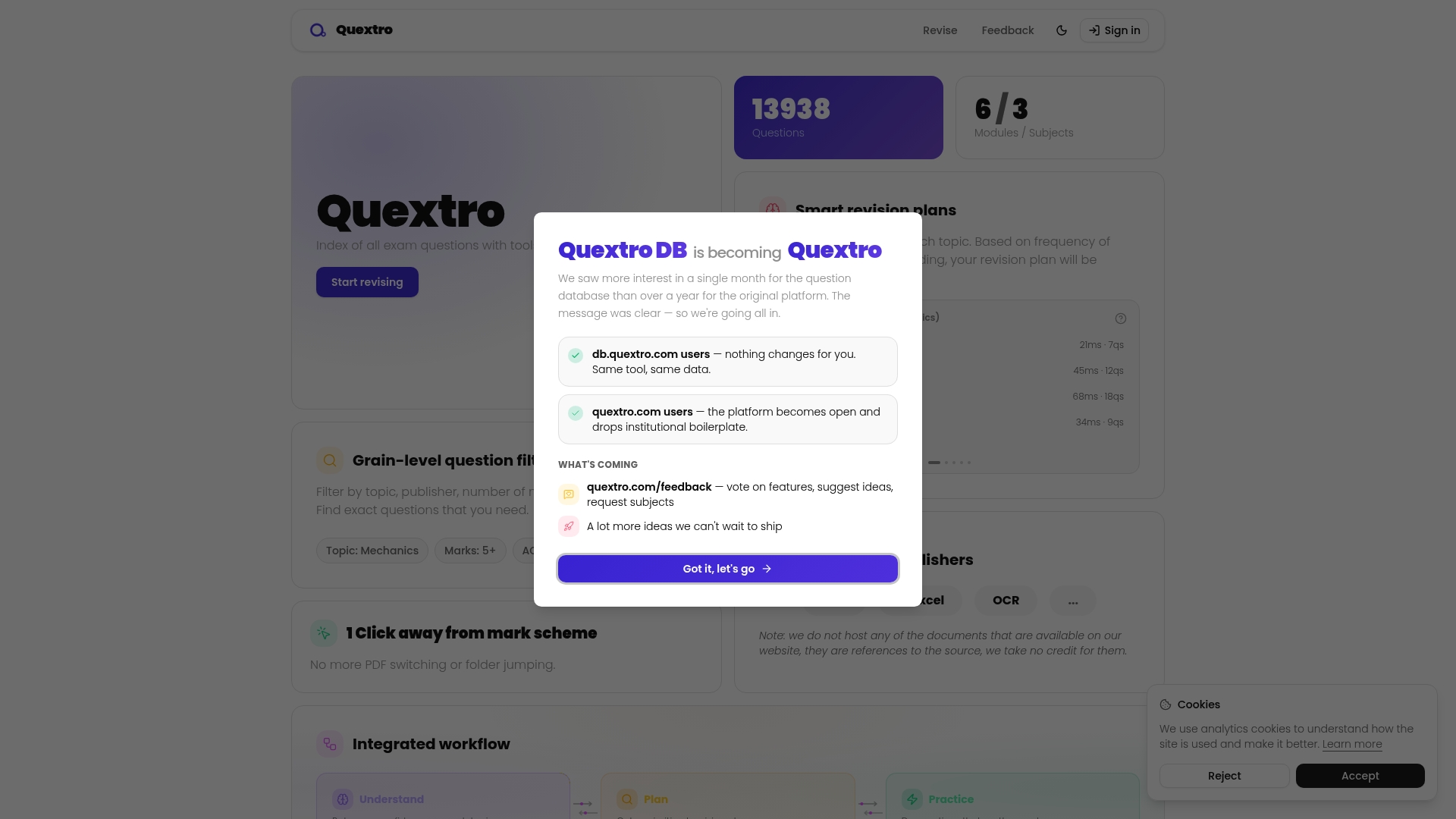
You can filter questions by topic, difficulty, publisher and marks, allowing you to focus on exactly what you need to practise. Whether you're strengthening your pure maths foundations, tackling challenging mechanics problems or mastering statistics techniques, Quextro's platform adapts to your needs. The smart revision plans adjust based on your confidence ratings and question frequency, eliminating the need to juggle multiple PDF files or lose track of your progress.
Explore pure mathematics past papers to build your calculus and algebra skills, dive into further mathematics practice for advanced topics, or review statistics maths questions to sharpen your data analysis abilities. Quextro's integrated workflow lets you answer questions directly on the site, track your progress automatically and save questions to personalised notebooks for later review.
Frequently asked questions
What are the main differences between AQA and Edexcel maths exams?
AQA exam style is more direct and structured, Edexcel's style is predictable with applied problems. AQA questions tend to signpost the methods required, making it easier to identify the approach. Edexcel emphasises real-world applications and maintains a consistent format across papers, which helps you build familiarity with question types through practice.
How can I decide the best exam board for my strengths?
Try past papers from different boards to see which match your style and where you feel most confident. Consider topics you find easier: if you excel in algebraic manipulation, OCR A's algebra-heavy approach might suit you; if you prefer applied problem solving, OCR B MEI's modelling emphasis could be a better fit. Your school's chosen board and available support also play a crucial role in your success.
Where can I access up-to-date past papers for A Level maths?
Official sites like AQA, Edexcel, and OCR provide past papers; third-party sites such as SaveMyExams and MrBartonMaths are also valuable. Use official exam board websites for the latest papers and mark schemes, ensuring they match the 2026 exam specifications. Supplement your study with trusted revision platforms that offer topic-organised questions, video solutions and diagnostic tools to target weak areas effectively.
Does the choice of exam board affect university admissions?
Universities treat A Level maths qualifications from all major UK exam boards equally for admissions purposes. What matters is your final grade, not which board awarded it. Focus on choosing the board that best matches your learning style and allows you to achieve the highest possible grade, rather than worrying about university preferences.
How much do mechanics topics vary between exam boards?
Mechanics content varies significantly in both depth and approach. AQA covers standard one-dimensional moments and projectiles, whilst OCR A includes more challenging two-dimensional moments like ladder problems. OCR B MEI emphasises modelling and interpretation, requiring you to construct mathematical models from contextual descriptions. Review past papers to understand the specific mechanics demands of your chosen board.