

Choosing the right revision strategies for A Level maths can feel overwhelming when you're bombarded with conflicting advice from teachers, tutors, and online forums. Many students spend countless hours rereading notes or passively highlighting textbooks, only to find their exam performance doesn't reflect their effort. The difference between average results and top grades often comes down to using evidence-based methods that genuinely improve retention and problem-solving skills. This article cuts through the noise to present proven best practices that transform how you prepare, helping you work smarter and achieve the A Level maths results you deserve.
Table of Contents
- Key takeaways
- Establishing criteria for effective exam preparation
- Top methods: spaced repetition and active recall
- Maximising past paper practice for exam success
- Avoiding common mistakes and strengthening algebra fundamentals
- Comparing best practices for a personalised revision strategy
- Boost your A Level maths revision with targeted resources
- Frequently asked questions
Key Takeaways
| Point | Details |
|---|---|
| Problem solving over memorisation | Prioritise problem solving and genuine understanding over mere memorisation of rules and formulas. |
| Spaced repetition | Spaced repetition spreads revision across days and weeks to strengthen long term memory. |
| Active recall | Active recall involves testing yourself from memory before checking solutions to cement learning. |
| Timed past papers | Practice with past papers under timed conditions to improve exam technique and timing. |
Establishing criteria for effective exam preparation
Before diving into specific methods, you need clear criteria for evaluating any revision strategy. The most effective approaches prioritise long-term retention over short-term familiarity, meaning you'll remember formulas and methods weeks after learning them, not just until tomorrow's quiz. Effective revision emphasises practice over memorisation, starting early with daily or weekly reviews and focusing on problem-solving rather than rereading.
Your revision must also develop genuine understanding, not just surface recognition. When you encounter an unfamiliar problem setup in the exam, deep understanding lets you adapt methods rather than panic. This matters especially in algebra and mechanics, where questions often disguise familiar concepts in new contexts.
Exam technique deserves equal attention to content knowledge. You can understand every topic perfectly but still lose marks through poor presentation or time management. Method marks reward showing clear working, so your revision should practise writing solutions exactly as examiners expect.
Key criteria for choosing revision methods:
- Promotes active engagement rather than passive reading
- Builds retention that lasts weeks or months
- Develops flexible problem-solving skills
- Improves exam-specific presentation and timing
- Addresses your personal weak areas systematically
Avoid the trap of confusing familiarity with mastery. When you reread notes, topics feel easy because you recognise them, but recognition doesn't equal recall under exam pressure. Similarly, watching solution videos might make sense in the moment, yet you won't replicate that understanding independently without active practice. Following an A Level maths exam checklist ensures you meet all these criteria systematically rather than hoping your current methods work.
Top methods: spaced repetition and active recall
Spaced repetition means spreading your revision over time with increasing gaps between reviews, fighting the natural forgetting curve that erases most new information within days. Instead of cramming pure mathematics formulas the night before, you'd review them after one day, then three days, then a week, then two weeks. Each successful retrieval strengthens the memory pathway, making future recall easier and more reliable.
Active recall flips traditional revision on its head by testing yourself before you feel ready. Rather than rereading your notes on integration techniques, you'd close the textbook and attempt practice questions from memory, only checking answers afterwards. This retrieval practice feels harder than passive review, but that difficulty signals genuine learning.
Spaced repetition and active recall show superior effects on maths retention compared to rereading or highlighting. The research consistently demonstrates that students using these methods outperform those spending equal time on passive strategies, sometimes by significant margins.
Practical implementation for A Level maths:
- Create flashcards for formulas and test yourself daily
- Attempt past paper questions without notes before checking solutions
- Schedule topic reviews at increasing intervals using a calendar
- Use practice questions as your primary study method, not supplementary
- Resist the urge to check answers immediately when stuck
Pro Tip: Start each revision session by attempting three questions from topics you studied last week before touching new material. This five-minute retrieval practice dramatically improves long-term retention without adding significant time to your schedule.
"The testing effect shows that retrieving information from memory strengthens that memory more than simply restudying the material. For mathematics, this means attempting problems is more valuable than reviewing worked examples."
The AQA maths revision guide incorporates these principles by structuring practice around active problem-solving rather than passive content review. When you feel tempted to reread a chapter, grab practice questions on that topic instead. Your brain learns mathematics through doing, not observing.
Maximising past paper practice for exam success
Past papers represent your single most valuable revision resource because they show exactly what examiners actually ask and how they award marks. Past paper practice under timed conditions with mistake logs proves crucial for developing exam technique that translates content knowledge into marks.

Start incorporating full papers at least two months before your exams, not just in the final week. Early practice identifies gaps in your knowledge when you still have time to address them systematically. Complete each paper under strict exam conditions with no notes, no pauses, and a timer running to simulate real pressure.
Effective past paper practice routine:
- Choose a paper covering topics you've studied recently
- Set a timer for the exact exam duration and work continuously
- Mark your work honestly using the official mark scheme
- Record every mistake in a dedicated notebook with the question number
- Rework incorrect questions immediately without looking at solutions
- Review the mark scheme only after attempting corrections
- Schedule a follow-up session to retry similar questions
Pro Tip: Tackle the hardest questions first when practising individual topics, not the easiest. This approach builds confidence that you can handle anything the exam throws at you, and easier questions feel trivial by comparison.
| Practice approach | Benefits | Best used when |
|---|---|---|
| Timed full papers | Builds stamina and time management | Two months before exams |
| Untimed topic practice | Develops deep understanding | Learning new content |
| Mixed question sets | Improves topic recognition | One month before exams |
| Repeat difficult questions | Addresses specific weaknesses | Throughout revision |
Your mistake log becomes your personalised revision guide, showing exactly which topics need more attention. If you consistently lose marks on mechanics questions involving forces, that's a clear signal to drill those problems daily. Many students waste time revising topics they've already mastered whilst ignoring genuine weak areas.
Cover questions from multiple exam boards for broader exposure to different question styles and wordings. AQA might phrase a calculus question differently than Edexcel, and practising both builds flexibility. The principles remain identical, but varied exposure prevents you from memorising specific question formats rather than understanding concepts. Resources for reviewing past papers effectively help you extract maximum value from each practice session.
Avoiding common mistakes and strengthening algebra fundamentals
Algebra forms the foundation for nearly every A Level maths topic, from calculus and trigonometry to mechanics and statistics. Common mistakes include weak algebra foundations, skipping steps and cramming instead of consistent practice. Students with shaky algebraic manipulation struggle throughout their course, losing method marks even when they understand the underlying concepts.
Skipping working steps represents one of the costliest errors in A Level maths exams. You might reach the correct final answer through mental arithmetic, but examiners can't award method marks without seeing your process. Always show factorisation steps, substitutions, and simplifications explicitly, even when they feel obvious.
Frequent mistakes that cost marks:
- Rushing algebraic manipulation and making sign errors
- Failing to show clear substitution into formulas
- Neglecting to state assumptions in mechanics problems
- Skipping diagram labels in statistics questions
- Forgetting units in final answers
Consistent daily practice beats intensive cramming sessions every time. Spending 30 minutes on algebra drills each day builds stronger skills than a six-hour marathon once weekly. Your brain consolidates mathematical procedures during sleep, so regular exposure with rest intervals in between optimises learning.
Mechanics and statistics often receive less attention than pure mathematics, yet they contribute equally to your final grade. Many students focus heavily on calculus and algebra whilst leaving mechanics until the last minute, then panic when exam questions require confident application of forces or probability concepts.
"Students who maintain consistent daily practice across all modules, including mechanics and statistics, significantly outperform those who concentrate solely on pure mathematics. Balance your revision time proportionally to the weighting of each paper."
Develop a daily routine that includes 15 minutes of algebraic manipulation practice, even on topics you think you've mastered. Factorise quadratics, simplify surds, manipulate trigonometric identities, and solve simultaneous equations without calculators. This foundational work pays dividends across every exam paper. The guide on answering A Level maths questions provides detailed strategies for presenting work to maximise method marks.
Comparing best practices for a personalised revision strategy
No single method works perfectly for every student or every topic, so understanding the strengths and limitations of each approach helps you build a balanced revision plan. The most successful students combine multiple strategies, adapting their methods based on time available, topic difficulty, and personal learning preferences.
| Method | Strengths | Challenges | Ideal for |
|---|---|---|---|
| Spaced repetition | Excellent long-term retention, prevents cramming | Requires advance planning and discipline | Formula memorisation, topic review |
| Active recall | Identifies genuine knowledge gaps quickly | Feels difficult and uncomfortable initially | All topics, especially problem-solving |
| Past paper practice | Builds exam technique and confidence | Time-consuming, needs mark schemes | Final preparation phase |
| Mistake logging | Targets weak areas efficiently | Requires honest self-assessment | Ongoing throughout revision |
| Daily algebra drills | Strengthens foundations across topics | Can feel repetitive | Continuous skill maintenance |
Prioritise spaced practice and retrieval for long-term retention over passive strategies. Research consistently shows these active methods produce better exam performance than rereading notes or watching tutorial videos, even when students report feeling less confident during the learning process.
Blend methods based on your revision timeline. Three months before exams, focus on spaced repetition and topic-based active recall to build comprehensive knowledge. Six weeks out, increase past paper practice whilst maintaining your mistake log. In the final fortnight, complete full papers under timed conditions whilst doing quick daily reviews of your logged errors.
Your learning style influences which methods feel most natural, but don't let comfort dictate your entire strategy. Active recall feels harder than passive review because it genuinely challenges your brain, and that difficulty drives learning. Push through the initial discomfort, and you'll see results that passive methods never deliver.
Practical tips for combining methods:
- Use spaced repetition for formulas whilst practising active recall on problem-solving
- Log mistakes from past papers then use spaced repetition to review them
- Maintain daily algebra drills alongside your main revision focus
- Alternate between timed and untimed practice based on confidence levels
- Adjust your balance as exams approach, increasing past paper volume
The key is consistency across all methods rather than perfection in any single approach. Students who practise a little of everything daily outperform those who master one technique but neglect others. Resources for selecting exam questions help you choose the right practice materials to support your blended strategy.
Boost your A Level maths revision with targeted resources
Applying these best practices becomes significantly easier when you have access to comprehensive, well-organised revision materials. Quextro provides an extensive exam questions database with over 13,955 past paper questions from major exam boards, all filtered by topic, difficulty, and marks. You can build custom practice sets targeting your specific weak areas identified through mistake logging, then track your progress as you work through them.
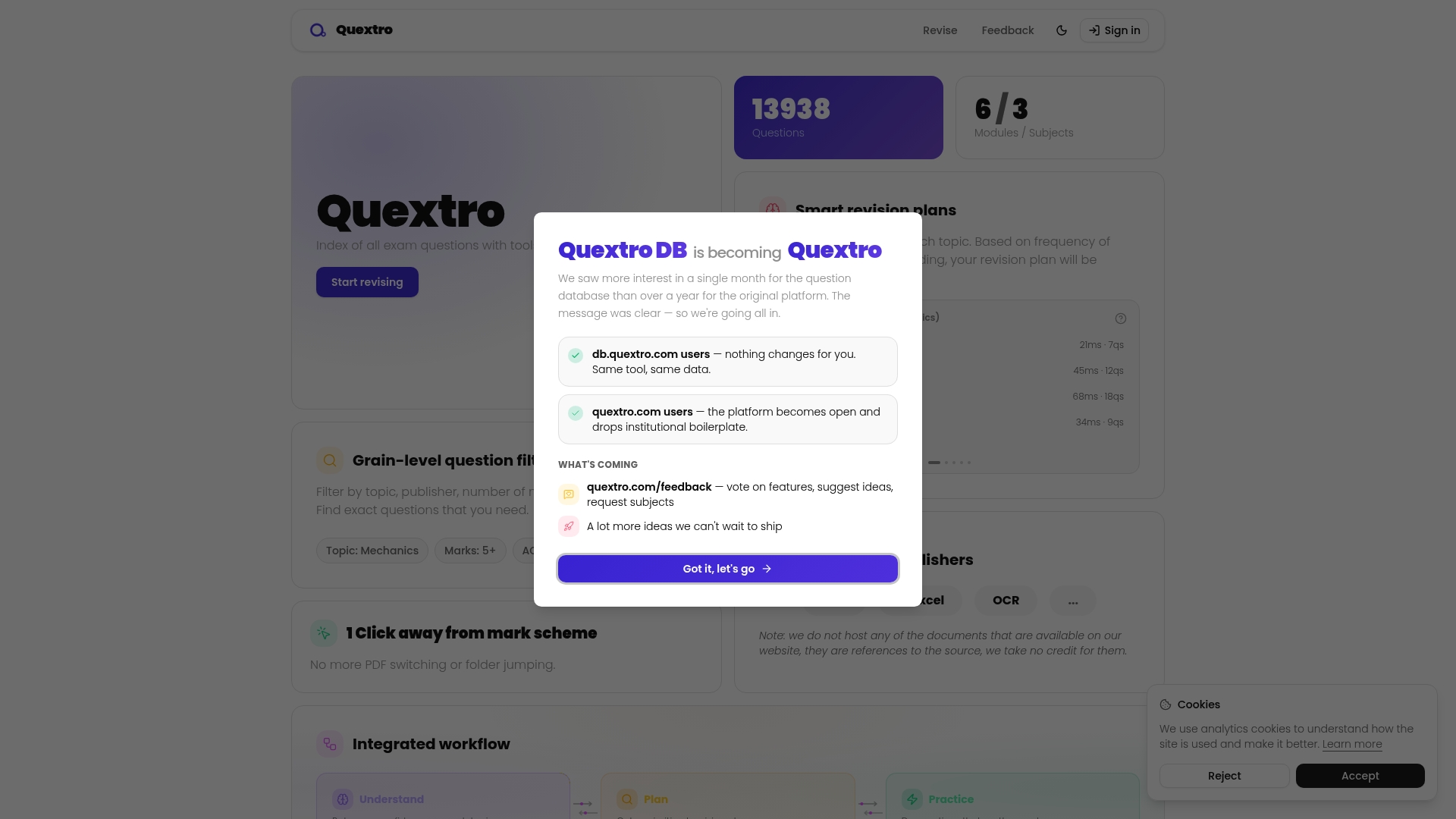
The platform's smart revision plans adapt based on your confidence ratings and question frequency, implementing spaced repetition automatically without requiring manual scheduling. You can practise pure mathematics papers and statistics mathematics papers directly on the site, with your answers automatically saved and mistakes logged for future review. This integrated workflow eliminates the need for printing PDFs or switching between multiple resources, letting you focus entirely on active practice and retrieval.
Frequently asked questions
What are the best ways to start revising for A Level maths?
Begin at least three months before your exams to allow sufficient time for spaced repetition cycles. Start by reviewing core concepts from earlier in your course and analysing mistakes from past homework or mock exams to identify weak areas. Create a realistic schedule that includes daily practice rather than long weekend sessions, and prioritise active recall over passive rereading from day one.
How can I use past papers most effectively?
Complete papers under strict timed conditions to simulate real exam pressure and build stamina. Mark your work immediately afterwards using official mark schemes, then maintain a detailed mistake log recording every error with the question number and topic. Rework incorrect questions without looking at solutions first, then review the mark scheme only after attempting corrections. Use papers from different exam boards to gain exposure to varied question styles and wordings.
What common mistakes should I avoid in A Level maths revision?
Never cram the night before exams, as this produces poor retention and increases anxiety without improving performance. Always show complete working steps to secure method marks, even when answers seem obvious through mental calculation. Don't neglect mechanics or statistics modules whilst focusing solely on pure mathematics, as all papers contribute equally to your final grade. Avoid passive revision methods like rereading notes or highlighting textbooks, which create false confidence without building genuine recall ability.