

Facing thousands of past exam questions can overwhelm even the most dedicated A Level maths student. Without a clear system, you risk wasting precious revision time searching for relevant problems or repeating questions you have already mastered. Effective organisation transforms this chaos into a strategic advantage, helping you target weak areas, track progress, and build confidence before exam day. This article explores proven methods to structure your question bank, from digital tagging systems to physical binders, so you can revise smarter and achieve better results.
Table of Contents
- Key takeaways
- How to evaluate your organisation criteria
- Top methods to organise exam questions effectively
- Comparing organisation tools: digital vs physical
- Choosing the best organisation approach for your revision
- Explore curated A Level maths question banks on Quextro
- Ways to organise exam questions: frequently asked questions
Key Takeaways
| Point | Details |
|---|---|
| Organisation criteria | Identify the most relevant factors such as topic area, difficulty, exam board, question type and year to tailor your revision system. |
| Topic based grouping | Grouping questions by topic lets you target concepts and spot patterns in exam board questioning styles. |
| Weighting alignment | Aligning your organisation with syllabus weighting helps focus on the topics that appear most frequently in past papers. |
| Three core methods | Digital folders, physical binders and spreadsheets cover both digital and manual learning preferences and provide flexible ways to search and filter. |
| Start with recent papers | Begin by organising questions from the last three exam sessions to stay relevant and avoid overwhelming your initial setup. |
How to evaluate your organisation criteria
Before choosing an organisation method, identify the criteria that matter most for your revision goals. Topic area remains the most common starting point because A Level maths syllabuses divide content into clear modules like pure mathematics, statistics, and mechanics. Grouping questions by topic lets you focus revision sessions on specific concepts, making it easier to spot patterns in exam board questioning styles.
Difficulty level offers another powerful lens. Separating foundation questions from advanced problems helps you build confidence systematically whilst ensuring you challenge yourself with harder material as exams approach. Exam board matters too, especially if your school uses AQA, Edexcel, OCR, or CIE, since each board has distinct question formats and marking preferences. Question type, whether multiple choice, short answer, or extended response, shapes the skills you practise and the time you allocate during mock exams.
Aligning your organisation to syllabus weighting maximises efficiency. If pure mathematics accounts for 60% of your exam, dedicate proportional attention to those questions. Selecting exam questions to boost A Level maths revision 2026 helps personalise revision and improves study focus. Track which topics appear most frequently in past papers and prioritise those areas in your question bank.
Consider these criteria when building your system:
- Topic area: Pure, statistics, mechanics, or further maths modules
- Difficulty level: Foundation, intermediate, or advanced based on mark allocation
- Exam board: AQA, Edexcel, OCR, CIE for format familiarity
- Question type: Multiple choice, short answer, extended response, proof questions
- Year and paper: Useful for tracking syllabus changes or identifying outdated content
Pro Tip: Start by organising questions from the last three exam sessions for each topic. This gives you recent, relevant material without overwhelming your initial setup. Add older papers only after you have worked through current content.
Top methods to organise exam questions effectively
Three core methods dominate successful question organisation. Digital folders offer the simplest entry point for most students. Create a main folder labelled A Level Maths Questions, then add subfolders for each major topic. Within each topic folder, add further divisions by difficulty or exam board. Save PDFs with clear naming conventions like Pure_Calculus_Hard_AQA_2024. This structure supports quick searches and lets you drag files between folders as your understanding evolves.
Physical binders suit learners who retain information better through writing and tactile interaction. Purchase dividers labelled by topic and insert printed questions in plastic sleeves. Use coloured tabs to mark difficulty levels: green for foundation, amber for intermediate, red for advanced. Write notes directly on question sheets and store mark schemes in a separate section at the back. This method creates a portable revision tool you can annotate during study sessions.

Spreadsheets provide maximum flexibility for students managing hundreds of questions. Set up columns for question ID, topic, subtopic, difficulty, exam board, year, marks available, confidence rating, and date attempted. Filter and sort by any combination of criteria to generate custom practice sets. Link each row to the actual question file stored in a cloud folder for instant access.
Follow these steps to build a digital question bank:
- Create a cloud storage folder accessible from all your devices
- Download past papers from exam board websites or Foundation Mathematics question sets
- Split multi-question papers into individual files using PDF editing tools
- Name each file with topic, difficulty, board, and year for searchability
- Tag files with metadata if your cloud service supports it
- Build a master spreadsheet linking to each file location
- Update the spreadsheet after each practice session with performance notes
Compare these methods based on your preferences:
- Digital folders: Fast setup, easy backup, requires consistent naming discipline
- Physical binders: Supports handwritten annotations, portable without devices, takes physical storage space
- Spreadsheets: Ultimate filtering power, tracks performance over time, steeper learning curve for setup
- Hybrid approach: Combines digital convenience with physical active recall, requires maintaining two systems
Most successful students eventually adopt a hybrid model, using digital storage for the master question bank whilst printing selected questions for focused practice sessions. Experiment with each method for two weeks before committing fully.
Comparing organisation tools: digital vs physical
Choosing between digital and physical tools depends on how you learn best and where you study most effectively. Digital platforms excel at searchability and portability. Digital platforms provide searchable databases whilst physical notes can aid memorisation through tactile learning. A tablet loaded with past papers weighs less than multiple binders and lets you practise anywhere with battery power. Cloud syncing means your entire question bank travels between school, home, and library without physical bulk.
Physical tools offer distinct cognitive benefits. Writing solutions by hand activates different neural pathways than typing, strengthening memory formation. Spreading printed questions across a desk gives you spatial awareness of your progress through a topic. Colour coding with highlighters and sticky notes creates visual cues that digital highlighting cannot replicate as effectively.
| Feature | Digital tools | Physical tools |
|---|---|---|
| Access speed | Instant search and filtering | Manual browsing through sections |
| Customisation | Unlimited tags and metadata | Limited to dividers and colour coding |
| Portability | Entire library on one device | Bulky for large question sets |
| Annotation | Typing or stylus input | Handwriting with full freedom |
| Backup security | Automatic cloud backup | Risk of loss or damage |
| Revision impact | Good for quick review | Better for deep memorisation |
| Cost | Subscription or device investment | Printing and stationery expenses |
Digital tools shine when you need to filter questions by multiple criteria simultaneously. Search for all hard calculus questions from Edexcel papers in the last two years, then export that subset for a focused practice session. Tag questions you found challenging and revisit them automatically through spaced repetition algorithms if your platform supports smart scheduling.
Physical organisation works brilliantly for visual learners who need to see their progress. Watching a completed questions pile grow provides tangible motivation. Flipping through annotated pages during final revision jogs memory more effectively than scrolling through digital files for some students.
Pro Tip: Use digital organisation for your master archive and question discovery, then print selected questions for timed practice under exam conditions. This hybrid approach gives you searchability when planning revision and handwriting practice when simulating real exams. Scan your handwritten solutions back into your digital system to maintain a complete performance record.
Choosing the best organisation approach for your revision
Your ideal organisation system depends on honest answers to several questions. Do you study primarily at a desk or move between locations? Fixed desk learners benefit from physical binders, whilst students who revise on buses or in cafes need digital portability. Which topics currently challenge you most? If you struggle with three specific areas, organise those questions by difficulty level to build skills progressively. Do you prefer structured routines or flexible spontaneity? Rigid systems suit planned revision schedules, flexible tagging accommodates adaptive study sessions.
Consider these factors when finalising your approach:
- Study location habits: Single desk versus multiple locations daily
- Current confidence levels: Weak areas need granular difficulty sorting
- Available technology: Reliable device access versus print resources
- Revision timeline: Months remaining versus weeks before exams
- Learning style: Visual, kinaesthetic, or reading/writing preference
- Budget constraints: Free digital tools versus printing costs
Tailoring question organisation to personal revision goals increases retention and confidence. Trial your chosen method for two weeks, then evaluate honestly. Can you find specific questions within 30 seconds? Does the system encourage regular practice or create friction? Are you actually using the organisation features you set up?
Adjust based on results. If digital folders feel overwhelming, simplify to three main categories: topics I understand, topics I am learning, topics I struggle with. If physical binders become unwieldy, digitise older questions and keep only current focus areas in print. Successful organisation evolves with your understanding.
Review and update your question sets monthly. Remove questions on topics you have mastered to reduce clutter. Add new past papers as exam boards release them. Mark questions you have attempted multiple times to avoid false confidence from memorised answers rather than genuine understanding. Your organisation system should reflect your current revision needs, not remain static from initial setup.
Schedule a weekly 15-minute organisation session. File completed questions, update your confidence ratings, and plan next week's practice topics based on gaps your system reveals. This regular maintenance prevents the chaos that prompted better organisation in the first place.
Explore curated A Level maths question banks on Quextro
Building a comprehensive question bank from scratch takes significant time and effort. Quextro offers expertly organised collections covering every A Level maths module, saving you hours of searching and sorting. Browse thousands of questions already categorised by topic, difficulty, and exam board, with integrated mark schemes and model solutions.
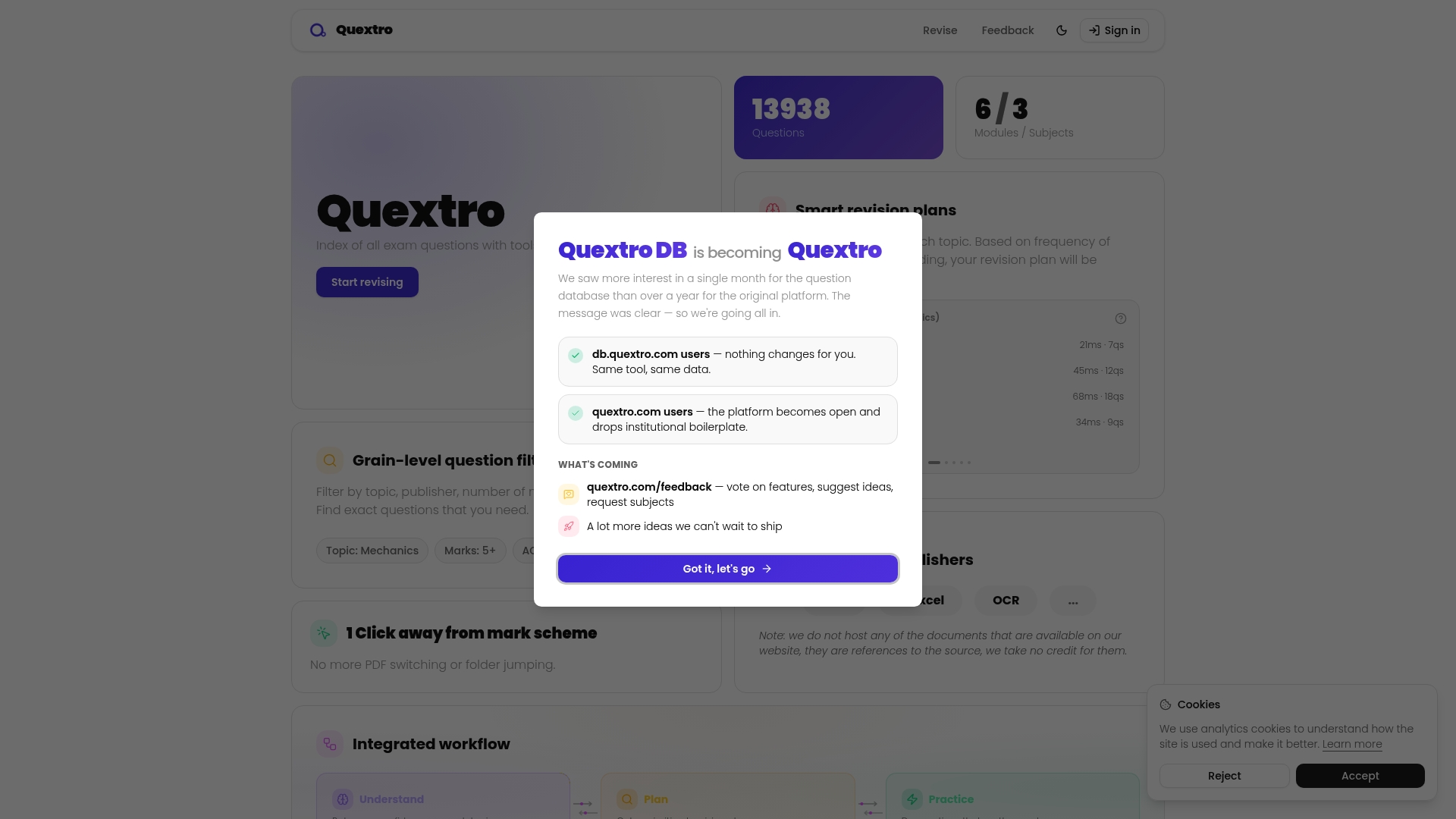
The platform lets you filter questions instantly by multiple criteria, creating custom practice sets that match your revision goals. Track which questions you have attempted, rate your confidence on each topic, and let the system suggest questions targeting your weak areas. Whether you focus on Foundation Mathematics question papers, Pure Mathematics question papers, or Decision Further Mathematics question papers, Quextro provides the structured resources to complement your personal organisation system. Register today to access tailored revision tools designed specifically for A Level exam success.
Ways to organise exam questions: frequently asked questions
How often should I update my organised question sets?
Update your question bank monthly to add newly released past papers and remove questions on fully mastered topics. Perform a major review at the start of each term to realign your organisation with current syllabus focus and upcoming mock exams. Weekly maintenance sessions keep the system functional without becoming a revision distraction itself.
Should I organise questions by topic or difficulty first?
Start with topic organisation because it mirrors your syllabus structure and makes initial setup intuitive. Within each topic folder or binder section, add difficulty subdivisions once you have collected enough questions. This two-tier approach balances findability with skill progression, letting you drill specific concepts at appropriate challenge levels.
What digital tools work best for filtering exam questions efficiently?
Cloud storage with robust search functions like Google Drive or OneDrive handles basic filtering through filename conventions. Dedicated spreadsheet software like Excel or Google Sheets enables advanced multi-criteria filtering when you add metadata columns. For maximum power, platforms like exam question filtering guide offer purpose-built tools with pre-tagged questions and smart recommendation algorithms.
Are physical notes still useful when digital tools exist?
Physical notes remain valuable for active recall and exam simulation. Handwriting solutions engages different cognitive processes than typing, strengthening memory formation. Print questions for timed practice sessions under exam conditions, then digitise your annotated solutions to maintain a complete performance record combining both methods' strengths.
How do I integrate mark schemes with my question organisation?
Store mark schemes in the same folder structure as questions, using identical naming conventions with a suffix like MarkScheme. For spreadsheet systems, add a column linking directly to the relevant mark scheme file. Physical binders benefit from a dedicated mark scheme section with matching question numbers, or print schemes on the reverse of question sheets for immediate reference during self-marking.
Should I organise questions from all exam boards or focus on mine?
Prioritise questions from your specific exam board first because they match your exam format and marking style exactly. Once you have thoroughly covered your board's past papers, add questions from other boards on topics where you need extra practice. Different boards phrase questions uniquely, exposing you to varied problem-solving approaches that deepen understanding beyond single-board familiarity.