

Many A Level maths students believe that mastering content guarantees high marks, yet countless capable students lose marks through incomplete reasoning or poor notation. The difference between a B and an A often hinges not on knowing more maths, but on understanding exactly what examiners reward. Exam criteria define the specific standards examiners use to allocate marks, from logical justification to algebraic notation. By learning to think like an examiner and aligning your answers with these precise expectations, you can maximise every mark opportunity and approach exams with genuine confidence.
Table of Contents
- What Are Exam Criteria And Why Do They Matter?
- Common Errors Revealed By Examiner Reports And How Criteria Help Avoid Them
- How Mastering Exam Criteria Leads To Higher Grades And Exam Confidence
- Practical Strategies To Use Exam Criteria For Effective Revision And Exam Preparation
- Frequently Asked Questions About Understanding Exam Criteria
Key takeaways
| Point | Details |
|---|---|
| Exam criteria reveal marking standards | They detail exactly what examiners look for in reasoning, notation, methods and conclusions for each question. |
| Mark schemes show point-by-point rewards | Studying mark schemes before attempting questions helps you predict required points and improve exam technique. |
| Examiner reports expose common mistakes | Reports highlight recurring errors like incomplete reasoning and poor notation, providing insights into what loses marks. |
| Criteria fluency links to top grades | Understanding all criteria is vital for achieving A and A* grades, especially in proofs and multi-step algebra. |
| Strategic resource use improves performance | Iterative practice with past papers, mark schemes and examiner reports aligned with criteria sharpens exam skills. |
What are exam criteria and why do they matter?
Exam criteria define the exact skills and knowledge examiners assess in each question, offering a blueprint for how marks are allocated. They provide clarity on what constitutes a complete answer, from showing full reasoning to using correct notation and addressing every part of multi-step problems. Understanding these criteria allows you to tailor your answers to meet specific requirements rather than hoping your working happens to match examiner expectations.
Mark schemes exemplify criteria by showing how examiners reward answers point by point. Each mark is assigned for demonstrating a particular skill or reaching a specific milestone in your solution. Practitioners recommend studying mark schemes before attempting questions to predict required points, improving exam technique and performance in multi-step problems. This proactive approach transforms mark schemes from post-mortem tools into strategic guides that inform your thinking before you write.
Common criteria elements include:
- Showing full logical reasoning for each step, especially in proofs
- Writing neat, consistent mathematical notation throughout
- Addressing all parts of multi-step problems explicitly
- Justifying conclusions with reference to earlier working
- Using correct terminology and symbols as specified by the exam board
Ignoring criteria often leads to lost marks despite knowing the maths perfectly. You might solve a problem correctly but fail to show sufficient working, or use informal notation where formal symbols are required. Being criteria-fluent gives you a strategic advantage in exam technique because you understand not just what answer to reach, but how to present it for maximum marks. This awareness helps you allocate time efficiently, focusing effort on the elements examiners actually reward rather than unnecessary elaboration.
Pro Tip: Before starting any past paper question, spend 30 seconds scanning the mark scheme to identify how many marks are available and what key steps or justifications the examiner expects. This primes your brain to structure answers that meet criteria from the outset, reducing the need for corrections and improving your exam question strategies.
Common errors revealed by examiner reports and how criteria help avoid them
Examiner reports provide empirical evidence of where students consistently lose marks, offering invaluable insights beyond the syllabus content. Examiner reports highlight recurring errors like incomplete reasoning, poor notation, and rushing 'show that' questions, providing empirical insights into edge cases across AQA, Edexcel, OCR. These reports identify patterns: students often skip intermediate steps in proofs, mix notation conventions within a single answer, or fail to justify why a particular method applies to a given problem.
These errors cause loss of easy marks that criteria explicitly reward. A typical mistake involves writing a correct final answer but omitting the logical chain that connects given information to that conclusion. Examiners cannot award method marks if working is absent or incomplete, even when the final result is correct. Understanding criteria guides you to show full reasoning and correct notation as expected, treating each mark as an opportunity that requires specific evidence in your answer.
Frequent pitfalls include:
- Failing to justify each step in a 'show that' question, assuming the examiner will infer missing logic
- Mixing notation conventions, such as switching between exact and decimal forms without explanation
- Rushing through multi-part questions and missing sub-questions entirely
- Writing conclusions without referencing earlier working or given information
- Using informal language where mathematical terminology is required
Mark schemes and examiner reports pinpoint exactly what is missing in partial answers, making them diagnostic tools for improvement. For example, an examiner report might note that students lost marks in a particular AQA exam question by failing to state a key assumption before applying a formula. This specific feedback tells you precisely what criteria you need to address in future attempts.
"Candidates who demonstrated full working and clear notation consistently scored higher, while those who presented only final answers or incomplete reasoning lost marks even when their mathematical understanding was sound."
Learning from examiner reports gives critical insights into examiner expectations that go beyond simply knowing the maths. Being aware of these common faults empowers you to answer questions more confidently and correctly, treating each criterion as a checklist item to verify before moving to the next question. This systematic approach reduces careless errors and ensures you capture every available mark.
How mastering exam criteria leads to higher grades and exam confidence
Top A and A* grades often depend on full justification and algebraic fluency rewarded by exam criteria, not just on knowing advanced content. Grade boundaries vary by board and year (e.g., AQA A Level Maths 2024: 74% for A; Edexcel 68%), emphasising need to maximise every mark via criteria understanding. These narrow margins mean that dropping just a few marks through incomplete working or poor notation can shift you down a grade boundary, making criteria mastery essential for achieving your target grade.

Clear knowledge of marking criteria helps ensure no easy marks are dropped through incomplete answers. Students who master criteria tend to write answers that meet examiner expectations holistically, addressing reasoning, notation and structure in every response. This comprehensive approach increases confidence because you know exactly what constitutes a complete answer rather than guessing whether your working is sufficient.
| Exam Board | A Grade Boundary (%) | A* Grade Boundary (%) | Key Criteria Focus | | --- | --- | --- | | AQA | 74 | 82 | Full reasoning in proofs, clear notation | | Edexcel | 68 | 77 | Multi-step justification, algebraic fluency | | OCR | 71 | 80 | Logical structure, terminology precision | | CIE | 73 | 85 | Complete working, assumption statements |
Skillful application of criteria is especially important in questions involving proofs and multi-step reasoning, where each logical link must be explicit. These questions often carry high mark allocations and reward methodical, criteria-aware answers. Knowing what precise criteria are assessed helps allocate time efficiently in exams, focusing on key mark opportunities rather than spending excessive time on elements that carry fewer marks.
The table illustrates different thresholds across major exam boards, highlighting that criteria understanding is universal even though specific boundaries vary. Each board rewards similar fundamental skills: clear reasoning, correct notation, complete justification. Students who align their exam question strategies with these criteria consistently perform better because they meet examiner expectations systematically.
Pro Tip: After completing a practice paper, calculate your percentage score and compare it to the grade boundaries for your exam board. Identify which questions you lost marks on despite understanding the content, then review the mark scheme to see which criteria you missed. This targeted analysis reveals exactly where criteria awareness can boost your grade, turning near-misses into secure marks.
Practical strategies to use exam criteria for effective revision and exam preparation
Incorporating mark schemes and examiner reports into daily revision helps you understand criteria better and apply them consistently. Rather than treating these documents as afterthoughts, use them as primary learning resources that reveal examiner thinking. Tools like past papers, mark schemes and examiner reports (e.g., Edexcel June 2023) support iterative practice, with focus on weak topics identified via gaps between your answers and criteria expectations.
Use past papers to diagnose strengths and weaknesses related to specific criteria demands. Attempt questions under timed conditions, then analyse your answers against mark schemes to identify patterns in lost marks. Focus revision on weaker areas where criteria are not yet fully met, like algebraic notation consistency or proof structure clarity. This diagnostic approach ensures revision time targets the highest-impact improvements.
Follow this step-by-step revision method integrating exam criteria study:
- Select a past paper question from a topic you find challenging
- Read the mark scheme first to understand what criteria the question assesses
- Attempt the question, consciously addressing each criterion you identified
- Compare your answer to the mark scheme point by point, noting where marks were lost
- Read the examiner report for that paper to understand common mistakes on that question
- Reattempt the question, incorporating insights from the mark scheme and examiner report
- Review your improved answer to confirm all criteria are now met
| Resource | Purpose | Exam Preparation Benefit |
|---|---|---|
| Past papers | Authentic question practice | Familiarises you with question styles and time pressure |
| Mark schemes | Criteria breakdown | Shows exactly what examiners reward in each answer |
| Examiner reports | Common error analysis | Reveals typical mistakes to avoid and criteria often missed |
| Specification documents | Official content outline | Clarifies scope and depth of knowledge required |
Perform iterative practice cycles: attempt questions, check against mark schemes, review examiner reports, reattempt improvements. This cycle embeds criteria awareness into your thinking process, making it automatic rather than something you consciously remember. Using criteria-focused tools improves exam technique and answer precision over time, transforming how you approach every question.
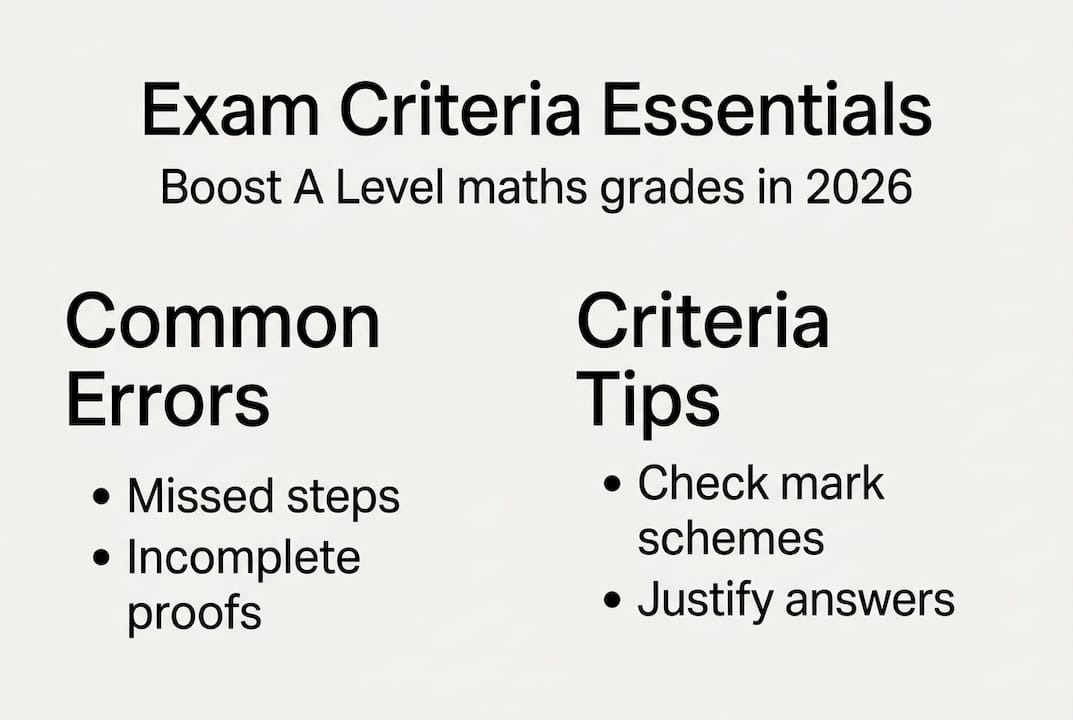
Pro Tip: Create a personal checklist of common exam criteria based on your exam board's mark schemes, such as "state assumptions," "show all working," "use correct notation," and "justify each step." Before submitting any practice answer, run through this checklist to self-assess whether you've met all criteria. This habit ensures you consistently capture marks that others miss through oversight. Combine this with selective exam question practice to target your weakest criteria areas efficiently.
Boost your A Level maths revision with Quextro
Applying exam criteria knowledge requires extensive practice with authentic questions aligned to your exam board. Quextro offers vast collections of A Level maths past papers from AQA, Edexcel, OCR and CIE, providing the raw material to sharpen your criteria-focused exam skills. Access tools tailored to key topics like pure mathematics and statistics to practise applying exam criteria in varied contexts confidently.

Use Quextro's question banks to implement the iterative practice cycles described earlier, filtering by topic, difficulty and exam board to target your specific needs. Flexible practice on Quextro supports continuous learning and exam technique improvement, with integrated workflows that eliminate the need for external PDFs. Track your progress as you master criteria across different question types, building the confidence and precision needed for exam success.
Frequently asked questions about understanding exam criteria
What does 'exam criteria' mean in A Level maths?
Exam criteria are the specific standards and expectations examiners use to allocate marks for each question. They define what skills, knowledge and presentation elements your answer must demonstrate to earn each available mark. Understanding these criteria helps you structure answers that meet examiner expectations precisely.
How can I use mark schemes to understand exam criteria better?
Read mark schemes before attempting questions to identify what the examiner expects in a complete answer. Compare your practice answers to mark schemes point by point, noting where you met or missed criteria. This comparison reveals patterns in how marks are awarded, helping you internalise criteria for future questions.
Why do examiners deduct marks for incomplete reasoning?
Examiners can only award marks for evidence they can see in your written answer. Incomplete reasoning means you haven't demonstrated the logical steps or justifications that specific criteria require, even if you understand the maths mentally. Showing full working ensures you capture all available method marks, not just the final answer mark.
How often should I review examiner reports during exam prep?
Review examiner reports after completing each past paper to understand common mistakes on specific questions. Make this part of your regular revision cycle, ideally weekly, to continuously refine your understanding of what examiners reward. Focus particularly on reports for papers you found challenging, as these highlight criteria you may be missing.
Can mastering exam criteria boost my confidence in exams?
Absolutely. Knowing exactly what examiners look for removes uncertainty about whether your answer is sufficient. This clarity allows you to answer exam questions effectively with confidence, focusing mental energy on solving problems rather than worrying about presentation. Criteria mastery transforms exam anxiety into systematic execution.
What's the most efficient way to learn exam criteria?
Combine active practice with immediate feedback by attempting questions, checking mark schemes, and reattempting with improvements. Create a personal criteria checklist based on your exam board's patterns and use it to self-assess every practice answer. This iterative approach embeds criteria awareness faster than passive reading of mark schemes alone.