

Many students think an exam notebook is simply a place to jot down random notes during revision. That misconception leads to cluttered, unhelpful study materials that fail to target the specific demands of A Level maths exams. An exam notebook is actually a curated, personalised collection of past exam questions with your own worked solutions and reflections. This guide will show you exactly what an exam notebook is, how to build one effectively, and why it transforms your revision from passive reading into active, exam-focused practice that directly improves your performance.
Table of Contents
- Key takeaways
- What is an exam notebook and why is it valuable?
- How to structure your exam notebook for A Level maths success
- Comparing exam notebooks with other revision resources
- Tips for using your exam notebook to maximise A Level maths exam performance
- Enhance your revision with Quextro's exam question database
- Frequently asked questions about exam notebooks
Key Takeaways
| Point | Details |
|---|---|
| Purpose and scope | It is a personalised collection of past exam questions with your own solutions and reflections, centred on practising actual exam style problems rather than general notes. |
| Active exam practice | By working through questions under authentic exam conditions you build familiarity with wording, mark schemes and time pressure, reducing anxiety and improving performance. |
| Structure for success | Organise the notebook by Pure Mathematics, Statistics and Mechanics, include a formula sheet and the mark scheme for immediate self assessment. |
| Practical setup tips | Date each entry, leave generous space for working and annotated mistakes, add the mark scheme and select past questions from your exam board to focus revision. |
What is an exam notebook and why is it valuable?
An exam notebook is your personalised compilation of past exam questions paired with your worked solutions, annotations, and reflections. Unlike general revision notes that summarise theory, an exam notebook centres entirely on practising actual exam-style problems. Think of it as your own version of a CGP workbook, where you add solutions and learn from mistakes. This approach mirrors how professional athletes review game footage to improve performance.
The value lies in active engagement with exam formats. When you work through questions in your notebook, you encounter the exact phrasing, mark allocations, and difficulty levels you'll face in the actual exam. This familiarity reduces anxiety and sharpens your ability to recognise question types instantly. You're not just memorising formulas; you're training your brain to apply them under exam conditions.
Exam notebooks also reveal patterns in your performance. After attempting multiple questions on integration or probability, you'll spot recurring mistakes or topics that consistently trip you up. This self-awareness lets you target revision precisely where it matters most, rather than wasting time on areas you've already mastered. The notebook becomes a diagnostic tool that adapts to your specific needs.
For A Level maths students, this targeted practice is essential because exams reward technique as much as knowledge. You might understand calculus perfectly but still lose marks through poor exam technique like missing units or misreading questions. Your exam notebook captures these mistakes in real time, creating a personalised error log you can review before the exam. This process of organising exam questions effectively transforms random practice into strategic preparation.
"An exam notebook turns passive revision into active problem-solving, building the muscle memory needed for exam success."
The key benefits include:
- Realistic exam practice that mirrors actual test conditions
- Immediate feedback through self-marking against mark schemes
- Personalised error tracking to identify weak areas
- Improved time management through timed question sessions
- Confidence building as you master question types
How to structure your exam notebook for A Level maths success
Creating an effective exam notebook requires deliberate organisation that mirrors the A Level maths syllabus structure. Start by dividing your notebook into clear sections matching the main content areas: Pure Mathematics, Statistics, and Mechanics. This division lets you target specific topics during revision sessions without flipping through unrelated material.
Follow this step-by-step approach to build your notebook:
- Create topic dividers using tabs or colour-coded pages for Pure, Statistics, and Mechanics sections.
- Add a formula sheet at the start of each section listing key equations and theorems you'll need.
- Select past exam questions from your exam board, focusing on topics you find challenging or frequently tested.
- Leave generous space below each question for your working, allowing room to annotate mistakes later.
- Include the mark scheme on a facing page or folded insert so you can self-assess immediately after attempting the question.
- Date each entry to track when you practised specific topics and monitor improvement over time.
- Reserve final pages for a master list of common errors and topics needing further practice.
The CGP workbook model provides an excellent template for this structure. These workbooks organise questions by topic with clear mark schemes, and your personal notebook should replicate this clarity whilst adding your unique insights and annotations.
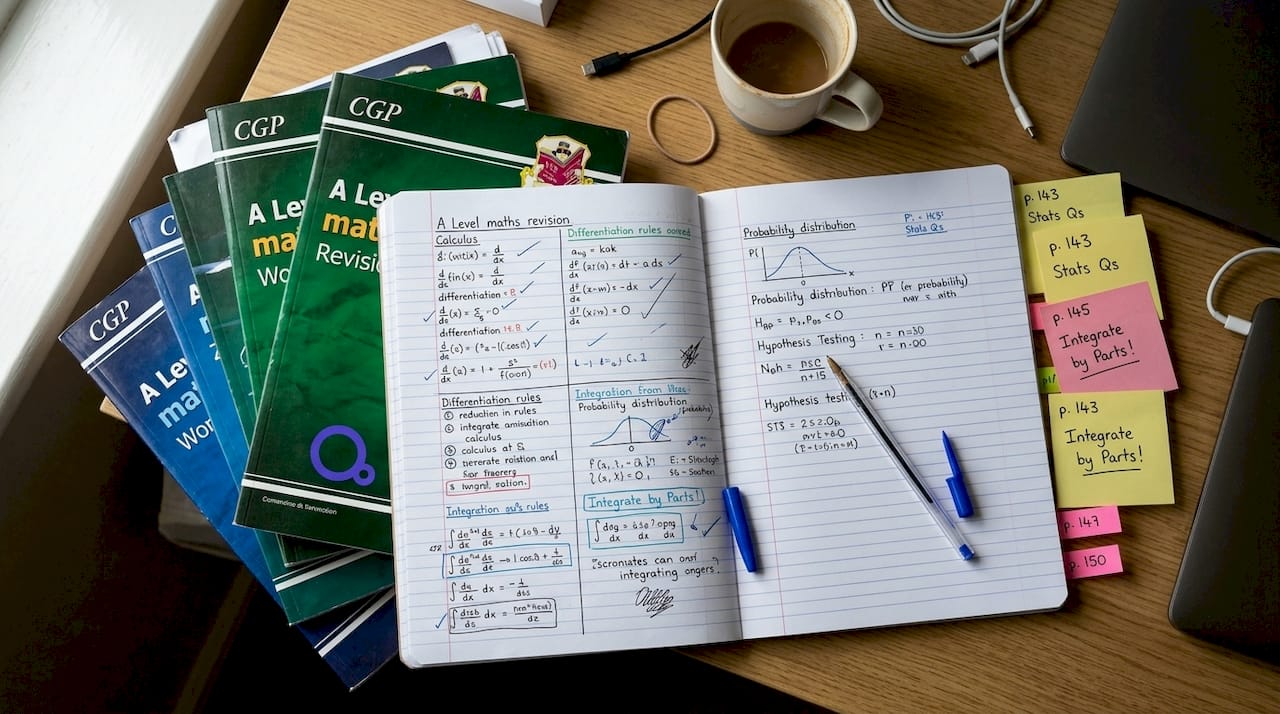
Colour-coding enhances navigation significantly. Use one colour for Pure topics like calculus and algebra, another for Statistics concepts, and a third for Mechanics problems. This visual system lets you locate specific topics in seconds during revision sessions. Some students add sticky notes flagging particularly challenging questions they want to revisit.
Regular updates keep your notebook relevant. After each practice paper or homework assignment, add questions that challenged you or revealed gaps in understanding. This ongoing curation ensures your notebook evolves with your learning, always focusing on areas needing attention rather than becoming a static collection of random problems.
Pro Tip: Create a quick-reference index on the inside cover listing page numbers for each major topic. This simple addition saves valuable time when you need to find specific question types during intensive revision periods.
Your notebook should also include space for reflection. After completing a question, write a brief note about what made it difficult or what concept you need to review. These annotations become invaluable when you revisit the notebook weeks later, immediately reminding you of your thought process and learning needs. This structured approach aligns perfectly with an exam preparation checklist that emphasises systematic, targeted revision.
Comparing exam notebooks with other revision resources
Understanding how exam notebooks fit within your broader revision toolkit helps you allocate study time effectively. Each resource serves distinct purposes, and recognising these differences prevents redundant effort whilst maximising learning efficiency.
| Resource type | Primary focus | Best used for | Limitations |
|---|---|---|---|
| Exam notebooks | Active problem-solving with past questions | Practising exam technique and timing | Requires initial time investment to curate questions |
| General revision notes | Theory, concepts, and formula summaries | Understanding foundational principles | Limited exam-style practice |
| CGP workbooks | Structured question practice with answers | Guided learning and topic introduction | Generic content not personalised to your weaknesses |
| Textbooks | Comprehensive theory with worked examples | Deep conceptual understanding | Often lack sufficient exam-style questions |
| Past papers | Full exam simulation | Assessing overall readiness | Don't isolate specific weak topics |
Exam notebooks occupy a unique middle ground between theory and full exam simulation. General revision notes help you understand concepts like differentiation or probability distributions, but they don't train you to apply these concepts under exam pressure. Your exam notebook bridges this gap by providing focused practice on specific question types.
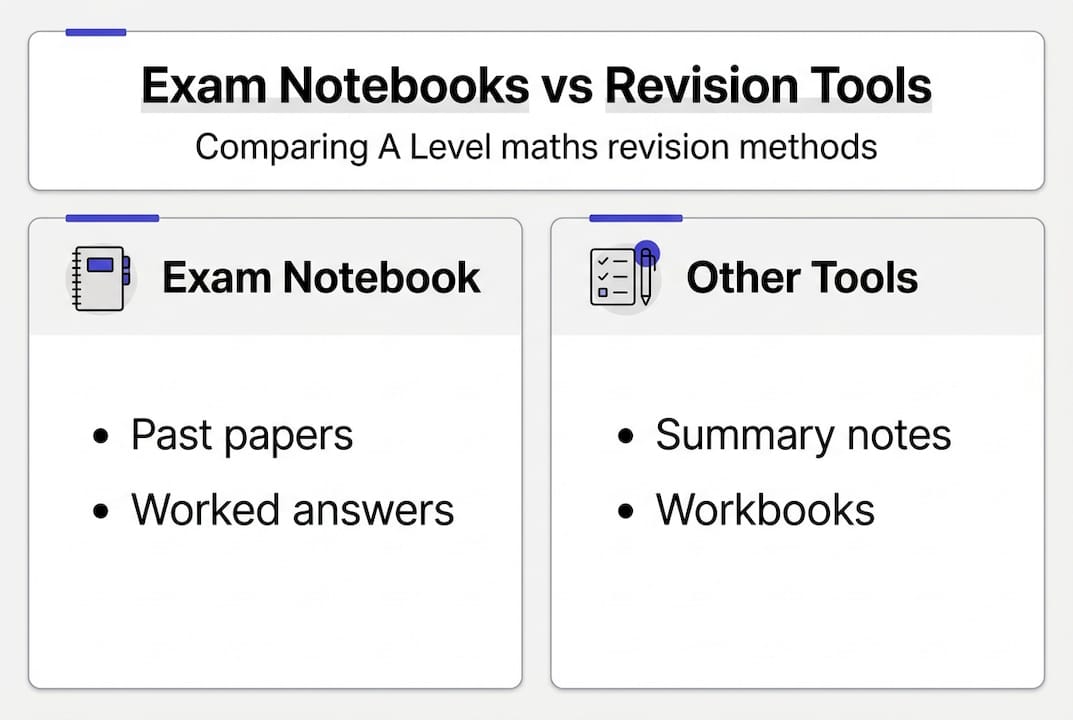
CGP workbooks offer structured question sets that work brilliantly as source material for your personal notebook. The key difference is personalisation: whilst a CGP workbook presents questions in a fixed order for all students, your exam notebook contains only questions relevant to your specific learning needs. You might skip topics you've mastered and triple down on areas causing difficulty.
The active nature of exam notebooks sets them apart from passive revision methods. Reading through worked examples in a textbook creates an illusion of understanding because the solution is already visible. When you attempt questions in your exam notebook, you confront gaps in knowledge immediately. This active recall strengthens memory far more effectively than passive review.
Combining resources strategically yields the best results:
- Use textbooks and revision notes to build foundational understanding of new topics
- Practise applying concepts through your exam notebook's curated questions
- Identify weak areas from notebook performance and return to notes for targeted review
- Complete full past papers periodically to assess overall exam readiness
- Update your notebook with challenging questions from past papers
This integrated approach ensures you're not just collecting study materials but actively using them to improve performance. Your exam notebook becomes the central hub connecting theory from notes with practical application through answering exam questions effectively. The notebook's personalised nature means it grows increasingly valuable as you add more questions and reflections, unlike static printed resources that remain unchanged.
Tips for using your exam notebook to maximise A Level maths exam performance
Owning an exam notebook means nothing without strategic usage that translates practice into improved exam performance. These actionable strategies ensure your notebook becomes a powerful revision tool rather than just another collection of notes gathering dust.
Implement timed practice sessions that simulate real exam conditions. Set a timer matching the marks-to-minutes ratio your exam board uses (typically one mark per 1.5 minutes for A Level maths). Attempt questions from your notebook under these time constraints without checking notes or mark schemes. This practice builds the time management skills essential for completing exams within the allocated period.
Review mistakes with brutal honesty. When you get a question wrong, don't just glance at the mark scheme and move on. Write out the correct solution in your own words, explaining each step as if teaching someone else. This process forces deeper engagement with the material and cements understanding. Identify whether mistakes stemmed from conceptual misunderstanding, calculation errors, or misreading the question.
Create a dedicated "frequent mistakes" section at the back of your notebook. After each practice session, log common errors like forgetting to convert units, dropping negative signs, or misapplying formulas. Before your exam, review this section to prime your brain to avoid these pitfalls. This meta-awareness of your error patterns is incredibly valuable.
Pro Tip: Use different coloured pens for your first attempt versus corrections. This visual distinction lets you quickly see where you struggled initially and track improvement when you reattempt questions weeks later.
Balance question difficulty to build both confidence and skills. Include easier questions you can complete quickly to maintain momentum and harder questions that stretch your abilities. This mix prevents frustration from constant struggle whilst ensuring you're not just practising problems you've already mastered. Aim for roughly 60% questions at your current level and 40% slightly above.
Pair your notebook practice with formula sheets and summary notes. Before attempting questions on a topic, spend five minutes reviewing relevant formulas and key concepts. This warm-up primes your memory and reduces the cognitive load during problem-solving. Keep these summary sheets accessible whilst working through notebook questions initially, then gradually wean yourself off them as confidence builds.
Schedule regular notebook review sessions separate from new question practice. Every two weeks, revisit questions you attempted previously and reattempt them without looking at your original solutions. This spaced repetition strengthens long-term retention and reveals whether you've genuinely mastered topics or just memorised specific solutions.
The strategies for choosing practice questions and following an exam preparation checklist complement your notebook usage perfectly. Your notebook isn't a standalone tool but part of a comprehensive revision system.
Key usage principles:
- Practise questions before looking at solutions to engage active recall
- Annotate mistakes immediately whilst the reasoning is fresh
- Reattempt difficult questions after targeted revision of underlying concepts
- Track performance metrics like accuracy and time taken per question
- Use notebook insights to guide where you invest additional study time
Your exam notebook's true power emerges through consistent, deliberate practice. Fifteen minutes daily with your notebook beats sporadic marathon sessions because regular engagement maintains momentum and prevents knowledge decay. The CGP workbook approach of systematic practice applies perfectly to your personal notebook: little and often, with immediate feedback, builds the exam confidence and competence you need.
Enhance your revision with Quextro's exam question database
Building a comprehensive exam notebook requires access to high-quality past exam questions across all A Level maths topics. Quextro's exam questions database provides exactly this resource, offering over 13,955 past exam questions from major exam boards including AQA, Edexcel, OCR, and CIE. This extensive collection lets you find targeted questions for any topic you need to practise, whether you're strengthening weak areas or maintaining proficiency in topics you've mastered.
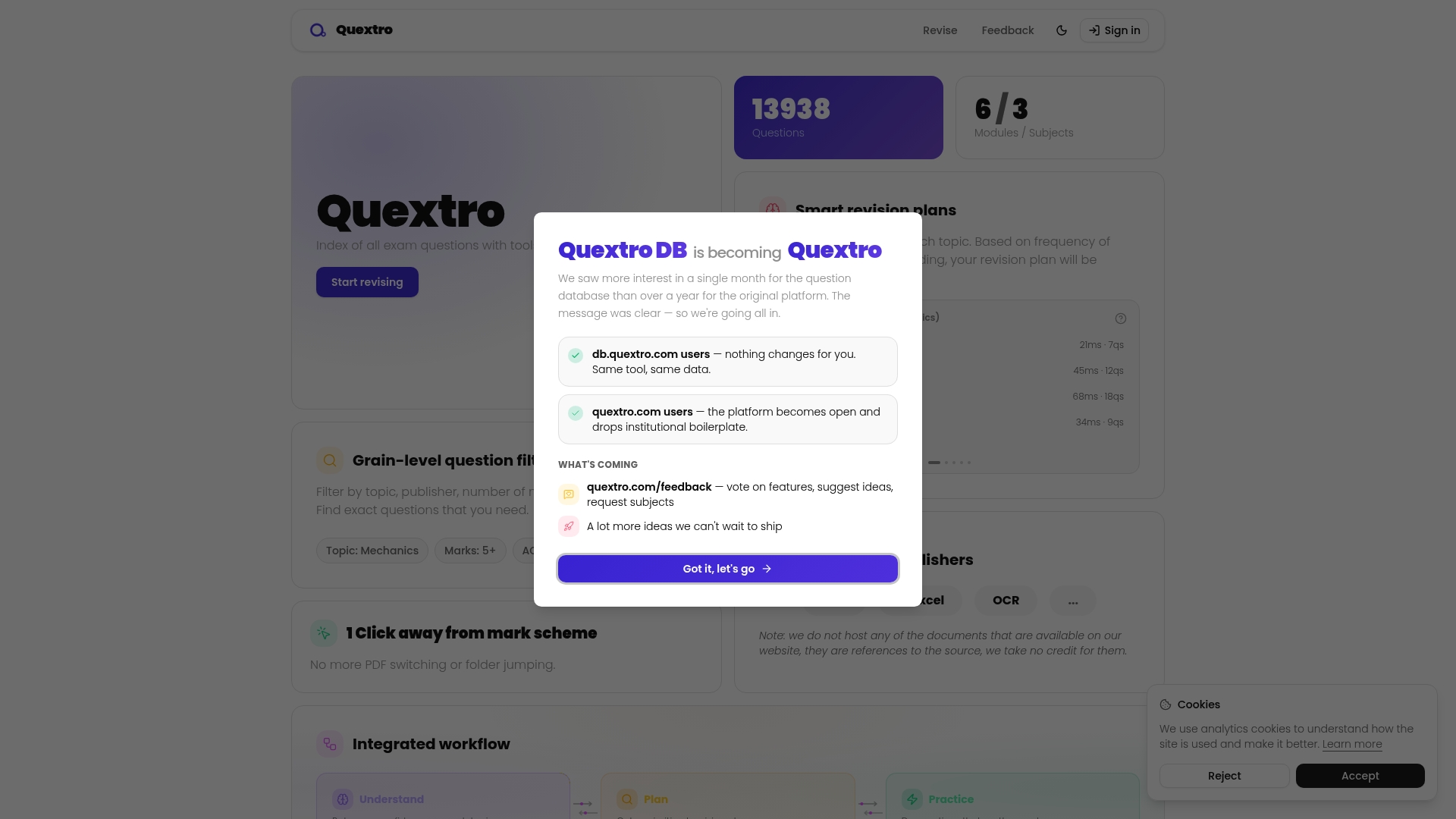
The platform's filtering system helps you select questions by topic, difficulty, publisher, and marks, making it simple to curate content for your exam notebook. Instead of manually searching through dozens of past papers, you can instantly locate questions on specific topics like integration techniques or probability distributions. This efficiency means more time actually practising and less time hunting for suitable questions. Quextro's foundation maths papers and questions and statistics maths papers and questions provide comprehensive coverage across the entire A Level syllabus, ensuring your exam notebook addresses all potential exam content.
Frequently asked questions about exam notebooks
What exactly should I include in an exam notebook?
Include past exam questions from your specific exam board, your worked solutions, mark schemes for self-assessment, and annotations about mistakes or difficult concepts. Focus on questions that challenge you rather than those you find easy, and organise by topic matching your syllabus structure for efficient navigation.
How often should I update or review my exam notebook?
Add new questions weekly as you identify topics needing practice, and review previous attempts every two weeks using spaced repetition. Before your exam, increase review frequency to every few days, focusing on your logged common errors and challenging questions that initially stumped you.
Can I use an exam notebook during the actual exam?
No, exam notebooks are revision tools only and cannot be taken into the exam hall. However, the practice and familiarity you gain from using your notebook will be stored in your memory, improving your performance when you sit the actual exam without any materials.
How do exam notebooks improve time management in exams?
Practising timed questions in your notebook trains you to recognise how long different question types should take based on their mark allocation. This experience helps you pace yourself during the real exam, knowing when to move on from a difficult question and return to it later if time permits.
Are digital exam notebooks as effective as paper ones?
Both formats work well, but paper notebooks often feel more natural for mathematical working and diagrams. Digital notebooks offer easier reorganisation and searchability. Choose based on your personal preference, but ensure whichever format you select allows easy annotation and review of your solutions. Many students find the physical act of writing by hand aids memory retention, making paper notebooks particularly effective for maths revision following an exam preparation checklist approach.