

Many students believe that all topics carry equal weight when preparing for A Level maths exams. This assumption leads to scattered revision that wastes precious time on less critical areas. High-frequency exam topics appear repeatedly across past papers and represent the concepts exam boards prioritise most. Understanding which topics recur most often allows you to focus your revision strategically, maximising your performance potential. This guide explains what high-frequency topics are, how to identify them through exam question pattern analysis, and how to build a revision plan that prioritises these crucial areas without neglecting the broader syllabus.
Table of Contents
- Key takeaways
- Understanding high-frequency exam topics in A Level maths
- How to identify high-frequency topics in your A Level syllabus
- Comparing high-frequency and less-common exam topics
- Applying knowledge of high-frequency topics to your revision plan
- Boost your A Level maths revision with Quextro
- Frequently asked questions
Key Takeaways
| Point | Details |
|---|---|
| High frequency topics | High frequency topics are those that appear most often across past papers and should form the core of revision. |
| Past paper analysis | Use past paper analysis to identify which topics recur and how many marks they typically carry. |
| Weighted revision planning | Allocate revision time in proportion to topic frequency and typical mark allocation. |
| Targeted practice builds confidence | Targeted practice builds confidence by exposing you to familiar question structures. |
Understanding high-frequency exam topics in A Level maths
High-frequency exam topics are those mathematical concepts and question types that appear most consistently across multiple examination series. Exam papers follow predictable patterns with certain topics recurring regularly, reflecting both curriculum emphasis and deliberate exam design strategies. Exam boards construct papers to assess core competencies thoroughly, which means foundational topics receive more attention than peripheral concepts.
Common high-frequency topics in A Level maths include calculus (differentiation and integration), algebraic manipulation, trigonometric identities and equations, coordinate geometry, and statistical distributions. These areas form the backbone of mathematical understanding and appear in various forms across pure mathematics, statistics, and mechanics papers. Recognising these patterns transforms your revision from a broad, unfocused effort into a targeted strategy.
Focusing on high-frequency topics offers several distinct advantages:
- You maximise mark potential by mastering questions that appear most often
- Confidence grows through repeated practice on familiar question structures
- Revision time becomes more efficient when directed towards impactful topics
- Exam anxiety decreases as you recognise question patterns during the test
- Your overall grade improves as you secure marks on the most common questions
The strategic benefit extends beyond simple repetition. When you understand which topics carry the most weight, you can allocate revision hours proportionally. A topic appearing in 40% of papers deserves more attention than one appearing in 5%. This approach does not mean ignoring less common topics entirely, but rather ensuring your preparation reflects the actual distribution of exam content. Smart students work efficiently, not just hard.
How to identify high-frequency topics in your A Level syllabus
Identifying high-frequency topics requires systematic analysis rather than guesswork. Follow this structured approach to pinpoint the topics that matter most:
- Access a comprehensive database of past papers covering at least three to five years of examination series
- Create a spreadsheet listing all syllabus topics as rows and exam series as columns
- Review each past paper and mark which topics appear, noting the number of marks allocated
- Calculate the frequency percentage by dividing topic appearances by total papers examined
- Rank topics by both frequency and average mark allocation to identify priority areas
- Cross-reference your findings with the exam board specification to confirm topic weighting
Consistent topic recurrence over multiple exam series can be tracked through databases of past questions, making this analysis far more reliable than intuition alone. When you examine pure mathematics past papers, statistics mathematics past papers, and decision further maths past papers systematically, patterns emerge clearly.

Look for three key indicators when spotting high-frequency topics. First, frequency count measures how often a topic appears across papers. Second, mark weighting shows how many marks that topic typically carries. Third, question theme recurrence reveals whether the same conceptual approaches repeat, even if surface details change. A topic appearing in 70% of papers with an average allocation of 12 marks clearly deserves more attention than one appearing in 20% of papers worth 4 marks.
Pro Tip: Create a colour-coded revision tracker where green highlights topics appearing in over 60% of papers, yellow marks those in 30 to 60%, and red indicates below 30%. This visual system helps you allocate revision time proportionally and ensures you never lose sight of priority areas during the busy weeks before exams.
Comparing high-frequency and less-common exam topics
Understanding the distinction between high-frequency and less-common topics helps you build a balanced yet strategic revision plan. The table below highlights key differences:
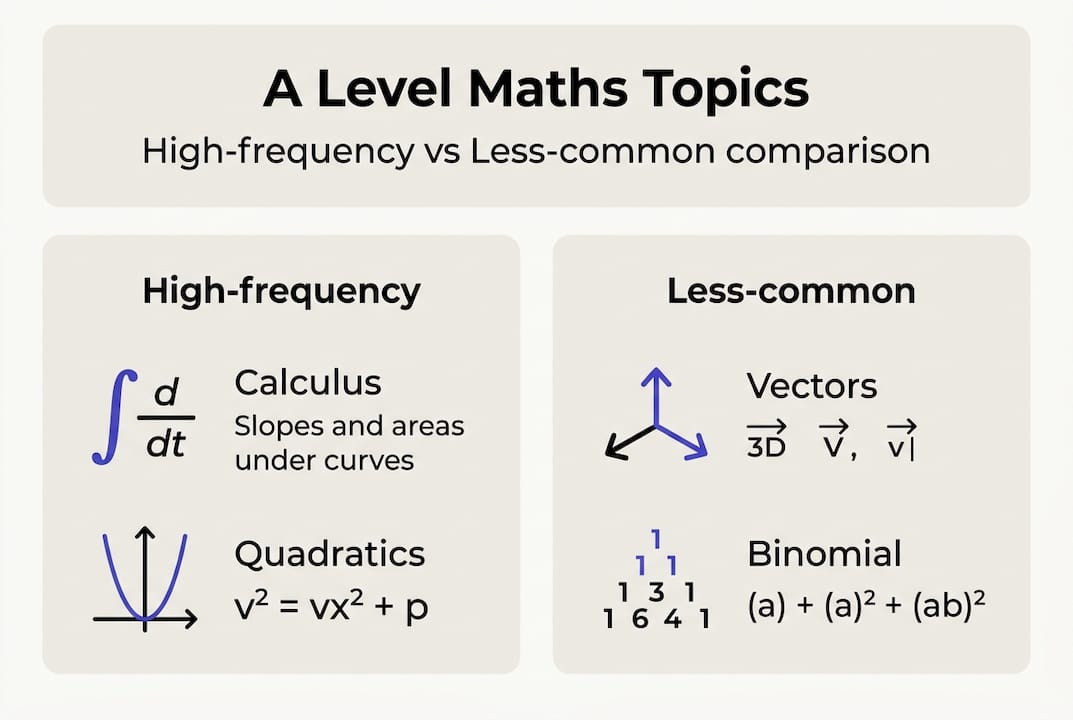
| Feature | High-frequency topics | Less-common topics |
|---|---|---|
| Exam appearance rate | 50% or more of papers | Below 30% of papers |
| Typical mark allocation | 10 to 20 marks per paper | 4 to 8 marks per paper |
| Question variety | Multiple question types and approaches | Limited question variations |
| Revision impact | High return on time invested | Lower but still necessary |
| Confidence building | Repeated practice yields strong familiarity | Occasional practice maintains coverage |
Balanced revision remains crucial to avoid missing out on occasionally tested but important topics. Exam boards occasionally include less-common topics to differentiate between students and assess breadth of understanding. Ignoring these areas entirely creates vulnerability to unexpected questions that could cost valuable marks.
When deciding how much time to allocate, consider these factors:
- Allocate 60 to 70% of revision time to high-frequency topics that appear most often
- Reserve 20 to 30% for moderate-frequency topics that appear occasionally but carry reasonable marks
- Dedicate 10% to less-common topics to maintain comprehensive coverage and avoid surprises
- Adjust proportions based on your current confidence levels in each area
- Prioritise topics where you have knowledge gaps over those you already understand well
Pro Tip: Schedule one revision session every two weeks specifically for less-common topics. This maintains familiarity without diverting excessive time from priority areas. Use this session to work through one or two questions from each less-common topic, keeping your skills sharp across the entire syllabus. This approach ensures you can select exam questions for revision strategically while maintaining comprehensive coverage.
Applying knowledge of high-frequency topics to your revision plan
Translating topic analysis into an effective revision schedule requires deliberate planning. Follow these steps to create a timetable that prioritises high-frequency topics:
- List all high-frequency topics identified through your past paper analysis
- Assess your current confidence level in each topic using a scale from 1 to 5
- Allocate more revision sessions to high-frequency topics where your confidence is lowest
- Schedule regular practice sessions focusing exclusively on these priority areas
- Integrate mixed-topic practice after mastering individual high-frequency topics
- Reserve specific time slots for comprehensive mock exams that test all topics together
Time-efficient revision targeting most impactful topics improves exam success and confidence. When you practise pure mathematics questions and core pure further mathematics papers systematically, you build the muscle memory needed for exam conditions.
Mix topic-focused practice with timed mock exams to simulate real exam pressure. Start with untimed practice to build understanding, then progress to timed sessions that replicate exam conditions. This progression builds both competence and confidence. Track your performance on high-frequency topics specifically, noting which question types cause difficulty and which you handle comfortably.
Revision best practices aligned with targeting high-frequency topics include:
- Practise high-frequency topics at least twice weekly to maintain sharp skills
- Use spaced repetition by revisiting topics at increasing intervals to strengthen long-term retention
- Attempt past paper questions under timed conditions to build exam stamina
- Review mark schemes immediately after practice to understand examiner expectations
- Focus on understanding method over memorisation to handle question variations confidently
- Keep a notebook of common mistakes to avoid repeating errors
Regular review and spaced repetition form the foundation of effective retention. Cramming high-frequency topics the night before exams yields poor results compared to consistent, distributed practice over weeks. Your brain consolidates information more effectively when you revisit material multiple times with gaps in between. Schedule revision sessions for the same high-frequency topic every four to seven days, gradually extending the interval as your confidence grows.
Boost your A Level maths revision with Quextro
Targeting high-frequency exam topics becomes significantly easier when you have access to comprehensive question databases organised by topic and difficulty. Quextro offers over 13,955 past exam questions from major exam boards including AQA, Edexcel, OCR, and CIE, all searchable and filterable to match your revision needs precisely.
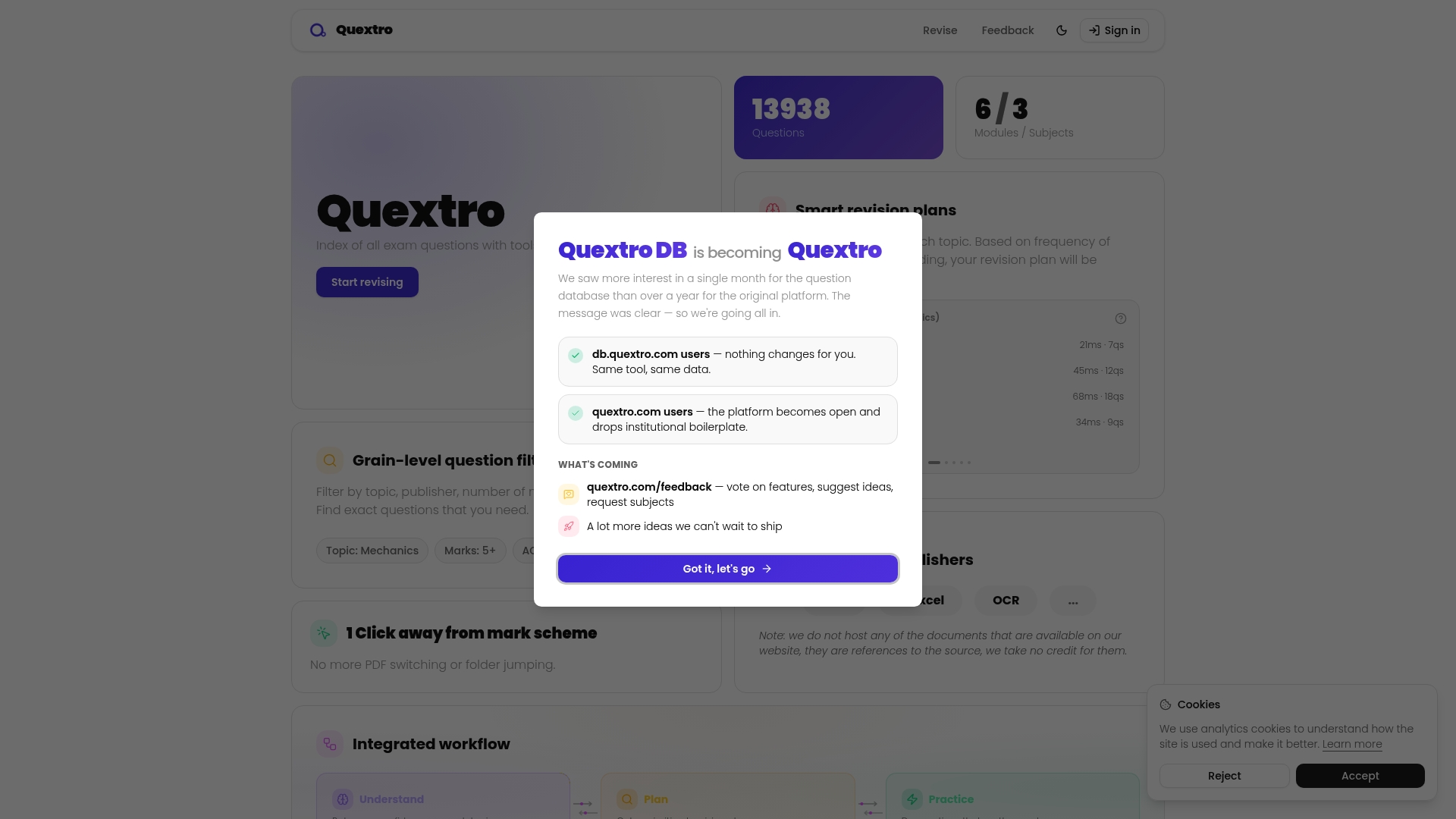
The platform's pure mathematics question database and statistics mathematics question database allow you to focus specifically on high-frequency topics you have identified as priorities. Filter questions by topic, mark allocation, and exam board to create targeted practice sessions that address your weakest areas. The smart revision plans adapt based on your confidence ratings and question frequency, ensuring you spend time where it matters most. Track your progress automatically and build question notebooks that consolidate your revision materials in one accessible location. By integrating Quextro's exam questions database into your revision strategy, you transform abstract planning into concrete, measurable improvement.
Frequently asked questions
What are examples of high-frequency topics in A Level maths?
Common high-frequency topics include differentiation and integration in calculus, solving quadratic and simultaneous equations in algebra, trigonometric identities and equation solving, coordinate geometry including circles and lines, binomial expansion, logarithms and exponentials, vectors, and probability distributions in statistics. These topics appear consistently across examination series because they represent fundamental mathematical skills. The specific topics vary slightly between pure mathematics, statistics, and mechanics modules, but the principle remains consistent.
How can I use past papers to find high-frequency topics?
Review at least ten to fifteen past papers spanning three to five years of exam series. Create a tracking sheet where you mark each topic appearance and note the marks allocated. Calculate the percentage of papers featuring each topic and rank them by frequency. Cross-reference high-frequency topics with mark allocation to identify those offering the best return on revision time. This systematic approach reveals patterns that intuition alone would miss.
Should I ignore less common topics during revision?
No, you should not ignore less common topics entirely, but you should allocate time proportionally. Reserve approximately 10% of your revision schedule for less common topics to maintain comprehensive coverage and avoid being caught off guard by unexpected questions. Focus the majority of your time on high-frequency topics whilst ensuring you have at least basic familiarity with the entire syllabus. Complete neglect of any syllabus area creates unnecessary risk.
What is the benefit of focusing on high-frequency topics?
Focusing on high-frequency topics improves exam confidence because you encounter familiar question types during the test. It increases your mark potential by ensuring you master the questions most likely to appear. Revision becomes more efficient as you direct effort towards areas with the highest probability of appearing. Your overall grade improves because you secure marks on the most common questions, which often form the foundation for achieving higher grade boundaries. Strategic focus does not mean narrow focus, but rather proportional allocation of limited revision time.