

TL;DR:
- Exam topic analysis helps prioritize revision on high-frequency and challenging topics.
- Combining data with personal mock results creates a targeted, efficient revision strategy.
- Using tools and patterns from past papers boosts exam performance and revision focus.
Revising every topic equally feels responsible, but it is one of the least efficient approaches you can take before A Level maths exams. Most students spend hours on topics they already understand while quietly avoiding the areas that trip them up most. Exam topic analysis changes that entirely. By systematically reviewing past papers to identify which topics appear most often, how difficult those questions tend to be, and where your personal performance falls short, you can build a revision strategy that is genuinely targeted. This article walks you through exactly how to do that, with practical steps and real data to back it up.
Table of Contents
- What is exam topic analysis?
- Why exam topic analysis boosts your revision efficiency
- Using data: How topic frequency and question difficulty work
- Practical methodology: Steps to analyse exam topics and track your performance
- The overlooked advantage: Combining tools and intuition for maths revision
- Take your revision further with Quextro's exam topic tools
- Frequently asked questions
Key Takeaways
| Point | Details |
|---|---|
| Targeted revision | Focus your study effort on topics most frequently tested and your weakest areas using topic analysis. |
| Empirical guidance | Use facility and frequency data from tools like AQA QLAPD to identify question difficulty and optimise practice. |
| Performance tracking | Compare your results to national data and track topic gaps to prioritise improvement. |
| Balanced strategy | Combine data-driven tools with personal intuition for the strongest revision outcomes. |
What is exam topic analysis?
Exam topic analysis is not simply flicking through old papers and hoping something sticks. It is a structured process of reviewing past exam questions by topic, frequency, and difficulty level, then using that information to direct your revision time where it matters most. Rather than treating every chapter in your textbook as equally important, you build a picture of what the exam board actually tests, and how often.
The approach works because A Level maths papers are not random. Exam boards follow specification structures, and certain topics appear with remarkable consistency year after year. Once you recognise those patterns, you stop wasting time on low-frequency topics and start investing effort in the areas that carry the most marks.
Here is what a solid exam topic analysis covers:
- Topic frequency: How often does each topic appear across multiple years of papers?
- Question difficulty: What is the national facility score for each question type, meaning how many students answered it correctly?
- Personal performance: Where are your marks consistently dropping compared to the national average?
- Specification alignment: Are you covering topics in the proportion the exam board actually tests them?
As AQA's QLAPD overview explains, exam topic analysis involves systematically reviewing past exam papers to identify topic frequencies, question difficulties, and performance metrics, enabling targeted revision. That is the official framing, and it is a useful one.
"Targeted revision is not about working harder. It is about working on the right things at the right time."
If you are new to this approach, start by analysing exam board questions across at least three years of papers before drawing any conclusions. One year's paper can be misleading. Three or more years reveal genuine patterns.
The key shift in mindset is moving from coverage to prioritisation. Coverage means touching every topic. Prioritisation means knowing which topics to revisit repeatedly because they carry the most weight in the actual exam.
Why exam topic analysis boosts your revision efficiency
The difference between uniform revision and analysis-driven revision is not subtle. It is the difference between spending six weeks reviewing content and spending six weeks improving your exam performance.
Consider calculus. Across Edexcel A Level maths papers, integration and differentiation appear in virtually every single exam. They are not optional topics you can skim. They are load-bearing pillars of the paper. A student who spends proportional time on calculus relative to its frequency will almost always outperform one who treats it as just another chapter.

The table below shows how the two approaches compare:
| Revision approach | Time allocation | Result |
|---|---|---|
| Uniform coverage | Equal time on all topics | Wastes time on low-yield areas |
| Analysis-driven | Weighted by frequency and weakness | Focuses effort where marks are won |
| Hybrid (data plus mocks) | Frequency data combined with personal gaps | Most efficient and personalised |
The Tutopiya analysis of top tested topics confirms that targeted revision prioritises efficiency by focusing on frequently tested topics and personal weaknesses, avoiding uniform coverage. That is not a minor improvement. It is a structural advantage.
When you are using past paper databases to build your frequency picture, patterns become clear quickly. Trigonometry, binomial expansion, and statistical hypothesis testing all appear with high regularity. Knowing this lets you allocate revision sessions with intention rather than instinct.
Pro Tip: Mechanics is consistently underestimated by students who focus heavily on pure maths. In many Edexcel papers, mechanics questions carry significant marks and test conceptual understanding rather than pure calculation. If you are weak on kinematics or Newton's laws, that is a high-value gap to close.
The emotional benefit of this approach is also real. When you know why you are revising a particular topic, and you can see it has appeared in seven of the last ten papers, revision feels purposeful rather than arbitrary.
Using data: How topic frequency and question difficulty work
Data is only useful if you know how to read it. Two metrics matter most in exam topic analysis: topic frequency and national facility.
Topic frequency tells you how often a topic appears across past papers. High-frequency topics like calculus, algebra, and trigonometry deserve more revision time simply because they are more likely to appear. Low-frequency topics are not irrelevant, but they should not dominate your schedule.
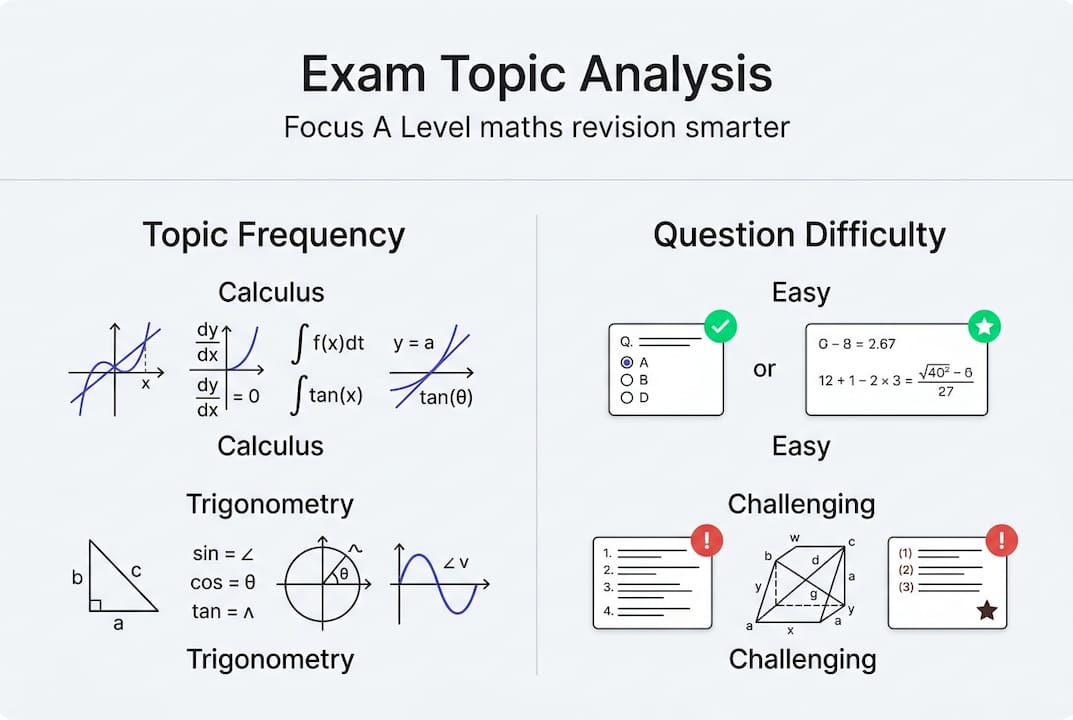
National facility is a percentage score that shows how many students in the national cohort answered a question correctly. A question with a facility of 80% is relatively accessible. A question with a facility of 30% is genuinely hard. This matters because it helps you calibrate your expectations and identify where the exam board is deliberately testing deeper understanding.
Here is how those metrics might look in practice:
| Topic | Frequency (last 5 years) | Approximate national facility |
|---|---|---|
| Calculus (integration) | High (every paper) | 45 to 65% |
| Trigonometric identities | High | 40 to 60% |
| Mechanics (kinematics) | Medium to high | 35 to 55% |
| Numerical methods | Medium | 50 to 70% |
AQA's QLAPD provides data from every exam question since 2017 including national facility, used to select questions by difficulty, topic, or specification for targeted revision. That kind of granular data is genuinely powerful when used well.
However, facility scores are not a perfect predictor of how you will perform. They reflect the national cohort, which includes students at every ability level. Your personal mock results may diverge significantly. The most effective approach combines past paper databases for frequency analysis with your own tracked performance to build a personalised difficulty map.
For additional context on structuring your approach, past paper strategies from specialist revision resources can help you use this data without becoming overwhelmed by it.
The key insight here is that data narrows your focus. It does not replace practice. You still need to sit down and work through questions. But data tells you which questions to prioritise.
Practical methodology: Steps to analyse exam topics and track your performance
Understanding the data is just the start. Applying it methodically is where the real gains are made. Here is a clear process you can follow right now.
-
Categorise past questions by topic. Take at least five years of past papers from your exam board and sort every question into topic categories. Use the specification as your guide. This gives you a raw frequency count per topic.
-
Score each topic by frequency and difficulty. Combine how often a topic appears with its typical facility score. Topics that appear often and have low facility scores are your highest priority. They are both likely to appear and likely to cost you marks.
-
Track your mock performance question by question. After each mock exam, record your marks per question alongside the topic it tested. Over time, patterns emerge. You will see clearly which topics consistently let you down.
-
Prioritise weak, high-frequency topics. Build your revision timetable around this matrix. High frequency plus personal weakness equals urgent priority. Low frequency plus personal strength equals low priority.
As the AQA methodology outlines, the process involves categorising past questions by topic, analysing frequency and difficulty, tracking personal mocks, and prioritising weak or high-frequency topics. The AQA Mock Exam Analyser also uses mock exam data to compare your marks per question against national data, identifying gaps by topic for targeted practice.
Pro Tip: Build a simple spreadsheet with topics along one axis and paper years along the other. Mark each topic as it appears. After five years of data, the high-frequency topics become visually obvious. Add a column for your mock scores per topic and you have a personalised revision dashboard.
For deeper guidance on structuring this process, exam board question analysis and effective maths revision tips from specialist sources can help you refine your approach further.
The overlooked advantage: Combining tools and intuition for maths revision
Here is something most revision guides will not tell you. Data-driven tools are brilliant, but they are not the whole story. Students who rely only on official frequency data sometimes miss something important: their own instincts about where they feel shaky.
Conventional wisdom says trust the data. We say trust the data and trust your gut. When you sit down after a mock and feel that a particular topic did not go well, that feeling is information. It deserves weight alongside the numbers.
The AQA QLAPD approach and student-led gap analysis from past papers are not competing methods. They are complementary. Official tools tell you what the national picture looks like. Your personal mock analysis tells you what your picture looks like. The most effective revision strategy holds both in tension.
Students who combine these two sources of insight tend to revise with far greater precision than those who rely on either alone. The data narrows the field. The intuition sharpens the focus within that field. Together, they create a revision approach that is both evidence-based and genuinely personal.
Take your revision further with Quextro's exam topic tools
If you want to apply everything covered in this article without building every system from scratch, Quextro makes that significantly easier. The platform gives you access to over 13,955 past exam questions from AQA, Edexcel, OCR, and CIE, all filterable by topic, difficulty, and mark allocation.
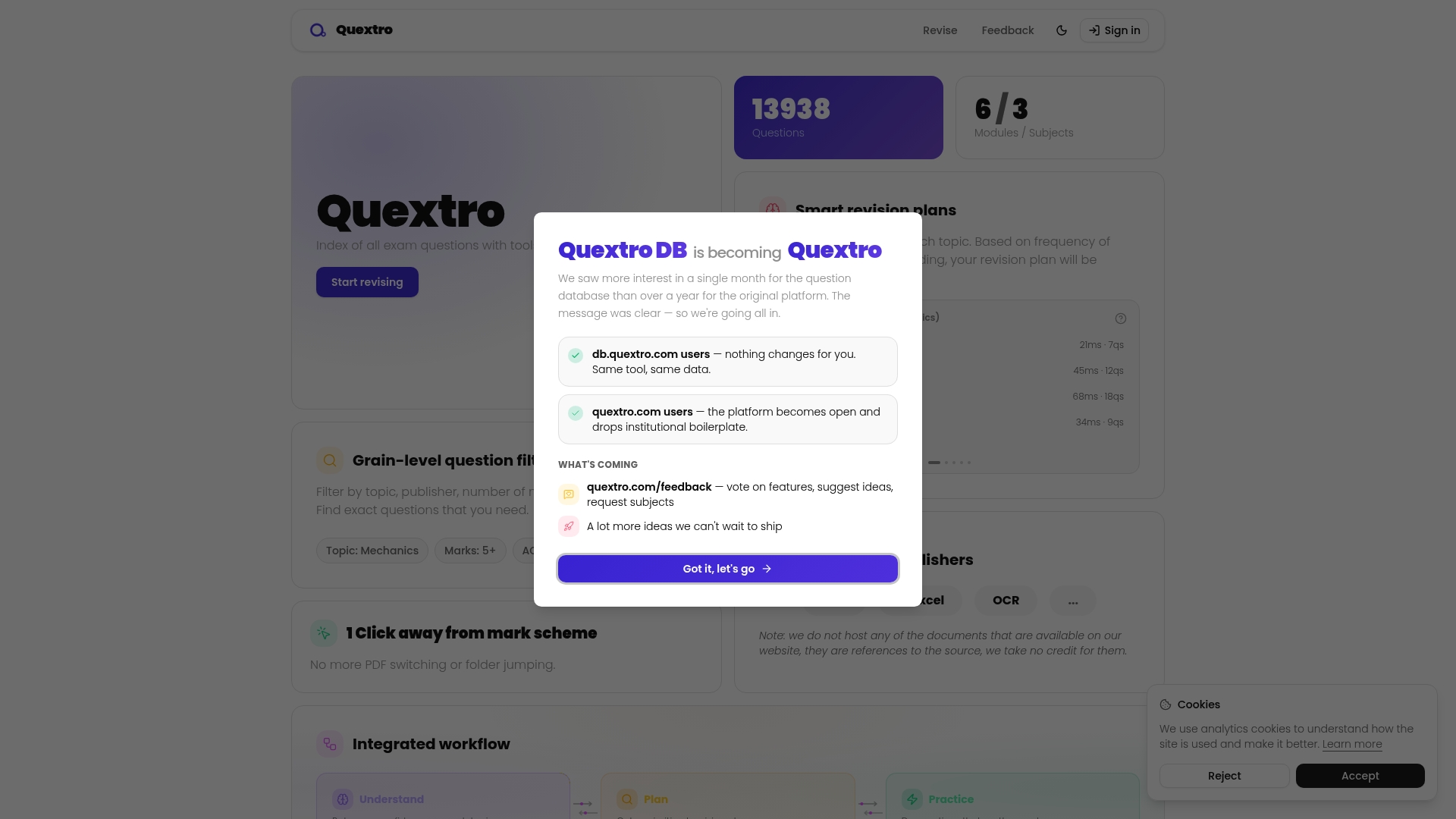
You can work directly through the Edexcel maths question database or focus specifically on the Mechanics question database if that is your gap area. Smart revision plans adapt based on your confidence ratings and question frequency, so your timetable reflects your actual needs. Visit the Quextro revision hub to start building a revision strategy that is genuinely targeted, not just thorough.
Frequently asked questions
How do I identify high-frequency maths topics?
Topic frequency analysis ranks topics by appearance in past papers, and tools like AQA QLAPD make it straightforward to spot which topics such as calculus or mechanics appear most often across years.
Is facility data a reliable guide for exam revision?
Facility data is a useful indicator of question difficulty, but because it reflects the national cohort, it should be combined with your own mock exam results for a more accurate personal picture.
What tools help me track my maths performance?
The AQA Mock Exam Analyser compares your marks against national data by topic, and platforms like Quextro provide integrated progress tracking so you can see exactly where to focus next.
Can I use exam topic analysis for other subjects?
Absolutely. The same principles apply to sciences, economics, and other essay-based subjects by reviewing past papers for recurring question types and high-frequency themes across multiple years.