

Over 80% of A Level maths exams consistently test the same handful of topics. That single fact changes everything about how you should revise. Most students spend hours grinding through random past papers, hoping coverage alone will carry them through. But the students who consistently hit top grades are not working harder. They are working with a clearer map. This guide explains exactly how to analyse exam question patterns, which topics to prioritise, and how to turn that analysis into a structured, efficient revision strategy that genuinely moves the needle on your results.
Table of Contents
- What does it mean to analyse exam question patterns?
- The evidence: How pattern analysis improves results
- Identifying high-frequency topics and examiner trends
- Using mark schemes and error analysis to sharpen your strategy
- Choosing the right exam questions for efficient revision
- Why most students still overlook pattern analysis for maths revision
- Take the next step: smarter revision with curated exam question databases
- Frequently asked questions
Key Takeaways
| Point | Details |
|---|---|
| Pattern analysis boosts results | Focusing on exam question patterns improves grades significantly compared to unfocused revision. |
| Recent papers matter most | Use past papers from the last 3–5 years for the most exam-relevant experience. |
| Mark schemes and errors | Studying mark schemes and tracking mistakes sharpens answer technique and fixes weaknesses. |
| High-frequency topic focus | Prioritise topics and questions that appear most often for maximum revision efficiency. |
What does it mean to analyse exam question patterns?
As you consider how exam content is structured, it is vital to clearly define what true analysis involves and why it is more powerful than generic past-paper practice.
Analysing exam question patterns means systematically studying past exam papers to identify which topics appear most often, how questions are phrased, and what formats examiners consistently favour. It is not simply sitting down and doing a paper from start to finish. That is practice. Analysis is the deliberate step before practice, where you gather intelligence about the exam itself.
In practical terms, pattern analysis involves:
- Counting how frequently each topic appears across multiple sittings
- Noting whether questions are calculation-based, proof-based, or applied
- Tracking examiner language and phrasing habits across years
- Spotting which topics combine in multi-part questions
- Identifying which mark allocations signal depth of response required
The common misconception is that doing lots of past papers automatically builds this awareness. It does not. You can complete twenty papers and still miss the underlying structure if you are not actively recording what you observe. True pattern analysis turns passive practice into active intelligence gathering.
"Pattern analysis is not about predicting the exam. It is about understanding the examiner's priorities so deeply that nothing surprises you on the day."
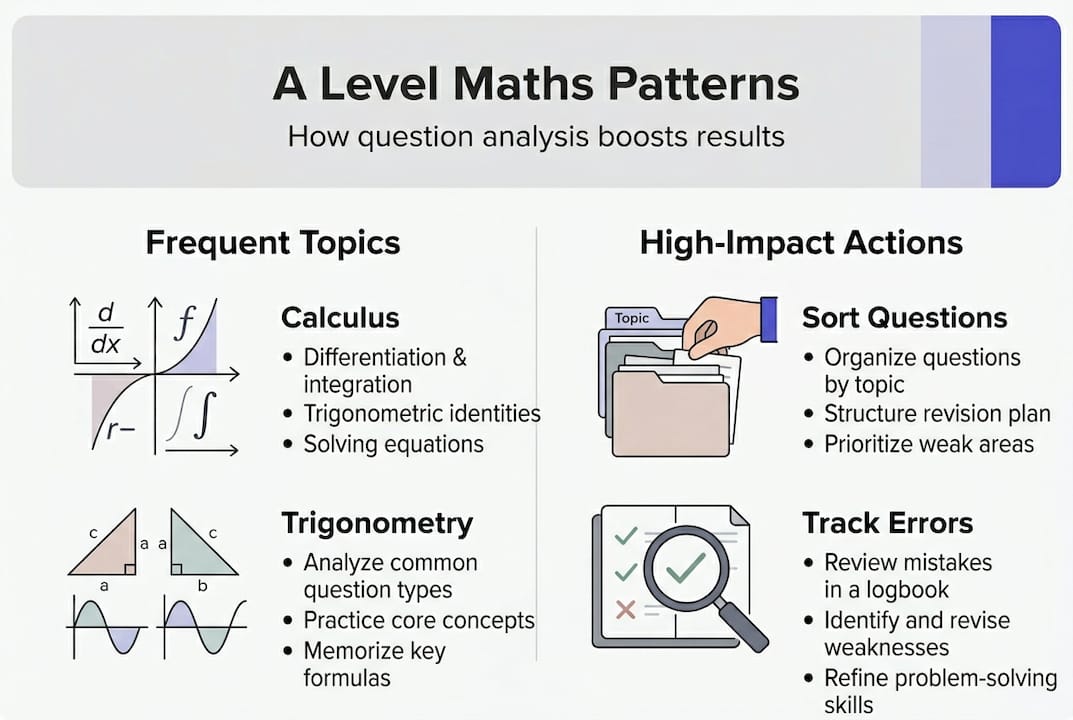
This matters because high-frequency exam topics like calculus and trigonometry dominate the paper year after year. Students who recognise this early stop treating every topic as equally important. They allocate revision time proportionally, which is a fundamentally smarter approach. Using past paper databases to organise this process makes the analysis faster and far more reliable than flicking through individual PDFs.
The evidence: How pattern analysis improves results
With a firm understanding of what pattern analysis is, the next question is: does it actually pay off? The data is telling.
Strategic filtering of past questions based on patterns leads to a 15 to 20% improvement in exam results compared to random practice. That is not a marginal gain. For a student sitting on a B grade, a 15% uplift could realistically mean the difference between a B and an A.
The reason this works comes down to three mechanisms. First, focused revision builds deeper fluency in the topics that actually matter. Second, pattern analysis uncovers hidden examiner priorities that generic revision guides rarely highlight. Third, students who practise strategically develop stronger exam technique because they have seen the same question structures repeatedly and know exactly how to approach them.
| Revision approach | Typical outcome | Time efficiency |
|---|---|---|
| Random past paper practice | Moderate improvement | Low |
| Topic-by-topic textbook revision | Good understanding | Medium |
| Pattern-driven question filtering | 15 to 20% improvement | High |
The table above illustrates why practising exam questions through a pattern lens is so effective. You are not just building knowledge. You are building exam-specific fluency, which is a different and more valuable skill.
Pro Tip: After completing any past paper, spend ten minutes categorising every question by topic before checking your answers. This builds your pattern recognition instinct faster than any other single habit.
The students who boost revision outcomes most dramatically are those who treat each paper as a data source, not just a practice run. That mindset shift is where the real gains begin.
Identifying high-frequency topics and examiner trends
The results raise a new question: what exactly should students focus on? Identifying big patterns is the key step.
Certain topics dominate A Level maths papers with remarkable consistency. Calculus and trigonometry alone account for over 80% of exam content across major boards. Statistics and mechanics questions follow closely, particularly in papers two and three. If you are not deeply confident in differentiation, integration, and trigonometric identities, you are leaving a significant portion of the paper underserved.

Here is a breakdown of approximate topic frequency across recent AQA and Edexcel papers:
| Topic | Estimated frequency | Typical mark allocation |
|---|---|---|
| Calculus (differentiation and integration) | Very high | 20 to 30 marks |
| Trigonometry | High | 15 to 20 marks |
| Statistics and probability | High | 15 to 25 marks |
| Algebra and functions | Medium to high | 10 to 20 marks |
| Vectors | Medium | 8 to 12 marks |
To identify these patterns yourself, follow this process:
- Select the last three to five years of papers from your specific exam board
- Create a simple spreadsheet with topics as rows and exam years as columns
- Mark each topic every time it appears, noting the marks available
- Calculate the total frequency and average marks per topic
- Rank topics by combined frequency and mark weight
For AQA students, the AQA QLAPD tool provides detailed performance data by question, showing exactly where students across the cohort lose marks. This is invaluable for analysing exam board questions because it reveals not just what is tested but where students consistently struggle. Pairing this with AQA exam data gives you a precise picture of where your effort will yield the greatest return.
Focusing on the last three to five years is deliberate. Older papers may reflect a different syllabus or examiner style, making them less relevant to your actual exam.
Using mark schemes and error analysis to sharpen your strategy
Once you know which topics to target, mastering how marks are awarded and catching your own weak spots becomes the next winning move.
Mark schemes reveal exact marking criteria, including which method steps earn marks independently of the final answer. This is critical. In A Level maths, a wrong final answer does not necessarily mean zero marks. If you show the correct method, you can still collect method marks. Students who understand this structure write answers very differently from those who do not.
Reverse-engineering a mark scheme means reading it before you mark your own work, then asking: did I hit each required step? Did I present my working in the order the examiner expected? This habit transforms mark schemes from answer keys into writing guides.
Error analysis takes this further. Persistent misconceptions and procedural errors are identifiable and fixable when you track them systematically. Common culprits in A Level maths include:
- Algebra slips when rearranging complex expressions
- Sign errors in differentiation and integration
- Misreading question phrasing on applied statistics problems
- Forgetting to check domain restrictions on trigonometric equations
Pro Tip: Keep a dedicated error log. Every time you lose a mark, write down the question type, the mistake made, and the correct approach. Review this log weekly. Patterns in your own errors are just as valuable as patterns in the exam itself.
Practical techniques for using mark schemes effectively include attempting the question fully, then comparing your working step by step against the scheme rather than just checking the final answer. For effective answer strategies, re-doing questions you got wrong without looking at the solution first is far more effective than simply reading through the correct method.
Choosing the right exam questions for efficient revision
Pattern recognition only pays off when you practise wisely. Here is how to choose the right questions for your goals.
Prioritising recent papers from the last three to five years aligns your practice with current syllabus requirements and examiner expectations. Papers from before 2017 often reflect a different specification entirely, making them poor predictors of what you will actually face.
Here is a quick checklist to filter questions worth your time:
- Is the question from a paper within the last five years?
- Does it cover a topic in your top five by frequency?
- Does it carry five or more marks, indicating depth is required?
- Have you seen this question type before but not yet mastered it?
- Does the mark scheme show a multi-step method you need to practise?
If a question scores yes on three or more of these, it belongs in your revision queue. If it scores two or fewer, it is likely a lower-priority item.
Pro Tip: Avoid spending time on questions from topics that appear once every four or five years unless you have already mastered the high-frequency areas. Scarcity does not mean importance.
For optimising question choice, grouping questions by topic rather than by paper is more efficient. Instead of doing a full paper, pull together ten integration questions from five different years and work through them as a focused set. This builds topic fluency faster. Structured past paper selection tools make this kind of targeted grouping straightforward, saving you the manual effort of hunting through individual PDFs.
Why most students still overlook pattern analysis for maths revision
With all these tools and evidence available, it is worth reflecting on why this strategic approach is not yet universal.
The honest answer is habit and anxiety. Most students revise the way they were taught to revise: open a paper, work through it, check answers, repeat. It feels productive because it is busy. Pattern analysis requires stopping, stepping back, and thinking about the exam as a system. That feels less like revision and more like procrastination, even when it is the opposite.
There is also a fear of missing out. Students worry that by focusing on recurring topics, they will be caught out by an unusual question. But this misunderstands probability. An unusual question worth six marks is far less important than a high-frequency topic worth twenty-five marks that you have not fully mastered.
The students who embrace pattern analysis consistently report lower revision stress and higher confidence going into the exam. They are not gambling on coverage. They are making informed decisions about where their time delivers the greatest return. That is not a shortcut. It is simply better strategy.
Take the next step: smarter revision with curated exam question databases
If you want to immediately start applying these principles, curated question banks make it straightforward.
Quextro gives you access to over 13,955 past exam questions from AQA, Edexcel, OCR, and CIE, all filterable by topic, difficulty, marks, and exam board. You can browse exam questions mapped directly to current syllabuses, so every question you practise is relevant and high-value.
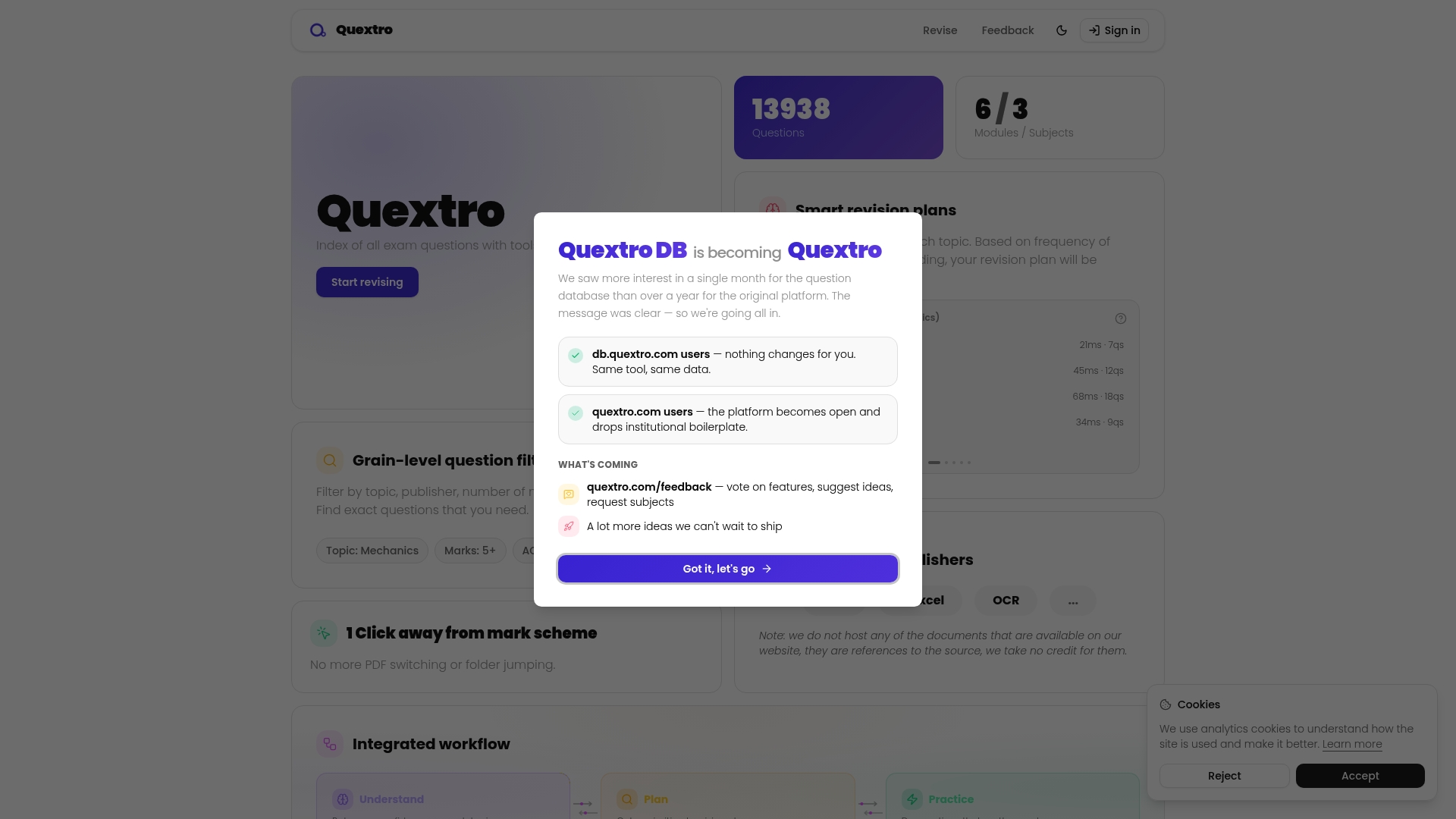
The platform's smart revision tools let you rate your confidence by topic, track your progress automatically, and work through pure maths question sets without juggling external PDFs. Everything the pattern analysis approach demands, organised in one place. Start a targeted practice set today and see the difference focused revision makes.
Frequently asked questions
How do I spot high-frequency topics for A Level maths revision?
Look for topics that appear most often in recent exam papers using summary tables or databases from the last three to five years. Calculus and trigonometry consistently account for over 80% of exam content across major boards.
What is QLAPD and how does it help with revision?
QLAPD is AQA's Question Level Analysis and Performance Data tool, available since 2017, which shows the percentage of marks achieved per question by cohort and grade. It reveals exactly where students lose marks, helping you focus revision on the highest-impact areas.
Why not just do every past paper in order?
Working through every paper sequentially is less efficient because older papers may not reflect the current syllabus or examiner style. Prioritising recent papers and high-frequency topics saves time and aligns your practice with what actually appears in your exam.
How does error analysis help in maths revision?
Tracking your mistakes against mark schemes highlights recurring procedural errors so you can address specific weaknesses directly rather than repeating the same mistakes across multiple papers.