

Many A Level maths students spend hours grinding through past papers, yet still walk into exams feeling underprepared. The problem is rarely effort. It is method. Random question practice creates the illusion of progress while leaving genuine gaps in topic coverage. Strategic filtering by topic frequency, personal weakness, and recency can improve scores by 15 to 20% compared to unstructured practice. This article gives you a clear, evidence-backed framework for analysing exam board questions so every revision session counts.
Table of Contents
- Why analysis matters for exam board questions
- Know your exam boards and high-frequency topics
- Step-by-step: Analysing exam board questions for maximum impact
- How to use mark schemes, examiner reports and tracking tools
- Common mistakes to avoid and pitfalls in question analysis
- Upgrade your revision with smart filtering and targeted question banks
- Frequently asked questions
Key Takeaways
| Point | Details |
|---|---|
| Targeted analysis is key | You can boost A Level maths scores by focusing on frequently-tested and personally weak topics instead of random practice. |
| Know high-frequency topics | Identify and prioritise the main topics that appear in nearly every exam for efficient study and greater confidence. |
| Track and adjust regularly | Track your strengths and difficulties weekly to keep your preparation closely aligned with exam demands. |
| Use mark schemes and reports | Analysing examiner feedback and grading criteria enhances your understanding of what earns top marks. |
| Avoid comfort zone traps | Focus revision outside your comfort zone to cover edge cases and avoid missing hidden marks in the exam. |
Why analysis matters for exam board questions
There is a widespread belief among students that doing more questions automatically leads to better results. It does not. Volume without direction is one of the most common revision traps in A Level maths. The exam question practice benefits only materialise when you are practising the right questions at the right difficulty level.
"Strategic filtering of exam questions by topic frequency, personal weakness, and recency improves scores by 15 to 20% compared to random practice."
Analysis gives you a map. Without it, you are navigating an exam without knowing which roads are most likely to appear. Targeted analysis helps you:
- Identify which topics appear most frequently across recent papers
- Pinpoint your personal weak areas before they cost you marks
- Build genuine confidence through deliberate, structured practice
- Reduce wasted time on topics you already understand well
The shift from random to analytical practice is also about mindset. When you understand why you are selecting a particular question, you engage with it more deeply. Selecting questions for revision with intention transforms passive repetition into active learning, which is where real improvement happens.
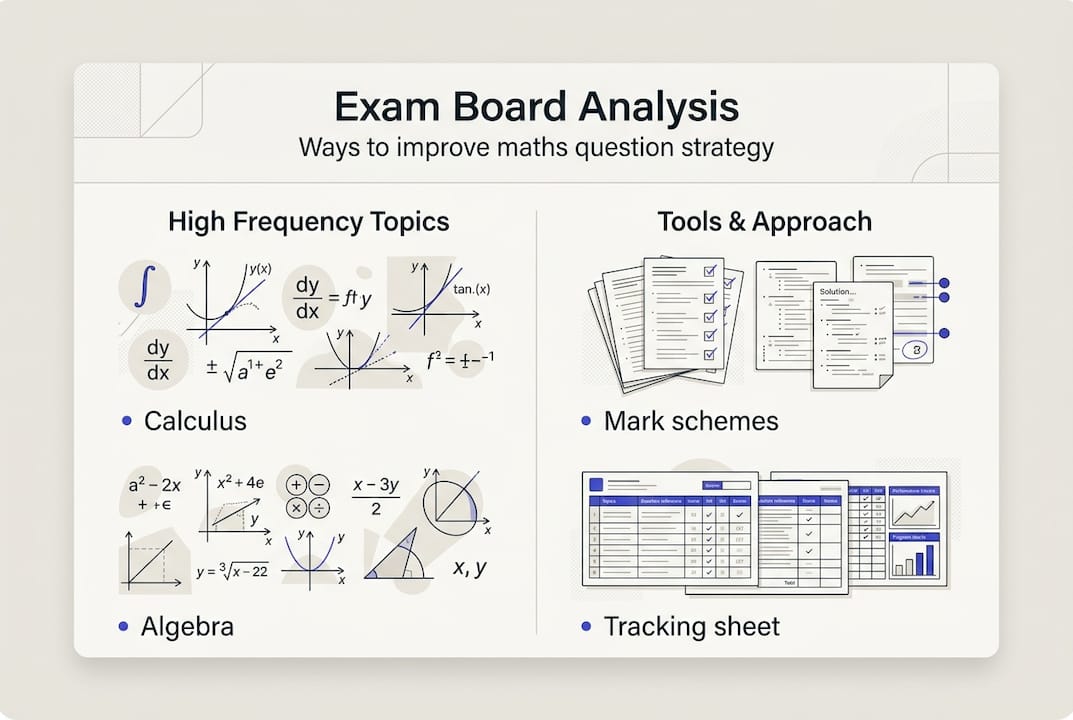
Know your exam boards and high-frequency topics
Before you can analyse questions effectively, you need to understand how your specific exam board structures its papers. Edexcel, AQA, and Cambridge (CIE) each have distinct emphases, mark allocations, and question styles. Knowing these differences helps you filter smarter.
High-frequency maths topics appear across all major boards, but their weighting varies. Calculus and trigonometry alone feature in over 80% of papers, making them non-negotiable priorities regardless of how confident you feel in them.
Here is a comparison of the most common high-frequency topics across the main boards:
| Topic | Edexcel | Cambridge (CIE) | AQA |
|---|---|---|---|
| Calculus | Very high | Very high | Very high |
| Algebra and functions | High | High | High |
| Trigonometry | High | High | High |
| Vectors | Moderate | High | Moderate |
| Coordinate geometry | High | Moderate | High |
| Kinematics and SUVAT | High (Mechanics) | High (Mechanics) | Moderate |
| Forces | Moderate | Moderate | Moderate |
The top frequent topics across Edexcel and Cambridge follow a consistent pattern: calculus, algebra and functions, trigonometry, vectors, and coordinate geometry dominate pure maths, while kinematics and forces lead in mechanics. Reviewing AQA board trends alongside your own board gives you a broader picture of where examiners consistently focus their attention.
Key topics to prioritise in your analysis:
- Calculus: differentiation, integration, and their applications
- Trigonometry: identities, equations, and graphs
- Algebra and functions: transformations, composite and inverse functions
- Vectors: magnitude, direction, and geometric proofs
- Coordinate geometry: circles, lines, and parametric equations
Step-by-step: Analysing exam board questions for maximum impact
Having a clear process removes guesswork and makes your revision sessions far more productive. Follow these steps consistently and you will start to see patterns that most students miss entirely.
- Filter by topic frequency first. Start with the topics that appear most often in recent papers. Use the table above as your baseline and cross-reference with your board's specification.
- Rate your confidence weekly. Assign each topic a score from one to five. Be honest. A topic you rated as four last week may have dropped after a difficult practice session. Personal difficulty ratings evolve, so reassess every week without fail.
- Apply the 60-30-10 rule. Spend 60% of your question practice on weak topics, 30% on moderate ones, and 10% on strong areas. This balance ensures you shore up weaknesses without completely neglecting your strengths.
- Review the most recent papers first. Examiners often revisit topics in cycles. Checking the last three to five years of papers reveals which topics are currently in rotation and which may be due to reappear.
- Record edge cases and multi-topic questions. Some questions blend two or three topics, such as calculus applied within a trigonometric context. These multi-topic blends are common in higher-mark questions and require separate tracking.
- Avoid the comfort trap. It feels productive to practise questions you already find easy. It is not. Deliberately seek out solved exam questions in your weaker areas and sit with the discomfort of getting things wrong.
Pro Tip: Create a simple tracking sheet with columns for topic, confidence score, date last practised, and number of errors. Reviewing this weekly takes five minutes and keeps your question filtering process sharp and responsive.
Here is a sample data table to guide your weekly tracking:
| Topic | Confidence (1-5) | Last practised | Errors this week | Priority |
|---|---|---|---|---|
| Integration | 2 | 3 days ago | 4 | High |
| Trigonometric identities | 3 | 1 week ago | 2 | Medium |
| Vectors | 4 | 5 days ago | 1 | Low |
| Kinematics | 2 | 10 days ago | 5 | High |
Using a structure like this when organising questions ensures nothing slips through the cracks as your exam date approaches.
How to use mark schemes, examiner reports and tracking tools
Analysing questions is only half the process. Understanding why an answer is correct, and what examiners specifically reward, is where many students gain an edge.

Mark schemes are not just answer keys. They reveal the exact steps examiners expect, including method marks that you can earn even if your final answer is wrong. Using mark schemes actively, rather than just checking whether you got the right answer, trains you to think like an examiner.
Examiner reports are equally valuable and are often overlooked. Published after each exam series, they describe the most common errors students made and highlight approaches that scored full marks. Reading these reports for your target topics gives you direct insight into what separates a grade B from an A.
Key habits to build into your analysis routine:
- Read the mark scheme before reviewing your working, not after. This forces you to identify where your method diverged from the expected approach.
- Highlight recurring errors in examiner reports for your weakest topics. These are almost certainly areas where you are losing marks too.
- Track your question attempts digitally using a spreadsheet or a dedicated revision app. Log the topic, date, mark achieved, and any errors. Over time, patterns become obvious.
- Adjust your strategy as you improve. A topic that was in your 60% weak category three weeks ago may now belong in the 30% moderate group. Answering exam questions effectively requires ongoing recalibration, not a fixed plan.
The consensus among educators is clear: combining filtering, tracking, and mark scheme analysis produces the strongest and most consistent score improvements.
Pro Tip: After completing a past paper question, write one sentence explaining why you lost any marks. This reflection step takes thirty seconds but dramatically accelerates your understanding of examiner expectations.
Common mistakes to avoid and pitfalls in question analysis
Even students with a solid revision plan can fall into habits that quietly undermine their progress. Recognising these pitfalls early saves you weeks of misdirected effort.
- Sticking to favourite topics. It feels reassuring to practise what you are already good at. But avoiding comfortable questions is one of the most important disciplines in effective revision. Your exam will not let you skip the hard parts.
- Ignoring multi-topic and edge case questions. Questions that blend calculus with vectors, or trigonometry with coordinate geometry, are disproportionately common in the higher mark ranges. Neglecting them leaves marks on the table.
- Skipping weekly self-evaluation. Your confidence in a topic changes constantly. A student who rated trigonometry as strong in week two but never reassessed may be blindsided by a difficult question in week six.
- Counting questions instead of tracking coverage. Completing fifty questions sounds impressive. But if forty of them were on the same topic, you have not covered your bases. Focus on breadth of topic coverage, not raw question count.
Pro Tip: Once a fortnight, review your tracking sheet and ask yourself: which topic have I avoided this week? That topic is almost certainly where your next practice session should begin. Reviewing question difficulty tips can also help you calibrate which questions to tackle next.
Upgrade your revision with smart filtering and targeted question banks
Putting all of this into practice manually takes time. The good news is that digital tools can handle the filtering, tracking, and organisation for you, so you can focus entirely on the maths.
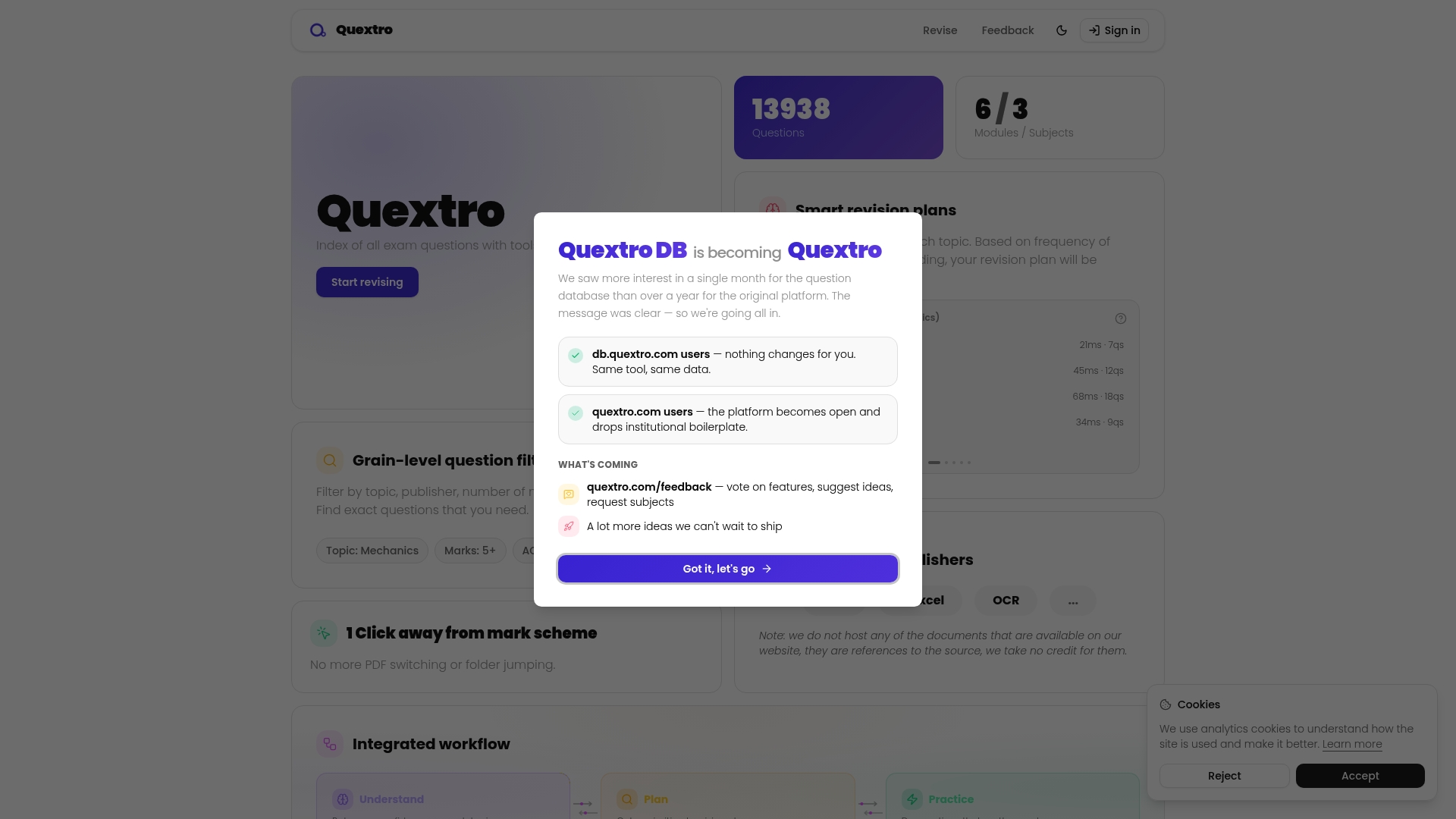
Quextro gives you direct access to over 13,955 past exam questions from AQA, Edexcel, OCR, and CIE, all filterable by topic, difficulty, marks, and publisher. Rather than hunting through PDFs, you can pull up exactly the questions you need in seconds. The Quextro Edexcel maths database lets you apply the 60-30-10 rule instantly by filtering for your weakest topics and most recent papers. You can also explore statistics maths questions with built-in confidence tracking and automatic progress saving. Every step in this article's framework is built into the platform, making targeted analysis a natural part of your daily revision.
Frequently asked questions
What is the best way to prioritise which exam board questions to analyse?
Focus on topics that appear most frequently in past papers and cross-reference these with your weakest areas from recent practice. Filtering by frequency and weakness consistently produces score improvements of 15 to 20% over random practice.
How often should I reassess my confidence in different A Level maths topics?
Reassess at least once per week. Confidence ratings evolve quickly as you practise, and weekly check-ins ensure your revision stays focused on what actually needs attention.
Why are mark schemes important when analysing past exam questions?
Mark schemes reveal the exact steps and method marks examiners award, not just the final answer. Filtering and mark scheme analysis together form the most effective approach to improving exam technique.
Do I need to analyse every exam board's questions or focus only on my syllabus?
Prioritise your own board's papers, but reviewing other boards occasionally broadens your exposure to different question styles. The top topics across Edexcel and Cambridge overlap significantly, so cross-board practice on core topics is rarely wasted effort.