

Only 17.4% of A Level Maths entrants achieved an A* in 2023/24. That means the vast majority of students, many of them genuinely capable, fell short of their potential. The gap between a B and an A* rarely comes down to raw ability. More often, it comes down to how you revise. Passive re-reading, highlighting notes, and grinding through textbook exercises can feel productive, but they rarely translate into exam marks. This article gives you practical, evidence-backed strategies to sharpen your revision, build real exam confidence, and give yourself the best possible shot at the grade you deserve.
Table of Contents
- Understand the exam structure and criteria
- Choose active revision techniques for maximum impact
- Train with real exam questions and past papers
- Exam techniques and day-of strategies for peak performance
- Our perspective: The truth about levelling up your A Level maths
- Advance your revision with Quextro's resources
- Frequently asked questions
Key Takeaways
| Point | Details |
|---|---|
| Know what examiners want | Focusing your revision on the actual mark scheme gives you an edge in targeting what matters most. |
| Use active revision | Active recall and regular self-testing are far more effective than re-reading notes. |
| Practise with real exam questions | Working through past papers reveals gaps and builds true exam readiness. |
| Apply smart exam day strategies | Effective time management and calculator checks can turn nerves into confidence. |
| Quality beats quantity | Targeted, high-impact revision is more valuable than hours spent on generic study. |
Understand the exam structure and criteria
Knowing exactly what examiners want is one of the most underused advantages available to you. Every A Level Maths paper is built around three assessment objectives: AO1, AO2, and AO3. AO1 tests your ability to use and apply standard techniques. AO2 asks you to reason, interpret, and communicate mathematically. AO3 requires you to solve problems in unfamiliar contexts. Most students practise AO1 heavily but neglect AO2 and AO3, which is precisely where marks are lost.
Command words matter enormously. When a question says show, you must present every step of working clearly. Justify means you need to explain your reasoning, not just produce an answer. Hence tells you to use a specific previous result. Misreading these words is one of the most common sources of avoidable mark loss. Reviewing the exam board criteria for your specific specification helps you understand precisely what each command word demands.
Active recall and focused revision yield much higher grades than passive study. This is not just good advice; it is backed by evidence. The students who improve most are those who test themselves repeatedly, not those who re-read their notes.
Common pitfalls to avoid in exam answers:
- Not directly answering the question asked
- Skipping explanation steps in show or prove questions
- Misinterpreting command words
- Presenting working that is too brief for the marks available
- Failing to state conclusions in context for applied questions
Pro Tip: Download the examiner reports for your board from the last three years. These reports list the exact mistakes that cost students marks, and reading them is one of the fastest ways to improve. Pair this with your preparation checklist to make sure you are covering every requirement before exam season.
Choose active revision techniques for maximum impact
Knowing what examiners look for, the next step is choosing how to revise for maximum retention and exam confidence. The difference between students who improve dramatically and those who plateau often comes down to one thing: active versus passive revision.
Active recall means forcing your brain to retrieve information rather than simply re-reading it. In maths, this looks like closing your notes and attempting a question from scratch, then checking your answer. Spaced repetition means returning to topics at increasing intervals, so you revisit calculus after two days, then five days, then a fortnight. Self-testing, whether through past paper questions or flashcards for formulae, builds the kind of memory that holds up under exam pressure.
"Students using active revision techniques consistently outperform those relying on passive study methods in A Level mathematics."
A model revision session using these techniques:
- Spend five minutes recalling everything you know about the topic without notes
- Identify gaps and review only those specific areas
- Attempt three to five exam-style questions on the topic
- Mark your work against the mark scheme and note every error
- Revisit the same topic two days later using a different set of questions
41.8% of students achieved A or A in A Level Maths in 2023.* Students who use structured, active techniques are far more likely to sit in that group.

For topic summaries, try condensing an entire chapter onto one side of A4. This forces you to identify what is truly essential rather than copying everything out. For formulae, physical flashcards work well because the act of writing them out is itself a form of active recall. Review your exam revision best practices to build a session structure that fits your schedule and learning style.
Train with real exam questions and past papers
With your revision techniques set, it is time to put theory into practice with authentic exam-style questions. Textbook exercises are useful for building initial understanding, but they are not the same as real exam questions. The format, phrasing, and mark allocation of past papers are different in ways that genuinely matter.
Benefits of training with real past paper questions:
- Immediate feedback on which topics need more work
- Exposure to unusual question formats before exam day
- Familiarity with how marks are allocated across a paper
- Improved time management through timed practice
- Reduced anxiety because the format feels familiar
| Feature | Textbook exercises | Past paper questions |
|---|---|---|
| Challenge level | Predictable | Varied and contextual |
| Mark allocation | Rarely shown | Always shown |
| Exam similarity | Low to moderate | High |
| Feedback speed | Slow (answer at back) | Fast (full mark scheme) |
Concise notes and exam-accurate practice are more effective than traditional passive study. This is why working through real questions and self-marking with the official mark scheme is so powerful. When you mark your own work, you see exactly where method marks are awarded and where full marks require a specific step.
For guidance on answering exam questions effectively, it helps to understand how marks are structured across different question types. Understanding exam question difficulty also helps you pace yourself during timed practice.
Pro Tip: Do not work through every topic in sequence. Rotate topics in your practice cycles so you are mixing, say, integration with statistics and mechanics in the same session. This mirrors the actual exam and forces your brain to switch between areas, which is exactly what exam day demands. You can find advice on reviewing past papers strategically to make the most of this approach.
Exam techniques and day-of strategies for peak performance
Even with the best revision, your approach on exam day can make a crucial difference. Students who have prepared thoroughly sometimes underperform because of avoidable errors in how they manage the exam itself.
Key exam techniques to apply on the day:
- Read every question carefully before writing anything
- Answer questions you are confident about first to secure easy marks
- Annotate diagrams and underline key values in worded problems
- Check calculations by substituting your answer back into the original equation
- Allocate time proportionally, roughly one minute per mark
Stress management is often overlooked. If you blank on a question, move on and return to it later. A slow, deliberate breath before you begin helps settle your focus. Arriving early, having your equipment ready, and knowing the exam format in advance all reduce the mental load on the day itself.
| Common error | Impact on marks | How to check |
|---|---|---|
| Misreading a negative sign | Loses method and accuracy marks | Re-read the question after solving |
| Unit errors in applied questions | Loses final accuracy mark | Write units at every stage |
| Rounding too early | Incorrect final answer | Keep full values until the last step |
| Skipping a step in proof questions | Loses all marks for that part | Write every line of reasoning |
Calculator fluency helps verify tricky results and boosts confidence under pressure. Practise using your calculator for integration, equation solving, and statistical functions so these feel automatic. Knowing how to use it efficiently means you can double-check answers in the time you have left.
Remember, 96.1% of candidates passed A Level Maths in 2023/24. The exam is designed to be passable. Your goal is to maximise every mark available, and knowing how to select exam questions strategically during the paper helps you do exactly that. Reviewing exam questions with solutions beforehand also builds the pattern recognition that makes the real thing feel manageable.
Our perspective: The truth about levelling up your A Level maths
Here is something most teachers will not say directly: the students who improve the most are rarely the ones who study the longest. They are the ones who study most honestly.
There is a widespread belief that more hours automatically produce better results. In reality, six hours of passive note-reviewing can produce less improvement than ninety minutes of focused problem-solving with immediate self-marking. Volume feels like progress. It rarely is.
The single most overlooked habit in A Level maths revision is reviewing your mistakes in detail. Not glancing at the mark scheme and moving on, but sitting with each error, understanding exactly where your reasoning broke down, and then attempting a similar question to confirm you have genuinely fixed it. This is what targeted exam practice actually means.
"Quality revision always beats quantity when it comes to A Level maths."
If you are putting in the hours and not seeing results, the answer is almost never to study more. It is to study differently.
Advance your revision with Quextro's resources
With these strategies in hand, here is where you can find tailored support for your next revision session. Quextro gives you access to over 13,955 past exam questions, all organised by topic, difficulty, exam board, and mark value. You can filter questions to target exactly the areas where you need the most work, without digging through PDFs or hunting for mark schemes.
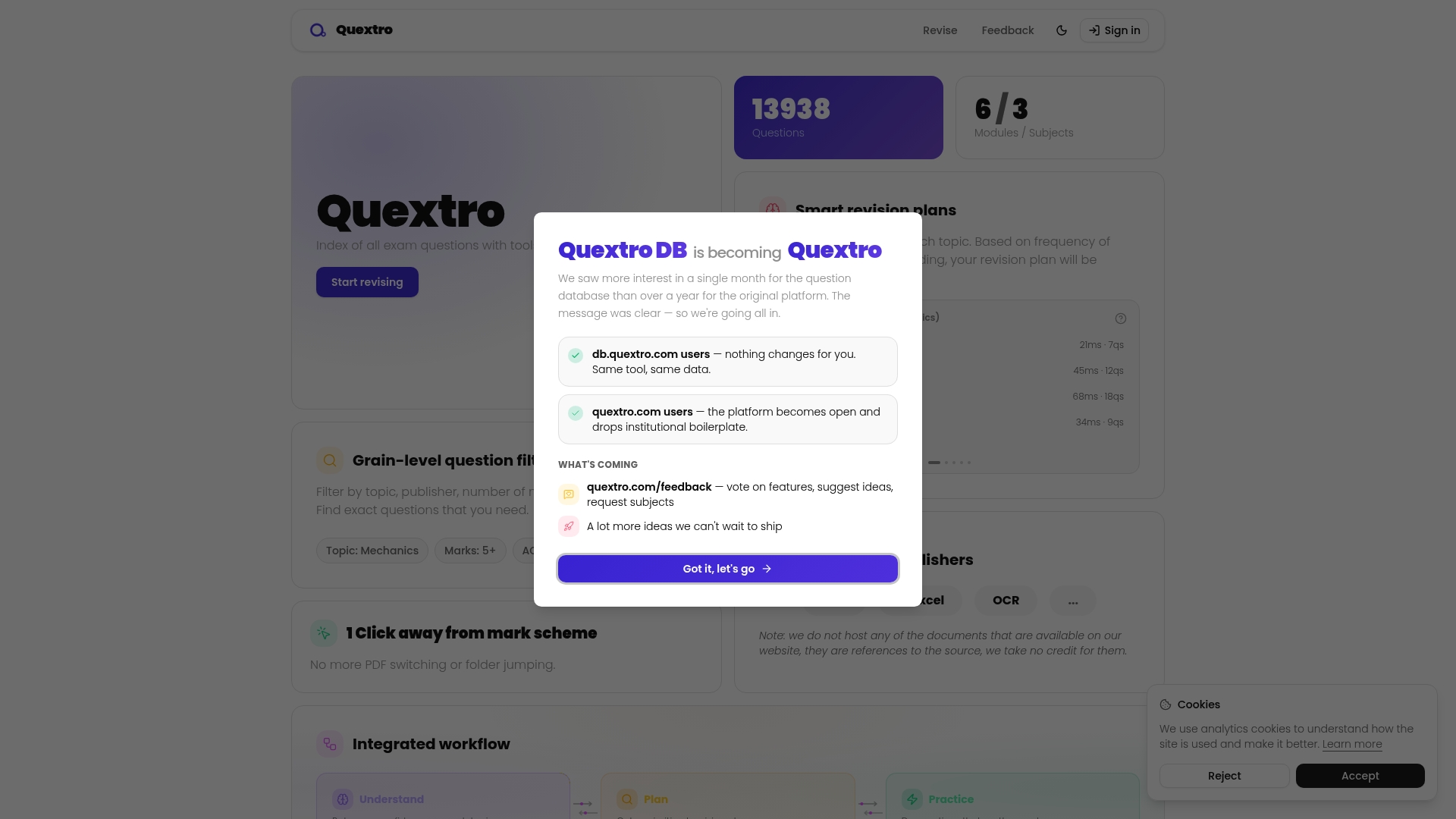
Whether you need statistics practice papers to sharpen your applied maths or want to work through foundation maths exam resources to build confidence from the ground up, Quextro has curated content that covers every area of the specification. Smart revision plans adapt to your confidence ratings, so your practice time is always spent where it counts most.
Frequently asked questions
What is the best way to revise for A Level maths?
Active recall, spaced repetition, and practising real exam questions are the most effective methods for A Level maths revision, consistently outperforming passive approaches like re-reading notes.
How many students get an A* in A Level maths?
17.4% of entrants achieved an A* in A Level Maths in 2023/24, meaning targeted revision strategies give you a real edge over the majority of candidates.
Should I focus on harder or easier questions for A Level maths revision?
A balanced mix works best: begin with questions you can answer to build momentum, then push into harder territory to develop the deeper understanding that separates A and A* candidates. Guidance on question selection strategies can help you structure this effectively.
How important is calculator skill for A Level maths exams?
Calculator fluency is crucial for verifying answers and maintaining confidence under pressure, particularly in papers where checking your result can be the difference between full marks and a careless error.