

TL;DR:
- Topic-based revision provides clear focus, identifies gaps, and enhances long-term retention.
- Structuring revision around exam topics ensures systematic coverage and builds exam confidence.
- Using question banks and tools like Quextro simplifies targeted practice and progress tracking.
Spending hours on revision only to see your mock scores plateau is one of the most demoralising experiences in A Level preparation. The problem usually isn't effort. It's structure. When you revise without a clear topic framework, you end up revisiting comfortable material while quietly avoiding the areas that actually need work. Topic-based organisation changes that entirely. It gives your revision direction, ensures every part of the syllabus gets proper attention, and makes it far easier to measure genuine progress. This guide covers both the reasoning behind the method and the practical steps to implement it effectively.
Table of Contents
- Why topic-based revision boosts your learning
- How to organise your maths revision by topic
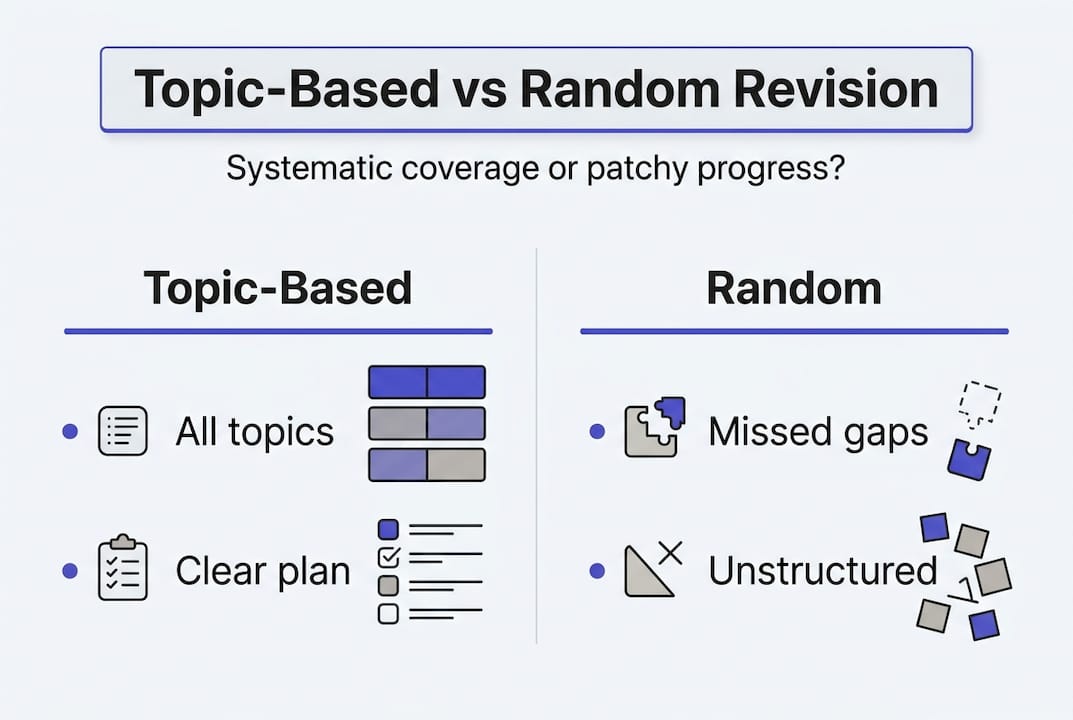
- Comparing topic-based and random revision approaches
- Tools and resources to support topic-based organisation
- Our perspective: What most students overlook about exam topic organisation
- Take your topic-based revision to the next level with Quextro
- Frequently asked questions
Key Takeaways
| Point | Details |
|---|---|
| Boosts exam focus | Organising by topic ensures you systematically cover every area and tackle weaknesses directly. |
| Saves study time | Targeted topic revision prevents wasted hours and helps you see measurable progress. |
| Improves results | Mock exam accuracy and confidence typically rise with well-structured, topic-based preparation. |
| Enables easy tracking | Checklists and digital tools allow fast identification of remaining gaps before the exam. |
Why topic-based revision boosts your learning
The brain doesn't store information randomly. It builds networks of connected ideas, and recalling one concept becomes much easier when it's linked to others in the same cluster. When you revise maths by topic, you're working with that natural architecture rather than against it. Spending a focused session on integration, for example, means your brain is repeatedly activating the same neural pathways, strengthening them with each question you attempt.
This approach also reduces the paralysing feeling of not knowing where to start. A Level maths covers an enormous range of content, from calculus and trigonometry to statistics and mechanics. Without structure, the sheer volume becomes overwhelming. Breaking it into named topics makes the workload feel manageable, and each completed topic gives you a genuine sense of momentum.
Here's what topic-based revision consistently delivers:
- Clearer knowledge gaps: You quickly discover which topics you can handle confidently and which ones need more time.
- Reduced cognitive overload: Focused sessions on one area prevent the mental fatigue of jumping between unrelated concepts.
- Faster mastery: Repeated exposure to a single topic in a short window accelerates understanding far more than scattered practice.
- Greater confidence: Ticking off topics as you master them builds real self-assurance heading into the exam.
As noted in best practices for A Level maths, organising revision by topic leads to improved long-term retention and exam performance. That's not a minor gain. Students who structure their revision this way consistently outperform peers who rely on random practice.
"The most effective revision isn't the longest revision. It's the most targeted."
If you're currently working through past papers without a topic filter, you're likely reinforcing strengths while leaving weaknesses untouched. Structured revision fixes that imbalance directly.
How to organise your maths revision by topic
Building a topic-based revision plan doesn't require anything elaborate. It requires clarity and consistency. Here's a straightforward framework to get started.
- Download your exam board specification. Whether you're sitting AQA, Edexcel, OCR, or CIE, your specification lists every topic that can appear in the exam. This is your master checklist. Print it or save it somewhere you'll actually use it.
- Sort topics by confidence level. Go through the list and honestly rate each topic: strong, needs work, or haven't started. This initial audit is uncomfortable but essential. It tells you exactly where to focus your time.
- Build a weekly timetable with topic slots. Assign specific topics to specific days. Don't just write "maths revision." Write "binomial expansion" or "hypothesis testing." The more specific the slot, the more focused your session will be.
- Use topic-filtered question banks for practice. Rather than working through a full past paper randomly, practise questions grouped by topic. This is where choosing practice questions strategically makes a real difference to how quickly you improve.
- Review and adjust weekly. At the end of each week, check which topics have improved and which still feel shaky. Shift your timetable to give more time to persistent weak spots.
As highlighted in guidance on A Level maths revision 2026, breaking down your syllabus and using topic checklists improves focus and ensures thorough coverage. The checklist isn't just a planning tool. It becomes a live document that reflects your actual progress.
Pro Tip: Don't wait until you feel "ready" to move on from a topic. Set a minimum number of questions per topic, say eight to ten, and move on once you've hit that target with reasonable accuracy. Perfectionism at this stage wastes time you don't have.
The key is that this plan should feel personal. Your weak topics are different from your classmate's weak topics. A generic revision schedule won't serve you as well as one built around your specific gaps.
Comparing topic-based and random revision approaches
It helps to see the contrast laid out plainly. Many students default to random revision simply because it feels productive. Flicking through a full past paper, attempting a mix of questions, and marking your answers can feel like serious work. But the outcomes often don't match the effort.

| Factor | Topic-based revision | Random revision |
|---|---|---|
| Coverage | Systematic, all topics addressed | Patchy, some areas repeatedly skipped |
| Confidence | Builds steadily per topic | Uneven, hard to track |
| Gap identification | Clear and early | Often discovered too late |
| Exam readiness | High, with measurable progress | Variable, difficult to assess |
| Stress levels | Lower due to structure | Higher due to uncertainty |
Students using topic-organised revision demonstrate higher accuracy in mock exams. That accuracy comes from the repeated, focused practice that topic-based study naturally produces.
Here's what random revision tends to produce in practice:
- False confidence: You score well on topics you already know and feel prepared, even when large gaps remain.
- Neglected areas: Without a checklist, some topics simply never get revised.
- Harder self-assessment: It's difficult to know what you actually understand when your practice is scattered.
Topic-based revision isn't just a preference. It's a measurably more effective strategy. The structure itself does part of the work for you, ensuring you can't accidentally skip a topic two weeks before the exam.
Tools and resources to support topic-based organisation
Having a plan is one thing. Having the right tools to execute it is another. Fortunately, there are both digital and physical resources that make topic-based revision far easier to maintain.
Digital platforms are the most powerful option for A Level maths. A good platform lets you filter questions by topic, difficulty, and exam board, so every practice session is precisely targeted. Rather than hunting through PDFs for relevant questions, you can pull up exactly what you need in seconds.
| Resource type | Best use | Example |
|---|---|---|
| Topic question banks | Targeted practice per topic | Quextro filtered search |
| Mind maps | Visual overview of topic connections | Hand-drawn or digital |
| Flashcards | Quick recall of formulae and definitions | Anki or paper cards |
| Topic checklists | Tracking coverage and confidence | Printed specification |
Pro Tip: Use a mind map at the start of each topic to sketch out everything you already know. Then fill in the gaps as you revise. This active recall technique is far more effective than re-reading notes passively.
Physical tools still have genuine value. A printed checklist pinned above your desk keeps your topic plan visible. Colour-coded notes by topic make it easy to return to specific areas quickly. Flashcards work particularly well for formulae, definitions, and key theorems that need to be automatic under exam conditions.
For structured digital practice, foundation maths questions on Quextro are organised to make targeted revision straightforward. You can also access statistics papers and pure maths resources filtered by topic and difficulty. As the evidence shows, using organised question banks leads to more targeted revision and better exam outcomes.
The combination of a clear topic checklist and a reliable question bank is, genuinely, all you need to make topic-based revision work.
Our perspective: What most students overlook about exam topic organisation
We've observed hundreds of A Level maths students work through their revision, and one pattern stands out clearly. Students who set up a topic list at the start of term often abandon it within two weeks. They create the structure, feel organised, and then gradually drift back to comfortable habits. The list becomes a relic rather than a working tool.
The students who actually benefit from topic-based organisation are the ones who treat it as a living document. They update it after every mock. They shift their focus when results reveal a persistent weakness. They don't just tick boxes quickly to feel productive. They sit with a difficult topic until it genuinely clicks.
There's also a subtler lesson here. Top scorers don't necessarily cover more topics than everyone else. They go deeper into the topics that matter most for their specific exam board. Flexibility, adjusting your plan based on real evidence from deeper revision insights and mock results, is often what separates a B from an A.
Organisation is the starting point. Honest, ongoing engagement with that organisation is what actually drives results.
Take your topic-based revision to the next level with Quextro
If you're ready to embed topic-based organisation into your maths revision, Quextro makes the process significantly more straightforward. With over 13,955 past exam questions from AQA, Edexcel, OCR, and CIE, the platform is built specifically for targeted A Level preparation.
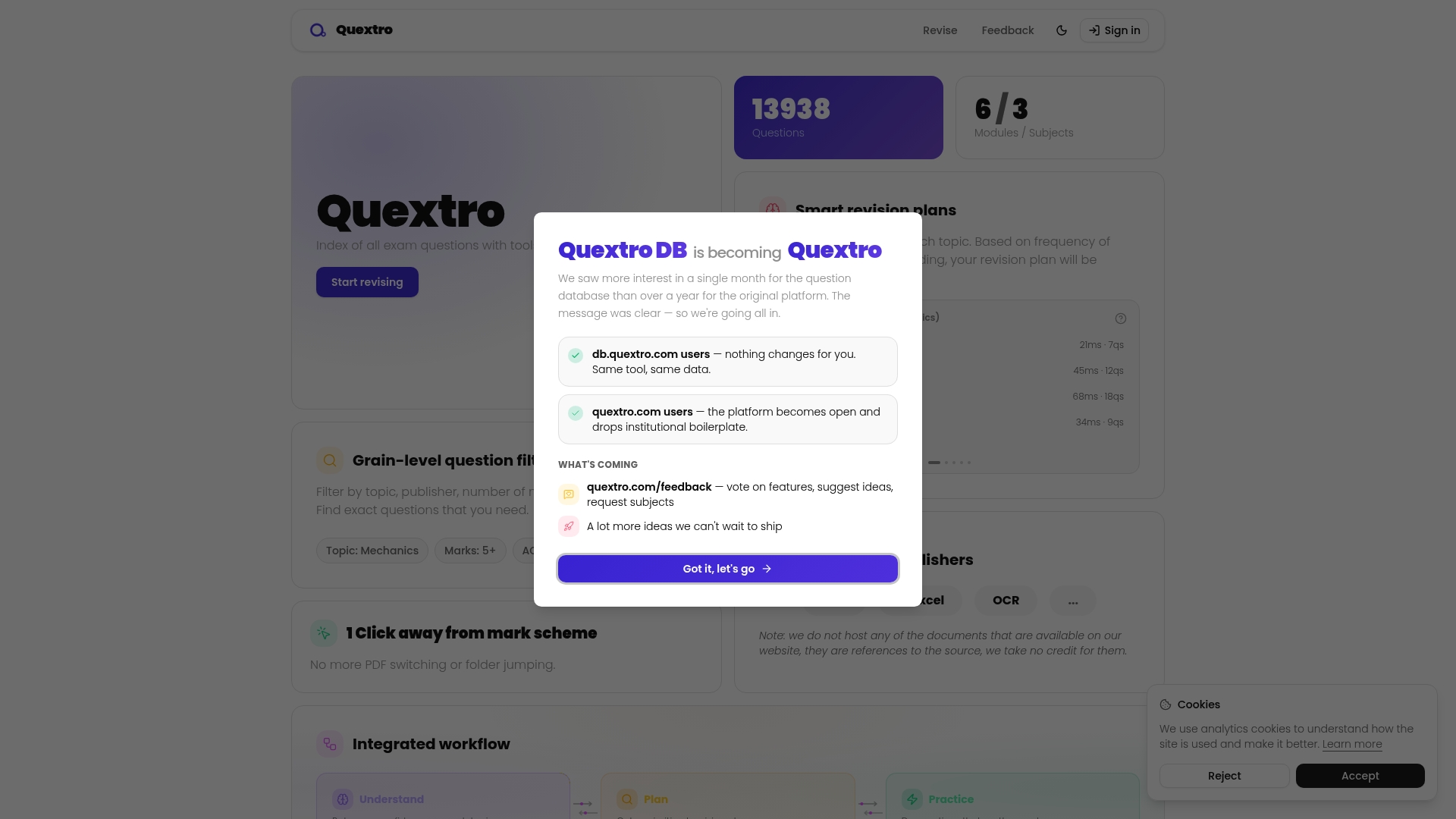
You can filter topic-wise maths questions by topic, difficulty, and marks, so every session is precisely focused on what you actually need to practise. Whether you're working through statistics revision or drilling pure mathematics resources, Quextro's smart revision tools track your confidence and progress automatically. Start building your topic-based revision journey today and give your preparation the structure it deserves.
Frequently asked questions
What are the main benefits of organising revision by exam topic?
It boosts focus, helps plug knowledge gaps, and makes study more efficient by ensuring all areas are covered systematically. Topic-based revision improves long-term retention and results across a wide range of students.
How can I identify which topics need more attention before my A Level maths exam?
Track your progress using topic checklists and review mistakes from practice questions to spot weak areas. Regular progress review and mock exam results guide efficient, targeted revision.
Are there resources that help me find A Level maths exam questions arranged by topic?
Yes, platforms like Quextro provide extensive question banks and past papers sorted by specific maths topics. Organised question banks enable targeted, topic-based revision without the need for external PDF searches.
Does topic-based revision work for all maths students?
While most students benefit, it's especially effective for those who prefer structure or have identified certain weak topics. A structured approach is proven to help a wide range of learning styles and ability levels.