
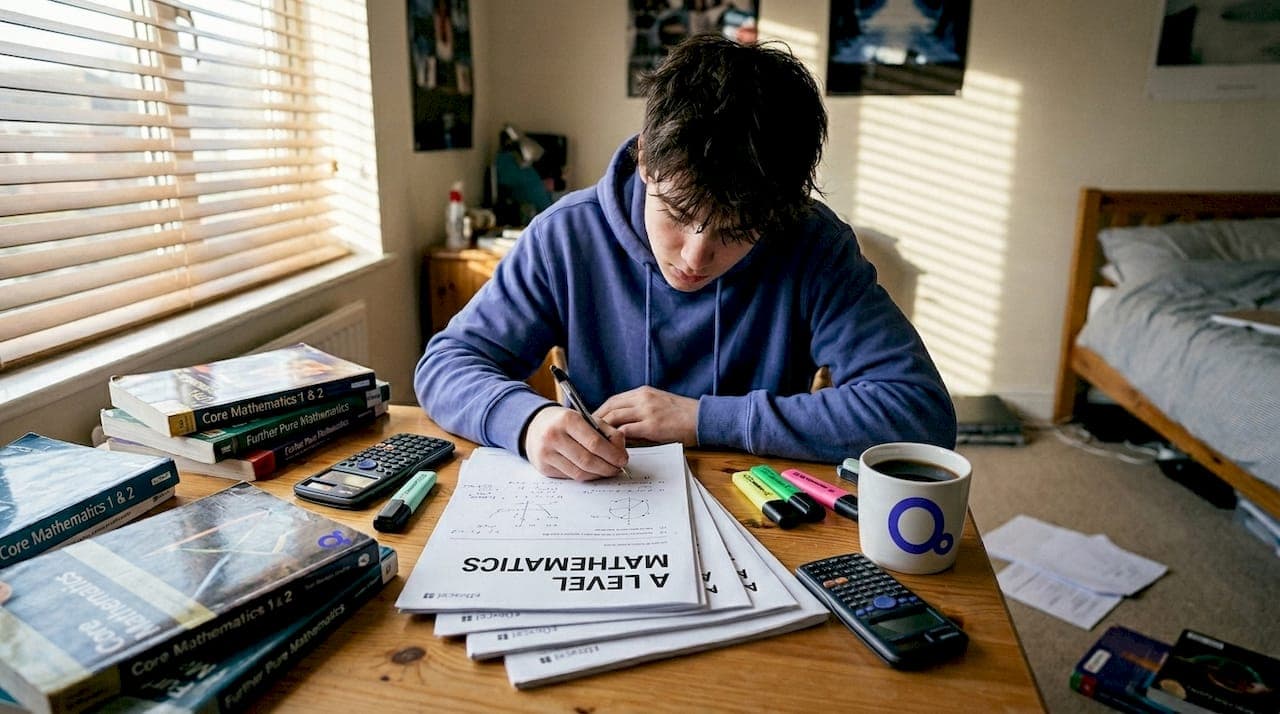
Hundreds of past exam questions exist across AQA, Edexcel, OCR, and CIE, and picking the wrong ones to practise can quietly cost you marks. Not all revision is equal. Spending three hours on topics you already understand feels productive but rarely moves the needle. The students who improve fastest are those who practise strategically, choosing questions by board, topic, and difficulty rather than working through papers at random. This guide walks you through exactly how to find, compare, and use the best A Level maths exam questions so your revision time actually counts.
Table of Contents
- How to choose the right exam questions
- Sample exam questions by board and topic
- Comparison of exam formats and question focus
- Choosing questions for your revision plan
- Go further with expert-curated exam practice
- Frequently asked questions
Key Takeaways
| Point | Details |
|---|---|
| Strategic question choice | Selecting by board, topic, and format boosts your revision efficiency. |
| Practice from past papers | Real exam questions reveal what examiners expect and common pitfalls. |
| Comparison aids focus | Understanding exam format differences lets you target your strengths. |
| Expert-curated resources | Platforms let you filter and access topic-driven questions with model solutions. |
How to choose the right exam questions
The single biggest mistake students make is treating all past papers as interchangeable. They are not. AQA, Edexcel, and OCR each have distinct question styles, command words, and context settings, even when the underlying maths is identical. Knowing which board you are sitting is the starting point for every revision session.
Here is a simple framework for selecting exam questions that actually match your needs:
- Identify your exam board. AQA, Edexcel, and OCR each have their own paper structure and mark schemes. Always confirm which board your school uses.
- Pick a specific topic. Rather than doing a full paper, isolate one area such as integration, binomial expansion, or projectile motion.
- Filter by difficulty. Start with accessible questions to build confidence, then move to multi-step problems that require sustained reasoning.
- Check the year. More recent papers reflect the current specification, which matters especially for Statistics and Mechanics content.
- Review the mark scheme immediately after. This is where the real learning happens, not just in answering the question.
Syllabus differences matter more than most students realise. A Mechanics question on Edexcel might frame a forces problem using a real-world scenario with a diagram, whilst OCR might present the same concept more abstractly. The maths is the same, but the reading and interpretation demands differ. Following exam preparation best practices means accounting for these stylistic differences early in your revision.
Pro Tip: Begin your revision with mixed-topic questions from your specific board rather than full papers. This forces your brain to switch between methods, which is exactly what the real exam demands. Edexcel past papers are structured as 100-mark, 2-hour papers, giving you a reliable benchmark for timing your practice sessions.
Using an exam checklist before each session keeps your selection purposeful and stops you drifting into comfortable but unproductive territory.
Sample exam questions by board and topic
Seeing real question examples side by side is one of the fastest ways to understand what each board actually expects. Below are typical question styles across the three main content areas.
Pure mathematics
- Edexcel: "Solve the equation 2sin²x + sinx = 1 for 0 ≤ x ≤ 360°, giving all solutions."
- AQA: "Find the exact value of ∫(1 to 3) (2x + 1) / √x dx."
- OCR: "Given that f(x) = x³ + 2x² + kx + 4 has a repeated root, find the value of k."
Statistics
- Edexcel: "A random variable X follows a normal distribution with mean 50 and standard deviation 8. Find P(X > 62)."
- AQA: "A bag contains 4 red and 6 blue counters. Two are drawn without replacement. Find the probability both are red."
- OCR: "Use a hypothesis test at the 5% significance level to determine whether the sample mean supports the claim."
Mechanics
- Edexcel: "A particle of mass 3kg is pulled along a rough horizontal surface by a force of 15N. Given friction is 6N, find the acceleration."
- OCR: A sample assessment question from OCR Paper 3 (H240/03) involves a 4kg bar pulled by a 40N force with 10N friction, applying Newton's Second Law as (40 − 10 − μ × 40) = 4a to find acceleration.
What stands out across all three boards is the emphasis on multi-step reasoning. A single question might ask you to set up an equation, solve it algebraically, and then interpret the result in context. The exam practice benefits of working through these layered questions regularly are significant: you build fluency in switching between mathematical techniques without losing track of the overall problem.
"The mark scheme rewards method as much as the final answer. Students who show clear, logical working consistently pick up more marks, even when their final answer is wrong." — A Level mathematics examiner
Stat callout: Most A Level maths papers across all major boards are worth 100 marks and last 2 hours, meaning you have roughly 1.2 minutes per mark. Knowing this shapes how long you should spend on each question during timed practice.
For a detailed breakdown of how to approach each question type, the AQA revision guide and the guide on answering exam questions are worth bookmarking.
Comparison of exam formats and question focus
Understanding the structural differences between boards helps you plan your revision more precisely. Here is a direct comparison of the three main A Level maths exam formats.
| Exam board | Paper name | Duration | Total marks | Content focus |
|---|---|---|---|---|
| AQA | Paper 1: Pure | 2 hours | 100 | Algebra, calculus, proof |
| AQA | Paper 2: Pure and Mechanics | 2 hours | 100 | Mixed pure, kinematics, forces |
| AQA | Paper 3: Pure and Statistics | 2 hours | 100 | Mixed pure, probability, hypothesis testing |
| Edexcel | Paper 1: Pure Mathematics 1 | 2 hours | 100 | Core pure topics |
| Edexcel | Paper 2: Pure Mathematics 2 | 2 hours | 100 | Advanced pure topics |
| Edexcel | Paper 3: Statistics and Mechanics | 2 hours | 100 | Statistics and mechanics combined |
| OCR A | Paper 1: Pure Mathematics | 2 hours | 100 | Pure content |
| OCR A | Paper 2: Pure and Statistics | 2 hours | 100 | Pure and statistics |
| OCR A | Paper 3: Pure and Mechanics | 2 hours | 100 | Pure and mechanics |
The table makes one thing immediately clear: all three boards use the same 100-mark, 2-hour format per paper. What differs is how they combine content. Edexcel separates Statistics and Mechanics into one shared paper, whilst AQA splits them across two papers each paired with Pure content. OCR A follows a similar split to AQA.
As all boards align on core methodologies including Newton's laws and kinematics, practising Mechanics questions from any board reinforces the same underlying skills. The wording and scenario may change, but the physics and mathematics do not.
Pro Tip: If you are struggling with Statistics, try OCR questions even if you sit AQA. The core probability and hypothesis testing content is identical, and exposure to different question styles sharpens your ability to interpret unfamiliar contexts. For more on making the most of this approach, see the guide on reviewing past papers.
Use the table above to identify which paper format plays to your strengths. If you are more confident in Pure than Applied, boards that front-load Pure content in earlier papers give you a stronger start and more time to settle into the exam.
Choosing questions for your revision plan
Knowing what to practise is only half the battle. The other half is how you sequence your practice. A structured approach turns a pile of past papers into a genuine revision plan.
Step-by-step question selection process:
- Audit your weakest areas. Look at your most recent mock or class test and list the topics where you dropped the most marks.
- Choose your board and topic. Pull questions specifically from your exam board on that topic. Past papers are best for targeted practice, and filtering by topic makes this far more efficient than doing full papers.
- Set a time limit. Use the 1.2-minutes-per-mark rule to simulate real exam pressure. A 6-mark question should take no more than 7 to 8 minutes.
- Attempt without notes first. Resist the urge to check your textbook mid-question. Exam conditions mean working with what you know.
- Check the mark scheme in detail. Do not just confirm whether your answer is right. Study how the marks are allocated and where method marks are available.
- Repeat with a harder question on the same topic. Consolidation comes from repetition with increasing difficulty, not from moving on too quickly.
Revision checklist for aligning with past paper patterns:
- Have you covered all three content areas: Pure, Statistics, and Mechanics?
- Are you practising questions from your specific exam board?
- Have you attempted at least one question from each paper in the most recent two years?
- Are you reviewing mark schemes after every attempt, not just when you get something wrong?
- Have you timed at least some of your practice sessions under realistic exam conditions?
Reviewing mark schemes is non-negotiable. Many students skip this step when they get the right answer, but mark schemes reveal the expected method, which is often different from the approach a student used. Examiners award method marks, so knowing the preferred route through a problem is as valuable as knowing the answer. The guide on answer strategy covers this in detail.
Timed practice is the final piece. Working through questions without a clock is useful early in revision, but as your exam approaches, every session should simulate real conditions. This builds the mental stamina and time awareness that separates confident students from those who run out of time on Paper 3.
Go further with expert-curated exam practice
If you want to put this selection strategy into action immediately, Quextro gives you access to over 13,955 past exam questions organised by board, topic, difficulty, and marks. No more hunting through PDFs or guessing which questions are relevant.
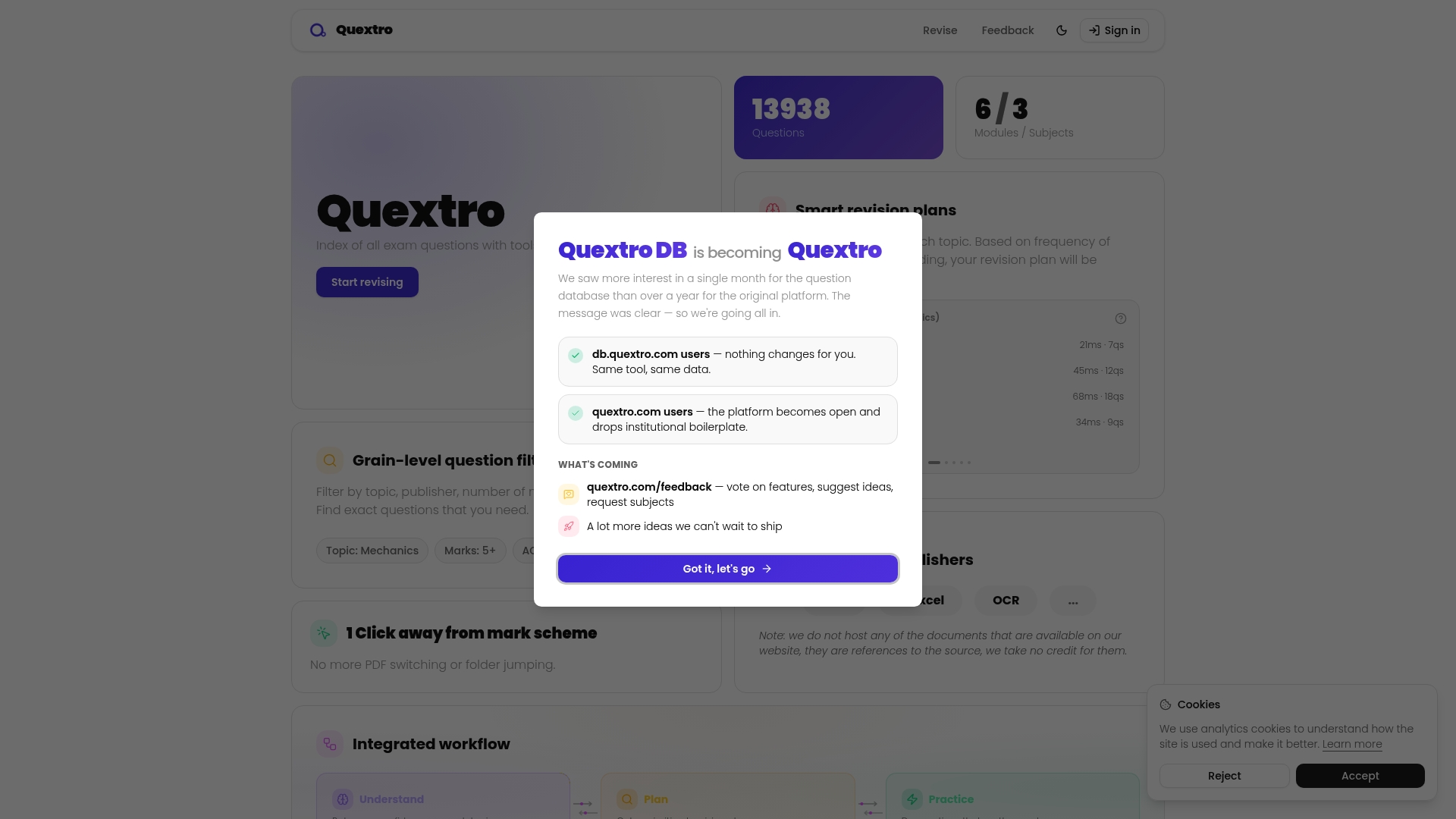
You can jump straight into Pure maths question sets if algebra and calculus are your focus, work through Foundation papers to build core confidence, or push yourself with Further maths modules when you are ready for a greater challenge. Quextro's smart revision plans adapt to your confidence ratings, so the platform automatically surfaces the questions you need most. Answer directly on the site, save your progress, and track improvement over time without a single PDF download.
Frequently asked questions
What are common types of A Level maths exam questions?
Most questions cover Pure maths, Statistics, and Mechanics, with a strong emphasis on multi-step calculations. All major boards align on core methodologies including Newton's laws and statistical hypothesis testing.
Which exam board questions are the hardest?
Difficulty depends more on the topic than the board. 100-mark, 2-hour papers are standard across AQA, Edexcel, and OCR, so the challenge level is broadly comparable.
How do I use past maths exam questions most effectively?
Mix question types, set a timer based on the mark allocation, and always study the mark scheme after each attempt. Targeted past paper practice consistently outperforms re-reading notes for exam performance.
Can I use exam questions from other boards for revision?
Yes. Since all boards align on core maths methods, cross-board practice is genuinely useful. Just check that the topic matches your syllabus before you begin.