

TL;DR:
- Marking your own work using official examiners' criteria helps identify specific errors and applicable marks, leading to deliberate improvements.
- By understanding how examiners assess methods and answers, students can confidently replicate successful approaches and reduce exam anxiety through consistent self-evaluation.
Getting your marked paper back and seeing red annotations without truly understanding why you lost those marks is one of the most frustrating experiences in A Level maths preparation. You practised for hours, your working looked reasonable, yet marks slipped away in ways that feel arbitrary. The truth is, examiners follow precise conventions that most students never study directly. When you learn to mark your own work using the same logic an examiner applies, you stop guessing and start making deliberate improvements. This guide gives you a complete, step-by-step method for doing exactly that.
Table of Contents
- What you need before you start marking
- Step-by-step method for marking your own answers
- Understanding mark schemes and assessment criteria
- Common pitfalls and how to troubleshoot your marking
- Tracking your progress and making improvements
- The real secret: why professional-style self-marking changes everything
- Boost your exam preparation with resources and question banks
- Frequently asked questions
Key Takeaways
| Point | Details |
|---|---|
| Use exam board resources | Practice with authentic A Level maths papers and official mark schemes for the most accurate results. |
| Mark like an examiner | Compare your working to actual criteria using examiner comments and codes, rather than just matching answers. |
| Avoid common marking errors | Watch for missed method marks and always consult teaching guidance for special cases. |
| Track your improvement | Log your results to find patterns and focus revision on areas where marks are most often lost. |
What you need before you start marking
Once you understand the benefits of self-marking, gather the tools you will need for the most authentic experience. Working through a past paper without the correct resources is like rehearsing a play without a script. You might practise the movements, but you will never know whether your performance actually hits the marks.
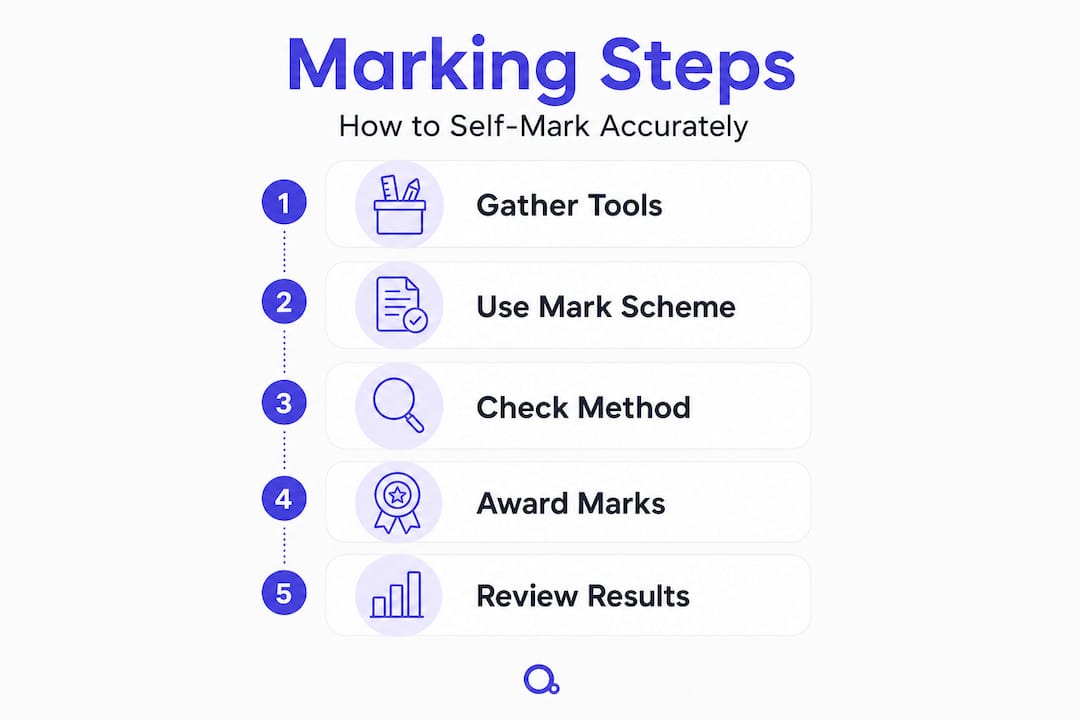
Every accurate self-marking session requires three core documents: the exam paper itself, the official mark scheme, and any associated teaching or examiner guidance. AQA provides official sample papers, mark schemes, and teaching guidance for A Level Maths through its All About Maths portal, and other major boards including Edexcel, OCR, and CIE host equivalent resources on their own sites. Always download documents from the official board site rather than third-party aggregators, since these can contain errors or outdated versions.
Here is a summary of what to collect and why each piece matters:
| Resource | Purpose |
|---|---|
| Past exam paper | Provides authentic question context and phrasing |
| Official mark scheme | Shows accepted methods, partial credit, and marking conventions |
| Teaching or examiner guidance | Clarifies ambiguous marking decisions and common student errors |
| Specification document | Confirms topic scope so you know what is examinable |
| Blank answer booklet (optional) | Mimics exam conditions for more realistic practice |
Before you sit down to mark, check that the mark scheme matches the exact paper series. Mark schemes from a different sitting, even for the same module, can vary in accepted methods. Understanding the art of using mark schemes effectively is a skill in itself and pays dividends across every topic.
Pro Tip: Always cross-reference the year and series code printed on the mark scheme with the one on your exam paper. A mismatched document will mislead your marking and undermine the whole exercise.
Step-by-step method for marking your own answers
With your resources ready, it is time to learn the process examiners actually use, step by step. Many students make the mistake of comparing their answer only to the final numerical result printed in the mark scheme. Real marking is far more nuanced than that.
Follow this numbered sequence for every question you mark:
- Complete the paper under timed conditions first. Never mark as you go. Simulate exam pressure, then put the paper aside for at least twenty minutes before reviewing.
- Read the full mark scheme entry for the question. Before comparing anything, understand what the scheme is actually rewarding. Note any alternative methods listed.
- Annotate your answer with ticks and crosses at each step. Work line by line, not just at the final answer. Award marks where your working earns them, not solely where it looks neat.
- Note any marks lost and write the specific reason beside each one. Was it a missing negative sign, a failure to show sufficient working, or a logical leap without justification?
- Check the examiner notes section if available. These often explain which errors were most common among candidates nationally, giving you crucial context.
- Total your marks and record the result. Log your score against the maximum available for that question and paper.
Here is a comparison of the two approaches students commonly use, and why the mark scheme method is significantly more powerful:
| Approach | What it reveals | What it misses |
|---|---|---|
| Comparing to model answer | Whether the final answer matches | Partial credit opportunities, method marks |
| Following the official mark scheme | Method marks, accuracy marks, follow-through credit | Nothing, when done correctly |
"Benchmark your performance empirically using official mark schemes instead of relying solely on model answers. The mark scheme tells you what was rewarded, not just what was right."
The distinction matters enormously. A student who integrates incorrectly in the first step of a multi-part question might still earn four or five marks for correct method in subsequent parts, provided the mark scheme includes follow-through credit. Ignoring this inflates your apparent deficit and demoralises you unnecessarily. For a deeper look at this process, the step-by-step mark scheme analysis guide expands on these techniques across different question types.
Pro Tip: Always award yourself method marks for a correct process even when your final answer is wrong. If your integration technique was sound but you made an arithmetic error, the mark scheme almost certainly gives credit for the method. Denying yourself those marks skews your data.
Understanding mark schemes and assessment criteria
Once you know how to mark, it is crucial to interpret the mark scheme the way examiners do, not just by copying answers but by understanding the underlying logic. Mark schemes are written in a specific shorthand that most students never decode, yet cracking this code is essential for accurate self-assessment.
The two fundamental mark types in A Level maths are method marks (M marks) and accuracy marks (A marks). Method marks reward the correct mathematical process, even when the answer contains an error. Accuracy marks are only awarded when the answer itself is correct, often contingent on a preceding method mark being earned. A third type, B marks, are independent marks awarded for specific correct values or statements regardless of method.
Common misunderstandings students have when interpreting mark schemes include:
- Treating the mark scheme as a single acceptable answer. Most schemes list several equivalent forms and explicitly state that other valid methods should be credited. Your answer does not need to match the printed layout word for word.
- Missing the "ft" or follow-through notation. This means marks can still be awarded in a later part even if you made an error earlier, provided your subsequent working is consistent with your own earlier result.
- Ignoring the "cao" notation. This stands for "correct answer only" and signals that no follow-through credit is available for that specific mark.
- Overlooking the word "or equivalent." Many numerical answers have multiple acceptable forms, such as a fraction, decimal, or surd.
AQA's teaching guidance clarifies what students must demonstrate in assessed requirements and helps align self-marking with official criteria. This document is particularly useful for understanding exactly how much working you need to show and what constitutes sufficient justification in proof-based questions.
"Students must show sufficient working to demonstrate their method clearly. An answer that arrives at the correct result by an ambiguous route will not necessarily earn method marks."
Being strategic about answering exam questions effectively means knowing not just the mathematics but also how to present it in the way examiners expect. Self-marking is what teaches you the difference.
Common pitfalls and how to troubleshoot your marking
Marking accurately is challenging. Here is how to spot and fix the issues students most often face when they first start self-assessing.
The most frequent errors include:
- Missing method marks by being too strict. Students often cross out an entire solution because the final answer is wrong, failing to award themselves valid method steps.
- Over-crediting vague working. Writing a formula and jumping to an answer without showing the intermediate steps does not earn method marks, even if the answer happens to be correct.
- Misreading mark cap notations. Some questions cap the total marks available in a part, regardless of the number of correct statements made. Always check whether a cap applies.
- Awarding accuracy marks when the method was flawed. If your method was incorrect, an accidentally correct answer will not earn the associated A mark.
- Ignoring alternative methods listed in the scheme. If you used a valid approach that happens to differ from the printed solution, check the scheme's alternatives section before penalising yourself.
When you are genuinely unsure how to score a response, use this troubleshooting checklist:
- Re-read the question carefully. Sometimes confusion arises from misreading the task itself.
- Return to the mark scheme and identify whether the mark is an M, A, or B mark.
- Check the examiner notes for any comments on how that specific mark was commonly awarded or withheld.
- If still uncertain, provisionally award zero and flag it for a teacher or peer review.
- Cross-reference with teaching guidance for the relevant topic area.
For further guidance on reviewing your work systematically, the resource on reviewing exam answers for higher grades offers structured techniques for analysing mistakes over multiple papers.
Pro Tip: Always check for follow-through marks before finalising your total. Even after a calculation error, you may still be entitled to subsequent marks if your working is logically consistent with your earlier (incorrect) result.

Tracking your progress and making improvements
After marking your work, keep improving by using the data you have gathered from this process. A single marked paper tells you your score. A series of marked papers, properly logged, tells you your patterns, and patterns are where real revision insight lives.
Use a simple tracking table to record your results across papers:
| Paper / date | Topic area | Marks earned | Marks available | Mark types lost | Action required |
|---|---|---|---|---|---|
| AQA June 2023 P1 | Integration | 14 | 18 | 2 × A mark, 1 × M | Practice substitution errors |
| AQA June 2023 P2 | Trigonometry | 9 | 12 | 2 × A mark | Review exact values |
| AQA Nov 2022 P3 | Proof | 7 | 10 | 1 × M, 2 × B | Study proof conventions |
After three or four sessions, this table becomes genuinely informative. You might notice that accuracy marks are consistently the issue rather than method marks, suggesting that your mathematical process is sound but your arithmetic or algebraic manipulation needs attention. Or you might see that certain topics cost you marks repeatedly, indicating a knowledge gap rather than an exam technique problem.
Using official mark schemes for self-assessment lets you track real progress against examiner standards, not just against your own expectations. This distinction is important because students who assess informally tend to overestimate their performance.
To turn your marking data into genuine grade improvement, build these habits into your revision:
- Review every lost mark immediately while the reasoning is still fresh in your mind.
- Re-attempt lost questions without looking at the mark scheme, then re-mark to check whether you have addressed the gap.
- Categorise errors as conceptual (you did not understand the topic), procedural (you understood but made a process error), or presentational (your working was unclear).
- Set weekly targets based on your tracking table, for example, reducing accuracy mark losses in calculus by half over two weeks.
- Also explore reviewing exam answers to build a structured post-paper review routine.
The real secret: why professional-style self-marking changes everything
Having worked through the technicalities, it is time to understand the deeper advantage of examiner-style marking. Most students treat self-marking as a chore, something they do quickly after a practice paper to check whether they got the answers right. That mindset misses the point entirely.
When you mark your own work the way a professional examiner does, you are not just checking answers. You are internalising the logic of how mathematics is assessed. You begin to think in marks. When you sit down to answer a question in the actual exam, you automatically write working that earns marks because you have spent weeks understanding exactly what earns them. That is not something that comes from practising more questions. It comes from studying how those questions are judged.
"The students who improve fastest are not the ones who do the most papers. They are the ones who spend as much time studying the mark scheme as they do answering the question."
This shift also reduces exam stress significantly. Anxiety in A Level maths often stems from uncertainty. You do not know whether your approach is good enough. Examiner-style self-marking removes that uncertainty because you have already tested your methods against official criteria, repeatedly and rigorously. You walk into the exam with evidence that your approach works, not just hope.
There is also a critical thinking benefit that rarely gets discussed. Analysing why a mark is or is not awarded forces you to understand the difference between a correct process and a correct answer. That is genuinely sophisticated mathematical thinking, the kind that distinguishes A and A* candidates from those who plateau at a B. Study the mark scheme analysis perspective to see how this mindset develops over time. Most students overlook this entirely. Do not be one of them.
Boost your exam preparation with resources and question banks
Ready to take your self-marking skills further? Practising across a wide range of mark schemes is the fastest way to sharpen your instincts as a self-assessor, and the more variety you encounter, the better you understand how different question types award marks.
Quextro gives you access to over 13,955 past exam questions from AQA, Edexcel, OCR, and CIE, each paired with mark scheme support and organised by topic, difficulty, and mark value. You can practise targeted areas such as statistics papers and questions or work through the decision mathematics question bank to build confidence in specific modules. With smart revision plans, question notebooks, and integrated answer workflows, Quextro turns every self-marking session into a structured, trackable step towards a higher grade.
Frequently asked questions
Where can I download official A Level mathematics mark schemes?
Official mark schemes are available directly on your exam board's website. AQA provides mark schemes through its All About Maths section, while Edexcel, OCR, and CIE host equivalent resources on their own portals.
How do I know if I have awarded myself the right marks?
Always refer to the full official mark scheme, including examiner notes, rather than relying on what looks correct to you. Official mark scheme conventions spell out exactly what earns each mark, including alternative methods and follow-through credit.
What is the difference between method marks and accuracy marks?
Method marks reward the correct mathematical process even when the final answer is wrong, while accuracy marks are only awarded when the answer itself is correct. Understanding this distinction is essential for fair and accurate self-assessment.
What if my answer is not word-for-word what is in the mark scheme?
Examiners look for correct methods and logical reasoning, not verbatim reproduction of a printed solution. Teaching guidance clarifies what students must demonstrate in assessed requirements, and most mark schemes explicitly list equivalent acceptable forms.