

TL;DR:
- Marks in A Level maths exams are allocated for method, accuracy, and independent explanations.
- Understanding mark distribution helps students revise efficiently and maximize partial credit.
- Analyzing mark schemes improves exam performance by focusing on demonstrating correct reasoning at each step.
Most students believe that getting the right answer is all that matters in a maths exam. That assumption costs marks every single year. A Level maths mark schemes are built around a layered system where method, accuracy, and reasoning each carry their own independent value, meaning you can score meaningfully even when your final answer is wrong. Understanding how marks are actually allocated transforms the way you revise and the way you perform under pressure.
Table of Contents
- What does marks allocation mean in A Level maths exams?
- Comparing marks allocation across major UK exam boards
- How marks allocation influences your revision and exam strategy
- Mark allocation walkthrough: Example question analysis
- The overlooked power of marks allocation: What most students miss
- Where to find top mark scheme resources and revision tools
- Frequently asked questions
Key Takeaways
| Point | Details |
|---|---|
| Marks are not just for answers | A Level maths rewards method and explanation as well as final solutions. |
| Board conventions are consistent | Most UK boards use M/A/B mark schemes, so revision strategies apply broadly. |
| Target method marks for maximum points | Showing your working can secure additional marks and reduce lost marks from errors. |
| Practise with mark schemes | Using past papers and mark scheme analysis helps you pinpoint how marks are awarded. |
| Smart revision boosts performance | Understanding allocation lets you focus prep on high-mark question features. |
What does marks allocation mean in A Level maths exams?
Marks allocation refers to the structured way examiners assign points to each part of a question. It is not simply about awarding one mark per correct answer. Instead, each question is broken into distinct credit categories that reflect different stages of mathematical thinking.
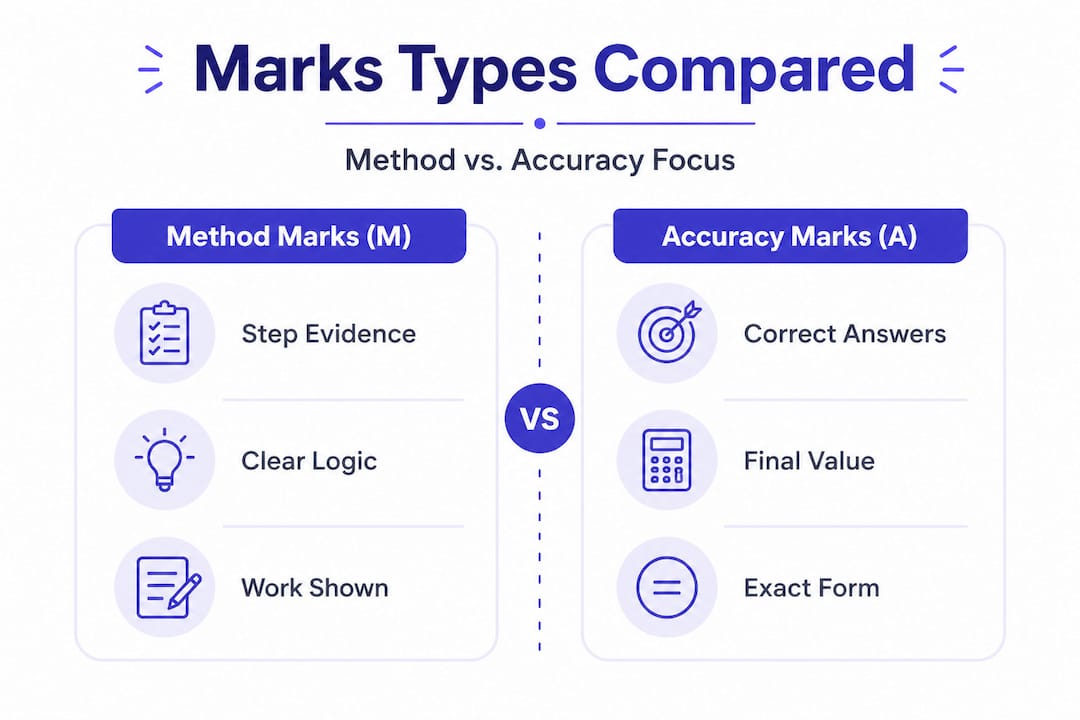
The three core mark types you will encounter are:
- M marks (method marks): Awarded for demonstrating a correct mathematical process or approach, regardless of whether the final answer is correct. If you set up an integration correctly but make an arithmetic slip, you still earn the M mark.
- A marks (accuracy marks): Awarded for correct numerical results or expressions, but only when the associated method mark has been earned. These marks are contingent on M marks being achieved first.
- B marks (independent marks): Awarded for specific correct statements, values, or explanations that stand alone. These are not dependent on other marks being achieved. A correct statement of a formula, for instance, might earn a B mark even if the rest of the working is flawed.
Understanding this structure immediately reshapes your exam approach. The mark scheme basics reveal that examiners are not just checking your answer; they are tracking your thinking at every step. All boards, including AQA, Edexcel, and OCR, use similar M/A/B conventions, which means this knowledge is universally applicable across whichever specification you are sitting.
Pro Tip: Download two or three official mark schemes from your exam board's website and highlight every M, A, and B mark in a different colour. This visual exercise makes the pattern of credit distribution immediately obvious and trains your eye to recognise where marks live within a question.
Marks are typically distributed across a question in proportion to the complexity of each step. A six-mark question on solving a differential equation, for example, might carry two M marks, two A marks, and two B marks, each rewarding a different cognitive stage. Recognising this pattern helps you avoid rushing to a final answer and instead ensures every step is clearly shown.
Comparing marks allocation across major UK exam boards
Once you understand the conventions, it is worth looking at how the major boards apply them. AQA, Edexcel, and OCR all follow broadly similar frameworks, but there are important differences that can affect how you approach each paper.
| Mark type | AQA | Edexcel | OCR |
|---|---|---|---|
| M (method) | Used extensively for multi-step processes | Used for core method, with clear sub-steps | Method shown with structured stages |
| A (accuracy) | Dependent on prior M mark | Dependent on prior M mark, strict on notation | Dependent on M, with allowances for equivalent forms |
| B (independent) | Awarded for standalone correct values or statements | Awarded for specific correct facts or formulae | Used for definitions and stated results |
| dep (dependent) | Applied when a mark relies on a previous specific mark | Clearly labelled in scheme | Sometimes implicit in wording |
The concept of "dep" or dependent marks is worth pausing on. Specifics like 'dep' (dependent) vary slightly between boards. A dependent mark means that credit is only available if a particular earlier mark was earned. On Edexcel papers, this is often labelled explicitly in the mark scheme. On OCR papers, the dependency may be implied by context. Knowing your board's convention matters.
A few specific points to consider when comparing exam boards:
- AQA tends to be very explicit about awarding marks for unsimplified correct expressions, so leaving an answer in surd form is often perfectly acceptable.
- Edexcel often places higher emphasis on notation accuracy, particularly in calculus questions where forgetting the integration constant can cost an A mark.
- OCR sometimes accepts a wider range of equivalent forms, but their questions can require more written justification for B marks.
Understanding the Edexcel exam structure in detail, for instance, reveals that Paper 3 (Statistics and Mechanics) has a notably different distribution of B marks compared to the pure maths papers. Statistics questions frequently award B marks for correctly stating hypotheses or conclusions in context, which is a common place where students lose easy credit through vague or incomplete wording.

How marks allocation influences your revision and exam strategy
With board differences in hand, let us consider how this understanding reshapes your actual revision and performance on the day. The connection between marks allocation and exam strategy is direct and powerful.
Candidates who study mark allocation perform more efficiently in exams. This efficiency comes from knowing exactly where to focus energy, both during revision and in the exam hall. Here is a practical strategy checklist built around marks allocation:
- Always show your method. Never perform a calculation mentally and write only the answer. An M mark is waiting for you even if your arithmetic fails.
- Lay out working in logical steps. Examiners follow a sequence. If your working jumps unpredictably, you risk losing method marks even if the final answer is correct.
- Write conclusions in full sentences for statistical or applied questions. B marks in these sections often require a specific phrase or reference to context.
- Check notation carefully. Missing a "dx" in an integral or omitting "+c" at the end of an indefinite integration is a common source of lost A marks.
- Use the mark allocation to gauge depth. A question worth one mark needs one clear step. A question worth five marks needs five distinct, visible contributions. Use the mark total as a guide for how much working to show.
- Revisit dropped accuracy marks separately. During revision, note which A marks you consistently lose. This often points to specific arithmetic habits rather than conceptual misunderstanding.
When analysing exam questions, a useful habit is to annotate the question paper with expected mark types before writing anything. For a differentiation question, you might note "M for applying chain rule, A for correct derivative, B for stating domain restriction." This mental map keeps you focused on earning each type of credit.
Pro Tip: Treat every past paper attempt as a mark scheme exercise, not just an answer-checking session. After completing a question, use the mark scheme to identify exactly which marks you earned and which you missed. This approach, outlined in maths exam success tips, shifts your feedback loop from "was I right?" to "did I earn every available mark?"
The best practices for exam preparation consistently emphasise that targeted revision beats generic practice. If you discover you are losing B marks on mechanics questions, you can focus specifically on stating Newton's second law correctly or defining variables clearly at the start of each solution. This precision is far more efficient than simply doing more questions without analysis.
Setting clear study goals around specific mark types, for instance targeting an improvement in A mark accuracy over two weeks, gives your revision measurable direction and keeps you motivated through a long exam cycle.
Mark allocation walkthrough: Example question analysis
To illustrate how this unfolds in practice, consider the following sample question drawn from a typical A Level pure maths paper:
"Find the equation of the tangent to the curve y = 3x² + 2x at the point where x = 1."
This question is typically worth four marks. Here is how mark scheme conventions determine exactly how points are awarded:
| Step | Working | Mark type | Marks available |
|---|---|---|---|
| 1 | Differentiate: dy/dx = 6x + 2 | M | 1 |
| 2 | Substitute x = 1: dy/dx = 8 (gradient) | A | 1 |
| 3 | Find y-coordinate: y = 3 + 2 = 5, so point is (1, 5) | B | 1 |
| 4 | Form equation: y = 8x + c, then c = 5 - 8 = -3, so y = 8x - 3 | A | 1 |
Let us walk through the reasoning:
- The M mark is earned by attempting differentiation using the correct rule. Even a student who writes "dy/dx = 6x + 2" and then makes an error substituting still earns this mark.
- The A mark for the gradient is contingent on the M mark being earned. A correct gradient from a wrong method would not receive this credit.
- The B mark for identifying the correct point is independent. A student who knows to substitute x = 1 into the original equation and correctly finds (1, 5) earns this mark regardless of what happened with the differentiation.
- The final A mark for the tangent equation follows from all previous steps being correct.
"A mark scheme is not a punishment for mistakes; it is a record of mathematical thinking. Students who understand this earn more marks, not fewer." This reflects the philosophy embedded in every mark scheme produced by UK exam boards.
The key takeaway from this walkthrough is that three separate types of thinking are being rewarded in a single four-mark question. A student who cannot complete the full solution can still earn two or three marks by demonstrating clear method and correct supporting work. Reviewing the step-by-step mark scheme for multiple question types builds the pattern recognition needed to maximise every available mark.
The overlooked power of marks allocation: What most students miss
Stepping back from the mechanics, there is a deeper insight that separates students who genuinely thrive from those who plateau despite hard work. Most students revise for correctness. The best students revise for credit.
These are not the same thing. Revising for correctness means practising until you can get the right answer reliably. Revising for credit means understanding precisely which parts of your working carry marks, so that even on a question where you stumble, you walk away with something rather than nothing.
Consider two students sitting the same integration question. Student A gets the correct final answer but shows minimal working. Student B makes a sign error at the last step but shows a full, well-structured method. In most mark schemes, Student B earns more marks. All boards use similar conventions, which means this principle applies whether you are sitting AQA, Edexcel, or OCR. Mark scheme strategies that focus on maximising partial credit are genuinely one of the most underused tools in A Level preparation.
The uncomfortable truth is that many students treat mark schemes as answer sheets rather than learning documents. They glance at the final answer, tick or cross their own work, and move on. This misses the entire point. A mark scheme tells you the examiner's thought process, the order in which mathematical reasoning is expected, and the precise language or form required for full credit.
Students who internalise marks allocation develop a different relationship with difficult questions. Rather than feeling defeated when they cannot complete a problem, they shift into a mode of maximising partial credit, showing method clearly, writing down any relevant formulae, and stating known values. This mindset shift, more than any additional content revision, is often what pushes a student from a C to a B or from a B to an A.
Where to find top mark scheme resources and revision tools
Putting marks allocation knowledge into practice requires access to quality materials. That is where targeted resources make a genuine difference.

Quextro brings together over 13,955 past exam questions from AQA, Edexcel, OCR, and CIE, all organised by topic, difficulty, and marks. You can use the Edexcel maths questions database to filter questions by mark value, which is particularly powerful when you want to practise questions worth a specific number of marks and study how that credit is distributed. For those working through statistical topics, the statistics questions database lets you target B-mark-heavy questions around hypothesis testing and interpretation. Smart revision plans on Quextro adapt to your confidence levels across topics, helping you spend time where mark scheme mastery will have the greatest impact on your grade.
Frequently asked questions
How are marks allocated in A Level maths exams?
Marks are given for correct methods, accuracy, and clear explanations, not just for final answers. The M/A/B system means partial credit is available at every stage of a solution.
Do all exam boards have the same mark allocation system?
Most UK boards use similar M/A/B mark conventions, but specifics like 'dep' (dependent) vary slightly between AQA, Edexcel, and OCR, particularly around how dependent marks are signalled in the mark scheme.
Can understanding marks allocation improve my exam grades?
Yes. Students who study mark allocation perform more efficiently and consistently earn more partial credit, which accumulates significantly across a full paper.
Where can I find resources to practise mark allocation strategies?
Quextro offers searchable question databases and smart revision tools that allow you to filter by mark value and topic, making it straightforward to build mark scheme awareness into your daily revision.