

TL;DR:
- Analyzing mark schemes reveals how examiner points are allocated, improving targeted revision.
- Using official resources ensures alignment with exam standards, reducing careless mistakes.
- Tracking and reflecting on mark loss helps identify specific weaknesses for strategic improvement.
You've worked through the practice paper, checked every calculation, and still your score barely shifts. It's one of the most frustrating experiences in A Level maths revision. The problem usually isn't effort. It's that practising without understanding how marks are actually awarded is like revising in the dark. Mark scheme analysis is the missing step between hard work and real results. This guide walks you through a clear, practical process for using mark schemes to decode examiner expectations, stop losing unnecessary marks, and build the kind of targeted revision habit that genuinely moves the needle.
Table of Contents
- Why mark scheme analysis matters for A Level maths
- Locating the right mark schemes and resources
- Step-by-step mark scheme analysis process
- Common mistakes and how to avoid them
- Verifying your progress: tracking improvements over time
- A fresh perspective: why real progress relies on self-reflection, not just mark schemes
- Take your revision further with Quextro
- Frequently asked questions
Key Takeaways
| Point | Details |
|---|---|
| Use authentic mark schemes | Always check your work against official exam board mark schemes for accurate feedback. |
| Follow a structured analysis | Break down each answer using the mark scheme, noting method, accuracy, and examiner comments. |
| Track and adapt | Record which marks you lose and adapt your revision to target your weakest points. |
| Avoid common pitfalls | Beware of assuming your method is correct—always confirm with the mark scheme’s solutions. |
Why mark scheme analysis matters for A Level maths
With that challenge in mind, let's clarify why investing time in mark scheme analysis makes such a difference.
Most students treat mark schemes as answer keys. They glance at the final answer, tick or cross their own work, and move on. That approach misses the entire point. A mark scheme shows you precisely how each mark is allocated across every step of a question, not just whether your final answer is correct. Understanding using mark schemes effectively changes the way you read questions entirely.
Here's what mark schemes actually reveal:
- Method marks (M marks): Awarded for using a correct method, even if your arithmetic slips.
- Accuracy marks (A marks): Only awarded when both method and answer are correct.
- Follow-through marks (ft marks): Given when your working is consistent with a previous error.
- Communication marks (B marks): Awarded for specific statements, conclusions, or notation.
Knowing this breakdown stops you from throwing away marks on careless errors. Many students lose A marks because they skip a line of working, not because they don't understand the topic. That's a fixable problem once you see it clearly.
"The mark scheme is the examiner's script. If you don't read it, you're guessing what they want."
Analysing schemes also builds awareness of analysing question patterns across papers, which helps you spot recurring question types and expected answer formats. Over time, you start to anticipate what examiners want before you even finish reading the question.
Official exam board guidance from boards such as AQA, Edexcel, and OCR provides authentic mark schemes that reflect exactly what will appear in your actual exam. Using unofficial or outdated materials risks practising against the wrong standards, which can quietly reinforce bad habits.
Locating the right mark schemes and resources
Now that you know why mark scheme analysis is vital, where can you actually find trustworthy mark schemes and supporting materials?
The most reliable starting point is always the official exam board. AQA maths resources, along with Edexcel and OCR, publish mark schemes and examiners' reports alongside every past paper. These are free to access and updated to reflect the current syllabus. Always match the mark scheme to the correct year and paper code, since small syllabus changes can affect what's expected.
Here's a comparison of the main resource types:
| Resource type | Examples | Best used for |
|---|---|---|
| Official exam board sites | AQA, Edexcel, OCR | Authentic mark schemes and reports |
| Third-party revision sites | Physics&MathsTutor | Curated papers and walkthroughs |
| Video walkthrough platforms | ExamSolutions | Step-by-step visual explanations |
| Structured revision platforms | Quextro | Filtered practice with progress tracking |
Beyond official sites, trusted third-party resources are genuinely useful. Physics&MathsTutor organises past papers by topic and year, making it easy to target specific areas. ExamSolutions provides video walkthroughs that show mark scheme logic in action.
For reviewing past papers efficiently, it helps to also read the examiners' report alongside the mark scheme. The report explains why students lost marks in that sitting, which is far more informative than the mark scheme alone. Think of the mark scheme as the map and the examiners' report as the commentary from someone who's watched thousands of students get lost on that same route.
If you're studying Edexcel structure and revision, pay particular attention to the breakdown between Paper 1 (Pure), Paper 2 (Pure and Mechanics), and Paper 3 (Pure and Statistics), as mark allocations differ across sections.
Step-by-step mark scheme analysis process
Once you have your resources, it's time to dig into the practical side: step-by-step mark scheme analysis.
Follow this five-step process every time you work through a past paper question:
- Select a question from a topic you want to strengthen. Don't just pick easy ones.
- Attempt it independently under timed conditions. Close the mark scheme completely.
- Mark your work using the scheme, going line by line through each part, not just the final answer.
- Cross-reference with the examiners' report to understand why marks were commonly lost.
- Log every mark you dropped and note the reason: method error, missing working, wrong notation, or arithmetic slip.
To see this in practice, consider a typical A Level integration question worth 6 marks. The mark scheme might allocate 1 M mark for selecting the correct method, 2 A marks for accurate integration steps, 1 M mark for applying limits correctly, 1 A mark for the correct numerical answer, and 1 B mark for including the constant of integration or appropriate units. If you get the final answer right but skip showing the limit substitution, you lose 1 M mark and potentially 1 A mark. That's a third of the question gone for one missing line.
| Mark type | What it rewards | Can you recover it? |
|---|---|---|
| M mark | Correct method shown | Only if method is visible |
| A mark | Accurate answer following method | No, if method mark lost |
| ft mark | Consistent working from earlier error | Yes, if working is shown |
| B mark | Specific statement or notation | Only if explicitly written |
Sites such as ExamSolutions walkthroughs show exactly how marks are awarded for Mechanics problems, making it easier to see the process visually before applying it yourself. Use these alongside your own marking, not as a replacement for it.
Pro Tip: Never penalise yourself twice for the same error. If you made an arithmetic mistake in part (a) but carried it through correctly in part (b), you may still earn follow-through marks. The mark scheme will indicate this with "ft" notation. Always check before deducting.
For more detail on analysing exam board questions, it helps to annotate your own answers directly, circling where each mark was or wasn't awarded.

Common mistakes and how to avoid them
As you practise, it's all too easy to fall into certain traps. Let's look at what to avoid for maximum benefit.
The most common error is confusing method marks with accuracy marks. Students sometimes assume that getting the right answer is enough. It isn't. If you write down a correct answer with no working, you may earn the A mark but lose the M mark entirely, depending on the question. Examiners cannot award marks for reasoning they cannot see.
Here are the mistakes that cost students the most marks:
- Ignoring alternative valid answers: Mark schemes often list several acceptable methods. If yours isn't listed, that doesn't mean it's wrong. Check the "or equivalent" notes carefully.
- Skipping examiner comments: Common pitfalls are flagged in examiners' reports, and ignoring them means repeating the same errors across multiple papers.
- Copying model answers without understanding them: Writing out a mark scheme answer word for word teaches you nothing. You need to understand why each step earns a mark.
- Misreading "show that" questions: These require every line of working to be explicit. The answer is given to you. The marks are entirely for the process.
Pro Tip: For "explain why" or "show that" questions, treat the mark scheme as a checklist of required statements. Each bullet point in the scheme usually corresponds to one mark. Write your answer to tick every box, not just reach the conclusion.
Referring to AQA revision tips alongside your mark scheme practice helps reinforce the specific language and notation that AQA examiners expect.
Verifying your progress: tracking improvements over time
After careful practice and feedback, how do you measure your real progress? Here's how to track improvement using mark scheme insights.
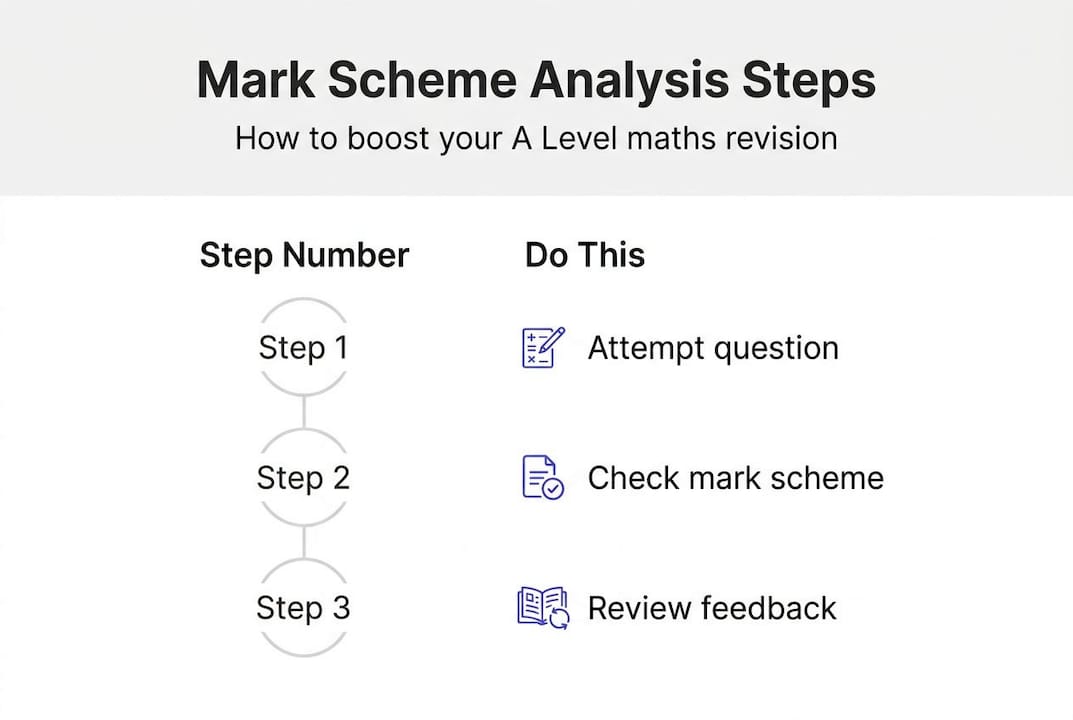
Keeping a simple progress log is one of the most effective revision habits you can build. After each practice paper or question set, record your score, the topics covered, and the specific mark types you lost. A basic spreadsheet works well for this.
Here's what to track:
| Tracking column | Why it matters |
|---|---|
| Topic and question type | Reveals recurring weak areas |
| Marks lost by type (M, A, B, ft) | Shows whether errors are method or accuracy based |
| Paper date and exam board | Ensures you're covering the full range |
| Improvement across attempts | Confirms whether revision is working |
Once you have three or four papers logged, patterns become obvious. You might notice you consistently drop A marks in differentiation but rarely lose M marks, which tells you your method is sound but your arithmetic needs attention. That's a very different revision priority to someone losing M marks across the board.
Analysing results trends over time lets you shift from reactive revision (doing more questions) to strategic revision (fixing the specific thing that costs you marks). Using mark scheme-based resources from official boards and trusted academic sites makes this tracking far more accurate, because you're measuring yourself against the real standard.
Review your log weekly. Adjust your question selection to focus on the topics where your mark loss is highest. This is how mark scheme analysis becomes a genuine feedback loop rather than a one-off exercise.
A fresh perspective: why real progress relies on self-reflection, not just mark schemes
Mark schemes are powerful tools, but they have a limit. A student who mechanically checks answers against a scheme and moves on will improve more slowly than one who pauses and asks, "Why did I think that approach would work?"
The students who see the biggest gains are those who treat every lost mark as a question worth investigating, not just a box to tick. When you lose an M mark, don't just note it. Ask yourself whether you misread the question, rushed the method, or genuinely didn't understand the concept. Those are three very different problems with three very different fixes.
A deep dive into exam questions reveals that the mark scheme is a mirror, not just a measuring tool. It shows you how you think under pressure. The most valuable revision sessions are the ones where you sit with a wrong answer long enough to genuinely understand why it was wrong, not just what the right answer was.
Mark schemes reward process. So should your revision.
Take your revision further with Quextro
Ready to supercharge your revision with guided practice? Here's where Quextro can help.
Quextro brings together over 13,955 past exam questions from AQA, Edexcel, OCR, and CIE, all organised by topic, difficulty, and mark allocation. Instead of hunting through PDFs, you can filter directly to the question types where your mark scheme analysis shows you're losing marks.

Start with Pure Mathematics resources to sharpen your core skills, or head straight to Mechanics Mathematics revision if that's where your progress log shows the most room for improvement. Register free to track your progress automatically and build a revision plan that adapts as your confidence grows.
Frequently asked questions
What is a mark scheme and why should I use it?
A mark scheme lists the criteria examiners use to award marks to each part of a question, so your answers align with the standards that earn points. Using it helps you understand exactly what examiners expect, rather than guessing.
Where can I find official A Level mathematics mark schemes?
Official exam board websites including AQA, Edexcel, and OCR publish free, up-to-date mark schemes and past papers alongside examiners' reports. Always match the scheme to the correct paper code and year.
How do I use mark schemes to improve my exam scores?
Attempt questions independently first, then check your work step by step using the mark scheme, noting where marks are lost. Mark scheme analysis helps you identify precisely which parts of your answer score marks and which don't.
Are third-party sites like Physics&MathsTutor reliable for mark scheme analysis?
Trusted third-party sites offer curated mark schemes and detailed walkthroughs, but always verify that materials match your exam board's syllabus. Physics&MathsTutor and similar sites are widely used for Mechanics and Pure resources.
How can I track my progress using mark schemes?
Log your scores and lost marks across practice papers to spot patterns and focus revision on weak topics. Mark scheme-based tracking leads to more targeted revision and measurable improvement over time.