

TL;DR:
- Simply doing past papers without reviewing answers leads to repeated mistakes and grade stagnation.
- Active review with mark schemes and examiner feedback identifies knowledge gaps and improves exam technique.
- Regular, targeted reflection transforms revision into a feedback loop that builds resilience and higher marks.
Most A Level maths students treat past papers as a performance test. You sit down, work through the questions, check your score, and move on. It feels productive. But here is the uncomfortable truth: completing past papers without deeply reviewing your answers is one of the most common reasons students plateau. Active revision with mark schemes and examiner feedback is what separates students who improve rapidly from those who keep making the same mistakes. This guide shows you exactly how reviewing exam answers transforms your revision, which errors to catch, and how to turn every paper into a direct route to higher marks.
Table of Contents
- Why simply doing past papers is not enough
- How reviewing exam answers exposes your knowledge gaps
- Spotting examiner expectations and maximising partial marks
- Recognising patterns and recurring topics to supercharge revision
- Building your review cycle: a step-by-step framework
- Why reviewing exam answers really sets top students apart
- Get the most from your A Level maths revision
- Frequently asked questions
Key Takeaways
| Point | Details |
|---|---|
| Active review outperforms passive study | Systematic review of exam answers using mark schemes gives a proven advantage over simply doing past papers. |
| Identify and fill your knowledge gaps | Using a gap list from marked papers lets you direct your revision towards what matters most for top grades. |
| Understand how examiners award marks | Learning the mark scheme rules for method and accuracy marks helps you secure extra points even when the answer is incomplete. |
| Spot recurring topics and common errors | Analysing reviewed answers makes it easier to focus revision on high-yield topics and avoid repeated mistakes. |
| Cycle and repeat for best results | Using a repeatable review and gap-closing process transforms your exam performance and confidence. |
Why simply doing past papers is not enough
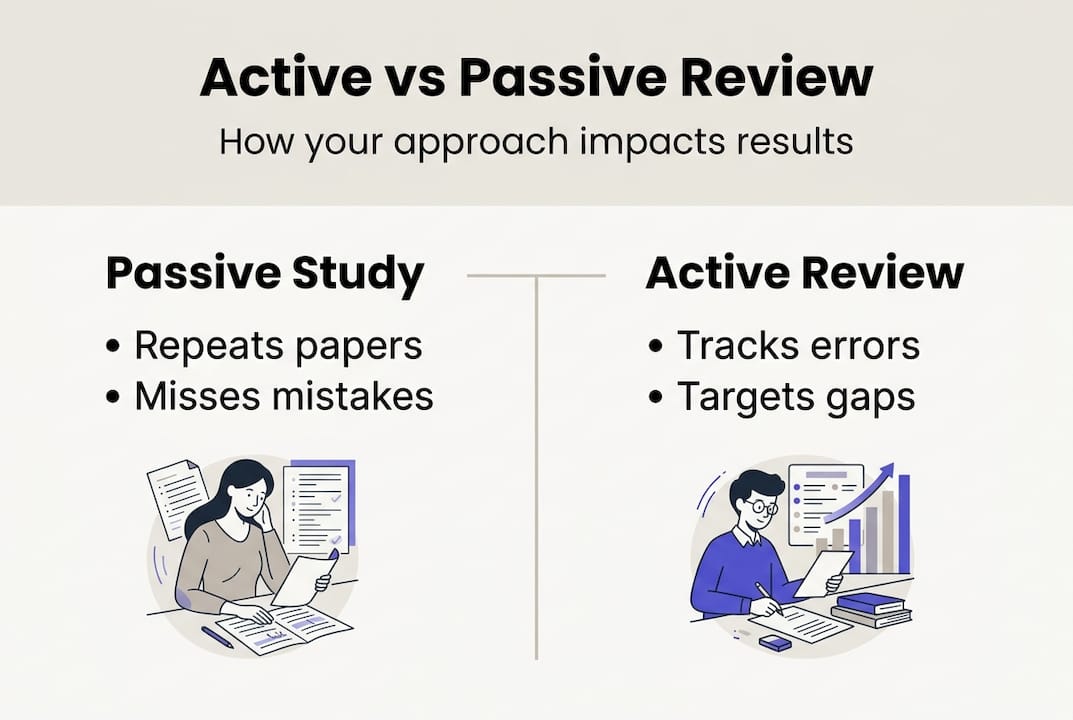
There is a big difference between doing a past paper and reviewing one. Doing a paper tells you your score. Reviewing it tells you why you lost marks and what to do about it. Without that second step, you are essentially practising your existing habits, including the wrong ones.
Many students fall into a cycle of completing paper after paper without ever addressing the mistakes they keep repeating. This feels like revision. It rarely produces the results students expect. The issue is that passive completion does not build exam technique or close knowledge gaps. It simply reinforces whatever you already know.
Consider what the data shows. 41.8% of A Level maths students achieved A*/A in 2023, and that group is strongly associated with active revision strategies rather than passive repetition. The distinction matters enormously.
Active review, by contrast, means sitting with your completed paper and a mark scheme, marking every question strictly, and logging where you dropped marks. It means reading examiner reports to understand what the examiner actually wanted. As one revision resource puts it, passive note-reading is insufficient; active review with mark schemes builds exam technique, stamina, and mark capture under timed conditions.
Here are the most common pitfalls students encounter when they skip the review stage:
- Repeating the same calculation errors without realising it
- Missing marks on method steps because they do not understand what examiners expect
- Spending revision time on topics they already understand well
- Never building the exam technique needed to perform under pressure
- Failing to spot recurring question types that appear across multiple papers
If any of these sound familiar, the good news is that a structured review process fixes all of them. Exploring exam preparation best practices and reviewing past papers for success gives you a strong foundation to build from.
How reviewing exam answers exposes your knowledge gaps
Having established why active review matters, let us look at how it pinpoints where you truly need to focus.
When you mark your own answers using an official mark scheme, something important happens. You stop guessing which topics you are weak in and start knowing. A marked paper becomes a personalised revision map, showing you exactly which question types cost you marks and which topics need more work.

Using mark schemes to expose gaps and direct targeted revision prevents you from wasting time on topics you already handle well. This is one of the most powerful shifts you can make in your revision approach.
Here is how to turn a marked paper into a gap list:
- Mark every question strictly against the mark scheme, awarding marks only where the scheme allows.
- For every question where you lost marks, write down the topic, the type of error, and the marks dropped.
- Group your errors into categories: knowledge gaps, method errors, careless mistakes, and notation issues.
- Rank each category by the number of marks lost across the paper.
- Use this ranked list to plan your next revision session, starting with the highest-impact gaps.
This approach transforms revision from a vague activity into a targeted operation. Compare the two methods:
| Approach | Time spent | Outcome |
|---|---|---|
| Random revision | High | Covers topics you may already know |
| Review-driven revision | Focused | Targets only your actual weak areas |
| Redoing full papers only | High | Reinforces existing habits |
| Gap list from review | Efficient | Closes specific knowledge gaps fast |
Pro Tip: Keep a dedicated revision log, a simple notebook or spreadsheet, where you record every topic you dropped marks on. Review this log before each study session. Focus on missed marks first, not on redoing entire papers from scratch.
By analysing question patterns and choosing key exam questions strategically, you make every revision hour count far more.
Spotting examiner expectations and maximising partial marks
Now that you know where your knowledge gaps are, the next step is to learn how examiners actually award marks and what they look for.
A Level maths mark schemes use two main types of marks. Method marks (M1) are awarded for using a correct method, even if your final answer is wrong. Accuracy marks (A1) are awarded for a correct answer, but they usually depend on the method mark being earned first. Understanding this distinction is critical because it means you can still gain marks even when you make an error, provided your method is sound.
Mark schemes reveal examiner expectations for method and accuracy marks, and reviewing them teaches you how to maximise partial credit even when your answer is incorrect.
Here is a breakdown of common errors and their mark impact:
| Error type | Marks typically lost | How to avoid it |
|---|---|---|
| Skipping method steps | M1 and A1 | Always show full working |
| Premature rounding | A1 | Keep exact values until the final step |
| Incorrect notation in stats | A1 | Follow mark scheme notation closely |
| Wrong formula applied | M1 | Revise formula conditions carefully |
The errors that cost students the most marks are often the smallest ones:
- Rounding intermediate values too early in a calculation
- Not stating hypotheses clearly in statistics questions
- Dropping a negative sign during differentiation or integration
- Forgetting to include units or constants of integration
- Writing answers without sufficient working to earn the method mark
Pro Tip: Always write out every calculation step clearly, even when it feels obvious. Under exam pressure, students rush and skip steps. Those skipped steps are often where method marks live.
When you review your answers with a mark scheme guide, you train yourself to think like an examiner. That mindset shift is what makes the difference between losing two marks per question and picking up every available mark. Practising effective exam question answering reinforces these habits further.
Recognising patterns and recurring topics to supercharge revision
Beyond gaining marks on each question, reviewing lets you step back and see which topics the exam boards keep testing. Here is how to spot those patterns.
When you review multiple past papers, you start to notice that certain topics appear again and again. Calculus, in particular integration and differentiation, appears in almost every paper. Statistics questions on hypothesis testing and probability distributions are consistently present. Mechanics questions on kinematics and forces follow predictable structures. Recurring patterns in questions across topics like calculus, statistics, and mechanics make up a significant portion of exam marks.
Recognising these patterns lets you allocate revision time where it matters most. Rather than treating all topics equally, you can weight your effort towards high-frequency, high-mark areas.
In 2023, 41.8% of A Level maths students achieved A/A grades.* This figure is closely linked to consistent, targeted review rather than passive repetition.
Reviewing also helps you catch the traps that examiners set repeatedly:
- Misapplying the suvat equations in mechanics, particularly when acceleration is not constant
- Confusing the conditions for using a normal approximation in statistics
- Forgetting to check whether a function is increasing or decreasing before applying a test
- Misreading probability questions that require conditional rather than unconditional probability
Statistics and mechanics questions are frequently underestimated, yet they test roughly a third of the entire course. Pressure-induced errors in these areas, such as suvat misapplication, are among the most common mark-losers in the exam.
Pro Tip: As you review each paper, score every topic from one to five based on your personal confidence. Topics scoring one or two should dominate your next revision sessions. This simple scoring system creates exponential progress because you stop wasting time on fours and fives.
Using an exam preparation checklist alongside your pattern recognition work keeps your revision organised and ensures no high-value topic slips through.
Building your review cycle: a step-by-step framework
Spotting patterns and maximising marks only works if you follow a consistent cycle. Here is a simple framework for reviewing exam answers that top students swear by.
The most effective review cycle has four stages, and it repeats. Each repetition shrinks your gap list and builds your confidence:
- Complete a timed paper. Sit the paper under real exam conditions. No notes, no extra time. This is the only way to simulate actual exam pressure.
- Mark strictly using the official mark scheme. Award marks only where the scheme allows. Do not give yourself the benefit of the doubt.
- Build your gap list. Record every topic and error type where you lost marks. Note the number of marks dropped for each.
- Fix and reattempt. Study the relevant topics, then reattempt the questions you got wrong without looking at the solutions first.
As OCR's guidance on past papers makes clear, the goal is not just to score grades but to use papers diagnostically, turning them into personalised revision plans rather than performance tests.
"The primary benefit of past paper review is diagnostic: it turns papers into personalised revision plans rather than performance tests, shrinking gap lists over repeated cycles."
The cycle works because targeted review turns papers into a feedback loop rather than a one-off exercise. Each cycle produces a shorter gap list. A shorter gap list means higher marks.
In the weeks before your exam, aim to complete one paper per week and review it fully before starting the next. Use past paper databases to access a wide range of papers across exam boards and topics.
Why reviewing exam answers really sets top students apart
Here is an opinion that most revision guides will not tell you: the difference between a B and an A* in A Level maths is rarely about intelligence. It is almost always about feedback loops.
The students who consistently review their answers are building something that goes beyond exam technique. They are developing the habit of learning from failure rather than avoiding it. Every marked paper is a mirror. Most students glance at it and look away. The best students stare at it until they understand every reflection.
Expert consensus consistently points to active review as the distinguishing factor for top performers, even when raw grade uplift data is difficult to isolate. Surface learning, memorising methods without understanding when to apply them, collapses under real exam pressure. Reviewing builds genuine problem-solvers who can adapt when a question looks unfamiliar.
The students who review are also more resilient. They are not rattled by a difficult question because they have already seen what happens when they get something wrong and fixed it. That psychological confidence is worth marks on its own. Exploring maths exam tips can help you build this mindset alongside your technical preparation.
Get the most from your A Level maths revision
Ready to put your review framework into practice? Quextro gives you everything you need to make this cycle work efficiently.
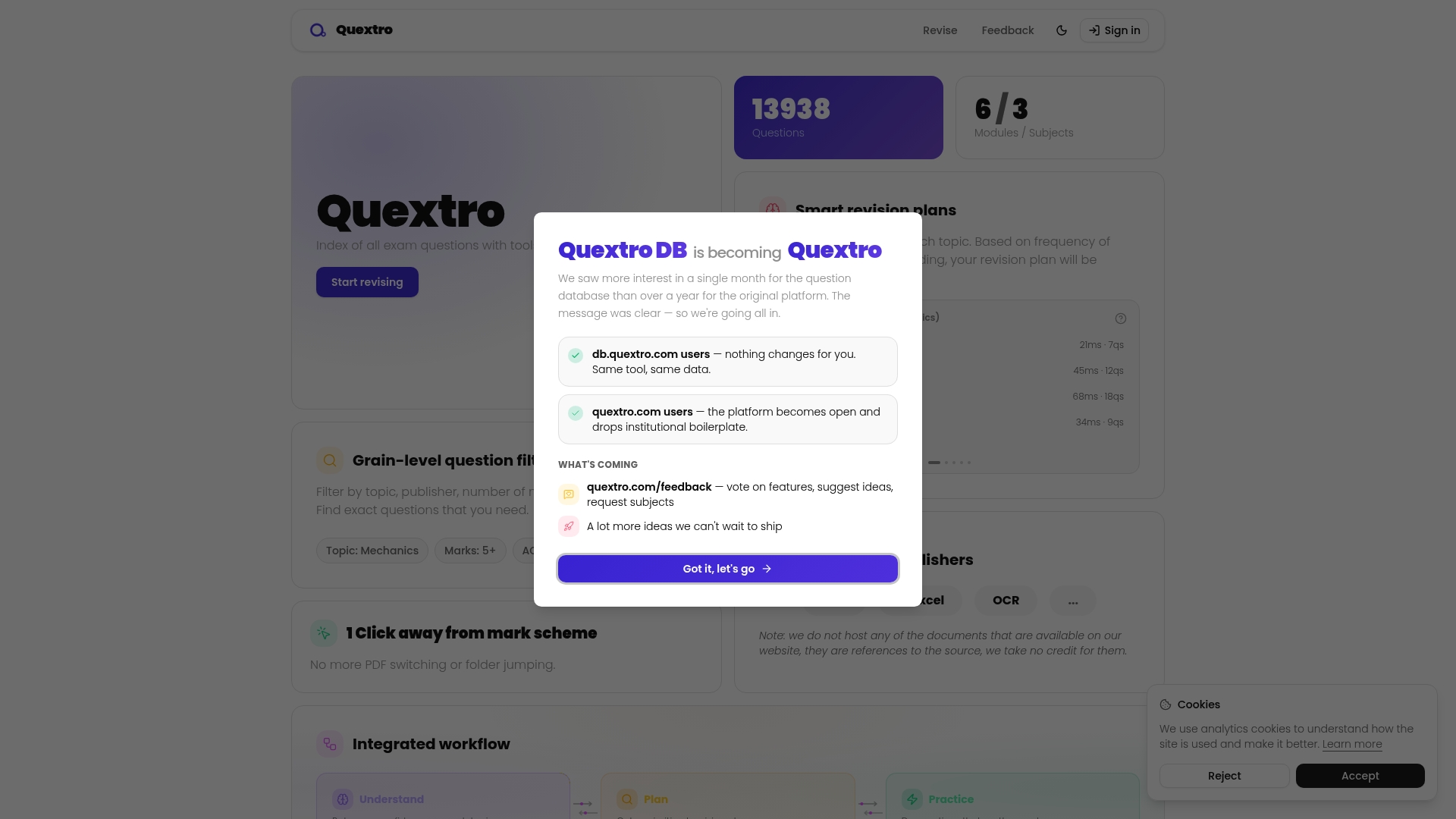
With over 13,955 past exam questions organised by topic, difficulty, and exam board, Quextro lets you target exactly the areas your gap list highlights. Whether you need to drill pure maths past papers or work through statistics past papers question by question, the platform filters content to match your specific needs. You can answer questions directly on the site, track your confidence by topic, and save your progress automatically. Explore all Quextro revision tools and make every revision session count.
Frequently asked questions
What is the best way to review A Level maths exam answers?
Mark your answers strictly using official mark schemes, log every mistake in a gap list, and focus your next revision session on the topics where you dropped the most marks. Targeted review prevents wasted time on topics you already handle well.
Why do examiners deduct marks even for small mistakes?
Examiners follow mark schemes that award separate method (M1) and accuracy (A1) marks, so a minor notation error or skipped step can cost you the accuracy mark even if your method is correct. Mark scheme expectations are precise and non-negotiable.
Is it really necessary to review statistics and mechanics as thoroughly as pure maths?
Absolutely. Statistics and mechanics together test roughly a third of the course, and pressure-induced errors such as suvat misapplication are among the most frequently penalised mistakes in A Level maths exams.
How can reviewing exam answers affect my predicted grade?
Consistent active review closes knowledge gaps and builds exam technique, both of which directly improve your performance in assessments that inform predicted grades. Active revision strategies are strongly associated with the 41.8% of students who achieved A*/A in 2023.
What are the biggest mistakes students make when reviewing exam answers?
The most damaging mistakes are failing to log errors systematically, ignoring examiner feedback in mark schemes, and treating the score as the only useful output. Real improvement comes from understanding why you lost each mark, not just how many you lost.