

Many students believe A Level maths exams only reward correct final answers. This misconception causes unnecessary stress and lost marks. Mark schemes actually reward the full problem-solving process, not just the solution. Understanding how mark schemes work transforms your exam strategy and boosts your scores significantly. This article explains mark scheme structure, the key mark types used by examiners, and practical tips to use them effectively in your A Level maths exams. You will learn how to maximise marks even when final answers are uncertain.
Table of Contents
- Key takeaways
- What is a mark scheme and why does it matter?
- Understanding the core mark types in A Level maths
- Navigating mark scheme nuances and edge cases
- How to use mark schemes to boost your exam performance
- Boost your A Level maths revision with Quextro
- Frequently asked questions
Key Takeaways
| Point | Details |
|---|---|
| Core mark types | The three main mark types are M for method, A for accuracy dependent on method, and B for independent marks, with A dependent on earning the M mark. |
| Show working | Clear working helps secure M marks and can unlock A marks even if the final answer is wrong. |
| Partial credit | Partial credit rewards the problem solving process by awarding marks for method even if the final result is incorrect. |
| Units and presentation | Always include units and label graphs where appropriate to maximise B marks. |
What is a mark scheme and why does it matter?
A mark scheme is an official document provided by exam boards like AQA, Edexcel, and OCR detailing mark allocations for each question. These documents guide examiners in assigning marks fairly and consistently, regardless of the varied approaches students might take. Mark schemes focus on rewarding the correct method, not just the final answer. This emphasis on process over product distinguishes A Level maths from simpler multiple choice exams.
Using mark schemes during revision helps you understand examiner expectations and avoid losing marks unnecessarily. They clarify exactly what examiners look for in your working. They reward partial progress even if final answers are incorrect. They discourage guesswork without working. They help you plan how to structure answers effectively.
Mark schemes provide detailed criteria for exactly how marks are awarded per exam question. Each question breaks down into specific marking points, with clear conditions for earning each mark. Understanding this breakdown transforms how you approach exam questions. Instead of rushing to a final answer, you recognise the value of demonstrating each step clearly.
When you study mark schemes alongside past papers, you develop insight into which steps earn marks. This knowledge guides efficient working during exams. You learn to prioritise showing method over speed. You understand why neat, logical presentation matters. You discover how to earn marks even when uncertain about final answers. Creating an exam preparation checklist that includes mark scheme review ensures you maximise this strategic advantage.
Understanding the core mark types in A Level maths
A Level maths mark schemes use three main types of marks, each with specific rules and purposes. Core mark types include M (method), A (accuracy dependent on method), and B (independent) marks with specific rules for allocation. Understanding these distinctions helps you maximise marks strategically.
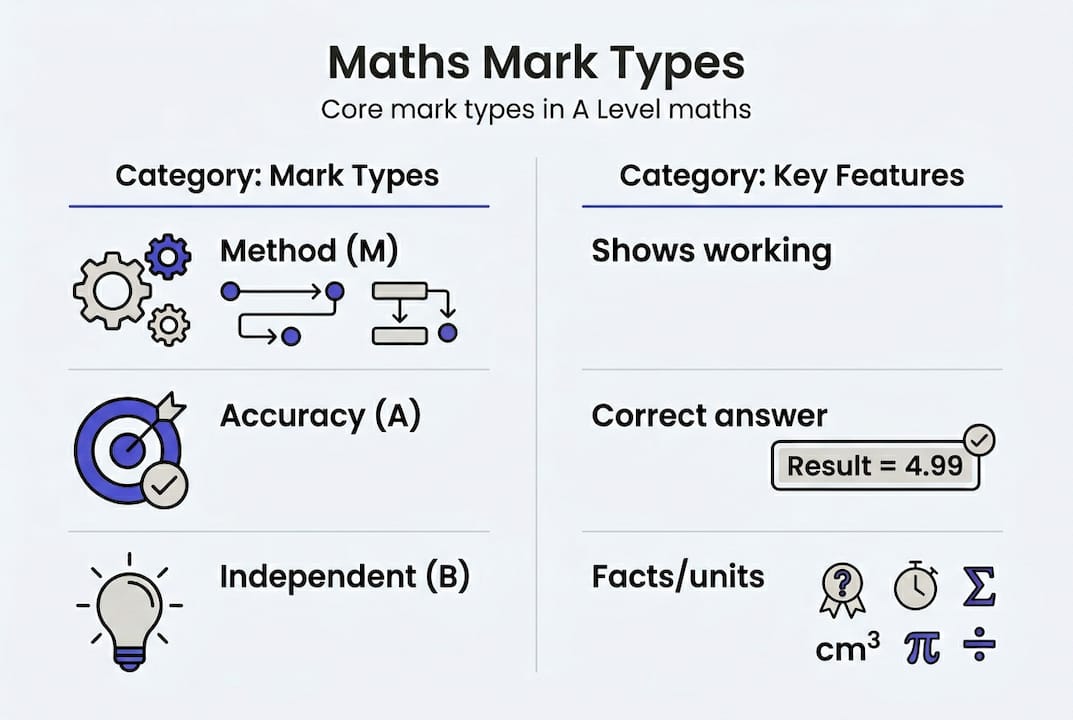
Method marks (M) reward correct problem-solving steps. These marks recognise that you have chosen the right approach and applied appropriate techniques. You earn M marks by demonstrating understanding of the mathematical process, even if subsequent calculations contain errors. For example, correctly substituting values into the quadratic formula earns an M mark regardless of arithmetic mistakes later.
Accuracy marks (A) reward correct final answers but depend on earning the preceding M mark. This dependency prevents lucky guesses from earning full credit. If you write a correct answer without showing method, you miss the M mark and therefore cannot earn the A mark either. This rule emphasises the importance of showing working clearly.
Independent marks (B) reward factual points like units, graph readings, or definitions, independent of M marks. These marks are easier to secure because they do not depend on previous working. Always include units where appropriate and label graphs clearly to collect these straightforward marks.
| Mark type | Purpose | Dependency | Example |
|---|---|---|---|
| M (method) | Rewards correct solving steps | None | Substituting into quadratic formula |
| A (accuracy) | Rewards correct answers | Requires preceding M mark | Correct final solution |
| B (independent) | Rewards factual points | None | Including units or labelling axes |
Mark schemes use abbreviations to clarify marking conditions. The term 'cao' means 'correct answer only', indicating an answer that must be exact. The term 'oe' means 'or equivalent', allowing alternative correct forms of the same answer. Special cases (SC) accommodate common misunderstandings with adjusted marks, recognising typical student errors whilst still rewarding partial understanding.
Consider a quadratic equation question worth 3 marks. The mark scheme might allocate M1 for correct substitution into the formula, M1 for correct simplification, and A1 for the correct final answer. If you substitute correctly but make an arithmetic error, you earn M1 but lose M1 and A1, scoring 1 out of 3. If you show all working correctly, you earn all 3 marks. This example illustrates how answering A Level maths questions with clear working protects your marks.

Pro Tip: Always write full working clearly to secure those valuable method marks even if your final answer is uncertain. Examiners cannot award marks for steps they cannot see, so make your reasoning explicit.
Navigating mark scheme nuances and edge cases
Mark schemes contain built-in checks to avoid rewarding lucky guesses or incomplete work. No accuracy (A) mark is given without the correct method (M) mark to prevent guesswork; special cases (SC) cover common errors; examiners rely on team leaders for judgement calls. These nuances ensure fair marking whilst recognising genuine understanding.
The dependency rule means you must show your solving process to earn accuracy marks. Simply writing a correct answer without working earns zero marks in many cases. This rule might seem harsh, but it ensures marks reflect mathematical understanding rather than chance. It also means incorrect final answers can still earn substantial marks if the method is sound.
Common special case (SC) allowances give partial credit for typical mistakes if method is visible. For example, a mark scheme might award M1 for correct quadratic formula substitution even with a slight calculation error in simplification. These allowances recognise that small arithmetic slips should not completely negate demonstrated understanding of the mathematical concept.
Markers use judgement when student work falls into grey areas. They escalate uncertain cases to team leaders, ensuring fair and consistent marking across all exam papers. This process protects students from arbitrary decisions whilst maintaining rigorous standards. Understanding this human element behind marking helps you appreciate why clear presentation matters.
Key tips to avoid losing marks include showing your solving method explicitly, even for seemingly simple questions. Carefully label units and answers to gain B marks without extra effort. Be aware of how marks depend on previous steps when planning your working. Understand abbreviations like 'cao' and 'oe' in mark schemes so you know when exact answers are required versus when equivalent forms are acceptable.
Consider a trigonometry question where you must find an angle. If the mark scheme specifies 'cao', your answer must be exact to the required precision. If it says 'oe', alternative correct forms like simplified fractions or exact multiples of π are acceptable. Knowing these distinctions prevents unnecessary mark loss from format issues.
Pro Tip: Practising with official mark schemes improves your ability to predict which steps earn marks, guiding efficient working. Regular exposure to mark schemes trains your brain to think like an examiner, helping you structure answers strategically. This skill becomes invaluable during exams when time pressure increases. Use an exam question filtering guide to find relevant practice questions with mark schemes.
How to use mark schemes to boost your exam performance
Studying official mark schemes should be part of your revision to understand examiner expectations. Mark schemes reward process over product; showing full working is vital to secure partial marks, thereby improving scores. This strategic approach transforms exam performance without requiring additional mathematical knowledge.
Follow this step-by-step approach to applying mark scheme knowledge effectively. First, learn the common mark types and their meanings so you recognise them instantly. Second, use mark schemes to identify key solving steps rewarded in typical questions across different topics. Third, show every methodical step clearly in your working during practice and exams, making your reasoning explicit. Fourth, check dependencies for accuracy marks to avoid missing marks through incomplete working. Fifth, use units and labelling carefully to gain independent B marks that require minimal effort.
| Answer type | Working shown | Marks earned | Reason |
|---|---|---|---|
| Correct answer with full working | Complete method and correct calculations | 3/3 | All M and A marks awarded |
| Correct answer without working | Final answer only | 0/3 | No M marks, therefore no A marks |
| Incorrect answer with correct method | Correct approach, arithmetic error | 2/3 | M marks awarded, A mark lost |
| Incorrect answer with partial method | Some correct steps, wrong approach | 1/3 | Partial M marks for correct elements |
This comparison illustrates how working and clear structure matter more than final answers. The difference between zero marks and substantial partial credit lies entirely in showing your method. Even when uncertain about your final answer, demonstrating correct problem-solving steps protects your score.
Pro Tip: Practise with past papers alongside mark schemes to develop familiarity and identify weak areas for improvement. Work through questions, then immediately check the mark scheme to see exactly where you earned or lost marks. This immediate feedback accelerates learning and helps you internalise examiner expectations.
Following this strategy helps you earn partial credit even if final answers are imperfect, maximising your overall score with less stress. You stop viewing exams as all-or-nothing tests and start seeing them as opportunities to demonstrate understanding through clear working. This mindset shift reduces anxiety and improves performance. Choosing exam questions for revision that match your weak areas and reviewing past papers effectively with mark schemes creates a powerful revision strategy.
Boost your A Level maths revision with Quextro
Understanding mark schemes is essential, but applying this knowledge requires extensive practice with real exam questions. Quextro offers an extensive database of A Level maths exam questions across all key topics, providing the perfect platform to implement the strategies covered in this article.
Users can access past papers with official mark schemes to practise applying knowledge effectively. The exam questions database includes over 13,955 questions from major exam boards like AQA, Edexcel, OCR, and CIE. Foundation, mechanics, statistics, and further maths papers are available to cover all exam areas comprehensively. Whether you need foundation mathematics papers or mechanics maths questions, Quextro provides organised access to exactly what you need.
Integrating these resources into your revision helps you master mark scheme expectations and boost marks naturally. The platform's filtering system lets you focus on specific topics, difficulty levels, or mark allocations, enabling targeted practice. Using Quextro complements your learning and exam strategy development smoothly with real exam content.
Frequently asked questions
What is a mark scheme?
A mark scheme is an official document from exam boards that details exactly how marks are allocated for each question in an exam. It specifies which steps earn method marks, which answers earn accuracy marks, and what conditions apply. Examiners use mark schemes to ensure consistent, fair marking across all students.
Can I get marks if my final answer is wrong?
Yes, you can earn substantial marks even with an incorrect final answer if you show correct method. Method marks (M) reward proper problem-solving steps regardless of arithmetic errors. This is why showing full working is essential. You might earn two-thirds of available marks despite a wrong answer if your approach is sound.
Why do some marks depend on previous marks?
Accuracy marks (A) depend on method marks (M) to prevent rewarding lucky guesses without understanding. If you write a correct answer without showing how you reached it, you cannot earn the A mark because you have not earned the prerequisite M mark. This dependency ensures marks reflect genuine mathematical understanding.
How can I practise using mark schemes effectively?
Work through past papers, then immediately review the mark scheme to see exactly where marks were allocated. Compare your working against the mark scheme to identify which steps you missed or presented unclearly. Regular practice builds familiarity with examiner expectations. Creating an exam preparation checklist that includes mark scheme review ensures consistent progress.
What do abbreviations like cao and oe mean in mark schemes?
The abbreviation 'cao' means 'correct answer only', indicating the answer must be exact to earn the mark. The abbreviation 'oe' means 'or equivalent', allowing alternative correct forms of the same answer such as simplified fractions or different valid expressions. Understanding these terms helps you know when precision matters versus when flexibility is allowed.