

TL;DR:
- Structured past paper practice, including phases and error analysis, enhances exam readiness.
- Using official resources, mark schemes, and examiner reports improves self-assessment and technique.
- Quality revision with targeted practice and reflection yields better results than sheer quantity of papers.
You've spent hours at your desk, worked through notes, watched tutorials, and still your mock results feel inconsistent. Sound familiar? Many A Level maths students fall into the trap of passive revision, covering material without ever testing themselves under realistic conditions. The result is a gap between what you think you know and what you can actually demonstrate under pressure. Structured past paper practice closes that gap. This guide walks you through a phased, evidence-backed method that turns past papers from a source of dread into your most powerful revision tool.
Table of Contents
- Gathering the right materials and tools
- Mapping your revision: the phased approach
- Mastering mark schemes and examiner insight
- Targeted problem-solving and error logs
- Why quality beats quantity in past paper practice
- Take your revision further with curated resources
- Frequently asked questions
Key Takeaways
| Point | Details |
|---|---|
| Structured phases | Breaking revision into diagnostic, hybrid, and full timed phases yields better results than random practice. |
| Mark scheme mastery | Using official mark schemes and examiner reports helps capture crucial partial marks and learn from each attempt. |
| Quality over quantity | Rigorous, reflective practice is more effective than completing a large number of papers casually. |
| Error logging | Tracking and reviewing your mistakes by type ensures targeted improvement on weaker topics. |
| Resource curation | Leveraging databases, mark schemes, and online tutors streamlines your revision and boosts exam confidence. |
Gathering the right materials and tools
Once you recognise the importance of a methodical approach, the first step is ensuring you have everything required for structured practice. Rushing into past papers without the right resources is like revising with half the information. You need official papers, mark schemes, and examiner reports working together.
The best starting point is always the official exam board websites. Whether you sit AQA, Edexcel, or OCR, each board publishes free past papers directly on their sites. These are the most accurate reflection of what your actual exam will look like, formatted identically and using the precise language your examiner expects. As outlined in the official past papers guide, gathering materials from exam boards like AQA, Edexcel, and OCR is the essential first step in any structured revision plan.
Beyond the papers themselves, mark schemes are non-negotiable. They show you exactly how marks are awarded, which methods are acceptable, and where students commonly lose credit. Pair them with examiner reports, which are published after each sitting and contain direct commentary from the people who marked your paper. These reports highlight the mistakes students made most often, giving you a shortcut to understanding where marks are genuinely won and lost. Learning mark scheme analysis as a skill in itself is one of the highest-leverage things you can do.
For topic-specific drilling, external sites like PhysicsAndMathsTutor and Madasmaths offer well-organised question banks sorted by topic and difficulty. These are particularly useful in the early phases of revision when you want to isolate specific areas rather than tackle full papers.
Here is a quick comparison to help you decide when to use each type of resource:
| Resource type | Best used for | Limitation |
|---|---|---|
| Full past papers | Simulating exam conditions | Can be overwhelming early on |
| Topic-specific questions | Targeting weak areas | Less exam-condition realism |
| Mark schemes | Self-assessment and error analysis | Requires honest self-marking |
| Examiner reports | Understanding mark allocation | Only available after each sitting |
Before you begin, make sure you have the following ready:
- At least five recent past papers from your specific exam board
- Corresponding mark schemes for every paper
- Examiner reports from the last two to three years
- A dedicated notebook or digital document for error logging
- Access to a topic-question bank for targeted drilling
- A reliable calculator approved for your specification
Mapping your revision: the phased approach
Having gathered all resources, the next stage is structuring your practice using a proven phased approach. Without a clear plan, it is easy to drift between papers without making real progress. A three-phase structure keeps your revision purposeful from start to finish.
The timed practice tips from education specialists confirm a phased model: Phase 1 covers diagnostic and topic practice over one to three weeks, Phase 2 introduces hybrid practice over two to three weeks, and Phase 3 moves into full timed papers for four or more weeks, with two to three papers completed each week.
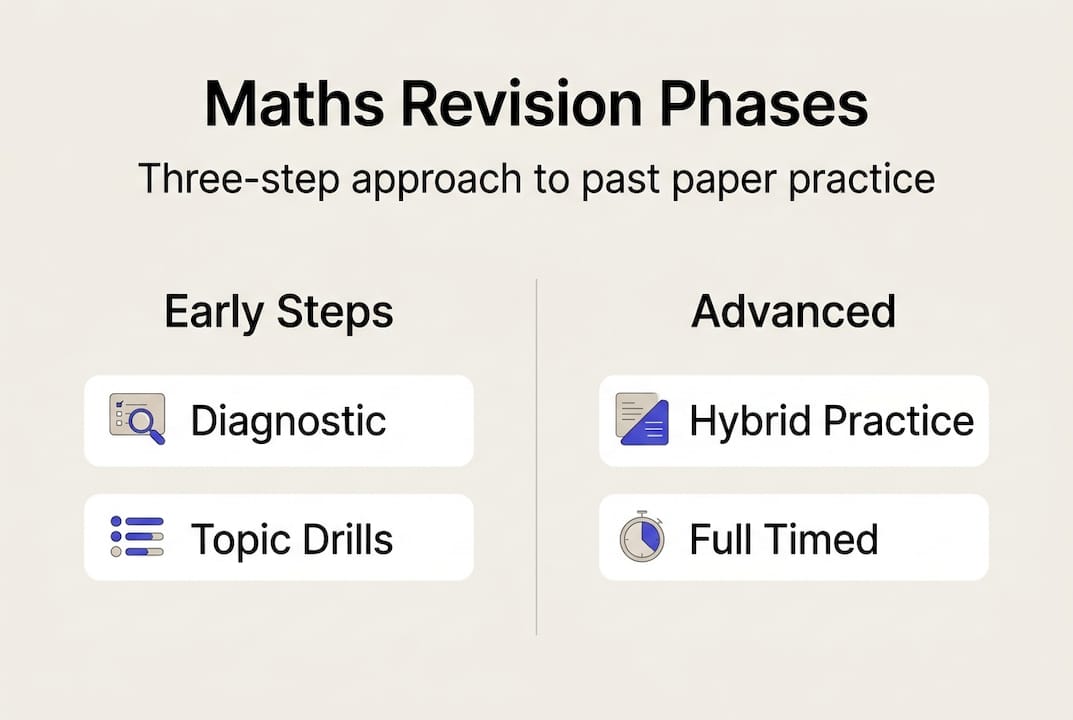
| Phase | Duration | Focus | Expected outcome |
|---|---|---|---|
| Phase 1: Diagnostic | 1 to 3 weeks | Topic questions, open notes | Identify weak areas |
| Phase 2: Hybrid | 2 to 3 weeks | Mixed open and timed tasks | Build speed and accuracy |
| Phase 3: Full papers | 4 or more weeks | Timed full papers, exam conditions | Exam readiness |
Here is how to work through each phase effectively:
- Phase 1: Select one topic at a time. Work through questions with your notes open. The goal is not speed; it is understanding. Note every question you struggled with.
- Phase 2: Begin closing your notes for easier questions. Introduce time limits on individual questions. Mix topics within a single session to simulate the unpredictability of a real paper.
- Phase 3: Sit full papers under strict exam conditions. No notes, no interruptions, timed to the minute. Mark immediately after and log every error.
Pro Tip: Resist the urge to jump straight into full timed papers at the start of your revision. Students who begin there often become demoralised quickly, which damages confidence and motivation. The phased approach builds both skills and resilience gradually.
As you move into Phase 3, your exam technique strategies become just as important as your mathematical knowledge. Knowing when to move on, how to manage time across sections, and how to structure written answers all contribute to your final mark.
Mastering mark schemes and examiner insight
With your revision mapped out, mastering self-assessment is the next crucial skill. Proper use of mark schemes and examiner insights makes the difference between students who plateau and those who keep improving.

Mark schemes use a specific notation that is worth understanding properly. Method marks, labelled M1, are awarded for using a correct approach even if your final answer is wrong. Accuracy marks, labelled A1, depend on getting the correct value. As confirmed by the official marking guidance, marking using official schemes and focusing on method versus accuracy marks is central to effective self-assessment.
This distinction matters enormously in practice. If you wrote down a correct method but made an arithmetic slip, you may still earn the M1 mark. Showing your working in full is therefore not optional; it is a mark-earning strategy. Students who write only their final answer lose method marks every time they make a small error.
Examiner reports take this further. They reveal the specific phrases and approaches that earned full credit, and they flag the misunderstandings that caused widespread mark loss. Examiner report insights consistently highlight calculator fluency as an underestimated factor, particularly for statistics and numerical methods questions.
Here is a practical process for working with mark schemes after each paper:
- Mark every question immediately after finishing the paper, while your thinking is fresh
- Highlight questions where you lost marks despite understanding the topic
- Distinguish between method errors and accuracy errors for each lost mark
- Read the relevant examiner report section for any question where you scored below half marks
- Rewrite your solution using the mark scheme's preferred method
"Exam technique alone can shift your grade by a full boundary. Students who understand how marks are awarded consistently outperform those who only focus on mathematical content."
Practising analysing mark schemes as a regular habit, rather than a one-off activity, is what separates students who improve steadily from those who stagnate.
Targeted problem-solving and error logs
Once you have learned how to mark your papers, it is time to leverage your mistakes as learning opportunities. An error log transforms random mistakes into a structured revision list, and it is one of the most underused tools in A Level maths revision.
Errors in maths tend to fall into three distinct categories. Concept errors occur when you do not understand the underlying principle, for example, misapplying the chain rule. Process errors happen when you understand the concept but execute the steps incorrectly, such as forgetting to reverse an inequality sign when dividing by a negative. Careless errors are arithmetic or notational slips that have nothing to do with understanding. Each type requires a different response. As the official guidance recommends, creating mistake logs that categorise errors by type is a core part of effective past paper practice.
Here is how to maintain your error log effectively:
- After marking each paper, record every question where you lost marks in your log.
- Write the topic, the type of error (concept, process, or careless), and a brief note on what went wrong.
- Revisit each logged question within 48 hours and attempt a similar question from a topic bank.
- Mark that entry as resolved only when you can answer a comparable question correctly without notes.
- Review your full log weekly to spot recurring patterns.
For targeted drilling on weak topics, resources like PhysicsAndMathsTutor and Madasmaths let you filter questions by topic and difficulty, making it straightforward to find practice material for your specific gaps. This targeted drilling approach is far more efficient than working through entire papers when you have a known weak area.
Pro Tip: Quality beats quantity every time. As research into exam preparation confirms, ten rigorous, fully reviewed papers outperform twenty papers completed casually without proper analysis. Every paper you sit should result in a completed error log entry and at least one targeted drilling session.
Your mistake analysis methods will evolve as your revision progresses. In the early phases, concept errors will dominate. By Phase 3, if your process is working, you should see a shift towards fewer concept errors and mostly careless ones, which is a sign of genuine progress.
Why quality beats quantity in past paper practice
There is a persistent myth among A Level students that doing more papers automatically leads to higher grades. It does not. Completing a paper and filing it away without reviewing it in detail is almost entirely wasted time. The learning happens in the review, not the sitting.
Reflective practice is what drives improvement. Each paper should prompt you to ask: where did I lose marks, why did I lose them, and what will I do differently next time? Without that loop, you are simply repeating the same mistakes at speed.
It is also worth balancing past paper practice with other revision methods. As expert guidance notes, tutors caution against over-relying on past papers alone, recommending a mix that includes flashcards, group study, and concept review. Legacy papers from older specifications can be useful, but only after filtering for content that still appears on your current syllabus.
The students who see the biggest grade jumps are not those who sit the most papers. They are the ones who treat each paper as a diagnostic tool, pair it with deliberate practice, and use quality revision strategies to address every gap they find.
Take your revision further with curated resources
Now that you understand the value of effective practice, see how tailored databases can streamline your next revision session.
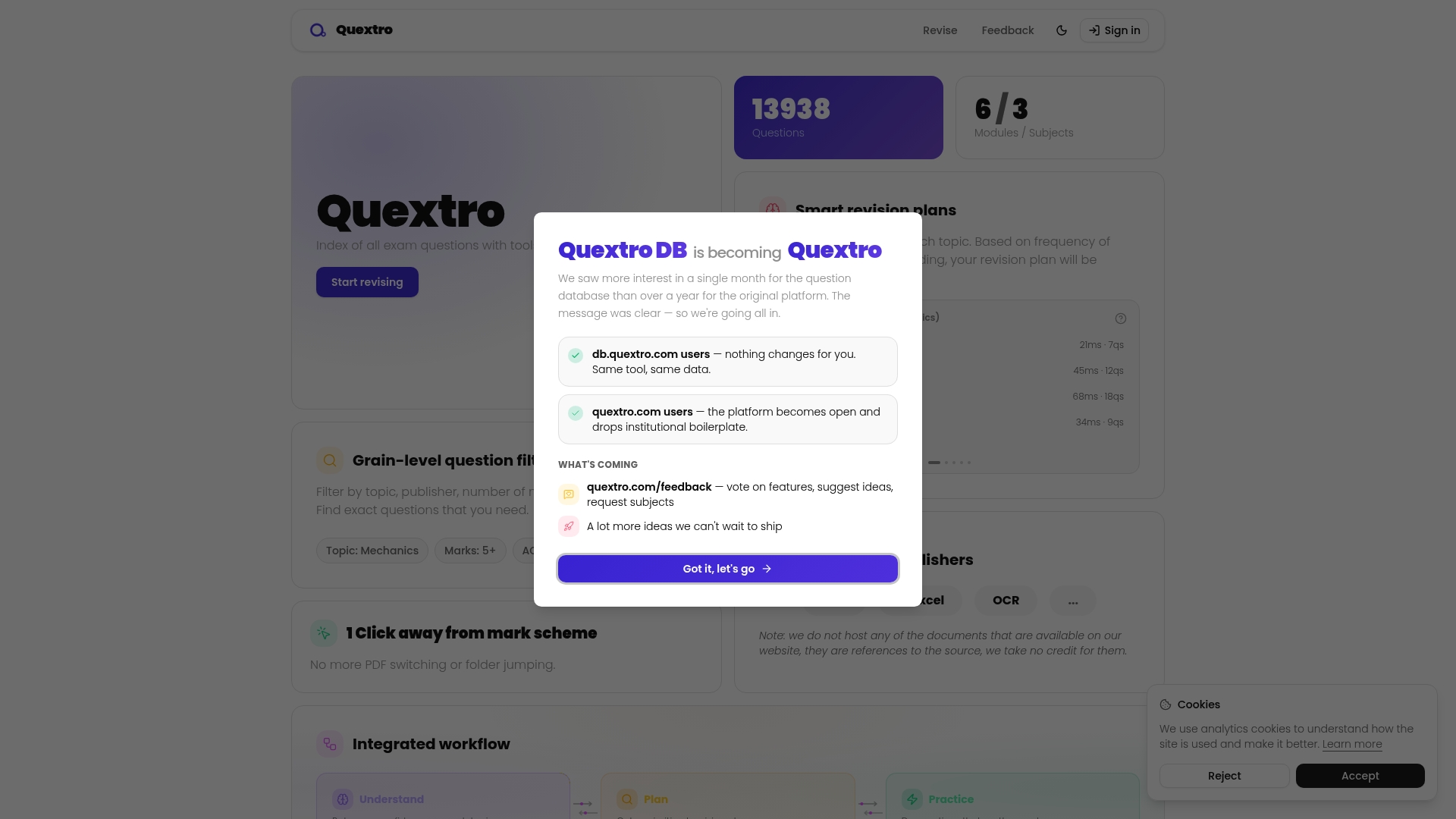
Quextro gives you access to over 13,955 past exam questions from AQA, Edexcel, OCR, and CIE, all filterable by topic, difficulty, and mark allocation. Instead of hunting through PDFs, you can go straight to the questions that matter most for your revision. Whether you are working through the pure mathematics database or the further mathematics database, the platform adapts to your confidence levels and tracks your progress automatically. Start your structured revision today at Quextro and put the phased approach into action with the right questions at your fingertips.
Frequently asked questions
How often should I practise full past papers?
During the final phase, aim for 2 to 3 papers each week under strict exam conditions to build both stamina and timing awareness.
Should I start with topic questions or whole papers?
Begin with topic-specific questions to build confidence in individual areas, then transition to whole papers. Starting with topics prevents the overwhelm that often derails students who jump straight to full papers.
What's the best way to use a mistake log?
Record each error by type (concept, process, or careless) and revisit similar questions regularly. Categorising errors this way helps you identify patterns and target your drilling more precisely.
How can I maximise marks if I run out of time?
Always show your full working and attempt every question, because partial marks are available even for incomplete answers through method marks.
Is it helpful to do past papers from older specifications?
Legacy papers can be useful, but only after filtering for relevance to your current syllabus. Focus on recent papers first for the most accurate exam preparation.