

TL;DR:
- Effective exam technique, including clear working and time management, is key to top grades.
- Regular practice with past papers and error logs improves application under exam conditions.
- Mastering technique helps close the grade gap, regardless of mathematical ability.
In 2023, 41.8% of students achieved A*/A in A Level Maths. That is a striking figure, but here is what it really tells you: a large proportion of capable students did not reach those grades, and the gap was rarely about raw mathematical ability. It was about exam technique. Knowing how to solve a problem is only half the battle. Knowing how to present that solution, manage your time, and extract every available mark from a question is what separates a B from an A*. This article gives you a clear, practical framework for building the kind of exam technique that turns solid maths knowledge into the grade you deserve.
Table of Contents
- Understanding exam technique in A Level maths
- Core components of effective exam technique
- Expert nuances, common pitfalls, and mechanics-specific advice
- Applying exam technique: building confidence and consistent performance
- Why mastering exam technique is the real differentiator
- Enhance your maths exam technique with Quextro
- Frequently asked questions
Key Takeaways
| Point | Details |
|---|---|
| Technique over ability | Strategic exam methods matter more than raw maths talent for top marks. |
| Show all working | Clear step-by-step solutions secure critical method marks even if answers are wrong. |
| Avoid common pitfalls | Careful reading, proper units, and correct diagram use reduce frequent errors. |
| Practice for confidence | Timed exam conditions and mistake logs build consistent, results-driven revision habits. |
Understanding exam technique in A Level maths
Many students treat exam technique as a vague afterthought, something they will pick up naturally through revision. That assumption costs marks. Exam technique refers to the strategies and methods used during an exam to maximise marks, including showing clear working, structuring solutions logically, managing time, and understanding mark schemes to secure method marks even if the final answer is incorrect. It is a learnable skill, not a personality trait.
Think of it this way: two students with identical mathematical knowledge sit the same paper. One writes neat, logical steps and earns method marks even where the final answer is wrong. The other rushes, skips steps, and loses marks on questions they actually understood. The difference is technique, not intelligence.
Here are the core components that define strong exam technique in A Level maths:
- Clear working: Every step written out, even when it feels obvious
- Logical structure: Solutions that flow from one line to the next without jumps
- Time management: Knowing when to move on and return to a question later
- Mark scheme awareness: Understanding how marks are awarded so you target them deliberately
- Exam preparation best practices: Building habits before exam day so technique is automatic under pressure
A common misconception is that revision alone is sufficient. Students who spend hours re-reading notes but never practise effective question answering under exam conditions often find themselves unable to apply their knowledge when the clock is ticking.
| Grade | Approximate mark required | Technique emphasis |
|---|---|---|
| A* | 90%+ overall, 90%+ in A2 | Maximum: every mark counts |
| A | ~80% | High: method marks critical |
| B | ~70% | Moderate: accuracy and structure |
| C | ~60% | Foundation: basic working shown |
"Clear working can earn 70 to 80% of marks even if the final answer is wrong." This is why showing your method is non-negotiable, regardless of whether you are confident in your answer.
Building on exam success tips from experienced educators, the students who consistently reach A* treat technique as a separate discipline, not a by-product of revision.
Core components of effective exam technique
Now that you know the basics, let us break down what makes exam technique truly effective in practice. The following strategies are drawn from proven exam approaches used by top-performing A Level students: practising past papers under timed conditions, keeping a mistake logbook, showing clear steps, double-checking answers, drawing diagrams, and tackling easier questions first.
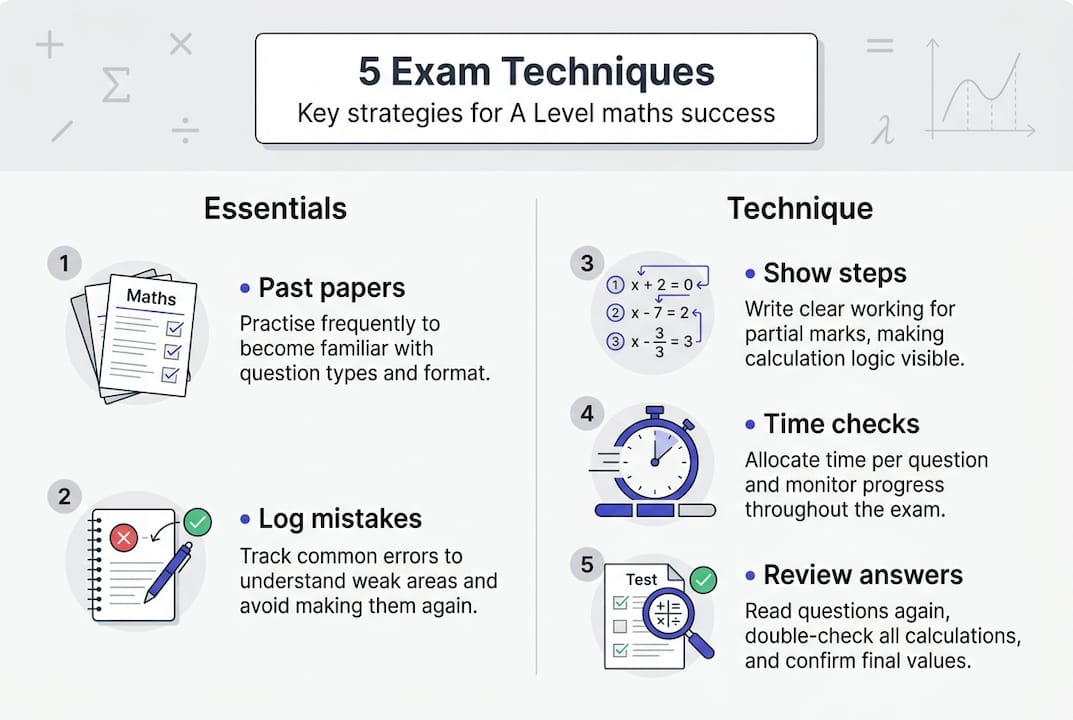
Past papers with mark scheme analysis are the single most effective revision tool available to you. Do not just check whether your answer is correct. Read the mark scheme line by line and ask yourself: where exactly did the examiner award marks? Which step earned the method mark? This trains your eye to spot what examiners value.

A mistake logbook is equally powerful. After every practice paper, write down every question you lost marks on, why you lost them, and what you should have done differently. Over time, patterns emerge. Maybe you consistently drop marks on integration by substitution, or you forget to check whether a quadratic has two solutions. Spotting the pattern lets you fix it before the real exam.
Use mark scheme techniques to understand exactly how marks are split between method, accuracy, and communication marks. Many students are surprised to find they can score 8 out of 10 on a question they could not finish.
For geometry, trigonometry, and vectors, always draw a diagram. Even a rough sketch forces you to organise information and often reveals the method. Students who skip diagrams regularly miss straightforward routes to the answer.
Here is a practical list to embed into your revision sessions:
- Simulate timed exam conditions at least twice per week
- Review the mark scheme immediately after finishing each question
- Log every error with a brief explanation of what went wrong
- Tackle the questions you find easiest first to bank marks quickly
- Draw diagrams for any question involving spatial reasoning
- Use targeted practice to focus on your weakest topics
For managing confidence, a traffic light approach works brilliantly: label each topic green (confident), amber (shaky), or red (needs work). Prioritise red and amber topics in your revision schedule.
Pro Tip: Do not wait until you have finished an entire paper before checking the mark scheme. After each question, mark it immediately. This keeps feedback tight and learning fast.
Expert nuances, common pitfalls, and mechanics-specific advice
With the fundamentals covered, let us look at the expert-level details and the mistakes that trip up even strong students. Edexcel examiner reports consistently highlight the same issues: applied maths questions require students to rewrite contextual problems as standard mathematical problems before solving; proof questions demand a clear concluding statement; and rounding too early causes cascading errors across multi-step questions.
| Common pitfall | Expert technique |
|---|---|
| Rounding mid-calculation | Carry exact values throughout; round only at the final step |
| Missing units in mechanics | Always include units at every stage, not just the answer |
| Sign errors in algebra | Rewrite negative terms explicitly before simplifying |
| Vague conclusions in proofs | Write a clear final statement: "Therefore, the result is proved" |
| Incorrect diagram labelling | Label forces, angles, and directions before starting any calculation |
For mechanics specifically, follow these steps:
- Draw a clear force diagram before writing any equations
- State the value of g you are using (g = 9.8 m/s² unless told otherwise)
- Define positive directions explicitly at the start of the solution
- Use suvat equations only when acceleration is constant; check this assumption first
- Restate the context in your conclusion (for example, "The particle decelerates at 2 m/s²")
Students working through question organisation strategies often find that structuring their working spatially on the page, with clear labels for each stage, reduces sign errors significantly. Exam board question analysis also reveals that examiners reward precision in language, particularly in statistics and proof.
For students who find mechanics challenging, the key shift is treating it as applied problem-solving rather than pure calculation. Read the scenario twice, extract the physical quantities, and then convert the problem into algebra.
Pro Tip: Always state your assumptions and constants at the start of a mechanics solution. Writing "g = 9.8 m/s², particle modelled as a point mass" takes five seconds and can protect marks if your method is otherwise correct.
Applying exam technique: building confidence and consistent performance
Finally, let us explore how to turn exam technique into an everyday habit for maximised confidence and results. Reaching A* requires sustained performance across the entire paper, typically 90% or above overall, which means you cannot afford to lose marks through avoidable technique errors. Consistency is the goal.
Traffic light systems and mistake logs target weaknesses empirically, avoiding the trap of spending equal time on every topic regardless of where your marks are actually being lost. This targeted approach is far more efficient than generic revision.
Statistic: Students aiming for A* need to demonstrate consistent accuracy and method across all question types, not just their favourite topics.
Here is a daily revision framework to embed exam technique as a habit:
- Complete one or two past paper questions under timed conditions every day
- Mark your work against the official mark scheme immediately afterwards
- Add any errors to your mistake logbook with a brief explanation
- Update your confidence tracker (traffic light system) for each topic practised
- Spend the final ten minutes of each session reviewing a previous mistake
- Use your exam preparation checklist to track readiness across all topics
Simulating exam conditions is non-negotiable. Sitting at a desk, timed, with no notes, is the only way to practise the mental discipline that exam technique requires. Students who only revise in comfortable, open-book conditions often find the real exam environment jarring.
For targeted question selection, focus on question types where you consistently lose marks rather than practising topics you already find easy. The data from your mistake logbook should drive this decision, not gut feeling.
The evidence is clear: students who combine structured practice with honest self-assessment outperform those who simply do more questions without reflection.
Why mastering exam technique is the real differentiator
Here is an uncomfortable truth that most revision guides gloss over: the gap between B and A* is rarely about who is more mathematically gifted. It is almost always about who applies technique more consistently under pressure.
Cramming the night before an exam feels productive, but it is one of the least effective strategies available. The students who reach A* are not necessarily the ones who know the most mathematics. They are the ones who have built daily habits: logging mistakes, reviewing mark schemes, and reflecting after every practice session. That discipline compounds over weeks and months.
Revision becomes genuinely productive only when it is targeted and structured. Spending three hours on topics you already understand is comfortable but wasteful. Spending thirty minutes on a topic you consistently drop marks on, using targeted practice strategies to guide your selection, is how real improvement happens.
"Consistency beats brilliance." The student who shows up every day, logs every mistake, and refines their technique incrementally will, over time, outperform the naturally talented student who relies on instinct alone.
Treat exam technique as a skill you are actively building, not a habit that will develop on its own. The investment is modest. The return, in marks and confidence, is significant.
Enhance your maths exam technique with Quextro
If you are ready to put these strategies into practice, Quextro gives you everything you need in one place. The platform's A Level maths question database holds over 13,955 past exam questions from AQA, Edexcel, OCR, and CIE, all filterable by topic, difficulty, and marks. You can simulate exam conditions directly on the site, answer questions, and review mark schemes without hunting through PDF files.
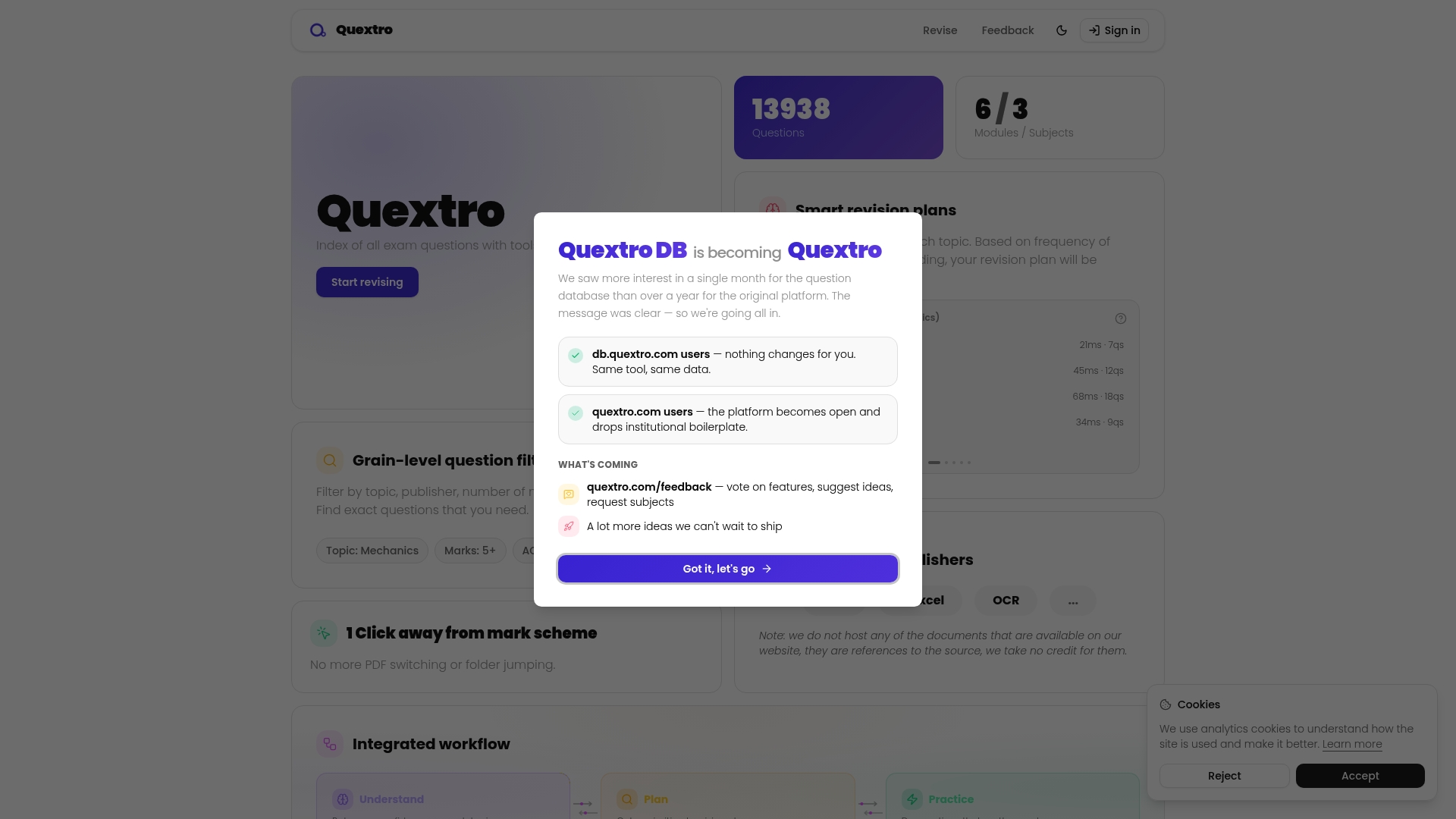
For students working on applied maths, the statistics questions section lets you target exactly the question types where technique matters most. Quextro's confidence tracking and smart revision plans adapt to where you are losing marks, so your practice is always focused where it counts.
Frequently asked questions
What is exam technique and why is it important for A Level maths?
Exam technique means using strategic methods such as clear working and time management to maximise marks; it is crucial because consistency and method, not just ability, determine whether you reach the top grades.
How can I improve my exam technique quickly?
Focus on practising past papers under timed conditions, analysing every mistake in a logbook, and showing every step of your working so you secure method marks even on questions you cannot fully complete.
What are common exam technique mistakes in mechanics questions?
Common errors include rushing algebra and missing units, incorrect diagram labelling, and forgetting to state constants such as g = 9.8 m/s² at the start of your solution.
How does exam technique affect grade boundaries for A Level maths?
The gap between B and A* is most often down to exam technique and consistency rather than raw ability; refining your technique can push your mark above the A* boundary even without learning new content.