

TL;DR:
- Edexcel A Level features a linear assessment with three pure and one applied paper combining Mechanics and Statistics.
- Success depends on understanding specific exam structures, applying contextual thinking, and practicing method-focused questions.
- Effective revision involves targeting weak areas, practicing past papers with mark scheme focus, and using tailored resources like Quextro.
Pearson Edexcel is one of the UK's largest exam boards, yet plenty of students begin their A Level journey assuming all boards are essentially interchangeable. They are not. Edexcel's linear assessment model, its specific applied maths paper, and the way method marks are weighted create a distinct exam environment that rewards particular preparation habits. Understanding those habits early is the difference between grinding through past papers aimlessly and building a revision plan that genuinely moves your grade. This article walks you through the Edexcel A Level structure, breaks down each maths paper, and gives you targeted strategies to revise smarter.
Table of Contents
- What is Edexcel A Level and how does it work?
- Deconstructing the Edexcel maths specification: Pure, Mechanics, Statistics
- Targeted maths revision strategies for Edexcel A Level success
- Expert insights: What most maths students miss and exam benchmarks
- What most revision guides get wrong about Edexcel maths
- Boost your maths revision with Quextro solutions
- Frequently asked questions
Key Takeaways
| Point | Details |
|---|---|
| Edexcel exam structure | Edexcel A Level maths is assessed through three pure papers and one applied paper focused on Mechanics and Statistics. |
| Revision effectiveness | Targeted practice using past papers and topic gaps is more valuable than repeating strengths. |
| Expert exam tips | Method marks count; avoid Mechanics traps like constant acceleration assumptions, aiming for A* means 76-86% raw marks. |
| Applied maths relevance | Mechanics and Statistics require real-world modelling and analytical thinking for higher grades. |
| Leverage resources | Using databases and revision tools aligns your prep with exam demands and raises success chances. |
What is Edexcel A Level and how does it work?
Edexcel A Level refers to qualifications offered by) Pearson Edexcel, one of the UK's major exam boards alongside AQA, OCR, and CIE. Pearson Edexcel is a commercial body, which means it invests heavily in specification design, mark scheme clarity, and examiner reports. That documentation is genuinely useful when you revise, because it tells you exactly what examiners expected and where students lost marks.
The qualification operates on a linear assessment model. This means all your A Level exams sit at the end of Year 13, with no coursework modules counting towards your final grade in Mathematics. Everything rests on your performance across three sittings. That structure demands consistent revision across two years rather than a last-minute sprint.
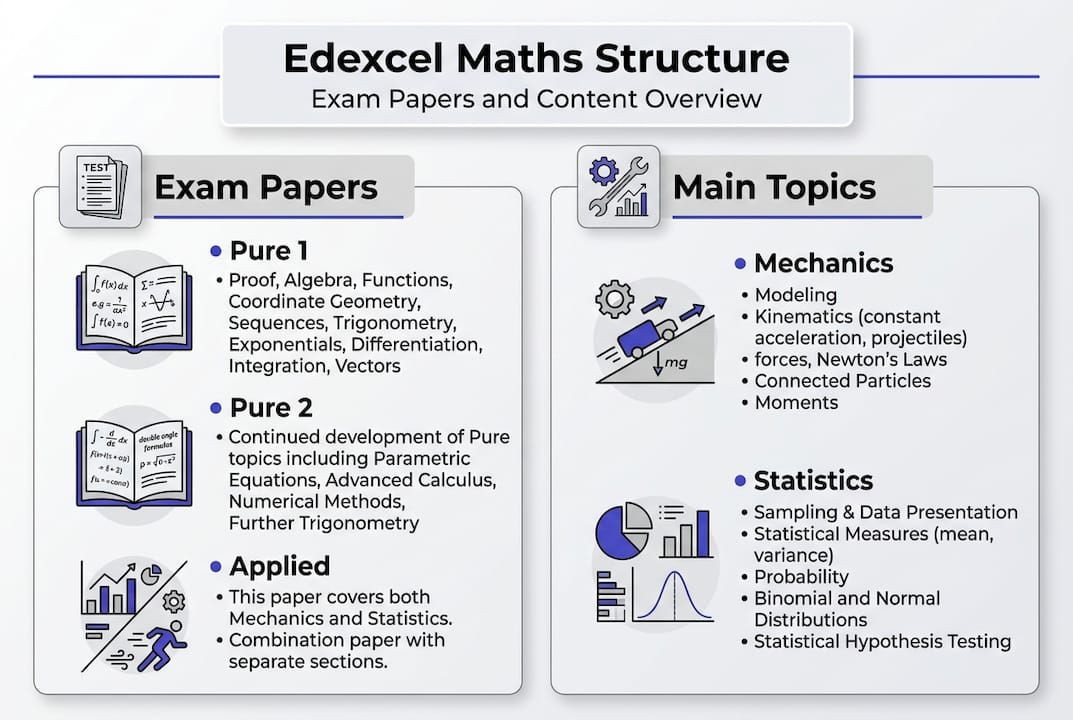
Edexcel A Level Mathematics, specification 9MA0, consists of three pure papers and one applied paper combining Mechanics and Statistics. Here is how the papers break down:
- Paper 1: Pure Mathematics (2 hours, 100 marks)
- Paper 2: Pure Mathematics (2 hours, 100 marks)
- Paper 3: Statistics and Mechanics (2 hours, 100 marks)
Each paper carries equal weighting. Pure Maths accounts for two thirds of your total mark, and the applied paper covers the remaining third.
How Edexcel compares to other boards
| Feature | Edexcel | AQA | OCR A |
|---|---|---|---|
| Pure paper count | 2 | 2 | 2 |
| Applied format | Combined S+M paper | Separate options | Separate options |
| Formula booklet | Yes | Yes | Yes |
| Large data set | Yes (Statistics) | Yes | Yes |
| Linear assessment | Yes | Yes | Yes |
The combined Statistics and Mechanics paper is one of Edexcel's most distinctive features. AQA and OCR A allow students to choose between Mechanics and Statistics as separate applied options. Edexcel tests both in a single sitting, which means you cannot ignore either topic. If you have been following an AQA maths revision guide for comparison, note that the applied paper structure differs significantly between boards.
Understanding this structure before you begin revising saves you from preparing for the wrong exam format entirely.
Deconstructing the Edexcel maths specification: Pure, Mechanics, Statistics
The Edexcel specification 9MA0 splits into two broad areas: Pure Mathematics and Applied Mathematics. Each tests a different kind of thinking.
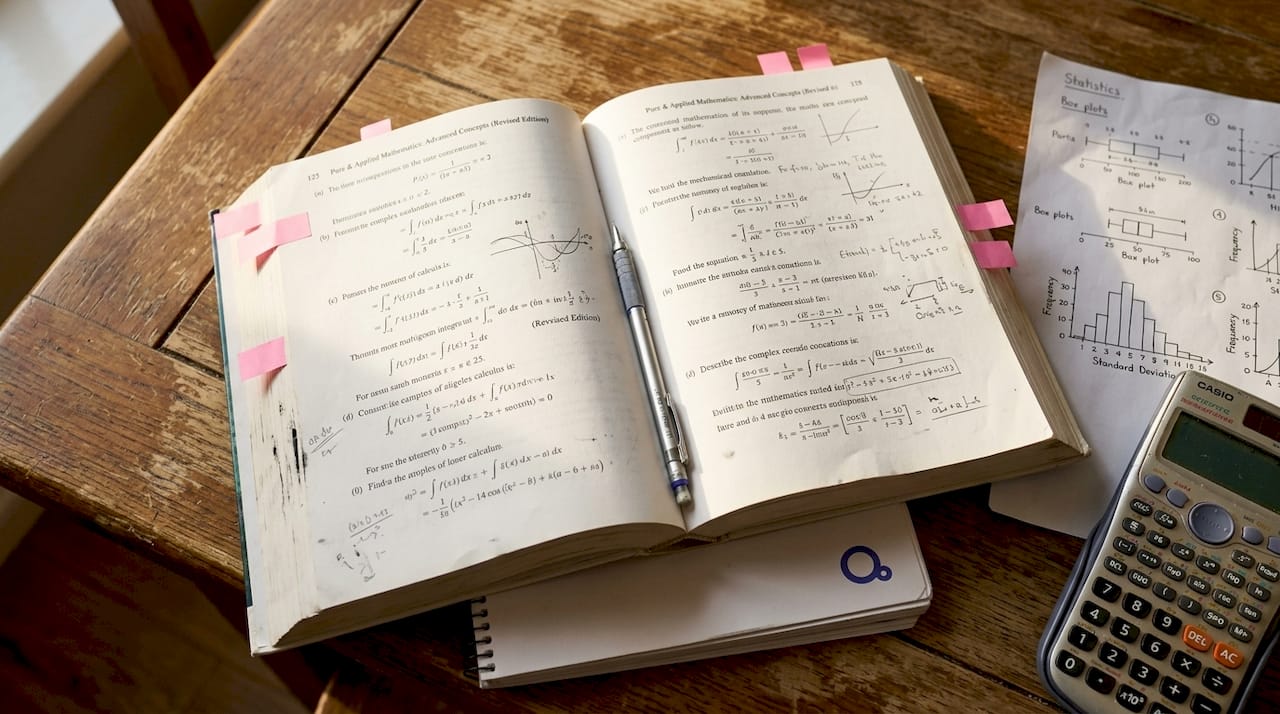
Pure Mathematics covers proof, algebra, coordinate geometry, sequences, trigonometry, exponentials, and calculus. These topics build on one another. Calculus, in particular, runs through a large portion of the paper. Integration by substitution, differential equations, and parametric equations all appear regularly. Pure Maths rewards precision and method. One algebraic slip can cascade through an entire question, so working carefully and checking your steps matters enormously.
Applied Mathematics is where students often struggle, not because the content is harder, but because it requires contextual thinking. The applied paper tests:
- Statistics: Sampling methods, probability distributions, hypothesis testing, and interpretation of the large data set.
- Mechanics: Forces, kinematics, moments, projectiles, and connected particles.
- Modelling assumptions: Both Statistics and Mechanics require you to state and critique assumptions, which is a skill many students underestimate.
For your Mechanics revision plan, focus on understanding when standard models apply and when they break down. A common exam scenario involves variable forces or non-uniform bodies, where the usual SUVAT equations simply do not work. Students who memorise formulas without understanding the underlying model are caught off guard by these questions.
Statistics questions on Edexcel often include written interpretation marks. Saying "the mean is 4.2" is not enough. You need to write "this suggests that, on average, 4.2 events occur per interval, which supports the hypothesis that..." That kind of contextual phrasing earns marks that pure calculation cannot.
Pro Tip: Practise writing out your reasoning in Statistics questions as if explaining to someone unfamiliar with the topic. Examiners reward clarity and context, not just correct numbers.
You can find detailed guidance on structuring your answers in these maths exam preparation tips, which cover both pure and applied sections.
Targeted maths revision strategies for Edexcel A Level success
Knowing the exam structure is only useful if your revision reflects it. The most effective approach starts with an honest audit of where you actually stand.
Begin by categorising every topic in the specification as red (weak), amber (shaky), or green (confident). Be ruthless. Students routinely overestimate their green topics because they feel familiar, not because they can execute them under exam conditions. Once you have your list, avoid over-revising strengths) and redirect that time to your red and amber areas first.
Here is a practical revision framework:
- Weeks 1 to 4: Topic-by-topic practice on red areas. Use question databases filtered by topic to drill specific skills.
- Weeks 5 to 8: Mixed practice on amber topics, integrating them with pure content.
- Weeks 9 to 12: Timed past papers under exam conditions, followed by structured review.
- Final two weeks: Targeted review of persistent errors only. No new content.
The key habit is reviewing past papers with genuine attention to mark schemes. Do not just check whether your answer is right. Check whether your method matches what the mark scheme rewards. Method marks are awarded for correct working even when the final answer is wrong. A student who writes a clear, correct method but makes an arithmetic error at the end can still earn four out of five marks.
"The student who understands the method but makes a slip will always outscore the student who guesses the right answer but shows no working."
Using past paper databases is far more efficient than printing individual papers and hunting for topics manually. Filtering by topic, difficulty, and mark value means you can spend 30 minutes practising exam questions on integration alone, rather than working through an entire paper where only three questions are relevant.
Pro Tip: When selecting revision questions, prioritise questions worth 4 to 6 marks. These multi-step problems test method most thoroughly and are where grade boundaries are typically decided.
Expert insights: What most maths students miss and exam benchmarks
Let us talk about what separates a B from an A, and an A from an A*.
The A* grade boundary typically requires a raw mark of approximately 76% to 86%, with method marks playing a decisive role even when the final answer is incorrect. That range shifts slightly year to year depending on grade boundaries, but it gives you a concrete target. If you are scoring 65% on past papers, you are not far off. Closing that gap requires precision in method, not necessarily learning new content.
Here are the most common expert-identified errors that hold students back:
- Assuming constant acceleration in Mechanics. SUVAT equations only apply when acceleration is constant. Questions involving variable forces, springs, or strings require integration or differentiation instead. Many students apply SUVAT regardless and lose all method marks.
- Ignoring context in Statistics. Hypothesis testing questions require you to state conclusions in context. "Reject H0" alone is never sufficient.
- Skipping proof questions. Proof by contradiction and proof by induction appear in Pure and are worth significant marks. Students who skip them in revision are leaving easy marks on the table.
- Misreading the large data set. Edexcel's Statistics paper references a specific large data set released before the exam. Students who are unfamiliar with its structure waste time during the paper.
"Method marks are the safety net of A Level Maths. Build the habit of showing every step, every time."
For detailed guidance on structuring your responses, these resources on answering exam questions and analysing board questions are worth your time before you sit any timed practice.
Understanding grade boundaries also helps you calibrate effort. If you need an A rather than an A*, the raw mark target is lower, and your revision can focus more on consistency across all topics rather than perfection in the hardest questions.
What most revision guides get wrong about Edexcel maths
Most revision guides treat Edexcel maths as a content problem. Learn the formulas, practise the techniques, sit the paper. That framing misses something important.
Edexcel's applied paper, in particular, is an interpretation problem. The Mechanics and Statistics questions are designed to test whether you understand the scenario, not just whether you can execute a method. Students who prepare using generic revision plans often drill pure techniques extensively and then walk into Paper 3 underprepared for the contextual demands.
Real exam preparation exposes gaps that no textbook can predict. A question might describe a particle on a rough inclined plane with a string at an angle, and the challenge is not the trigonometry. It is recognising which forces apply and in which direction. That recognition only comes from varied, contextual practice.
Following strong exam practices for maths means treating every practice question as a scenario to understand, not just a calculation to complete. That shift in mindset is what separates students who plateau at a B from those who break through to an A.
Boost your maths revision with Quextro solutions
Putting these strategies into practice requires the right tools. Quextro gives you access to over 13,955 past exam questions, all organised by topic, difficulty, and mark value, so you can target exactly the areas your revision needs most.
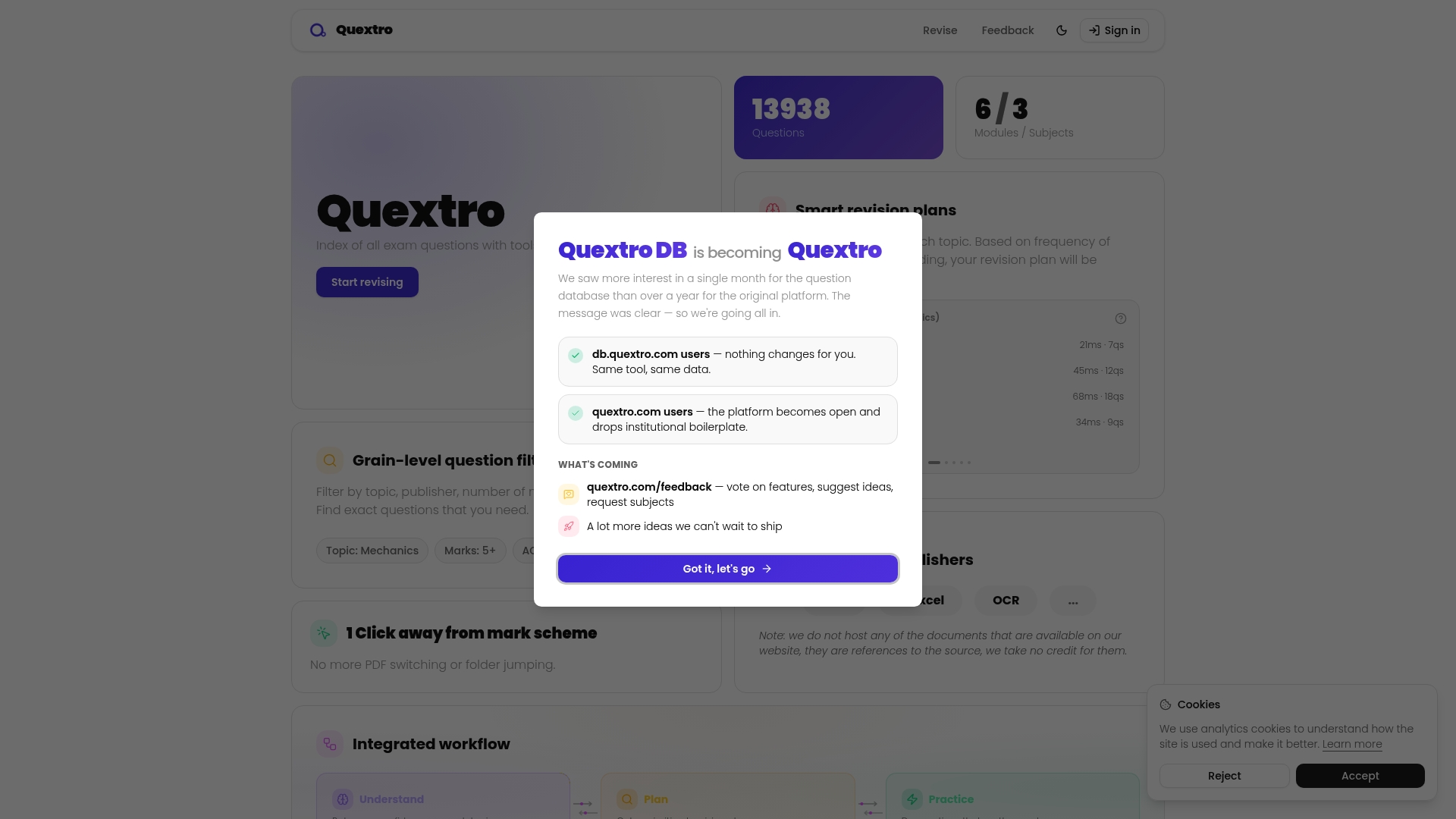
Whether you need to sharpen your understanding of statistics maths papers or build fluency with pure maths questions, Quextro filters questions by board, topic, and difficulty so your revision time is never wasted. Smart revision plans adapt to your confidence ratings, and automatic progress tracking means you always know where to focus next. Start your targeted revision at Quextro today.
Frequently asked questions
What subjects can I take for Edexcel A Level?
Edexcel A Level offers a wide range of subjects including Mathematics, Sciences, Economics, and Humanities, all assessed by Pearson) Edexcel across the UK.
How are Edexcel A Level maths exams structured?
The Edexcel A Level Maths exam includes three pure papers and one applied paper covering both Mechanics and Statistics, all sat at the end of Year 13.
What grade do I need for an A* in Edexcel A Level maths?
To achieve an A*, you typically need a raw mark of 76% to 86%, with method marks counting even when your final answer is incorrect.
What are common revision mistakes for Edexcel maths?
Common mistakes include over-revising strong topics), neglecting method mark discipline, and applying SUVAT equations to non-constant acceleration scenarios in Mechanics.
How can databases of past papers help me revise for Edexcel maths?
Past paper databases let you filter by topic) and difficulty, helping you focus revision time on weaker areas rather than repeating content you already understand.