

TL;DR:
- Understanding the differences in exam board question styles is crucial for targeted revision and exam confidence. While content largely overlaps across boards like AQA, Edexcel, and OCR, their unique question wording, modelling emphasis, and paper structure require tailored preparation. Focusing solely on your assigned board's past papers ensures familiarity with its specific tone, increasing your chances of success.
Choosing which A Level maths exam board to focus on might feel like a minor admin detail, but the differences between boards shape how you should revise, what to practise, and how questions will feel on the day. Most students assume the content is the content, and that any past paper will do. That assumption can cost you marks. Whether your school has assigned you AQA, Edexcel, or OCR, understanding the specific style and structure of your board is one of the most targeted revision moves you can make. This article breaks down the real differences with concrete examples, a comparison table, and clear advice you can act on today.
Table of Contents
- How exam board differences actually matter
- Examples: AQA vs Edexcel mechanics and statistics
- Why past papers matter for your chosen exam board
- Pitfalls: misconceptions about grade boundaries and specifications
- Summary table: main exam board style differences at a glance
- Our perspective: what most students get wrong about exam board differences
- Get the edge: find targeted past papers and revision help
- Frequently asked questions
Key Takeaways
| Point | Details |
|---|---|
| Style differences matter | Exam boards set questions differently even if they test similar topics. |
| Board-specific practice wins | Using past papers from your chosen board offers the best exam-day preparation. |
| Specifications are similar | The core topics are largely the same, but pay attention to how they’re assessed. |
| Grade boundaries shift | Don’t pick a board for perceived ‘easier’ grades as thresholds change each year. |
| Adapt your revision | Tailor your revision style and mock marking to match your exam board’s approach. |
How exam board differences actually matter
When teachers say "all A Level maths boards cover the same content," they are broadly correct. The specification topics, from calculus and trigonometry to hypothesis testing and kinematics, overlap enormously across AQA, Edexcel, and OCR. But saying the content is the same is a bit like saying two restaurants serve pasta: technically true, but the experience of eating there is entirely different.
The real differences show up in:
- Question style and wording: How a question is introduced, what context is wrapped around the maths, and how much interpretation is needed before you can start working.
- Modelling emphasis: How heavily the board leans on real-world modelling scenarios in mechanics and statistics.
- Structure of the paper: How questions are sequenced, how many marks are allocated to multi-part problems, and how much working is expected.
- Context presentation: Whether a problem drops you into a scenario with several paragraphs of backstory or cuts straight to the calculation.
As a general rule, mechanics differs in modelling emphasis and question contexts across boards, with AQA tending towards more direct and structured wording, while Edexcel leans into more formulaic and predictable question patterns with a stronger modelling focus.
"The boards change the feel but not the basic content. A student who only revises topics is only half-prepared."
This is the misconception that catches students out. They spend weeks perfecting their knowledge of integration or probability distributions, but walk into the exam and find the presentation of the question unfamiliar. Knowing how to choose an exam board is one thing, but understanding its specific question style is what actually builds exam confidence.
Pro Tip: As you work through past papers, actively note the tone of each question. Is it embedded in a long scenario? Does it ask you to "show that" or "hence find"? These small patterns reveal a board's personality, and once you see them, you can prepare for them directly.
Examples: AQA vs Edexcel mechanics and statistics
To make this concrete, let's look at sample differences between AQA and Edexcel, especially in mechanics and statistics.
A good starting point is the mechanics paper. AQA tends to frame mechanics questions with straightforward physical setups. You might get a particle on a rough inclined plane with clean numerical values and a question that signals clearly what to find. Edexcel, by contrast, is known for wrapping its mechanics questions in slightly more involved modelling language. A question might describe a real-world scenario at greater length before arriving at the mathematical task. This is not harder in terms of underlying maths, but it requires a different reading strategy.
| Feature | AQA | Edexcel |
|---|---|---|
| Mechanics question style | Direct, structured, clear numerical setup | More formulaic, modelling-focused, scenario-rich |
| Statistics approach | Contextualised but straightforward | Greater emphasis on interpreting real data |
| Question wording | Concise, less narrative | Moderate narrative, more scenario framing |
| Modelling emphasis | Moderate | High |
| Predictability of paper structure | Consistent but varied | Notably predictable format year-on-year |
According to board approach examples in our detailed comparison guide, the predictability of Edexcel's paper structure is often cited as both a strength and a risk. Students who prepare exclusively for that format can do very well, but those who have mixed their practice across boards sometimes find themselves thrown by the subtle framing differences.
Here are some specific patterns to watch out for:
- AQA statistics: Hypothesis testing questions often include a clear context (for example, a manufacturer's claim) and ask you to interpret results in plain language. The marking scheme rewards specific phrasing.
- Edexcel statistics: Questions frequently involve larger datasets and ask you to critically evaluate a model or a calculation, requiring slightly more analytical written responses.
- Edexcel mechanics: Expect questions where you set up equations from a described scenario before doing any calculation. The modelling step is often worth marks in itself.
- AQA mechanics: The setup is usually given more explicitly, so marks are weighted more towards the mathematical execution than the initial modelling stage.
Most A Level maths exam boards cover a similar core specification but differ meaningfully in detail and style. That detail is where your revision edge lives.
Why past papers matter for your chosen exam board
So, how do you actually apply these differences to your day-to-day revision?
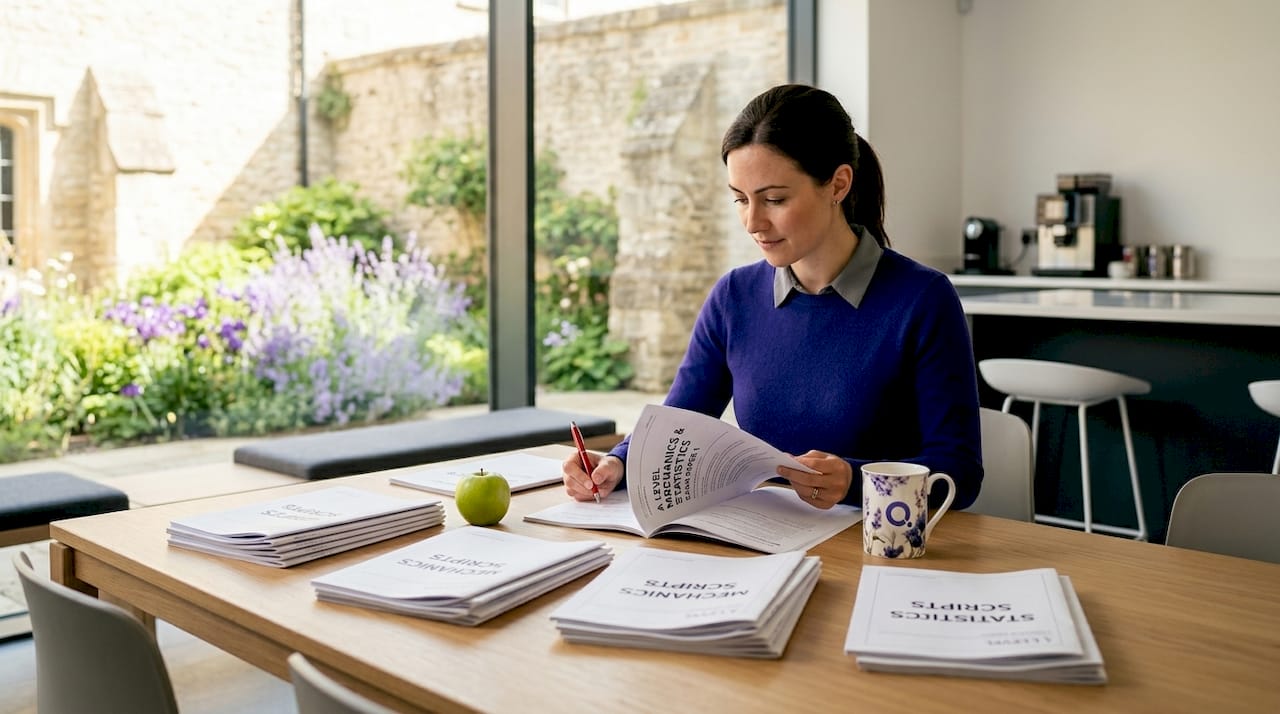
The single most important habit is to practise only with your chosen board's past papers. This sounds obvious, but many students dip into papers from other boards when they run out of their own, or because a particular question looks interesting. This dilutes your preparation. The exam-day familiarity you build from repeated exposure to one board's style is genuinely valuable, and mixing sources undermines it.
Using your chosen board's past papers is a well-established revision benchmark, precisely because exam structure and tone vary enough to create surprises if you are not used to them.
Here is a step-by-step approach to board-specific revision:
- Identify your board early. Confirm with your teacher which board your school uses. Do not assume.
- Download all available past papers for that board. Go back at least five to seven years for a solid sample size.
- Work through papers under timed conditions. Treat each session as a dress rehearsal, not an open-book exercise.
- Mark your work using only that board's official mark scheme. Mark schemes differ in how much they reward method marks, and the language used to describe acceptable answers varies.
- Log which question types trip you up. Use your error patterns to direct your next round of topic-focused practice.
- Return to questions you got wrong. Revisiting mistakes closes gaps faster than doing fresh questions repeatedly.
This process is covered in more depth in our guide on using past papers effectively and pairs well with our overview of revision strategies for success.
Pro Tip: If you find yourself short on papers, use your board's specimen papers and any published practice sets from your board's website before touching another board's materials. Authenticity of format is more valuable than volume from mixed sources.
Pitfalls: misconceptions about grade boundaries and specifications
Before you choose your revision approach, avoid these all-too-common traps.
The most persistent myth is that some exam boards have "easier" grade boundaries. Students sometimes look at historical grade boundary data and conclude that one board consistently requires fewer raw marks for a grade A. The problem is that grade boundaries shift every year based on how difficult that specific paper turned out to be, and thresholds are set after exam marking is complete. You cannot predict future boundaries from past ones.
"Thresholds vary and are set after exam marking. Comparing boundaries across boards or years to find an 'easier' route is not a reliable strategy."
Two misconceptions are especially common among students we speak to:
- Misconception 1: "Board X has lower grade boundaries, so it must be easier." In reality, a lower boundary simply means that particular paper was harder than expected. The boards are not in competition to offer lower bars; the boundary reflects the paper's actual difficulty that year.
- Misconception 2: "If I learn the full specification list, I am ready." The specification tells you what topics may appear, not how they will be tested. Two questions on the same topic from different boards can require very different approaches.
The smarter way to use specification documents is to treat them as a checklist of areas where you need both knowledge and style fluency. Check our guide on smart exam board comparisons for a structured way to do this.
Summary table: main exam board style differences at a glance
To wrap up the examples, here is a summary table to help you compare at a glance.
| Feature | AQA | Edexcel | OCR |
|---|---|---|---|
| Mechanics style | Direct, structured | Modelling-heavy, formulaic | Balanced, applied focus |
| Statistics approach | Clear context, interpretation required | Data-rich, analytical | More theoretical framing |
| Question wording | Concise, precise | Scenario-rich | Formal, methodical |
| Modelling emphasis | Moderate | High | Moderate to high |
| Paper predictability | Consistent | Very predictable format | Varies slightly |
| Multi-part question structure | Common | Very common | Common |
As exam board differences reflect question-style variation rather than topic variation, use this table to identify where your board's specific demands may require extra practice. If Edexcel is your board, for instance, you should be drilling your modelling setup skills in mechanics rather than just your calculation accuracy. If you are on OCR, focus on the formal mathematical language expected in written responses.
Use this table during your final exam preparation to remind yourself where your board's distinctive demands sit. It is a quick reality check before you select which past paper section to practise next.
Our perspective: what most students get wrong about exam board differences
Here is the hard truth we have picked up from helping hundreds of students navigate A Level maths: most students spend far too long debating which board is best and far too little time adapting to the board they have actually been assigned.
The exam board you sit is almost always determined by your school. You do not choose it. So the energy that goes into comparing boards would be far better spent developing fluency with your own board's question style until it feels completely natural. That is where the real advantage comes from.
The myth of the "easier" board is particularly damaging because it leads to paralysis or misplaced hope. Students tell themselves they would have done better if only their school used a different board. What actually matters is whether you have spent enough time recognising how your board signals what it wants. That recognition comes only from repeated, focused practice.
The key distinction between boards is question style, not topic coverage. Once you accept that, your whole revision mindset shifts. Instead of asking "do I know this topic?", you start asking "can I answer the way my board expects me to answer this topic?" That is a sharper, more useful question.
Depth beats breadth here. Twenty well-reviewed past papers from your own board, each marked honestly against the official mark scheme, will do more for your grade than fifty mixed papers from across boards. The familiarity you build with your board's rhythm, its typical command words, its preferred level of working shown, and its marking style is a genuine competitive advantage. Our guide on top maths exam tips goes further into how to build that kind of targeted fluency.
Get the edge: find targeted past papers and revision help
If you want to put all this comparison into action, here is where to start.
Quextro brings together over 13,955 past exam questions from AQA, Edexcel, OCR, and CIE in one place, organised so you can filter by board, topic, difficulty, and marks. There is no hunting through PDFs or switching between websites.
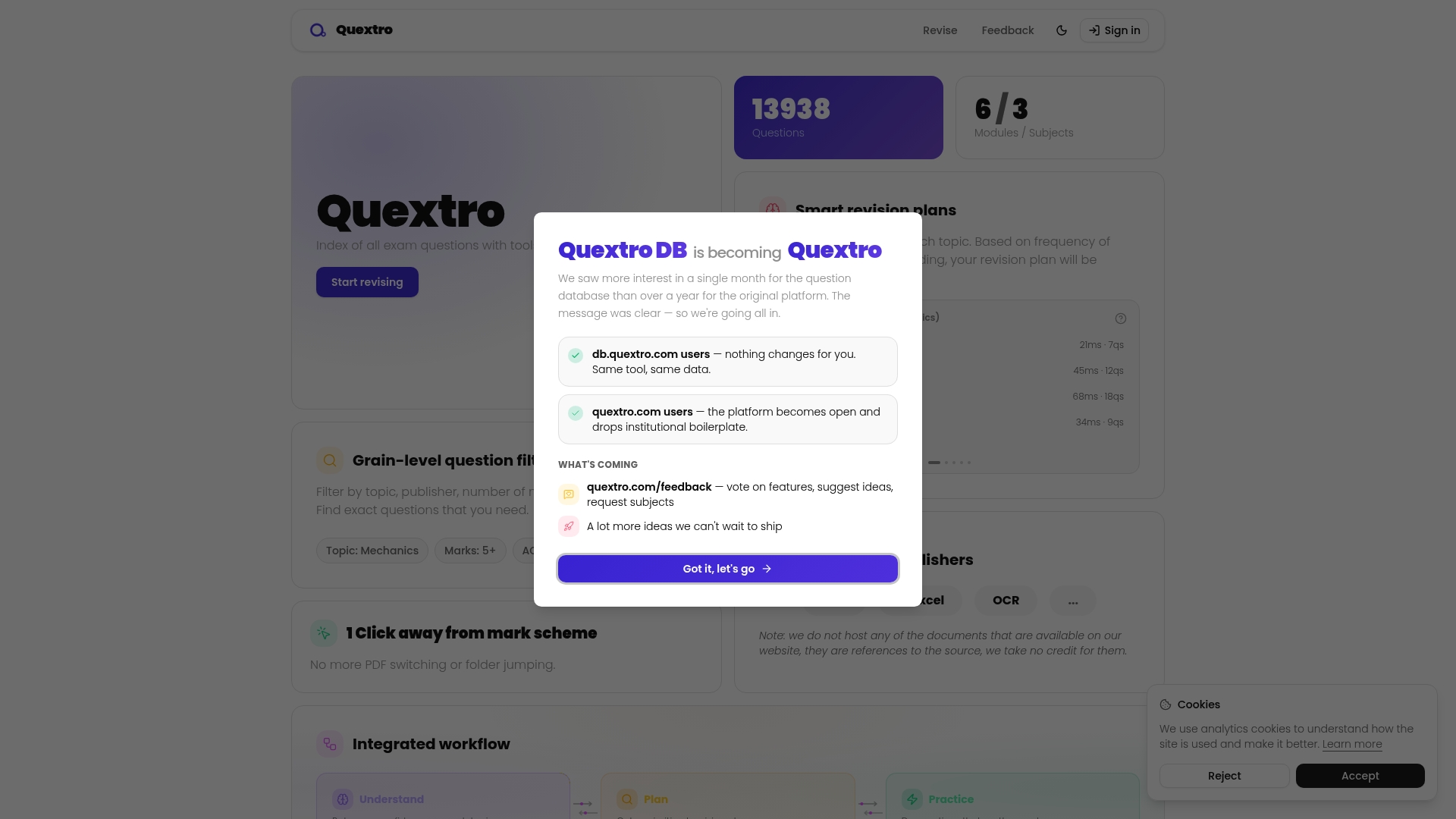
You can go straight to Edexcel A past papers if Edexcel is your board, or drill into Statistics papers and Mechanics papers specifically to build the targeted practice this article has outlined. Smart revision plans on the platform adapt based on your confidence ratings, so the questions you see next are always the ones most likely to move your grade forward. Board-specific revision has never been more straightforward.
Frequently asked questions
What is the biggest difference between AQA and Edexcel A Level maths exams?
AQA's mechanics tends to use more direct and structured wording, while Edexcel is more formulaic with stronger modelling focus throughout its papers.
Can I use past papers from any exam board to revise?
You should use past papers from your own assigned board, because structure and tone vary enough to create unexpected difficulties if you mix boards during revision.
Are the topics covered by each exam board very different?
Most boards cover almost the same specification, but the presentation and question style can differ significantly enough to affect how you need to prepare.
Do some exam boards have easier grade boundaries?
Grade boundaries shift every year based on paper difficulty, so it is impossible to reliably identify a board with consistently lower thresholds.
How do I choose which A Level maths exam board is right for me?
Your school will almost always assign your board, so focus your energy on understanding and adapting to that board's specific question style rather than comparing alternatives.