

TL;DR:
- Different exam boards have unique question styles, structures, and emphasis areas.
- Grade boundaries fluctuate yearly, reflecting paper difficulty, not overall exam board difficulty.
- Familiarity with your specific board's question patterns is more beneficial than comparing board difficulty.
Most students know that AQA, Edexcel, OCR A, and OCR B (MEI) all teach the same A Level Maths content. What many miss is that the way each board asks questions, structures papers, and rewards marks is genuinely different. Those differences shape which topics you should practise most, how you should time your exam, and where you are most likely to drop marks. If you know your board inside out, you gain a real revision edge. This guide breaks down exactly how each major board works, where they diverge, and how to use that knowledge to study smarter before your 2026 exams.
Table of Contents
- How exam boards structure A Level Maths
- AQA: Key features and unique style
- Edexcel: Predictability, modelling, and strengths
- OCR A and OCR B (MEI): Depth and applications
- Which exam board is harder? Grade boundaries and perceptions
- Why board familiarity beats board comparison for study success
- Access exam board-specific papers and boost your revision
- Frequently asked questions
Key Takeaways
| Point | Details |
|---|---|
| Core content is universal | All major A Level Maths boards cover the same Pure, Statistics, and Mechanics topics mandated by the government. |
| Board styles differ | AQA, Edexcel, OCR A, and MEI each have distinct question styles and emphases that can influence your revision approach. |
| No board is easier | Grade boundaries and Ofqual regulation mean no exam board consistently offers easier grades or questions. |
| Practise board-specific papers | Focusing revision on your board’s past papers helps you master assessment styles for exam success. |
How exam boards structure A Level Maths
Before you compare boards, it helps to understand what they all share. Every major A Level Maths exam board follows the same core content requirements set by the government. That means no board can quietly drop calculus or add an extra statistics unit on a whim.
The content split is fixed: two thirds Pure Maths, one sixth Statistics, and one sixth Mechanics, as mandated by the Department for Education. This is the same for AQA, Edexcel, OCR A, and OCR B. You will not find one board loaded with more mechanics or less pure than another.
The exam format is also consistent across most boards: three papers of two hours each, worth 100 marks apiece. Two papers cover Pure Maths, and the third covers Statistics and Mechanics combined. OCR B (MEI) is the exception, replacing one paper with a comprehension paper that tests reading and interpreting mathematical text.
Here is a quick summary of the shared structure:
| Feature | AQA | Edexcel | OCR A | OCR B (MEI) |
|---|---|---|---|---|
| Number of papers | 3 | 3 | 3 | 3 |
| Paper length | 2 hours | 2 hours | 2 hours | Varies |
| Marks per paper | 100 | 100 | 100 | 100 |
| Comprehension paper | No | No | No | Yes |
Ofqual, the qualifications regulator, monitors all boards to ensure that standards remain comparable year to year. Grade boundaries shift each summer to reflect how difficult a particular paper turned out to be. That means a tough paper in one year will carry a lower grade boundary, and an easier paper will carry a higher one. You can explore the examples of A Level exam boards and their histories to see how this plays out in practice, or check the exam board formats in more detail.
AQA: Key features and unique style
With baseline structure covered, let us look at what makes each board distinct, starting with AQA.
AQA is often described as the most straightforward of the four. Its questions tend to be clearly worded, with step-by-step prompts that guide you through a problem. That structure suits students who prefer to know exactly what is being asked rather than digging through layers of context.

AQA's approach is built on structured, direct questions with traditional mechanics and real-world data sets in statistics. The statistics component uses a large data set that you study in advance, so you are never walking in blind on that material.
Key features of AQA A Level Maths:
- Questions are clearly signposted with part marks
- Statistics relies on pre-released large data sets
- Mechanics follows a traditional, predictable format
- Less emphasis on complex algebraic manipulation than OCR A
- Examiner reports are detailed and genuinely useful
Who does AQA suit? If you find long, open-ended algebraic challenges frustrating and prefer to earn marks in clear, logical steps, AQA is likely a good fit. It rewards methodical working rather than creative leaps.
Pro Tip: Read the AQA examiner reports for the last three years before your mock. They tell you exactly which question types students consistently get wrong and why. That alone can add several marks to your total.
When practising, look at AQA exam questions alongside understanding exam question difficulty so you can calibrate where your time is best spent.
Edexcel: Predictability, modelling, and strengths
Edexcel is often chosen for its predictability and the sheer volume of revision resources available online. Let us compare that to what you already know about AQA.
Edexcel papers follow a recognisable structure year after year. If you have completed five or six past papers, you will start to notice that certain question types appear in almost the same position on the paper each time. That predictability can be a real confidence boost in the exam hall.
Edexcel places a strong emphasis on mechanics modelling, large data sets, and probability in statistics, and is generally considered less algebra-heavy than OCR A. Notably, Edexcel includes topics such as the normal approximation to the binomial distribution, which does not appear on AQA.
Key features of Edexcel A Level Maths:
- Consistent paper structure makes past papers highly predictable
- Strong mechanics modelling focus
- Probability and statistics go slightly deeper than AQA
- Abundant third-party revision resources online
- Large data set used in statistics
| Topic area | AQA depth | Edexcel depth |
|---|---|---|
| Probability | Standard | Deeper |
| Mechanics modelling | Traditional | Applied modelling |
| Algebra | Moderate | Moderate |
| Statistics | Large data set | Large data set + normal approx. |
Pro Tip: Use topic-specific revision tips for Edexcel's mechanics modelling questions. Modelling assumptions are a common source of lost marks because students answer the maths correctly but forget to state or critique the assumptions.
If you are on Edexcel, the Edexcel revision structure guide and advice on how to select Edexcel questions strategically can sharpen your focus considerably.
OCR A and OCR B (MEI): Depth and applications
Next, explore the two OCR options, especially if you value problem-solving or algebraic rigour.
OCR A is widely regarded as the most algebraically demanding of the four boards. Hypothesis testing in statistics is assessed rigorously, and the mechanics component places particular emphasis on forces and connected particles. If you enjoy abstract algebraic manipulation and are comfortable working through multi-step proofs, OCR A is designed for students like you.
OCR A is noted for challenging algebra and hypothesis testing in statistics, with strong coverage of forces and connected particles in mechanics.
OCR B (MEI) is a different beast entirely. The comprehension paper requires you to read a passage of mathematical text and answer questions about it. This is not purely a test of calculation; it rewards genuine mathematical literacy.
OCR B (MEI) develops problem-solving and context-based thinking through a comprehension paper, real-world applications, and numerical methods.
"The MEI comprehension paper rewards students who can read mathematics critically, not just compute it. It is a skill most other boards never test directly."
Key features shared by both OCR boards:
- Context-based scenarios that require interpretation, not just calculation
- Strong problem-solving component across all papers
- OCR A: algebra and hypothesis testing are particularly challenging
- OCR B (MEI): unique comprehension paper tests mathematical reading
For students on either OCR board, working through top OCR practice questions is essential. The question style is distinctive enough that generic practice from other boards will only take you so far. See the full OCR board details if you want a deeper overview.
Which exam board is harder? Grade boundaries and perceptions
Understanding board styles is key, but what about actual difficulty and grade boundaries?
The short answer is: no single board is officially harder. Ofqual ensures comparability across all A Level boards, meaning the regulatory framework is specifically designed to prevent one board from being a shortcut to better grades.
No definitive data shows one board consistently harder than another; grade boundaries adjust each year for fairness, with the 2025 Edexcel A Level Maths A* boundary sitting at approximately 86%.
| Board | Approximate 2025 A* boundary | Approximate 2025 A boundary |
|---|---|---|
| Edexcel | ~86% | ~70% |
| AQA | ~85% | ~68% |
Here is how to think about difficulty sensibly:
- Grade boundaries reflect how hard a specific paper was in a given year, not how hard the board is overall.
- A low boundary one year means the paper was tough; it does not mean the board is easier.
- Your performance depends far more on how well you know your board's style than on which board you sit.
- Cross-board comparisons from forums are rarely based on evidence and are almost always misleading.
For a clearer picture, look at 2025 grade boundaries alongside your own past paper scores. Use that data to make decisions, not anecdote. Understanding grade boundaries and how to analyse exam questions by board will give you a far more grounded view of where you stand.
Why board familiarity beats board comparison for study success
Here is the view most revision guides do not share openly: the conversation about which board is hardest is almost entirely a distraction. Students spend hours on forums debating whether Edexcel or OCR A is tougher, when that time would be far better spent completing another past paper from their own board.
Board familiarity is a concrete, trainable skill. When you sit ten papers from your own board, you start to internalise the rhythm of the questions. You know where the show-your-working marks sit, where the tricky wording tends to appear, and which topics the examiners return to year after year. That knowledge is worth far more than any cross-board ranking.
That said, there is genuine value in occasionally practising past exam papers from other boards. It builds versatility and stops you from becoming too dependent on one question format. Think of it as cross-training.
The most underused resource in A Level Maths revision is the examiner report. Most students read the mark scheme; almost none read the report. Examiner reports tell you precisely why marks were dropped across thousands of scripts. That is targeted intelligence you simply cannot get anywhere else. Prioritise those over forum opinions every time.
Access exam board-specific papers and boost your revision
Knowing the differences between boards is only half the work. The other half is getting enough targeted practice to make that knowledge stick.
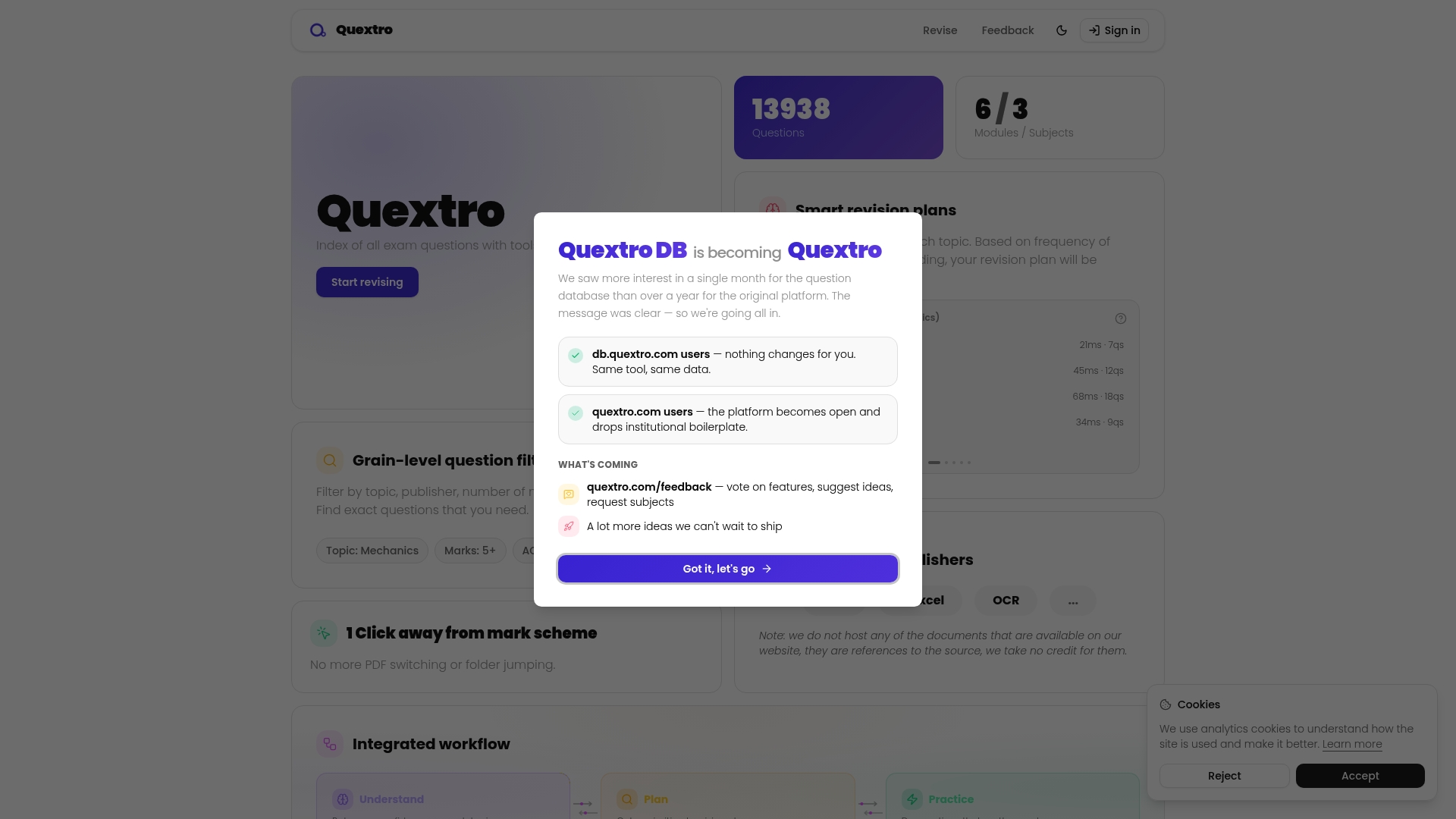
Quextro gives you direct access to over 13,955 past exam questions from AQA, Edexcel, OCR, and MEI, all organised by topic, difficulty level, and marks. You can filter by board and topic so every practice session is pointed and purposeful. Work through Edexcel past papers in sequence, dip into foundation maths resources to shore up weak areas, or explore the full board-specific database to build a revision plan that matches exactly how your board sets questions.
Frequently asked questions
Are some A Level Maths exam boards harder than others?
No. Ofqual ensures comparability across all boards, and grade boundaries are adjusted each year to maintain fairness, so no board is consistently harder than another.
Which A Level Maths exam board should I choose for easier questions?
Question style varies considerably: AQA is direct and structured, Edexcel is predictable and modelling-focused, OCR A is algebra-heavy, and MEI is problem-solving orientated. Choose based on your strengths and style preferences, not on a perceived difficulty ranking.
How do grade boundaries work for A Level Maths boards?
Grade boundaries adjust each year to reflect how difficult a specific paper was, keeping results fair across cohorts. A lower boundary in one year simply means that paper was harder, not that the board is easier overall.
Can I practise past papers from all boards?
Yes, and it is a good idea. Cross-board practice builds versatility and exposes you to a wider range of question styles, which strengthens your overall mathematical reasoning beyond your own board's format.