

TL;DR:
- Effective revision requires a structured plan focusing on active learning and deliberate topic coverage.
- Personalising your revision based on your strengths, weaknesses, and schedule leads to greater success.
- Regular review and flexible adjustments are essential for sustained progress and confidence.
Rereading your notes the night before an exam is not revision. It feels productive, but for A Level mathematics, passive repetition rarely translates into the problem-solving fluency examiners actually reward. The students who achieve the highest grades are not necessarily the ones who study the longest; they are the ones who study with intention. This guide cuts through the noise and gives you a clear, practical framework for building a revision plan that works, covering what exam revision planning actually involves, why it matters so much for A Level maths, and exactly how to put one together.
Table of Contents
- What is exam revision planning?
- Why revision planning matters for A Level maths
- Step-by-step method for effective revision planning
- Common pitfalls and how to overcome them
- Why personalised revision planning beats one-size-fits-all advice
- How Quextro can boost your revision journey
- Frequently asked questions
Key Takeaways
| Point | Details |
|---|---|
| Structured planning wins | Planned revision outperforms cramming by ensuring topic coverage and consistent progress. |
| Customise your approach | Tailor your plan to your strengths, weaknesses, and exam requirements for best results. |
| Adapt and review | Frequent reflection and flexibility help overcome setbacks and boost performance. |
| Use proven resources | Past papers and topic analysis are vital tools for high-impact A Level maths revision. |
What is exam revision planning?
At its core, exam revision planning is the process of deliberately organising your topics, resources, and time before your exams begin. It is not simply writing a timetable and hoping for the best. A genuine revision plan maps out what you will study, when you will study it, and how you will measure whether it is working. That last part is what most students overlook entirely.
Contrast this with the unplanned approach many students default to: flicking through past papers the week before the exam, reviewing whichever topic feels familiar, or highlighting notes without ever testing recall. These habits feel comfortable because they involve low mental effort. Unfortunately, effective revision strategies consistently show that passive study techniques produce far weaker long-term retention than active, structured approaches.
A quality revision plan has three defining features: a structured timetable, clear topic priorities, and scheduled review points. The timetable keeps you accountable. The priorities ensure you spend time where it matters most. The review points let you catch gaps before they become exam disasters.
"Structured revision produces better outcomes than last-minute cramming" — which is why organising your revision by exam topic gives you a measurable advantage over reactive studying.
Here is how structured and unstructured revision compare in practice:
| Feature | Structured revision | Unstructured revision |
|---|---|---|
| Topic coverage | Planned and balanced | Reactive and patchy |
| Time management | Allocated by priority | Spent on comfort topics |
| Progress tracking | Built into the plan | Absent or informal |
| Anxiety reduction | High (clarity reduces stress) | Low (uncertainty increases stress) |
| Exam readiness | Consistent and measurable | Unpredictable |
If you are serious about improving your results, transitioning to structured exam prep is one of the highest-impact decisions you can make this academic year.
Why revision planning matters for A Level maths
A Level mathematics is not a subject you can bluff. Unlike subjects where essay technique can compensate for content gaps, maths demands that you genuinely understand and can apply each concept under timed conditions. This is precisely why revision planning matters more here than in almost any other A Level subject.

Research consistently shows that targeted exam topic analysis improves grades by directing student effort towards high-yield areas rather than spreading energy thinly across everything. Students who followed a structured plan in studies of A Level preparation consistently outperformed those who revised without one, not because they worked more hours, but because they worked more strategically.
Consider the psychological benefit, too. When you have a clear plan in front of you, anxiety drops. You are not lying awake wondering whether you have covered enough material; you can see exactly what you have done and what remains. That mental clarity translates directly into calmer, more confident exam performance.
The practical advantages are significant and worth listing clearly:
- Balanced topic coverage so no area is left unprepared
- Time management that accounts for difficulty and exam weighting
- Reduced last-minute panic because you have built in buffer time
- Improved active recall through repeated, spaced review sessions
- Confidence building as you mark off completed topics and see progress
- Better exam technique because you practise under realistic conditions regularly
The data reinforces this. Students who allocate revision time proportionally to topic weighting in their exam board specifications tend to score higher on the weighted sections. If integration and differentiation account for a large portion of your paper, they deserve a proportionally larger share of your revision hours.
Pro Tip: Set small, specific goals for each session rather than vague targets like "do calculus." Instead, try "complete five integration by substitution questions and mark them." Specific goals reduce procrastination and give you a clear sense of achievement when the session ends.
Step-by-step method for effective revision planning
With the benefits clear, let us walk through exactly how to build an effective revision plan from scratch. This framework follows five stages: Audit, Prioritise, Plan, Execute, and Review. Each stage has a distinct purpose, and skipping any one of them weakens the whole structure.
-
Audit your syllabus. Download your exam board specification, whether that is AQA, Edexcel, OCR, or CIE, and go through every topic listed. Mark each one as confident, needs work, or not started. Be honest. This is your diagnostic baseline, and organising by topic at this stage makes the entire subsequent process far more efficient.
-
Prioritise by weight and weakness. Cross-reference your audit with the exam weighting for each topic. Topics that appear frequently across past papers and where you currently feel least confident should sit at the top of your priority list. Topics you are already strong in need maintenance, not heavy investment.
-
Build a weekly plan. Map your available study hours across the weeks until your exam. Assign specific topics to specific sessions. A typical week might look like this: Monday, proof and algebra; Tuesday, trigonometry; Wednesday, calculus; Thursday, statistics; Friday, mechanics; Saturday, mixed past paper practice; Sunday, review and adjustment. Include rest days. They are not optional; they are part of the plan.
-
Execute with active methods. Passive reading does not build the problem-solving muscle A Level maths requires. Use innovative study methods that force active recall, such as working through questions without looking at solutions, timed practice, and self-marking with honest error analysis. Organising exam questions by topic and difficulty allows you to build competence gradually and systematically.
-
Review and adjust weekly. At the end of each week, spend twenty minutes asking: which topics improved, which still feel shaky, and did I stick to my plan? If not, why not? Adjust the following week accordingly. Revision that organises by exam topic has measurable benefits precisely because regular review catches drift before it becomes a problem.
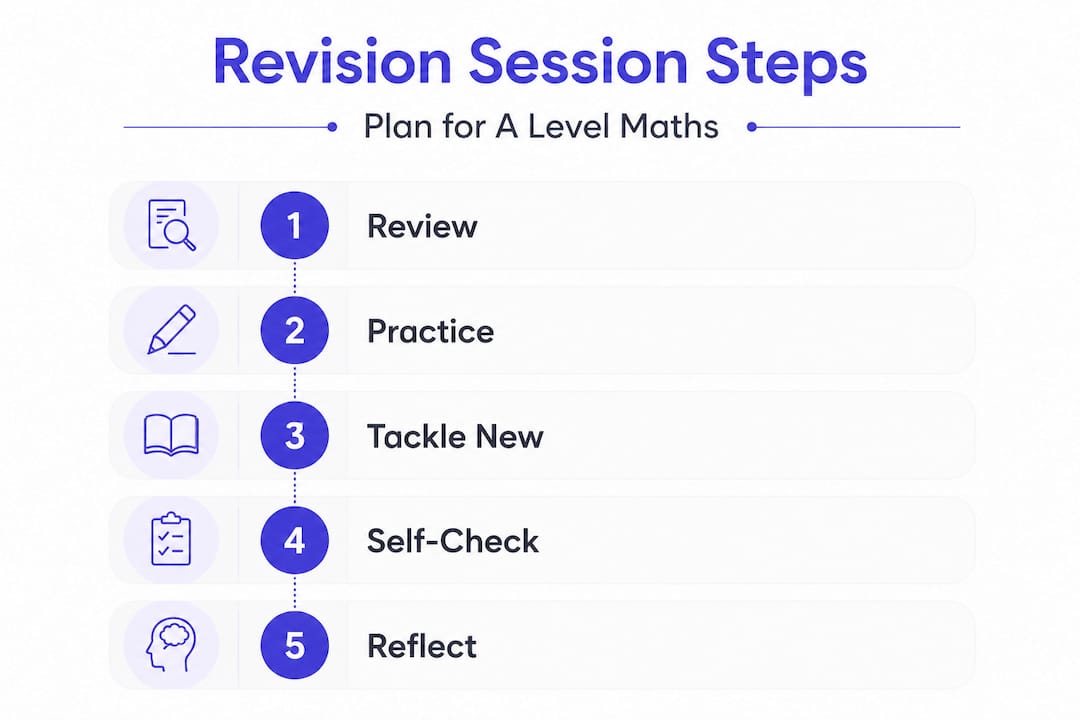
A quick template for a single revision session: ten minutes reviewing previous material, thirty minutes on new or difficult questions, ten minutes self-marking and noting errors, and ten minutes previewing the next session's topic. That sixty-minute structure is simple, repeatable, and effective.
Pro Tip: Use a question bank filtered by topic, difficulty, and marks rather than doing full past papers in the early stages of your revision. This lets you build topic-by-topic mastery before integrating everything under timed, whole-paper conditions closer to the exam.
Common pitfalls and how to overcome them
Even the strongest plans run into hurdles. The most common mistakes are not about effort; they are about structure, mindset, and flexibility. Knowing them in advance puts you in a far stronger position.
The most frequent problems students encounter include:
- Over-scheduling: Filling every hour of the day leaves no room for rest or unexpected setbacks. A plan that is impossible to follow becomes demoralising fast.
- Ignoring weak topics: Students naturally gravitate towards what they already understand. This feels productive but actually widens the gap in areas that need the most attention.
- Rigid inflexibility: Life happens. If you miss a session and refuse to adapt your plan, the whole structure can unravel. Treat the plan as a living document, not a fixed contract.
- Neglecting exam technique: Understanding content is necessary but not sufficient. Many students lose marks not because they do not know the material, but because they misread questions, rush method steps, or fail to show sufficient working. Exam technique strategies are essential for exam success, not just content revision.
- Skipping rest and wellbeing: Fatigue impairs memory consolidation. Sleeping less to study more is counterproductive. Rest is when your brain processes and stores what you have learnt.
"Progress, not perfection" is a principle worth keeping close during revision. A plan followed at eighty percent consistency over twelve weeks will always beat a perfect plan abandoned after two.
When things go off track, resist the urge to overhaul everything. Instead, use the top exam tips principle of small corrections: shift one or two sessions, reduce the scope of a topic slightly, or swap a heavy study day for lighter review. The goal is to stay in motion, not to be flawless. A practical final exam checklist in the final weeks can also help you verify that all major areas have been covered without triggering last-minute panic.
Finally, do not underestimate the role of physical wellbeing. Short walks, proper meals, and seven to nine hours of sleep are not luxuries during revision season. They are performance tools.
Why personalised revision planning beats one-size-fits-all advice
Here is something most revision guides will not tell you: the majority of "ultimate" revision plans you find online are almost useless for most students because they are generic. They assume every student has the same weaknesses, the same schedule, and the same learning pace. None of those assumptions hold in reality.
A student who finds trigonometry effortless but struggles with mechanics needs a fundamentally different plan from a student with the opposite profile. A student with three hours available each weekday needs a different structure from one juggling part-time work or other A Level commitments. Generic advice ignores all of this, and that is why so many students follow popular revision frameworks and still feel underprepared.
The most effective revision is self-aware. It asks, regularly and honestly, what is working and what is not. If timed questions are revealing the same errors week after week, that is a signal to change the approach, not to do more of the same. If a particular revision method, such as flashcards or worked examples, is helping certain topics click but not others, that is data worth acting on.
Flexible planning, where you adjust your focus, timing, and technique based on real feedback from your practice sessions, consistently delivers greater gains than sticking rigidly to a predetermined schedule. This is not about being disorganised; it is about being responsive. The exam preparation best practices that genuinely move the needle are built around the individual, not around a template.
Success in A Level maths ultimately depends on two things: effort and self-awareness. Effort alone is not enough if it is directed poorly. A student who studies smartly for three focused hours will almost always outperform one who drifts through six unfocused ones. Build a plan that fits your syllabus, your weaknesses, and your schedule, and revisit it honestly each week.
How Quextro can boost your revision journey
Ready to put this framework into practice? Quextro gives you the tools to make it happen without the usual friction of tracking down past papers and marking schemes across multiple websites.

With a database of over 13,955 past exam questions from AQA, Edexcel, OCR, and CIE, Quextro lets you filter questions by topic, difficulty, and marks so you can build your revision sessions around exactly what you need. If pure mathematics is your priority, the Pure Mathematics past papers section gives you immediate, targeted practice. If statistics is where you need the most work, the Statistics past papers collection lets you drill those topics systematically. Answer questions directly on the platform, track your confidence ratings, and let the smart revision tools adapt your plan as you improve.
Frequently asked questions
What is the first step in exam revision planning?
Start by auditing your syllabus, identifying every topic and assessing your strengths and weaknesses honestly, since structured exam preparation always begins with a clear picture of where you currently stand.
How many hours should I spend revising each day?
Aim for focused, consistent blocks of roughly two to three hours daily for A Level maths, using short breaks between sessions to maintain concentration and avoid mental fatigue building up over time.
How can I balance revision across different maths topics?
Use a plan that allocates time by topic weight and your current confidence level, giving more weekly hours to weaker or higher-weighted areas and adjusting the balance each week as your understanding improves.
What if my revision plan isn't working?
Reflect at the end of each week, make small targeted adjustments rather than scrapping everything, and consult resources or advice if a particular topic remains stuck, because successful revision is adaptive rather than rigid.
Are past papers useful for revision planning?
Absolutely. Past papers support structured revision by revealing weak areas, familiarising you with question styles and mark scheme language, and helping you prioritise which topics deserve more attention in the weeks ahead.