

TL;DR:
- Grade boundaries fluctuate annually based on exam difficulty, reflecting paper challenge levels rather than fixed scores.
- Students should revise using current boundary data for their exam board to set accurate targets.
- Focus on building deep understanding and exam technique rather than just aiming at the previous year's boundary to achieve top grades.
You might assume that scoring 75% in your A Level maths exam will always earn you the same grade. It won't. The reality of how A Level grading works surprises many students, and misunderstanding it can leave you revising to the wrong target entirely. Grade boundaries shift every single year, set only after all scripts have been marked, and they reflect how difficult that year's paper actually was. This guide explains exactly how the process works, why boundaries move the way they do, and how to use that knowledge to aim above the threshold rather than just scrape past it.
Table of Contents
- How does A Level grading work?
- Why do grade boundaries change every year?
- Exam boards and boundary differences: what to watch out for
- Interpreting your marks: what scores you actually need
- A fresh perspective on mastering A Level maths grading
- Take the next step with targeted exam resources
- Frequently asked questions
Key Takeaways
| Point | Details |
|---|---|
| Grade boundaries change annually | A Level maths boundaries are set after marking each year to adjust for paper difficulty and fairness. |
| Know your exam board | Different boards set different boundaries and question styles, so target your preparation accordingly. |
| Aim for safe scores | To maximise your grade, always aim at least 10–20 marks above the most recent boundary figures when practising. |
| Match grades to UCAS points | Each grade translates to UCAS points which impact your university offers. |
How does A Level grading work?
A Level results are reported on a scale from A* at the top, through A, B, C, D, and E, with U meaning ungraded. Every grade below E is considered a fail for university entry purposes, though an E still counts as a pass in technical terms. This scale is consistent across all exam boards and all subjects, so an A in maths from AQA means the same thing as an A from Edexcel, at least in theory.
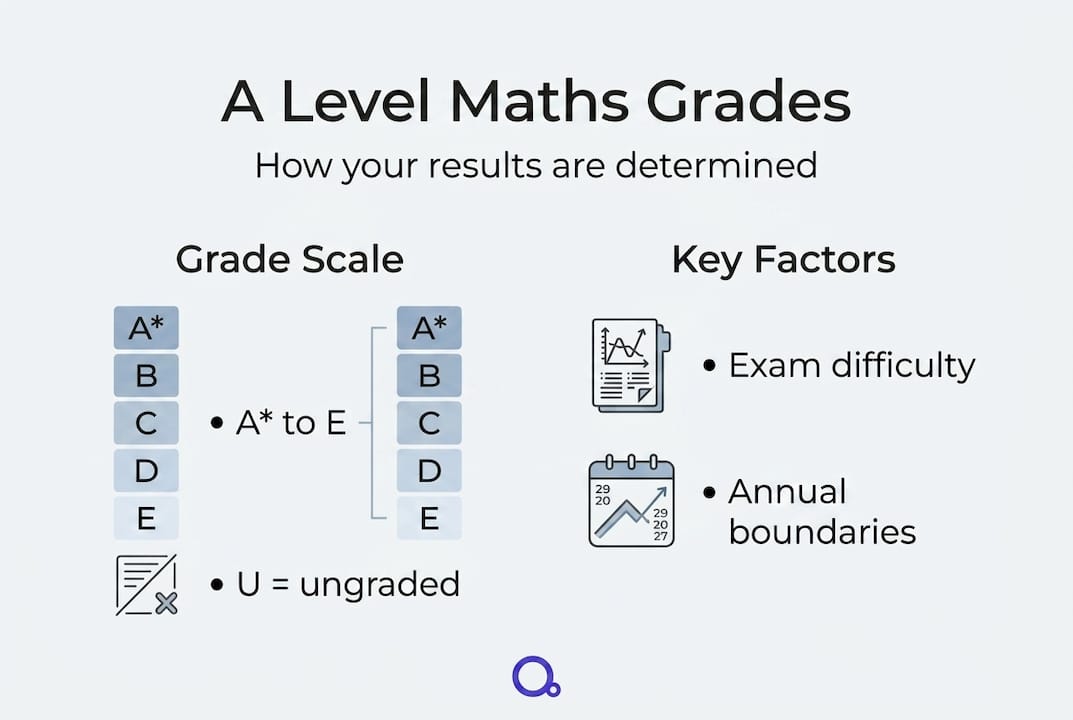
What most students don't realise is that the precise number of marks needed to achieve each grade is not fixed in advance. As outlined by A Level grading guidance from the government, boundaries are set post-marking to reflect paper difficulty, ensuring comparable standards year on year. In practice, this means senior examiners review a sample of scripts, assess where performance clusters, and determine where the grade thresholds should sit.
There are no quotas. The government does not decide in advance that only 10% of students can get an A*. If the paper was harder than usual and fewer students hit a certain mark, the boundary drops. If the paper was more accessible and students performed well across the board, it rises. The goal is consistency of standard, not consistency of score.
For maths specifically, papers vary in their algebraic demand, the number of multi-step problems, and the proportion of marks available for reasoning versus calculation. A year with a particularly tricky integration question might see the A boundary drop by several marks compared to the previous year. This is not favouritism or inconsistency; it is the mechanism doing exactly what it is designed to do.
Here is a simplified comparison of what raw marks and grades actually mean:
| Grade | What it signals | Typical raw mark range (indicative) |
|---|---|---|
| A* | Exceptional performance | ~80% and above |
| A | Strong performance | ~65–79% |
| B | Good performance | ~55–64% |
| C | Satisfactory performance | ~45–54% |
| D | Below expectation | ~35–44% |
| E | Minimum pass | ~25–34% |
These ranges are illustrative because the exact percentages shift each year. You can use an A Level grade calculator to model your score against recent boundary data.
"Understanding that grade boundaries exist to reflect the difficulty of each paper, not to limit how many students can succeed, is one of the most important shifts in mindset for any A Level maths student."
The key practical takeaway here is this: always revise your target grade using the actual boundary data for your maths exam board, not a generic percentage you found online.

Why do grade boundaries change every year?
Now that you know the mechanism, it is important to understand why these boundaries aren't the same every year. The answer has several layers, and maths is a particularly instructive example.
The most obvious driver is paper difficulty. Exam question writers aim for consistency, but a single poorly worded question or an unusually abstract problem can shift the mark distribution significantly. When examiners review scripts and find that a large proportion of able students lost marks on one question, they factor that into where boundaries should sit.
Post-COVID years have added another dimension. Rising boundaries illustrate this clearly. The AQA A Level Maths A grade boundary moved from 171 out of 300 in 2022 (57%), to 201 in 2023 (67%), to 222 in 2024 (74%), and held at 221 in 2025 (74%). That is a 17 percentage point rise in just three years. As students adapted after the disruption of the pandemic and exam boards worked to realign results with pre-pandemic standards, the mark needed to earn an A climbed sharply.
| Year | AQA A grade boundary | Percentage of total marks |
|---|---|---|
| 2022 | 171/300 | 57% |
| 2023 | 201/300 | 67% |
| 2024 | 222/300 | 74% |
| 2025 | 221/300 | 74% |
This table reveals a striking trend. If you had been preparing for your 2024 exam using 2022 boundaries as your target, you would have underestimated the required standard by roughly 51 marks. That is not a small margin. It can be the difference between an A and a C.
Exam boards also conduct detailed statistical analysis before finalising boundaries. They look at how the cohort performed across individual questions, compare results to similar cohorts in prior years, and make judgements about what a student at each grade threshold should reasonably be expected to demonstrate. Understanding how question difficulty impacts grades gives you a clearer picture of how this process affects your revision priorities.
The proportion of students earning A or A* in maths tends to be higher than in many other A Level subjects. Typically around 40 to 45% of maths A Level candidates achieve an A or A* in a given year. This reflects both the self-selecting nature of the cohort (students who choose A Level maths tend to be confident in the subject) and the way boundaries are calibrated to reward strong mathematical reasoning.
Pro Tip: Aim for at least 10 to 20 marks above last year's boundary for your target grade. Boundaries almost never drop dramatically in a single year, so building in that buffer protects you against small upward shifts and gives you genuine security heading into results day.
Exam boards and boundary differences: what to watch out for
With boundary setting in context, it is essential to recognise how your exam board could affect your target score. Not all A Level maths boundaries are created equal, and the differences can be significant.
AQA, Edexcel, OCR, and CIE each write their own papers. Because question style, paper structure, and overall difficulty vary between boards, the raw marks needed for each grade also differ. A student sitting AQA might need 222 marks for an A, while an OCR student in the same year could need a different number entirely. These are not comparable figures because the papers are not the same.
Boundaries differ between boards due to paper difficulty, and as noted in official grading guidance, no cross-board adjustments are made for disruptions or perceived unfairness between institutions. Each board's results stand on their own terms.
This matters enormously for your revision strategy. The most common mistake students make is finding boundary data online without checking which board it belongs to. Revising to the wrong board's targets can leave you either dangerously under-prepared or expending effort on question styles you won't actually face.
Some recent boundaries have prompted fairness debates. In 2025, OCR's A* boundary drew commentary because of where it sat relative to the perceived difficulty of the paper. These debates are a normal part of the process, but they do highlight that recent boundary changes can sometimes feel counterintuitive to students who expected a different outcome.
Here is a summary of what to check for each board:
- Question style: AQA tends to use more multi-step reasoning questions, while Edexcel often has slightly more structured guidance within questions.
- Paper structure: The number of papers, marks available, and topic weighting vary.
- Historical boundaries: Always look at three to five years of past boundaries for your board, not just one.
- A requirements:* Earning an A* typically requires exceptional performance of around 80 to 90% of raw marks, but the exact split between papers differs by board.
You can choose your exam board strategically if you are early in your course, but once you are in the exam hall, your focus needs to be entirely on your chosen board's past papers and style. Learning to analyse board questions is a distinct skill that pays off in marks.
Interpreting your marks: what scores you actually need
Once you have matched your exam board and understood the boundary context, let us convert all of this into actionable targets for your revision and exam technique.
Raw marks are the numbers you earn in the exam. Your grade is then determined by where those raw marks sit relative to the boundaries set after marking. The translation is straightforward once you have the boundary table for your board and year.
Maths and Further Maths show interesting patterns worth noting. A*/A rates in maths sit at approximately 45%, while Further Maths sees even higher proportions at around 60%, reflecting the specialist cohort. These figures are useful context, but they should not make you complacent. You are competing with motivated, well-prepared students.
Here is how your grade translates into UCAS points, which universities use for conditional offers:
| Grade | UCAS points |
|---|---|
| A* | 56 |
| A | 48 |
| B | 40 |
| C | 32 |
| D | 24 |
| E | 16 |
If your university offer requires AAB, for example, you need at least 136 UCAS points from three A Levels. Knowing exactly where you stand in raw marks relative to each boundary helps you prioritise which papers or topics to focus on in the final weeks of revision.
Follow these steps to set your personal mark target:
- Find the most recent grade boundary table for your specific exam board and all papers in your maths qualification.
- Add 15 marks to the A boundary as your personal minimum target. This accounts for upward drift and gives you a genuine buffer.
- Break that total down by paper. If you know your strengths, allocate a higher target to papers covering topics you find more accessible.
- Track your mock and practice scores against this target, not against a vague percentage in your head.
- Review your targets again after each set of mock results and adjust based on where you are losing marks.
Pro Tip: Always check the latest boundary tables before your revision intensifies, ideally in January or February, rather than waiting until April. Boundary trends from the previous two or three years give you the clearest picture of where standards are heading. Using exam success tips alongside boundary analysis sharpens your overall strategy. When reviewing exam answers, always categorise your lost marks by topic so you can revise with precision rather than simply repeating papers aimlessly.
A fresh perspective on mastering A Level maths grading
Here is an uncomfortable truth worth sitting with: students who obsess over hitting exactly the boundary mark are already thinking about it wrong. Boundaries are a floor, not a ceiling. Treating last year's A boundary as your personal target means you are optimising to just about pass a threshold that may well be higher this year.
The students who consistently achieve top grades do not revise to the boundary. They revise to the point where the boundary becomes irrelevant. They practise enough past questions, across enough topic areas, with enough genuine understanding, that minor boundary movements in either direction do not affect them.
The post-COVID years have shown us something important. As boundaries climbed sharply between 2022 and 2024, students who had been targeting the 2022 A boundary of 57% were left exposed. Students who had built genuine mathematical fluency and aimed well above any single year's threshold were not. Resilience and exam technique matter far more than precise mark predictions in volatile years.
Use boundary data for context and calibration. Understand the system. But never let a number become the ceiling of your ambition. The most powerful revision strategy is not chasing last year's cut-off; it is building understanding deep enough that the cut-off chases you.
Take the next step with targeted exam resources
With insight in hand, here is how to turn understanding into advantage using smart revision tools.

Quextro gives you access to over 13,955 past exam questions, organised by topic, difficulty, exam board, and mark value. Rather than hunting through PDFs for the right question type, you can filter directly to the content where you need the most practice and work above the boundary with precision. Whether you are strengthening your statistics reasoning or tackling decision mathematics, Quextro's targeted question banks keep your revision focused and measurable. Explore Decision Further Maths papers or work through Statistics Maths papers to build the consistency that pushes you well above the grade boundary, not just past it.
Frequently asked questions
What does an A* actually mean in A Level maths grading?
An A* in A Level maths is typically awarded for achieving around 80 to 90% of raw marks, with the exact boundary set each year based on overall paper difficulty and examiner judgement.
Why did A Level maths grade boundaries go up in recent years?
Boundaries rose post-COVID as exam boards worked to realign results with pre-pandemic standards and as the overall performance of the cohort improved year on year following the disruption to learning.
How do raw marks convert to UCAS points for university applications?
Your A Level grade maps directly to a fixed number of UCAS points; A* earns 56 points, A earns 48, B earns 40, and so on down the scale, which universities use to set and verify conditional offers.
Do all exam boards use the same boundaries for A Level maths?
No. Boundaries differ between boards because papers vary in difficulty and question style, so you must always check the boundaries published by your specific board rather than using figures from a different one.