

Even the most well-prepared A Level maths students can walk into an exam and feel blindsided by a question that seems to come from nowhere. You've revised the topic, you've done the past papers, and yet something about the phrasing or structure throws you completely. That feeling isn't a sign you've failed to prepare. It's a sign that question difficulty has a structure you haven't yet learned to read. Once you understand that structure, you can revise smarter, manage your time better in the exam, and stop leaving marks on the table.
Table of Contents
- What makes an exam question difficult?
- Recognising types of difficult questions
- Grade boundaries: What they reveal about difficulty
- Comparing exam boards: Is one harder than the other?
- How to overcome the hardest questions
- Put your understanding into practice with Quextro
- Frequently asked questions
Key Takeaways
| Point | Details |
|---|---|
| Identify tough questions | Look for multi-step reasoning, unfamiliar wording, or questions requiring synthesis, as these are often hardest. |
| Use grade boundaries wisely | Check recent grade boundaries to set realistic targets and avoid panic if you find a paper difficult. |
| Focus revision for depth | Deep understanding and varied practice, not memorisation, best prepare you for challenging questions. |
| Know your exam board style | Understand your own board's typical question approach to reduce surprises and tailor preparation. |
| Apply method marks strategy | Show every step in your working and be ready to skip-and-return to maximise scores on tough problems. |
What makes an exam question difficult?
Difficulty in A Level maths isn't simply about which topic a question covers. A question on basic differentiation can be straightforward or brutally hard depending on how it's constructed. The real drivers of difficulty are things like unfamiliar context, multi-step logic, and the need to select the right method without being told which one to use.
The assessment taxonomy framework used in mathematics education sorts questions into groups based on the skills they demand. Group A covers factual recall and standard procedures. Group C covers connections and genuine problem-solving, where you must synthesise ideas across topics. The jump between these groups is where most students lose marks.
Here are the main features that make a question genuinely difficult:
- Unfamiliar context: The maths is familiar but the setting is not
- Multi-step solutions: You must complete three or four logical steps without a prompt
- Method selection: No instruction is given on which technique to apply
- Complex algebra: Manipulation errors compound across a long solution
- Unusual application: A standard result is applied in an unexpected way
According to top student accounts, the hardest topics include Proof, integration and differentiation with trigonometric and exponential functions, 3D Vectors, Trigonometric identities, Parametric equations, and Mechanics modelling. What these share is that rote memorisation alone won't save you. Deep understanding and extensive practice are what separate students who score well from those who don't.
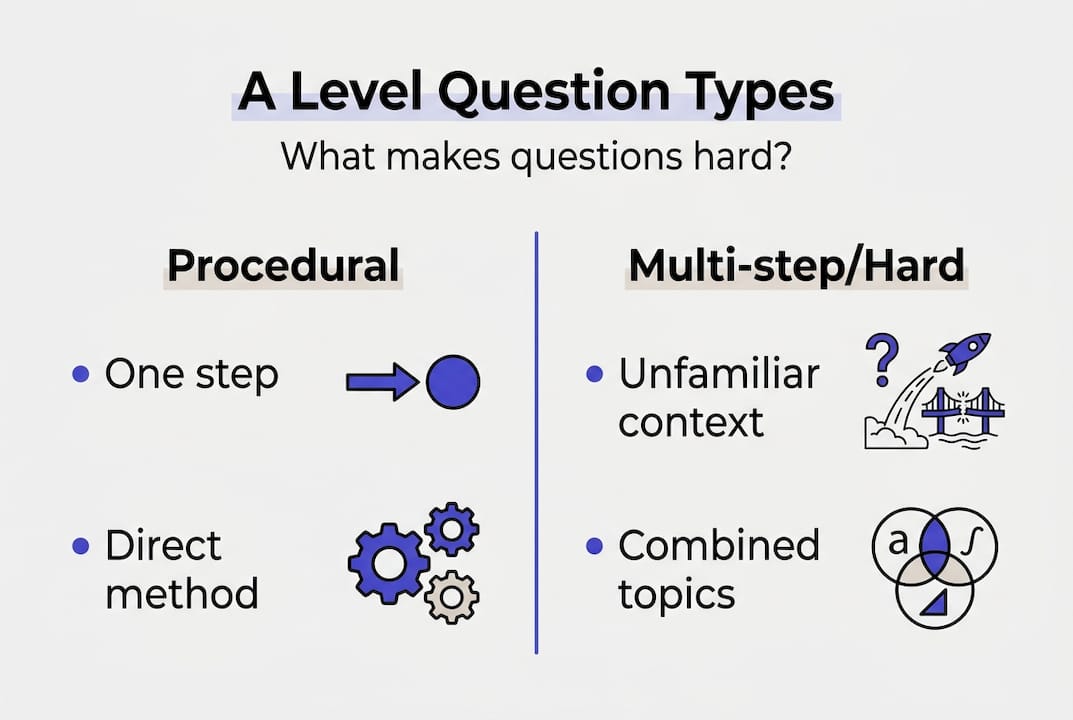
In A Level papers, 70 to 90% of questions are procedural, but the top grades hinge almost entirely on how well you handle the connections-style problems. Connecting this understanding to your revision best practices is the first step toward a genuinely targeted study plan.
Recognising types of difficult questions
Knowing what makes a question hard is useful. Being able to spot a hard question the moment you see it is even more useful. Certain structural cues appear consistently in the most challenging A Level maths questions.
Watch out for these warning signs:
- 'Show that': You must reach a given answer, leaving no room for error
- 'Hence': You must use a previous result, even if another method seems easier
- 'Prove': Requires formal logical reasoning, not just calculation
- 'Modelling': Involves setting up equations from a real-world scenario
- Multiple parts: Later parts often depend on earlier answers, so one mistake cascades
Here's a quick comparison of the two main question types you'll encounter:
| Feature | Procedural question | Connections/multi-step question |
|---|---|---|
| Method given? | Usually yes | Rarely |
| Steps required | One or two | Three or more |
| Topic scope | Single topic | Across multiple topics |
| Mark allocation | Lower | Higher |
| Risk of error | Lower | Higher |
The MATH taxonomy confirms that school-level exams sit at roughly 70 to 90% Group A questions, whilst university-level work shifts to around 50% Group C. A Level sits in between, building steadily toward those harder multi-step applications. Top student advice consistently highlights that planning your method before writing anything down is essential for multi-step questions.
It's also worth noting that some topics that feel easy in isolation produce hard exam questions. Quadratics, for instance, appear in questions that combine them with logarithms or geometric sequences in ways that catch students off guard. Understanding your exam board's question style and reviewing AQA question examples can sharpen your ability to recognise these traps early.
Grade boundaries: What they reveal about difficulty
Grade boundaries are one of the most underused tools in a student's revision arsenal. They tell you, in concrete numbers, how hard a paper actually was relative to others.
The principle is simple. Boundaries are set after marking is complete. If a paper was harder than usual, fewer students score highly, and the boundary drops to maintain fairness. If a paper was straightforward, the boundary rises. This means you can look at recent OCR grade boundaries and immediately gauge how demanding that year's paper was.
Here's a snapshot of recent data to give you a sense of the range:
| Exam board | Year | A* boundary | A boundary | Total marks |
|---|---|---|---|---|
| OCR Maths A | 2025 | 242 | 196 | 300 |
| OCR Maths A | 2025 (%) | ~81% | ~65% | 100% |
The A Level maths grade boundaries have been trending upward since 2022, with A*/A combined sitting at around 40% of the cohort in 2025. Boundaries have stabilised statistically across years according to Ofqual, but individual papers still vary noticeably.
Pro Tip: Always aim to score 5 to 10% above your target grade in practice. This buffer protects you if the real paper turns out to be harder than the ones you've been practising on.
Understanding boundaries also eases exam-day anxiety. If you find a paper genuinely tough, the boundary will likely reflect that. You can read more about how exam criteria work to see how this fits into the broader marking picture.

Comparing exam boards: Is one harder than the other?
This is one of the most common questions students ask, and the honest answer is: no board is officially harder. Ofqual ensures that standards are comparable across boards. What differs is style, and style matters enormously for how difficult a paper feels.
Exam board styles vary in meaningful ways. AQA tends to be more direct, with questions that guide you through the method more explicitly. OCR can be more algebraic and abstract, requiring you to work with less scaffolding. Neither is inherently harder, but one may suit your strengths better than the other.
Here's a practical strategy for making the most of your board's style:
- Learn your board's patterns. Spend time analysing past papers specifically from your board, not generic resources.
- Practise past papers for your board. Familiarity with the question style reduces surprise on exam day.
- Focus on keywords and mark schemes. Each board has preferred phrasing and expected answer structures.
- Don't switch boards for perceived easier questions. The grass is rarely greener, and switching disrupts your pattern recognition.
Pro Tip: Use mark schemes actively, not just to check answers. Study how the board expects you to present a solution. This alone can add several marks to your total.
Targeted practice is the fastest way to internalise these patterns. Selecting questions by board and topic and organising your question practice effectively are two habits that consistently separate high scorers from the rest.
How to overcome the hardest questions
Knowing a question is hard is one thing. Having a plan for what to do about it is another. These strategies are drawn from real student experience and examiner guidance.
- Build an error log. Every time you get a question wrong, record the topic, the mistake, and the correct method. Review it weekly.
- Make concise revision notes. One page per topic, focused on method steps and common pitfalls, not lengthy explanations.
- Spot patterns, don't memorise solutions. Recognising the type of problem is more valuable than remembering a specific answer.
- Tackle hardest topics first in your revision. Proof, integration, and 3D Vectors need the most time. Don't leave them until the week before.
- Work under timed conditions. Practising without a clock is comfortable but doesn't prepare you for the real pressure.
Pro Tip: Skipping a question and returning to it later is not a sign of weakness. It's a deliberate exam strategy. Spending eight minutes stuck on one question costs you marks elsewhere.
Multi-step questions require clear working at every stage. Even if your final answer is wrong, method marks are available throughout. Never skip steps to save time on paper. Calculator proficiency also matters more than most students realise. Knowing your calculator's functions for integration, equation solving, and statistical calculations can save several minutes on a hard paper.
For structured guidance on answering questions effectively, reviewing questions with full solutions, and understanding why consistent practice works, building these habits early in your revision cycle makes the biggest difference.
Put your understanding into practice with Quextro
Reading about question difficulty is a solid start. Practising it systematically is what actually moves your grade.
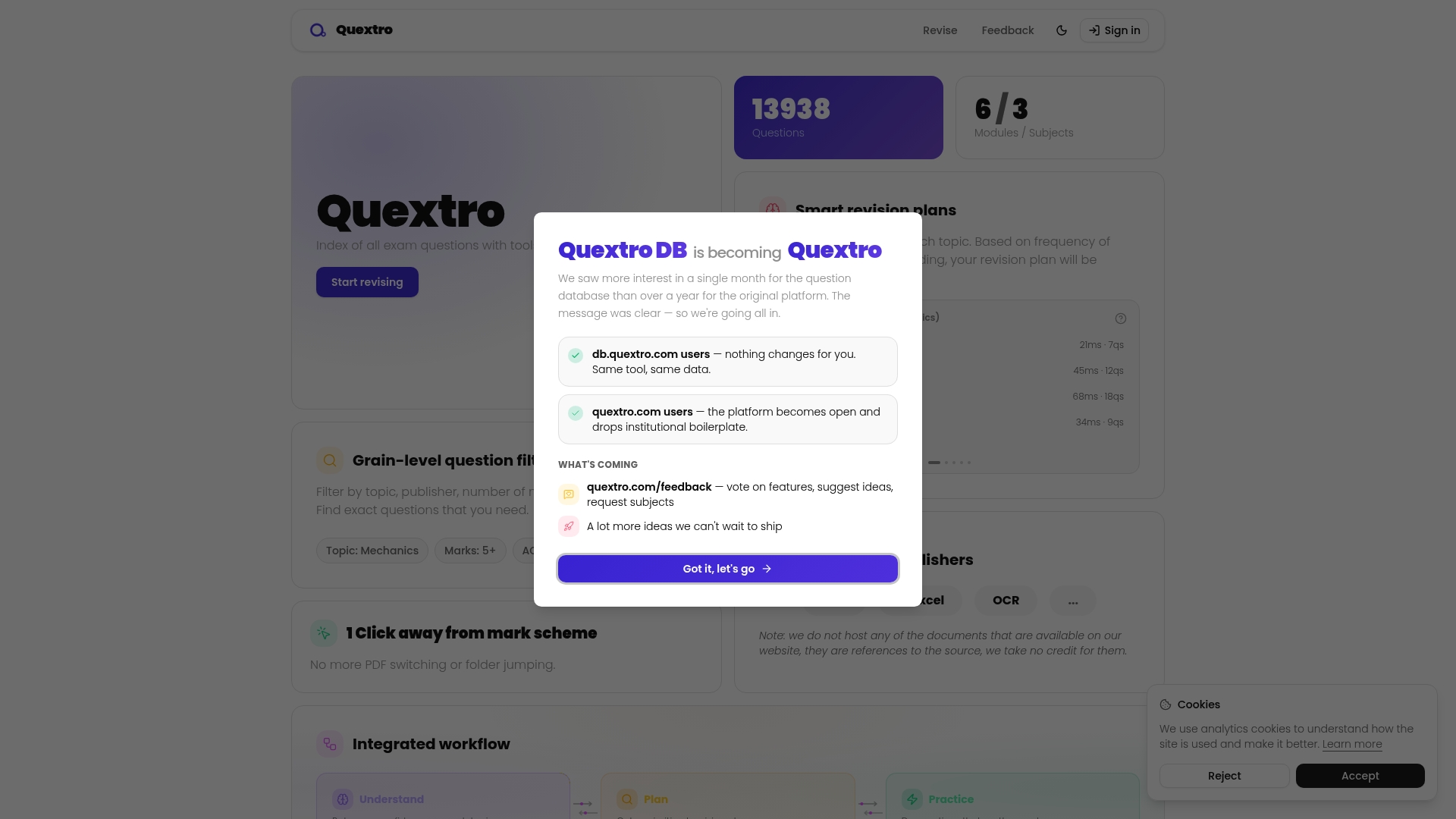
Quextro gives you access to over 13,955 past exam questions from AQA, Edexcel, OCR, and CIE, all filterable by topic, difficulty, mark allocation, and exam board. You can target exactly the connections-style questions that push you toward an A*, rate your confidence in each topic, and track your progress automatically. There's no need to hunt through PDFs or guess which questions to practise next. The platform builds a smart revision plan around your strengths and gaps, so every session is focused on what will actually improve your score.
Frequently asked questions
How do I tell if a maths exam question is 'hard'?
Hard questions usually involve unfamiliar contexts, multiple steps, or require both recall and creative application. Look for cues like 'prove', 'hence', or problems split across several parts, as these signal connections-style questions that demand more than standard procedure.
Will a 'hard' exam always have lower grade boundaries?
In most cases, yes. Grade boundaries are set after marking is complete, so a harder paper results in lower boundaries to ensure fair outcomes across the cohort.
Are some exam boards easier than others?
No board is officially harder. Board styles differ meaningfully though: AQA tends to be more direct whilst OCR can be more algebraic, so one may suit your working style better.
What helps most with the toughest questions?
Practising multi-part questions regularly, maintaining an error log, and building genuine problem-solving skills rather than relying on memorisation are the most effective approaches, particularly for the hardest topics like Proof and integration.