

TL;DR:
- CIE A Level Maths has a unique exam structure with pure and applied papers, requiring specific preparation.
- Grade thresholds vary by session, with around 80% needed for an A and over 90% for an A*.
- Effective revision involves timed practice, analyzing errors systematically, and personalizing study strategies.
Most A Level maths students assume that if they've revised the content, they're ready for the exam. With CIE, that assumption can cost you grades. The Cambridge International Examinations board structures its mathematics papers differently from AQA or Edexcel, with distinct paper combinations, unique mark allocations, and grade thresholds that shift each session. Understanding these mechanics is not optional revision trivia. It is the foundation of a genuinely effective preparation strategy. This guide walks you through the exam structure, how grades are actually calculated, the smartest ways to use past papers, and how to build a revision plan that fits your strengths and gaps.
Table of Contents
- The CIE A Level maths exam structure explained
- Decoding grade thresholds: What marks mean for your results
- Effective practice: How to use past papers and specimen questions
- Personalising your CIE maths revision strategy
- Why rethinking CIE maths revision changes everything
- Take your CIE maths revision further with expert support
- Frequently asked questions
Key Takeaways
| Point | Details |
|---|---|
| Know your exam papers | Understanding which papers and options you take is crucial for focused preparation. |
| Understand grade boundaries | Checking current and past thresholds helps you set realistic, high-impact goals. |
| Revise with purpose | Use past papers, specimen questions, and active error analysis for top results. |
| Personalise your approach | Tailor your revision to address specific weaknesses and work smart, not just hard. |
The CIE A Level maths exam structure explained
Before you can revise well, you need to know exactly what you're revising for. CIE A Level Mathematics is not a single block of papers. It is a carefully constructed combination of compulsory and optional components, and knowing this changes how you allocate your time.
The 9709 qualification requires you to sit Pure Mathematics Papers 1 and 3, alongside one Applied paper chosen from Mechanics (Paper 4), Probability & Statistics 1 (Paper 5), or Probability & Statistics 2 (Paper 6). The Pure papers are compulsory for every candidate. Your Applied choice depends on your school's offering or your own preference, though most students take either Mechanics or Statistics 1.
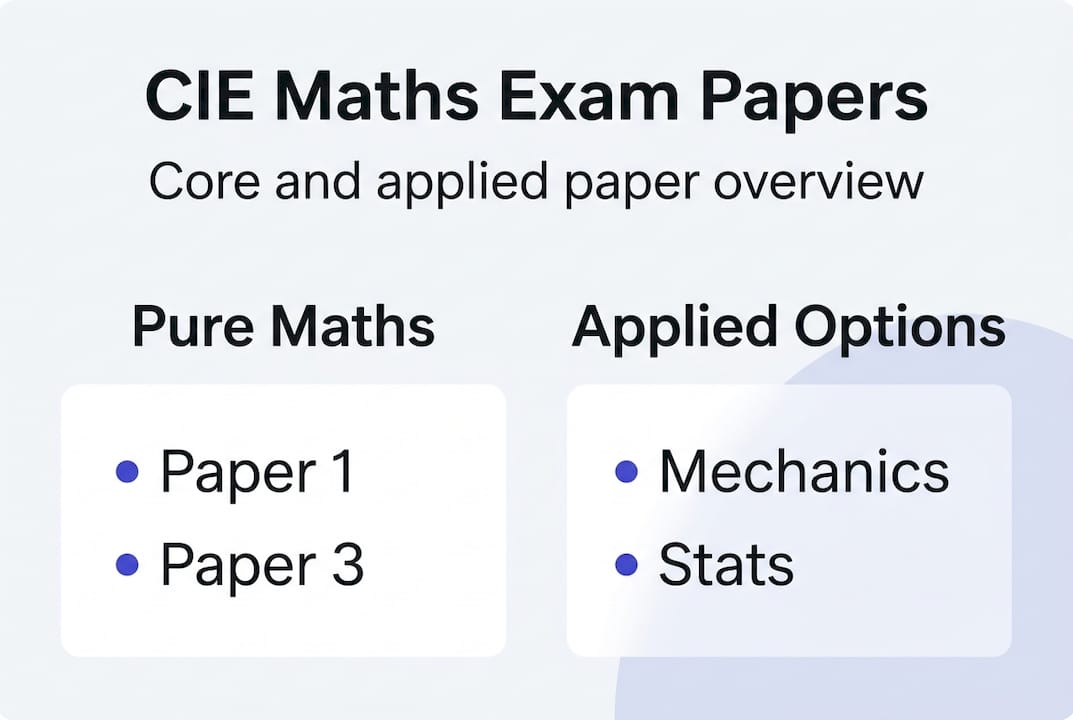
The paper timings and marks are worth memorising early:
| Paper | Content | Duration | Marks |
|---|---|---|---|
| Paper 1 | Pure Mathematics 1 | 1h 45m | 75 |
| Paper 3 | Pure Mathematics 3 | 1h 45m | 75 |
| Paper 4 | Mechanics | 1h 15m | 50 |
| Paper 5 | Probability & Statistics 1 | 1h 15m | 50 |
| Paper 6 | Probability & Statistics 2 | 1h 15m | 50 |
This structure matters for answering strategy. In a 75-mark paper over 1 hour 45 minutes, you have roughly 1.4 minutes per mark. In a 50-mark Applied paper over 1 hour 15 minutes, the ratio is almost identical. That means your pacing should be consistent across papers, but your depth of working may differ. Pure questions often demand multi-step algebraic reasoning, while Applied questions test interpretation and modelling.
Key things to understand about the structure:
- Pure 1 covers algebra, functions, coordinate geometry, trigonometry, differentiation, and integration at AS level.
- Pure 3 extends these topics and adds complex numbers, differential equations, and vectors.
- Applied papers are shorter but require precise use of formulae and contextual reasoning.
- Each paper is marked independently, and your total score across all three papers determines your grade.
For a broader look at how different boards approach exam structure details, comparing formats helps you appreciate what makes CIE distinctive.
Cambridge International designs its papers to reward mathematical reasoning and communication, not just correct answers. Method marks are available throughout, which means showing clear working is always worth your time.
Understanding the structure removes a surprising amount of exam anxiety. You stop feeling like you're preparing for something vague and start training for something specific.
Decoding grade thresholds: What marks mean for your results
Once the exam setup is clear, understanding how your papers are marked makes your revision more focused. Many students revise with a vague goal of "doing well" without ever looking at what score actually earns an A or A*. That is a costly oversight.
CIE uses raw mark thresholds, set after each exam session, to award grades. These thresholds are not fixed percentages. They shift based on how the cohort performed and how difficult the paper was judged to be. However, looking at recent data gives you a reliable target range.
From the March 2025 session, Paper 1 required 61 out of 75 marks for a grade A, which is approximately 81%. For the overall A* across a full option combination, the threshold sat at around 92%, equivalent to roughly 231 out of 250 marks.
| Grade | Approximate % needed | What this means in practice |
|---|---|---|
| A* | ~90 to 92% | Near-perfect performance across all papers |
| A | ~80 to 82% | Strong, consistent marks in Pure and Applied |
| B | ~70 to 72% | Solid understanding with some gaps |
| C | ~60 to 62% | Passing with moderate competence |
One insight that surprises many students: you do not need a perfect score to achieve an A*. Missing 20 marks across 250 still puts you in distinction territory. That means strategic revision, focusing on the question types where you drop the most marks, is more valuable than grinding for perfection on topics you already understand.
Pro Tip: Track grade thresholds across at least three recent sessions. If Paper 3 consistently has a lower A threshold than Paper 1, that tells you the paper is harder and your examiner expects slightly lower raw marks for the same grade.
Thresholds also shift between sessions, so never assume last year's numbers are fixed targets. Use them as a planning guide, not a guarantee. Keeping an eye on grade boundary insights across multiple sessions helps you spot patterns and set realistic score targets for each paper.
Effective practice: How to use past papers and specimen questions
With grade boundaries in mind, the next step is to optimise your practice and revision for top performance. Past papers are your single most valuable revision resource, but only if you use them correctly. Flicking through a paper and checking answers is not practice. It is a false sense of progress.
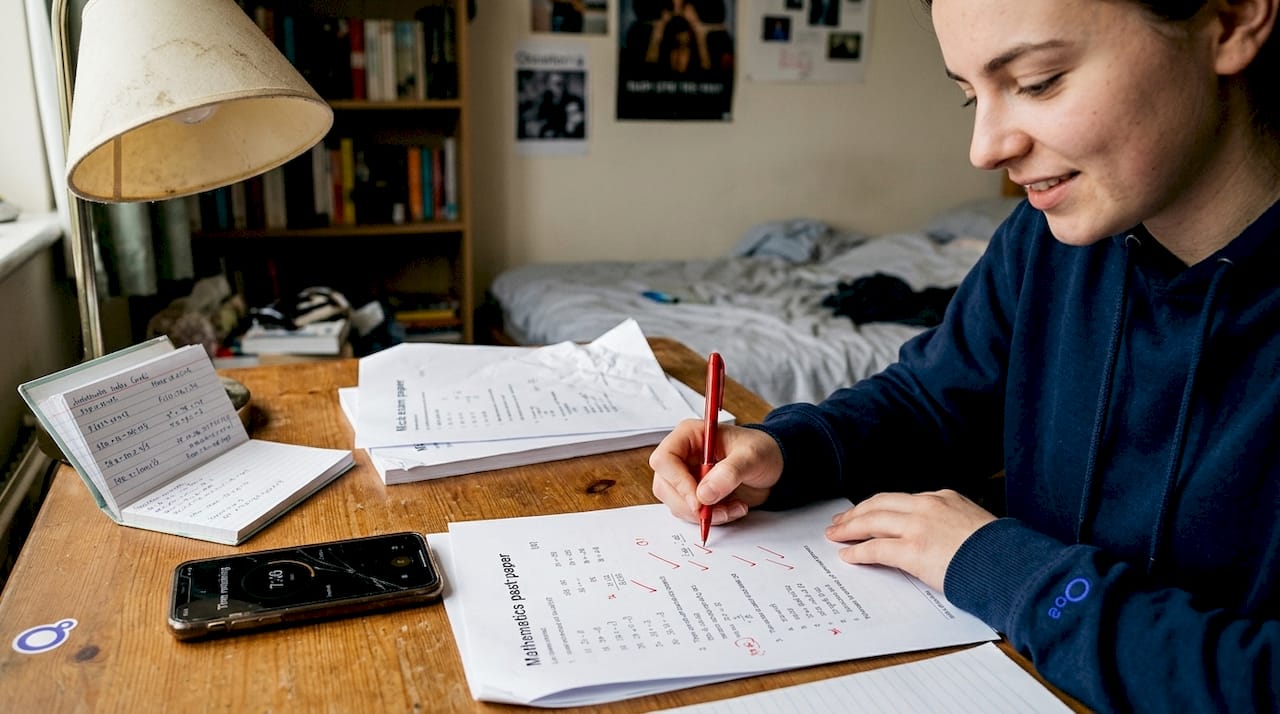
Cambridge advises students to use past and specimen papers for genuine exam simulation, alongside active recall techniques such as mistake notebooks and spaced repetition. These methods force your brain to retrieve and apply knowledge rather than passively recognise it.
Here is a structured practice sequence that actually works:
- Gather your papers. Collect at least five years of past papers for each component, plus the current specimen papers from Cambridge.
- Set real conditions. Sit the paper at a desk, with no notes, using the exact time limit. No pausing.
- Mark honestly. Use the official mark scheme. Do not award yourself method marks you did not clearly show.
- Log every error. Write down each question you dropped marks on, the topic it covered, and why you made the mistake.
- Analyse patterns. After three or four papers, your error log will reveal your genuine weak spots, not just the ones you assumed.
- Revisit and retry. Return to the weak topics, study the concept again, then attempt similar questions from other papers.
Pro Tip: Start timed practice at least eight weeks before your exam. Students who begin timed papers in the final two weeks rarely build the pacing instinct needed to manage a 75-mark Pure paper without rushing.
Specimen papers are particularly useful for newer syllabus versions because they show exactly what Cambridge intends to test. For deeper guidance on reviewing past papers effectively, and how to boost revision with practice questions filtered by topic, structured approaches consistently outperform random paper attempts.
"Interrogating questions, not just answering them, is what separates students who improve from those who plateau." This means asking: what concept is this testing, what method is expected, and where did my reasoning break down?
Personalising your CIE maths revision strategy
Practising past papers is only part of the solution. Your personal approach truly drives results. Two students can complete the same ten papers and achieve very different outcomes, purely based on how they reflect on and respond to their performance.
Start by building a weekly revision plan that identifies which paper or question type you find most difficult. If Pure 3 integration questions consistently lose you marks, that topic deserves more time than the areas where you already perform well. Be honest with yourself.
Using spaced repetition for tricky concepts, such as complex numbers or differential equations in Pure 3, means revisiting the topic at increasing intervals rather than cramming it once. This approach embeds understanding far more reliably than a single revision session.
Switching between Pure and Applied revision across the week also helps. Spending five consecutive days on Pure 3 leads to fatigue and diminishing returns. Alternating with Mechanics or Statistics keeps your thinking fresh and ensures Applied topics don't become neglected.
Useful tools for personalising your approach:
- Topic trackers: Rate your confidence in each syllabus area and update it weekly as you practise.
- Mistake notebooks: Record errors by topic and method type, then review them before each mock.
- Question analysis logs: Note which question styles (proof, modelling, multi-step) cause the most difficulty.
- Mock performance reviews: After each timed paper, compare your score against the grade threshold and adjust your focus accordingly.
- Adaptive planning: If a mock reveals unexpected weakness in Statistics, shift your next week's plan to address it rather than sticking rigidly to a preset schedule.
For reviewing mistakes in a structured way, the key is consistency. A mistake notebook you update after every paper session becomes one of your most powerful revision tools over time.
Pro Tip: Celebrate small wins. When a topic that once confused you starts clicking, acknowledge it. Positive reinforcement keeps motivation high during long revision periods.
Why rethinking CIE maths revision changes everything
Here is something most revision guides won't tell you: many high-achieving students plateau not because they lack effort, but because they confuse volume with strategy. Completing twenty past papers without analysing your errors is the mathematical equivalent of running on a treadmill and wondering why the scenery isn't changing.
The students who reach distinction level in CIE maths are not necessarily the ones who practise the most. They are the ones who understand the logic of the exam. They know which paper carries which type of reasoning demand. They track threshold trends. They treat each mistake as diagnostic data rather than something to move past quickly.
There is also a confidence dimension that rarely gets discussed. Students who understand the exam structure feel less anxious in the room. They know what a 75-mark paper demands of their time. They know that dropping five marks on Paper 1 does not ruin their A. That clarity is not a soft skill. It is a competitive advantage.
Be a reflective learner, not just a question-completing machine. The exam rewards mathematical thinking, and that only develops when you slow down, interrogate your errors, and adapt your approach session by session.
Take your CIE maths revision further with expert support
Putting these strategies into practice is far easier when you have the right resources at your fingertips. Quextro brings together over 13,955 past exam questions in one organised platform, filtered by topic, difficulty, and exam board, so you can target exactly the areas that need work.
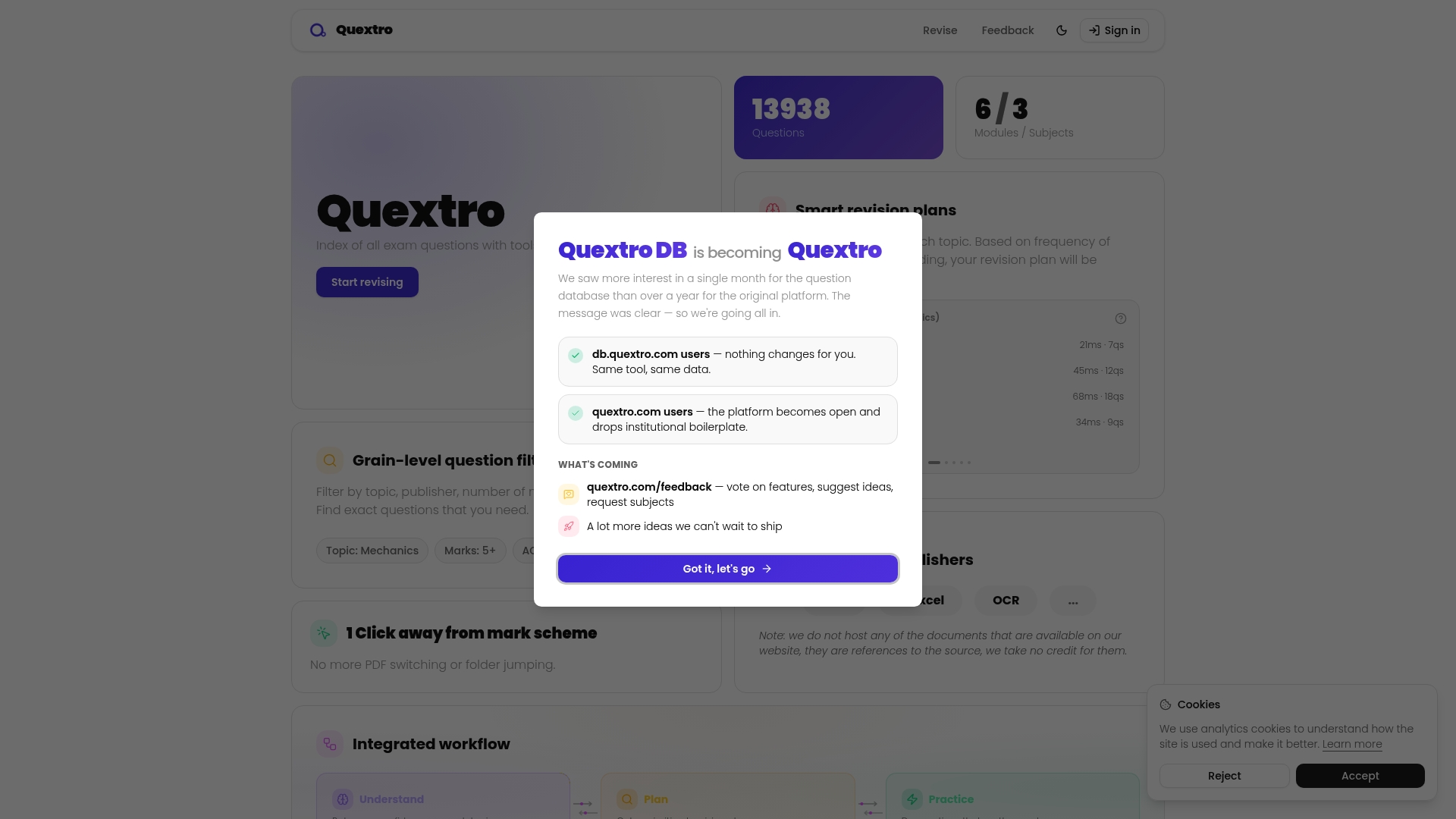
Whether you're drilling Statistics past papers or working through Mechanics past papers, Quextro's smart revision tools adapt to your confidence levels and track your progress automatically. No more hunting through PDFs or losing track of which questions you've attempted. Your personalised revision strategy becomes simpler, sharper, and far more effective when the right question bank is built around your needs.
Frequently asked questions
What papers do I have to take for CIE A Level mathematics?
You must take Pure Mathematics Papers 1 and 3, plus one Applied option: Mechanics or Probability & Statistics. The full paper breakdown is outlined in the Cambridge 9709 syllabus.
How are CIE maths grades calculated?
Raw marks on papers are converted to grades using annual thresholds, with A typically around 80 to 82% and A* at 90% or above overall. The March 2025 thresholds show Paper 1 requiring 61 out of 75 for a grade A.
What is the best way to practise for CIE maths exams?
Practise with past and specimen papers under timed conditions, then review every error systematically. Cambridge's own exam preparation guidance recommends active recall and mistake notebooks as core techniques.
How long are CIE A Level maths exams?
Pure papers are 1 hour 45 minutes each, while Applied papers are 1 hour 15 minutes each. The 2026 to 2027 syllabus confirms these timings alongside the mark allocations for each component.