

TL;DR:
- True exam readiness involves targeted practice, timed mock exams, and proficiency across all math components.
- Consistent review of past papers, mark schemes, and examiner reports is essential for effective preparation.
- Achieving at least 75-80% in timed full papers indicates genuine readiness and confidence.
Most students believe that spending the final week before their A Level maths exam revising every topic from scratch counts as being prepared. It does not. True exam readiness refers to a measurable state where you have completed targeted revision, hit benchmark performance levels through timed practice, and demonstrated proficiency across Pure Maths, Mechanics, and Statistics. Cramming might ease anxiety temporarily, but it rarely translates into the marks you need. This guide breaks down what exam readiness genuinely looks like for A Level maths and gives you a clear, actionable path to achieve it.
Table of Contents
- Defining exam readiness for A Level maths
- The core elements of exam readiness
- Key resources every student should use
- How to test if you're truly exam ready
- Why most students misunderstand exam readiness
- Level up your A Level maths preparation with Quextro
- Frequently asked questions
Key Takeaways
| Point | Details |
|---|---|
| Exam readiness is measurable | True readiness means achieving benchmark results, not just feeling prepared. |
| Use targeted resources | Past papers, mark schemes, and examiner reports are essential tools for A Level maths. |
| Test under real conditions | Simulate the full exam with timed past papers to honestly assess your preparation. |
| Consistent self-review matters | Reviewing mistakes and adapting your strategy is as important as completing practice questions. |
Defining exam readiness for A Level maths
Now we know exam readiness is more than a feeling, let's clarify what it actually involves in practice.
There is a crucial difference between feeling ready and being ready. Feeling ready often comes from familiarity with material. Being ready means you can perform under timed conditions, show clear working, and score consistently at your target grade. According to the exam readiness definition, a student is exam ready when they have completed targeted revision tasks, achieved benchmark performance levels, and demonstrated proficiency across all three A Level maths components.
A Level maths is split across three examined areas. Pure Maths carries roughly two thirds of the total marks, covering topics like calculus, algebra, trigonometry, and proof. Mechanics and Statistics share the remaining third. Mastery in all three is non-negotiable for top grades. Neglecting Statistics because you find it dull, or skipping Mechanics because it feels more like Physics, will cost you marks you cannot afford to lose.
Benchmark scores matter enormously. Here is a rough guide to what you should be targeting in timed mock conditions:
| Grade target | Benchmark score in timed mocks |
|---|---|
| A* | 90%+ |
| A | 80–89% |
| B | 70–79% |
| C | 60–69% |
These figures are not arbitrary. They reflect the level of consistent, reliable performance that translates into exam success. Use this exam readiness checklist to track where you currently stand against these benchmarks.
"Exam readiness is not a feeling. It is a measurable standard, proven through timed performance across all examined areas."
Key indicators that you are genuinely exam ready include:
- Scoring at or above your grade benchmark in timed full-paper attempts
- Completing all questions within the allocated time without rushing the final section
- Writing clear, logical working that an examiner can follow and award method marks for
- Identifying and correcting your own errors when reviewing marked work
- Feeling confident across Pure, Mechanics, and Statistics rather than just one area
If several of these do not yet apply to you, that is not a problem. It simply means you know exactly where to focus next.
The core elements of exam readiness
With exam readiness defined, it is time to lay out the main building blocks you must put in place.
Structured, regular revision consistently outperforms last-minute cramming for maths. The reason is straightforward: maths is a skill, not a collection of facts. You cannot memorise your way through a calculus question the way you might memorise a history date. Skills require repeated, deliberate practice over time. Spacing your revision across weeks rather than cramming it into days leads to far better retention and performance.

The most effective practice uses real exam-board materials. Working through past papers, studying mark schemes, and reading examiner advice gives you direct insight into what markers reward and what they penalise. Generic revision books are useful for notes, but they cannot replicate the specific style and demands of your actual exam.
Follow this sequence to build genuine readiness:
- Review your notes for a specific topic until you understand the core concepts and methods.
- Practise targeted questions from that topic, starting with lower-difficulty items and building up.
- Check mark schemes immediately after each question to understand where marks are awarded.
- Simulate timed topic sets to build speed and accuracy under mild pressure.
- Attempt timed full papers only once you have covered all topics adequately.
- Refine your technique by addressing recurring errors identified in your marked work.
Studying exam best practices and using structured past paper databases makes this process significantly more efficient. You spend less time hunting for resources and more time actually practising.
Comparison of revision approaches:
| Approach | Effectiveness | Risk |
|---|---|---|
| Cramming all topics last minute | Low | High demotivation |
| Structured topic-by-topic practice | High | Low |
| Early full-paper attempts | Medium | Demotivation if underprepared |
| Targeted sets then full papers | Very high | Minimal |
Pro Tip: Resist the urge to attempt a full past paper in the first weeks of revision. Students who attempt early full papers before building topic skills often feel discouraged by low scores, which damages motivation at a critical point. Build your skills first, then test them under full-paper conditions.
Key resources every student should use
Having covered what to do, you need the right tools. Here is exactly what will help you reach exam readiness efficiently.
Past papers and mark schemes are the foundation of effective A Level maths preparation. They show you precisely how questions are worded, how marks are distributed, and what level of detail examiners expect in your working. No other resource replicates this. Reviewing past papers regularly is one of the highest-value activities you can do in the months before your exam.
Examiner reports are frequently overlooked but genuinely powerful. These documents, published by each exam board after every sitting, detail the most common errors students make and explain what distinguished the top responses. Reading them is like being handed the marking team's notes directly.
According to key resource guidance, the essential toolkit for A Level maths includes exam board past papers and mark schemes from AQA, Edexcel, or OCR, official revision notes and textbooks, approved graphing calculators, and examiner reports highlighting pitfalls such as insufficient working or misreading questions.
Here is your essential resource list:
- Past papers and mark schemes from your specific exam board (AQA, Edexcel, OCR, or CIE)
- Official exam board specifications so you know every topic that can be tested
- Examiner reports for the last three to five years of sittings
- Approved graphing calculator practised regularly so you are confident on exam day
- Revision notes from trusted sources aligned to your specification
- Structured question databases for targeted topic practice
Practising exam questions in a focused, topic-by-topic manner is far more productive than simply working through papers from front to back without reflection.
Pro Tip: Check your exam board's approved calculator list well before the exam. Using the wrong model, or being unfamiliar with your calculator's functions under pressure, is an avoidable mistake that costs students marks every year.
How to test if you're truly exam ready
With resources lined up, here is how you will know if you are genuinely exam ready rather than just hoping for the best.
Self-assessment is the most honest measure of readiness. It removes the comfort of feeling familiar with your notes and replaces it with actual data from your performance. The 80% benchmark on timed sets correlates strongly with exam success, making it a reliable and practical target to work towards.
"Students reaching mock levels 2.5+ or 80%+ on timed sets pass most reliably. The data does not lie."
Use this step-by-step self-testing process:
- Select a full past paper from your exam board that you have not previously seen.
- Set a timer for the exact allocated time and work in exam conditions, no notes, no interruptions.
- Mark your paper using the official mark scheme, being strict with yourself.
- Calculate your percentage and compare it against the benchmark table above.
- Identify every question where you lost marks and categorise the error (concept gap, careless mistake, timing issue, or unclear working).
- Revisit the relevant topics or techniques before attempting another paper.
For answering exam questions effectively, focus on showing every step of your method. Examiners award method marks even when the final answer is wrong, so clear working is worth real marks. Learning how to select exam questions strategically during revision also helps you prioritise the topics that appear most frequently. These exam success tips can make a measurable difference to your final score.
Coverage checklist before attempting a full self-test:
- Pure Maths: all core topics attempted and scored at benchmark
- Mechanics: kinematics, forces, and moments covered with timed practice
- Statistics: probability, distributions, and hypothesis testing practised with mark schemes
- Timing: able to complete each paper section without overrunning
- Working clarity: every method step written out legibly and logically
Why most students misunderstand exam readiness
Here is an uncomfortable truth. Most students judge their readiness by how much time they have spent revising, not by what their scores actually show. Hours logged feels productive. But maths does not reward effort alone. It rewards accuracy, method, and consistency under pressure.
Cramming creates a false sense of confidence because you recognise material after reading it. Recognition is not the same as being able to reproduce a method under timed conditions without prompts. That gap is where marks are lost.
What genuinely separates high achievers is not the volume of practice but the quality of reflection. Students who consistently pass at 80%+ on timed sets do so because they analyse their errors, read examiner comments, and adapt their approach. They treat every marked paper as a feedback document, not just a score. Spending ten minutes reviewing exam answers carefully after each practice session is worth more than an extra hour of passive re-reading.
Pro Tip: After every timed set, write down the three errors you made most often. Address those specifically before your next attempt. Consistent self-checking and adapting your strategy beats simply working through more questions without reflection.
Level up your A Level maths preparation with Quextro
If you are ready to move from theory to practice, Quextro gives you the tools to do exactly that. The platform holds over 13,955 past exam questions from AQA, Edexcel, OCR, and CIE, all filterable by topic, difficulty, and marks. That means you can target the precise areas where your self-testing reveals gaps, rather than working through questions at random.
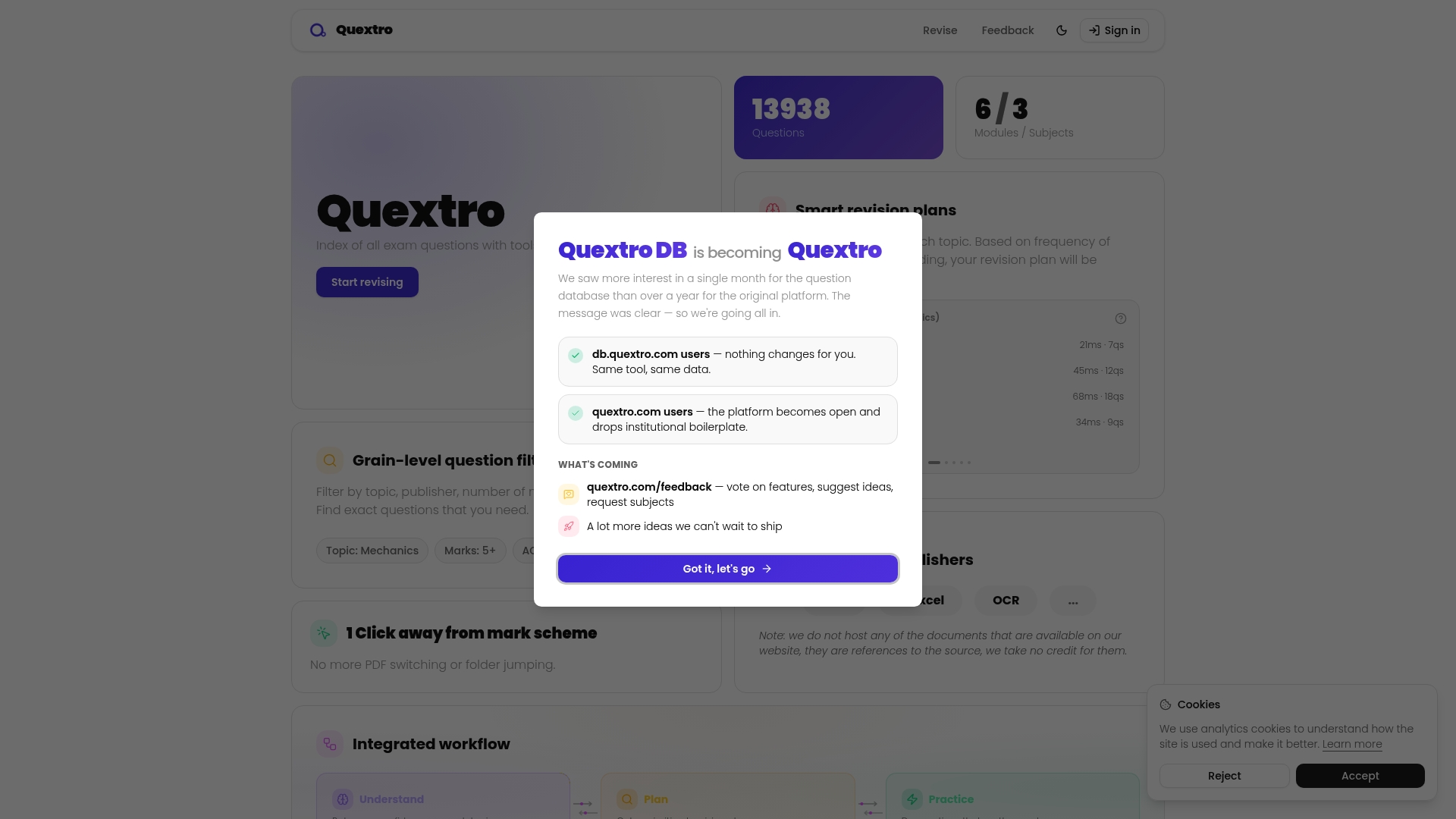
Explore A Level maths papers to practise full question sets, or drill into Mechanics maths questions if that is where your benchmark scores need work. Smart revision plans adapt to your confidence ratings, so your time is always spent where it matters most. Visit Quextro's maths revision hub to start building the kind of measurable, data-driven readiness that actually shows up in your results.
Frequently asked questions
What is the best way to test exam readiness for A Level maths?
Take a full past paper under timed conditions and aim for at least 75–80% to match top grades. That score range is the most reliable indicator of genuine exam readiness.
Which exam boards' resources should I use to prepare?
Prioritise your specific board's past papers, whether AQA, Edexcel, or OCR, alongside their official mark schemes for the most accurate and relevant practice.
When should I attempt full past papers during revision?
Only move to full past papers after covering core content by topic. Early full papers before skill-building is complete often lead to discouraging scores that harm motivation.
How important are examiner reports for exam readiness?
Examiner reports are essential. They identify common pitfalls such as insufficient working or misreading questions, which are exactly the errors that cost students marks in A Level maths.