

TL;DR:
- Focused exam revision targets high-frequency and your weak topics, boosting grades by 15-20%.
- Active practice and retrieval improve retention more than passive re-reading.
- Continuous testing, feedback, and strategic planning are essential for effective A Level maths revision.
Most students preparing for A Level maths spend hours re-reading notes and working through random questions, yet their grades stay stubbornly flat. The reason is straightforward: revision without focus is revision without impact. Focused exam revision boosts A Level maths scores by 15 to 20% compared to random practice, yet the majority of students never adopt this approach. This article explains exactly what focused revision is, why the evidence backs it so strongly, how to build it into your study routine, and where students most commonly go wrong when they try it.
Table of Contents
- What is focused exam revision and how does it work?
- The evidence: Why focused revision outperforms random study
- How to structure your A Level maths revision for maximum focus
- Advanced tips: Balancing challenge and feedback for complex topics
- What most students miss about focused revision
- Take your focused revision further with tailored resources
- Frequently asked questions
Key Takeaways
| Point | Details |
|---|---|
| Target weaknesses | Focusing revision on your weak areas provides much bigger gains than random practice. |
| Use high-frequency topics | Practise calculus, trigonometry, and other frequent topics that appear in most exams. |
| Test, don’t just read | Self-testing offers double the retention compared to passive reviewing. |
| Iterate and adapt | Track mistakes and update your revision plan for the best progress. |
| Balance for tough topics | Complex areas benefit from combined approaches: testing, feedback, and spaced revision. |
What is focused exam revision and how does it work?
With a clear motivation to improve, it's vital to understand exactly what focused exam revision is and why it's so effective.
Focused exam revision is a deliberate, structured approach where you practise questions on the topics most likely to appear in your exam and the areas where you personally struggle most. It is the opposite of sitting down and working through questions at random, or re-reading your entire textbook from cover to cover. Instead, you actively select what you practise and why.
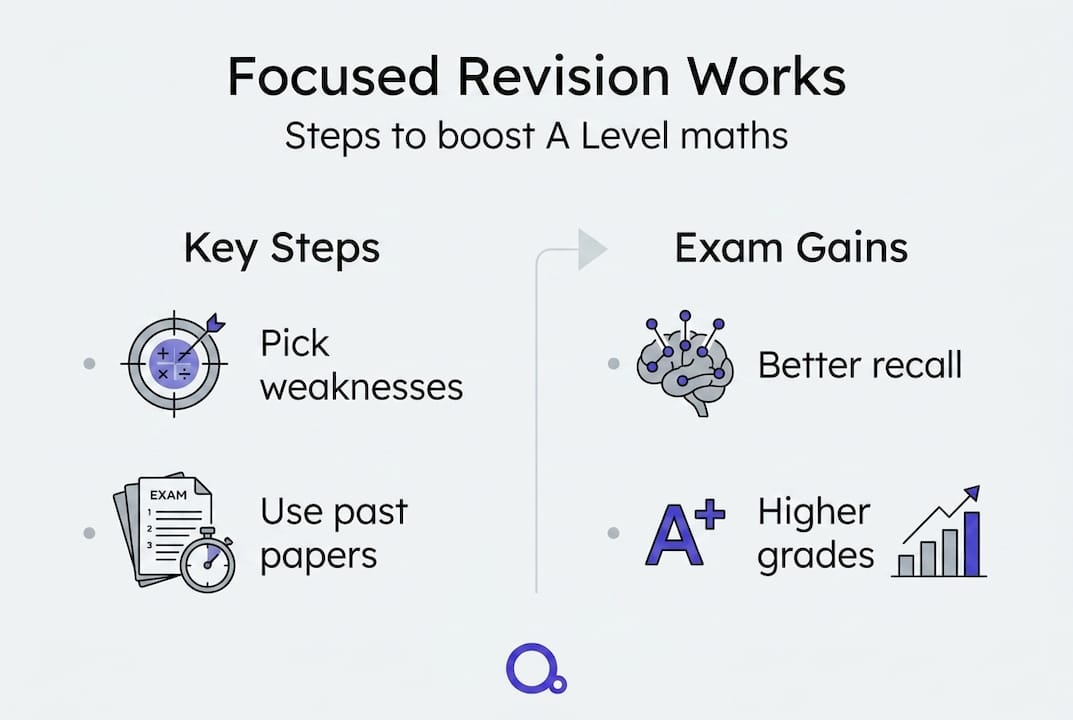
The mechanics are straightforward. You filter past paper questions by topic frequency, by your own identified weaknesses, and by the most recent papers from your exam board. This means every session has a clear purpose, and you waste almost no time on material you already understand well.
The testing effect in revision is central to why this works: prioritising high-yield exam questions on weaknesses and frequent topics forces your brain to retrieve information actively, which strengthens memory far more than passive reading. Think of it this way: a gym session where you target your weakest muscle groups produces faster results than one where you repeat only the exercises you already find easy.
Here is a quick comparison of the two approaches:
| Approach | What you practise | Time efficiency | Outcome |
|---|---|---|---|
| Random revision | Everything, in no order | Low | Slow, uneven improvement |
| Focused revision | Weak areas and high-frequency topics | High | Faster, targeted improvement |
The benefits of focused revision include:
- Higher marks for the same hours invested
- Reduced exam anxiety because you know your weak spots
- Better recall under timed conditions
- A clearer sense of where you still need work
Alongside topic selection, maths exam best practices such as reviewing errors carefully after every session are essential parts of making focused revision work. Each mistake is a data point, not a failure.
Pro Tip: After every practice session, write down the three questions you found hardest. Use that list to decide which topics to tackle in your next session. This single habit transforms unfocused practice into a genuine feedback loop.
For truly targeted exam practice, you need to match what you practise to what your exam board actually tests, not what feels comfortable.
The evidence: Why focused revision outperforms random study
Now that we've clarified what focused revision is, let's see what the research shows about its impact compared to traditional revision approaches.
The research is striking. Practice testing produces 2x retention compared to re-reading, with studies showing 80% retention after one week for those who self-test versus just 36% for those who re-read. Apply that to maths, and the difference between answering a past paper question on integration and re-reading your integration notes becomes enormous.
"Retrieval practice is one of the most effective learning strategies available, yet most students underuse it in favour of passive review."
When it comes to A Level maths specifically, topic coverage matters. High-frequency topics including calculus and trigonometry appear in over 80% of A Level maths exams. Spending the bulk of your revision time on these areas is not just sensible; it is statistically the most efficient thing you can do.
The numbers that matter:
- 80% retention with practice testing vs. 36% with re-reading after one week
- Over 80% of papers include calculus and trigonometry questions
- 15 to 20% grade improvement linked to focused revision strategies
Here is how revision methods compare on key outcomes:
| Method | Retention after 1 week | Exam relevance | Time to results |
|---|---|---|---|
| Re-reading notes | 36% | Low to moderate | Slow |
| Practice testing (focused) | 80% | High | Faster |
To maximise the effect of focused revision, follow this sequence:
- Practise questions on a specific topic under timed conditions.
- Mark your answers using the mark scheme and note every error.
- Review what went wrong and identify the underlying gap.
- Return to that topic two to three days later and repeat.
- Adjust your plan based on whether your scores are improving.
For a deeper look at which topics deserve the most attention, topic analysis tips can help you map your revision accurately. Understanding high-frequency exam topics is equally important when deciding where to invest your time first.
How to structure your A Level maths revision for maximum focus
With strong evidence for focused revision, let's look at the practical steps you can take to adopt this approach.

Building a focused revision plan does not need to be complicated. The key is to make intentional decisions about what you practise, rather than simply picking up wherever you left off.
Follow these five steps to get started:
- List your high-frequency exam topics. Begin by identifying the topics that appear most often on past papers for your specific exam board. Calculus, trigonometry, statistics, and algebra are strong starting points for most boards.
- Identify your weak areas using recent results. Look at your most recent mock exam or practice paper. Which questions did you lose the most marks on? These become your priority.
- Filter and practise past paper questions on those areas. Rather than completing full papers at random, select questions specifically on your weak topics. Organising revision by topic makes this far easier and keeps your sessions purposeful.
- Track your progress and review every error. Keep a log of which questions you attempted, how you scored, and what went wrong. Reviewing exam answers carefully, rather than just checking whether you got the right number, is where most of the learning actually happens.
- Refine your plan as you progress. As your weaker topics improve, shift your focus. A solid revision plan is a living document, not a fixed schedule. This iterative process, where you filter questions by frequency and weakness and track your improvement over time, is what separates genuinely effective revision from busy work.
A good framework for your overall A Level preparation is laid out in this university entry preparation guide, which covers how to pace your study across subjects.
Pro Tip: Spaced practice beats cramming every time. Instead of spending three hours on one topic in a single sitting, spread practice across three sessions of one hour each, with a day or two in between. Your retention will be dramatically better by exam day.
Advanced tips: Balancing challenge and feedback for complex topics
While focused revision is powerful, some advanced maths topics demand a more strategic balance.
Not all topics respond equally well to the same approach. When you are tackling something like proof by induction, differential equations, or complex numbers, simply hammering through more questions is not always enough. These areas require genuine conceptual understanding, not just procedural repetition.
Research on advanced domain cognitive load confirms that with complex material, the testing effect can be limited by high cognitive load. When a topic is too unfamiliar, attempting question after question without support can actually slow learning rather than accelerate it.
"Desirable difficulties aid learning only when the learner has enough prior knowledge to make sense of the challenge."
To balance challenge and feedback effectively, consider these approaches:
- Use worked solutions strategically. Before attempting a question cold, study a fully worked example of a similar problem. This reduces cognitive overload and gives your brain a framework to work from.
- Seek feedback on your method, not just your answer. In maths, losing marks often comes from method errors rather than arithmetic slips. Make sure you understand why a method works, not just whether your final answer matched.
- Space your attempts. If a topic feels overwhelming, practise it in short bursts across multiple sessions rather than trying to master it in one go.
- Rate your confidence honestly. After each session, note whether you feel more or less confident. This honest self-assessment guides you towards the right balance of challenge and consolidation.
For a complete guide to structured exam preparation, including how to handle your toughest topics, there is a detailed breakdown available that covers pacing, topic sequencing, and managing study pressure.
What most students miss about focused revision
Having covered the essential strategies, it's worth considering where students commonly go astray with focused revision.
Here is the uncomfortable truth: most students think focused revision simply means choosing a topic and practising it. But genuine focus is not a one-time decision. It is a continuous cycle of testing, identifying gaps, adjusting, and testing again. The moment you stop adapting your plan, you have stopped doing focused revision.
The single biggest error we see is students who stay in the comfort zone of topics they already find manageable. It feels productive. It builds confidence. But it does almost nothing for your grade, because the marks you are losing are on the topics you are quietly avoiding.
Your mistakes are your revision roadmap. Every error on a practice question is telling you exactly where your next session should be focused. Students who treat mistakes as embarrassments miss the most valuable feedback they will ever receive before the real exam.
Think of tips for exam success not as a checklist but as a mindset: the goal is to expose your weaknesses early, while you still have time to fix them.
Pro Tip: Test yourself at the start of your revision, not just at the end. Beginning a session with a few questions on your target topic reveals exactly what you do and do not know before you spend time reviewing material you may already understand.
Take your focused revision further with tailored resources
Ready to take the next step? Here is how Quextro's resources can streamline focused revision for your upcoming A Levels.
Quextro gives you direct access to a searchable database of over 13,955 past exam questions, organised by topic, difficulty, exam board, and mark allocation. Instead of flicking through PDFs or guessing which questions to practise, you can filter A Level exam questions instantly to match your specific weak areas and target the highest-frequency topics across AQA, Edexcel, OCR, and CIE.
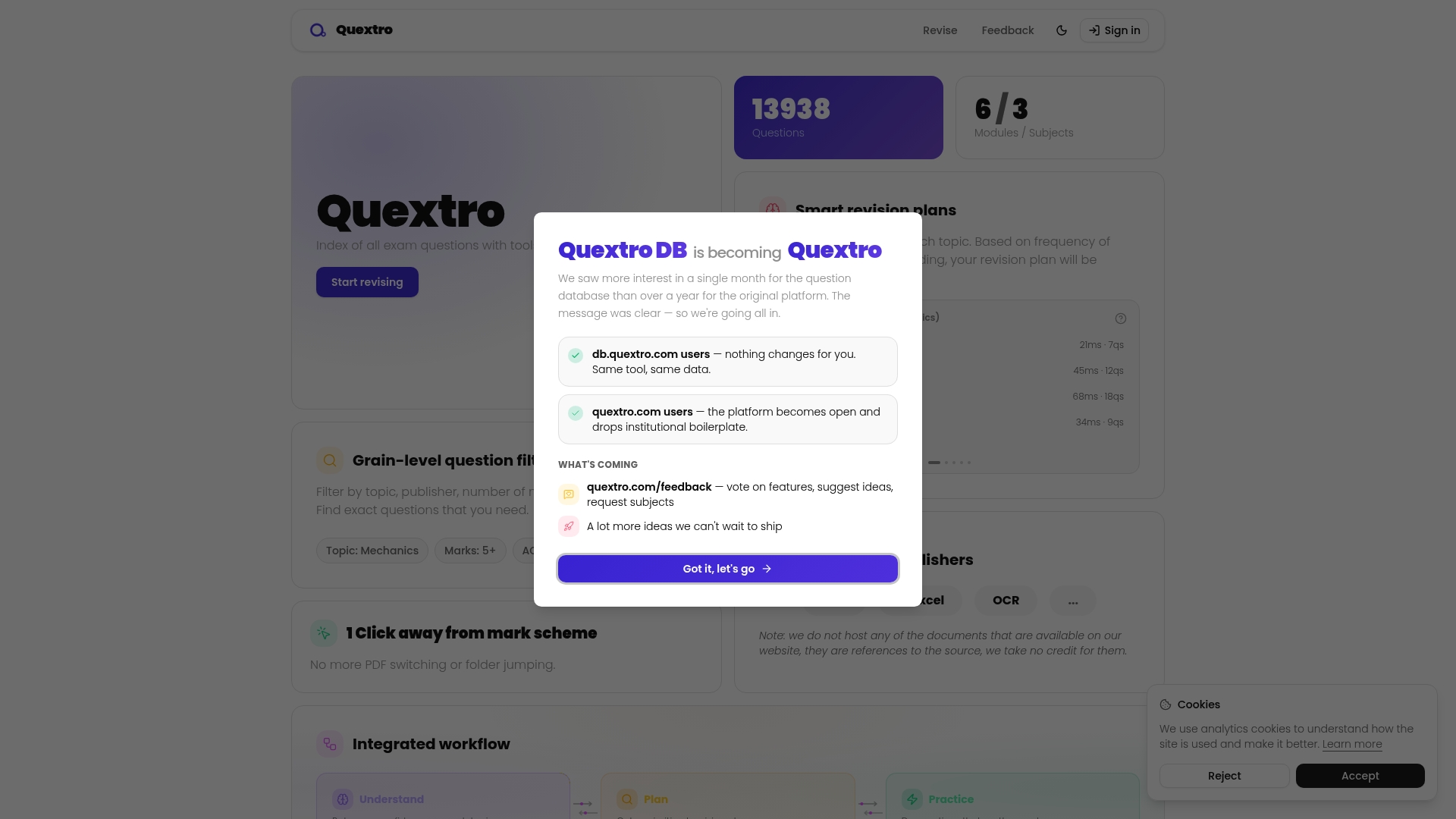
The platform also includes smart revision plans that adapt as your confidence in each topic changes, so your practice always reflects where you actually are, not where you were two weeks ago. If you are studying further maths, you can explore further maths practice papers in the same streamlined environment. No extra tools, no scattered resources. Just focused, trackable practice built around your exam.
Frequently asked questions
What does focused exam revision mean in A Level maths?
Focused revision means deliberately practising weak and frequently tested topics instead of passively reviewing everything. It targets high-yield exam questions to make every revision session count.
How much can focused revision improve my maths grade?
Research shows you can improve A Level maths scores by 15 to 20% with focused revision compared to random study. The improvement comes from directing effort at your actual gaps rather than comfortable material.
What topics should I focus on for the best results?
Prioritise calculus and trigonometry, which appear in over 80% of A Level maths exams. These topics offer the highest return on revision time for most students.
Is testing myself better than just re-reading my notes?
Yes. Practice testing doubles retention after one week compared to re-reading, with an 80% versus 36% retention rate. Active retrieval is significantly more effective than passive review.
What if my weak topics are the most complicated ones?
Blend practice with feedback and use worked solutions to reduce cognitive overload. Spacing your revision across multiple shorter sessions is more effective than intensive cramming for complex material.