

Most students revising for A Level maths spend hours rereading notes, highlighting textbooks, and working through random past papers with no clear strategy. It feels productive, but the results rarely reflect the effort. The good news is that there is a smarter way. 15 to 20% better scores are achievable when students switch from generic question sets to a targeted, filtered approach. This article breaks down exactly what targeted exam practice means, how it works in practice, and how you can implement it to make every revision session count.
Table of Contents
- What targeted exam practice actually means
- How targeted exam practice works in A Level maths
- Where to find high-quality targeted exam questions
- Maximising results: common pitfalls and advanced tips
- Take your revision further with Quextro
- Frequently asked questions
Key Takeaways
| Point | Details |
|---|---|
| Focus on weaknesses | Targeted practice helps you prioritise the topics and skills that will raise your marks fastest. |
| Quality over quantity | Strategic selection of exam questions delivers better results than doing every question available. |
| Track your progress | Regularly update your question selection based on your improvement and recent exam trends. |
| Use trusted sources | Access organised past exam questions from leading platforms for accurate and efficient practice. |
What targeted exam practice actually means
Targeted exam practice is not simply doing more past papers. It is a deliberate, strategic method that puts your weaknesses, the exam board's patterns, and the syllabus at the centre of every session. Rather than working through questions at random, you filter and select based on what matters most to your specific situation.
Targeted exam practice is a strategic revision method for A Level mathematics students involving filtering and selecting past exam questions based on personal weaknesses, topic frequency in exams, difficulty, and syllabus alignment, rather than random or exhaustive practice. That distinction is crucial. Quality beats quantity every time.
Here is how targeted practice compares with the approaches most students default to:
| Approach | Focus | Efficiency | Outcome |
|---|---|---|---|
| Rereading notes | Passive recall | Low | Minimal retention |
| Random past papers | Broad coverage | Medium | Inconsistent gains |
| Targeted exam practice | Weakness and frequency | High | Consistent improvement |
The Essex University revision research confirms that active, focused retrieval practice outperforms passive study methods significantly. A Level maths benefits especially from this approach because certain topics carry disproportionate weight in every exam series.
Common pitfalls of generic revision routines include:
- Spending equal time on topics you already understand
- Practising questions that rarely appear in your specific exam board
- Ignoring difficulty progression and staying in your comfort zone
- Failing to track which question types you consistently get wrong
The shift from why practising exam questions matters in theory to actually selecting exam questions with intention is where most students unlock real progress. When you know which topics appear most often and which ones trip you up, every question you attempt has a purpose.
"The most effective revision is not the longest revision. It is the most precisely aimed."
How targeted exam practice works in A Level maths
Now that you understand the theory, here is how targeted exam practice unfolds in a practical, step-by-step process for A Level students.

The mechanics involve sorting past papers by topic, analysing frequency, applying personal difficulty weighting, and iterating as you improve. Calculus and trigonometry, for example, appear in over 80% of A Level maths exams, making them non-negotiable priorities for almost every student.
Follow this process to build your targeted revision system:
- Collect your materials. Gather past papers from your specific exam board, covering at least the last five years. Organise them by year and paper.
- Sort by topic and subtopic. Break each paper into its component topics. Use a spreadsheet or a platform that does this automatically.
- Analyse frequency. Note which topics appear most often and carry the most marks. Calculus, algebra, and statistics tend to dominate.
- Apply personal filters. Cross-reference high-frequency topics with your own confidence ratings. Topics that are both frequent and weak are your highest priority.
- Work through questions systematically. Start with your highest-priority topics and increase difficulty progressively. Use resources on organising exam questions to keep your workflow clean.
- Review and adjust. After each session, update your confidence ratings. Move topics that improve to a lower priority and keep pushing on persistent weaknesses.
Here is a snapshot of how major A Level maths topics distribute across past papers:
| Topic | Approximate exam frequency | Typical mark weighting |
|---|---|---|
| Calculus (differentiation and integration) | Over 80% of papers | 20 to 30% of marks |
| Algebra and functions | Over 75% of papers | 15 to 25% of marks |
| Trigonometry | Over 80% of papers | 10 to 20% of marks |
| Statistics and probability | Over 65% of papers | 15 to 20% of marks |
| Mechanics | Over 55% of papers | 10 to 15% of marks |
The data makes it clear: ignoring calculus or trigonometry in your revision is simply not an option. Following exam preparation best practices means letting frequency data guide your time allocation, not habit or preference.
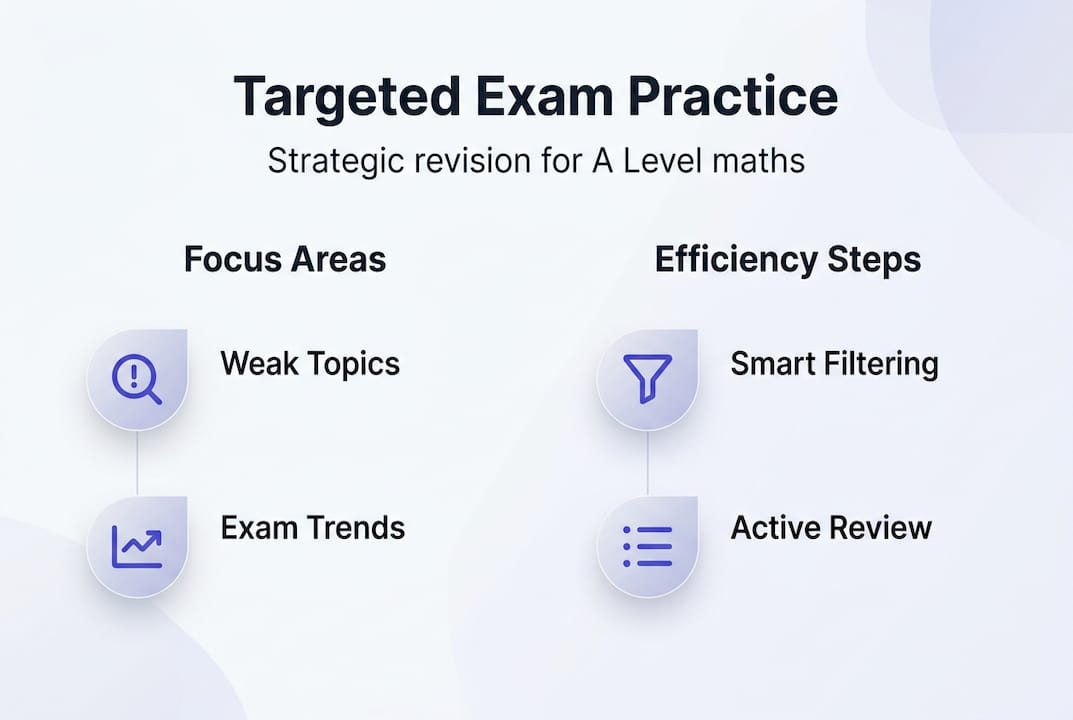
One common mistake students make is building a targeted list once and never updating it. Your weaknesses shift as you practise. A static list quickly becomes outdated and loses its advantage. Use an exam preparation checklist to keep your approach dynamic and responsive.
Where to find high-quality targeted exam questions
To apply targeted practice, you need access to well-organised, up-to-date questions. Here is where to find them.
The best sources for curated past questions from AQA, Edexcel, and OCR include topic banks from platforms like Save My Exams, Physics and Maths Tutor, Madasmaths, and Quextro, which hosts over 13,955 organised questions. Each platform has its own strengths:
- Quextro: Over 13,955 questions filterable by topic, difficulty, exam board, and marks. Smart revision plans adapt to your confidence ratings, and you can answer questions directly on the platform without downloading PDFs.
- Physics and Maths Tutor: Extensive topic-sorted question banks for all major exam boards, free to access.
- Save My Exams: Structured topic questions with model answers, useful for checking your working method.
- Madasmaths: A large collection of topic-specific worksheets, particularly strong for pure maths.
When using any of these platforms, always verify that the questions align with your current syllabus. Exam boards update their specifications periodically, and practising questions from an outdated syllabus wastes time. Check the specification year before you begin.
Pro Tip: Do not rely on a single source. Combining Quextro's filtering tools with the breadth of Physics and Maths Tutor gives you both precision and variety. Use the select exam questions guide to build a question set that covers your weak topics from multiple angles.
If you are sitting AQA, the AQA exam questions resource is particularly useful for board-specific filtering. Not sure which board you are on? The guide on choosing exam boards clarifies the differences quickly.
Maximising results: common pitfalls and advanced tips
Access to the right questions is only half the battle. Now, discover how to avoid the traps that undermine targeted practice and embrace strategies that drive real progress.
The biggest mistake students make is gravitating towards questions they already find manageable. It feels good to get things right, but it does not move the needle. Avoiding easy questions and consistently pushing into harder difficulty bands is what separates students who plateau from those who keep improving.
Here are the most impactful advanced strategies:
- Diversify difficulty deliberately. Once you can answer a topic's standard questions reliably, move to harder variants. Exam boards often include one or two high-difficulty questions per topic that separate the top grades.
- Simulate real exam conditions. Timed practice under exam conditions builds the mental stamina and time management skills that targeted question drilling alone cannot replicate.
- Combine technique with content. Knowing the maths is not enough. Study how to answer exam questions effectively, including how to structure working, use correct notation, and avoid dropped marks on method.
- Revisit topics you think you have mastered. Spaced repetition, returning to a topic after a gap, strengthens long-term retention far more than massed practice.
- Track everything. Use a notebook or digital tracker to log which questions you attempted, your score, and your confidence rating after each session.
Pro Tip: Once a week, set aside 45 minutes to complete a timed mini-exam using only your highest-priority targeted questions. This simulates real pressure and reveals whether your improvements hold under exam conditions.
"Targeted practice without timing is like training for a race without ever running at full speed."
AI-powered personalisation tools are beginning to emerge in revision platforms, and they show real promise for adapting question selection in real time. However, revision strategy research consistently shows that no algorithm replaces a student's own honest self-assessment of their weaknesses. Use technology as a tool, not a substitute for thinking critically about where you actually need work.
The AQA revision guide is a strong companion resource if you want board-specific guidance alongside your targeted practice sessions.
Take your revision further with Quextro
If you are ready to put targeted exam practice into action, Quextro is built precisely for this. With over 13,955 past exam questions organised by topic, difficulty, exam board, and marks, you can filter your way to exactly the questions that matter most for your revision right now.
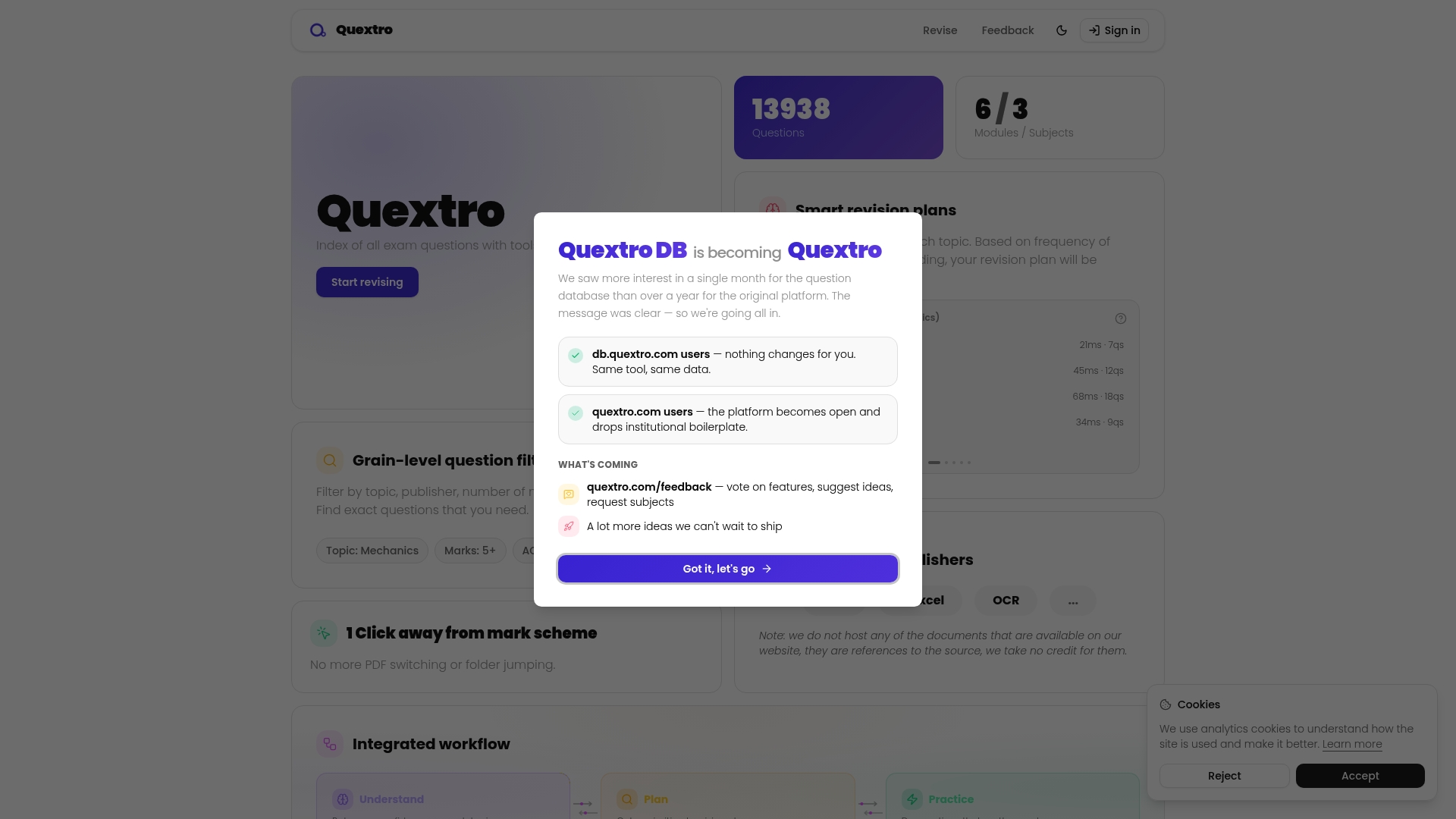
Quextro's smart revision plans adapt as your confidence grows, so your question set stays relevant throughout your preparation. You can rate your confidence in each topic, answer questions directly on the platform, and track your progress automatically without juggling PDFs or spreadsheets. Whether you are targeting calculus gaps, building trigonometry fluency, or working through statistics under timed conditions, Quextro gives you the structure to make every session count. Start your targeted revision at quextro.com.
Frequently asked questions
How does targeted exam practice differ from standard revision?
Targeted practice selects questions matched to your weaknesses, exam patterns, and syllabus, while standard revision usually covers material at random or by rote. The key difference is intentionality: every question you attempt has a specific reason behind it.
How much can targeted exam practice actually improve my marks?
Students using targeted practice see 15 to 20% better scores compared to those using generic question sets. That gap is significant enough to shift a grade boundary in most A Level maths papers.
Which websites organise A Level maths questions by topic?
Major sources include Quextro, Physics and Maths Tutor, Save My Exams, and Madasmaths, all of which offer topic-sorted or filtered question sets for the main UK exam boards.
Can targeted exam practice save time compared to normal revision?
Yes. Because you focus on high-impact topics rather than covering everything equally, you avoid wasted hours on low-frequency or already-mastered content. Quality over quantity is the core principle.