
TL;DR:
- Online past papers closely simulate real exams, helping students practice under timed, familiar conditions.
- Retrieval practice through past papers significantly enhances long-term retention and exam performance.
- Instant mark schemes and tracking features make online platforms more efficient and targeted for effective revision.
With dozens of revision tools competing for your attention, choosing the right resource for A Level maths is genuinely difficult. Flashcard apps, YouTube tutorials, revision guides — all of them have their place. But online past papers occupy a different category entirely. They replicate the actual exam, force you to apply knowledge under pressure, and provide immediate feedback through mark schemes. This article breaks down exactly why online A Level maths past papers give you a measurable advantage, and how to use them in a way that actually moves your grade upward rather than just filling revision hours.
Table of Contents
- Exam-realistic revision: Practise in the real test format
- Retrieval practice: Proven learning boost over re-reading
- Instant mark schemes and feedback: Learn from mistakes quickly
- Track progress, spot gaps, and target revision
- Customisable and accessible: Study anytime, anywhere
- Our take: Why online past papers are the true exam game-changer
- Find your perfect online A Level maths practice resources
- Frequently asked questions
Key Takeaways
| Point | Details |
|---|---|
| Exam-like practice | Online past papers let you experience the real test environment and marking approach before the big day. |
| Boosts memory retention | Retrieval practice with past papers leads to much stronger long-term recall of maths techniques. |
| Instant feedback | Online platforms provide immediate mark schemes, so you learn from mistakes right away. |
| Targets weak areas | Progress tracking highlights topics that need more attention for revision. |
| Flexible access | Study anytime from any device, customising practice to suit your individual schedule. |
Exam-realistic revision: Practise in the real test format
Once you understand what makes revision effective, everything points back to one principle: practise the thing you are being tested on. Online past papers are the closest you can get to sitting the real exam before exam day arrives.
Unlike revision guides or class notes, online past papers are formatted exactly as the real paper will appear. The question styles, command words ("show that," "hence," "prove"), and mark allocations all reflect what you will face in the exam hall. Practising the real exam format, including timed sessions and mark scheme analysis, demonstrably reduces avoidable mark losses. That phrase "avoidable mark losses" is worth sitting with. A significant proportion of marks lost at A Level are not because students lack the mathematical ability, but because they present working incorrectly, skip steps, or misread question demands.
Here is what regularly working through full online papers develops in practice:
- Time management under pressure: You learn to allocate roughly 1.8 minutes per mark, and you discover which question types eat your time unexpectedly.
- Stamina: A Level papers are long. Sitting a full paper online, without distractions, builds the mental endurance required for the real thing.
- Confidence: Familiarity reduces anxiety. Each paper you complete makes the format feel less threatening.
- Mark awareness: Seeing a 5-mark question, you begin to intuitively know that five distinct steps or statements are expected.
You can find well-organised past paper databases for A Level maths that cover all the major exam boards, making it straightforward to select papers relevant to your specification.
"The exam is not just a test of maths knowledge — it is a test of how well you can perform mathematics in exam conditions."
Pro Tip: After completing a timed paper, do not immediately check answers. Wait at least 30 minutes, then work through the mark scheme methodically. This gap helps you evaluate your work more critically, rather than rationalising errors because you remember your thought process.
When reviewing A Level maths past papers, many students make the mistake of only noting whether an answer was right or wrong. The more powerful approach is to understand why a method earns marks and whether a different valid method would score equally.
Retrieval practice: Proven learning boost over re-reading
Realistic practice is only half the story. The deeper reason past papers are so effective lies in a well-established cognitive mechanism: retrieval practice.
Retrieval practice means actively pulling information from memory rather than passively reading it. When you re-read your notes, your brain recognises the material and creates a false sense of familiarity. When you attempt a past paper question on integration by parts without looking at your notes, your brain has to reconstruct the method from scratch. That reconstruction process strengthens the memory far more than recognition ever does.
Research shows that retrieval practice outperforms rereading for long-term learning. Studies consistently demonstrate retention improvements of 30 to 50 per cent when students test themselves compared to re-reading the same material for the same amount of time. For A Level maths, this is transformative.
Here is how the effect plays out in practice:
- Attempt a topic question cold — before reviewing your notes on that topic.
- Note every step you struggle with — these gaps are your real revision targets, not the areas where you feel comfortable.
- Review the mark scheme — identify whether your method was mathematically sound but presented poorly, or whether there was a conceptual gap.
- Reattempt similar questions — use exam question practice for A Level maths to find comparable questions in the same topic area.
- Space repetitions — revisit the topic again after three to five days to consolidate retention.
| Revision method | Retention after one week | Exam performance impact |
|---|---|---|
| Re-reading notes | Low to moderate | Minimal unless paired with active recall |
| Watching video tutorials | Moderate | Better for conceptual understanding |
| Online past paper practice | High | Strong correlation with grade improvement |
| Flashcard recall | Moderate to high | Best for formulae and definitions |
The table above illustrates a clear pattern: activities that require you to produce knowledge outperform those that merely expose you to it. Structured online past papers harness this effect at scale, particularly when paired with systematic topic filtering to ensure you address gaps rather than just practising comfortable topics.
The uncomfortable truth: Most students gravitate toward revision methods that feel productive but are cognitively easy — re-reading highlighted notes, watching explanations. Past papers feel harder because they expose what you do not know. That discomfort is precisely where learning happens.
Instant mark schemes and feedback: Learn from mistakes quickly
Knowing that active practice is efficient, the online format delivers another substantial benefit: the speed at which you can assess your performance and correct course.
Traditional revision with printed papers involves a frustrating cycle — complete a paper, hunt for the mark scheme PDF, cross-reference page by page, and try to decode cryptic mark scheme notation. Online platforms eliminate this entirely. You finish a question or a full paper, and the mark scheme is immediately accessible alongside your work. This shortens what educators call the "feedback loop," which is the time between making an error and understanding it.

Why does a shorter feedback loop matter so much? Because the longer the gap between an error and its correction, the more likely that error becomes consolidated in memory. If you attempt a differential equations question on Monday and do not review the mark scheme until Friday, there is a real chance you will repeat the same mistake in the meantime, reinforcing the wrong method.
Here is how to use instant mark schemes most effectively:
- Work through the mark scheme line by line, not just checking the final answer. Award yourself marks honestly for each method step.
- Flag questions where you got the right answer by an unrecognised method — mark schemes often list alternative methods, and knowing yours is valid builds confidence.
- Categorise errors: Was it a careless arithmetic slip, a conceptual misunderstanding, or a presentation issue? Each type requires a different remedy.
- Re-attempt flagged questions within 24 hours, without looking at your previous working, to check whether the correction has actually stuck.
For support with reviewing exam answers for higher A Level grades, structured frameworks make this process considerably more systematic than ad hoc checking.
"A mark scheme is not just an answer key — it is a window into exactly how your examiner thinks."
Pro Tip: When using online mark schemes, print or screenshot questions where you lost marks unexpectedly, even on topics you thought you understood well. These "surprise losses" often reveal shallow understanding that feels solid until tested under exam conditions. Understanding how to review past papers systematically turns these moments into reliable grade gains.
Track progress, spot gaps, and target revision
With instant feedback in place, the next logical question is: how do you ensure your efforts are actually moving your grade upward? Tracking and analysis are key.
One of the most significant advantages of online past paper platforms over printed resources is the ability to monitor your performance across time. Tracking which papers you have completed, how you scored by section, and which topic areas repeatedly cause problems transforms revision from guesswork into a directed process.
Analysing question patterns for A Level maths is a genuinely underused strategy. Many students complete paper after paper without ever identifying that, for instance, they consistently lose marks on proof by contradiction or vectors in three dimensions. Without tracking, this pattern stays invisible.
Online platforms that support exam-style question practice build exam familiarity in a structured way — a principle central to how mainstream UK education support platforms approach revision. The goal is not just exposure to questions, but systematic accumulation of familiarity with question types.
| Approach | Progress visibility | Personalisation | Time efficiency |
|---|---|---|---|
| Printed past papers | None unless self-tracked | None | Low |
| Online past papers without tracking | Low | Low | Moderate |
| Online platform with tracking | High | High | High |
The advantages compound when you combine tracking with selecting exam questions for targeted revision. Rather than working through a full paper when you only need to practise trigonometric identities, you can isolate exactly those questions across multiple years and papers.
Pairing this with thoughtful effective study scheduling ensures that your tracked weak areas receive proportionally more revision time in the weeks before your exams.
- Identify your three weakest topic areas from completed papers.
- Dedicate two focused sessions per week exclusively to those areas.
- Re-test using topic-filtered questions after two weeks to measure genuine improvement.
- Rotate focus as gaps close, preventing neglect of other areas.
Customisable and accessible: Study anytime, anywhere
Beyond analytics and feedback, the sheer flexibility of online past papers makes them an accessible solution for busy students — and this matters more than many people acknowledge.
Printed past papers require a printer, ink, paper, a quiet space, and physical organisation. Lose a paper or spill something on your mark scheme, and you lose that work entirely. Online past papers remove all of these barriers. They are available 24 hours a day from any device with an internet connection, whether that is a laptop in the library, a tablet at home, or even a phone during a commute.
This flexibility enables a revision approach that educational research strongly supports: spaced, frequent short sessions rather than infrequent marathon sessions. Top tips for A Level maths exam success consistently highlight that students who revise in regular, focused intervals retain far more than those who rely on lengthy cramming sessions close to exam day.
Practical advantages of online access include:
- No printing costs or setup time — open a question and start immediately.
- Searchable by topic, difficulty, exam board, and year — find the exact practice you need in seconds.
- Automatic saving — your progress is preserved even if you close the session mid-way.
- Cross-device access — start a practice session on your laptop and continue on your phone.
- No lost paperwork — everything is stored and organised on the platform.
Combining online flexibility with a clear study plan and to-do list creation for focus helps students make the most of even short, opportunistic revision windows throughout the week.
Pro Tip: Set a 25-minute timer and commit to completing one topic cluster of past paper questions, then take a genuine break. This structured approach, known broadly as interval studying, prevents mental fatigue and makes online past papers far more sustainable across the long revision period leading up to A Level exams.
Our take: Why online past papers are the true exam game-changer
Here is something we have observed consistently through student feedback and performance data: the students who improve most dramatically are not the ones who complete the most past papers. They are the ones who use mark schemes and topic filters intelligently.
The majority of students treat past papers as a volume exercise. Complete a paper, skim the answers, move on. This approach produces modest improvement at best. The students who jump from a C to an A are typically doing something different. They are redoing individual questions they got wrong. They are filtering by topic to hammer a specific weak area before moving to the next. They are reading mark schemes not just to find the answer but to understand what the examiner is rewarding.
Most students drastically underuse the analysis tools available to them. They know, vaguely, that they "struggle with mechanics" but have never broken that down further. Online platforms change this by making the data visible and actionable. Suddenly "I struggle with mechanics" becomes "I consistently lose marks on resolving forces at an angle" — and that is a problem with a specific, fixable solution.
Our honest view is that best practice A Level maths revision is not about working harder. It is about ensuring every revision hour is targeted. Online past papers, used with genuine intention and analysis, are the most efficient mechanism available for achieving exactly that. The students who treat each paper as a diagnostic tool rather than a performance test are the ones who make the biggest gains.
Find your perfect online A Level maths practice resources
Ready to apply these revision benefits? Here is where targeted online past papers meet your exam goals.
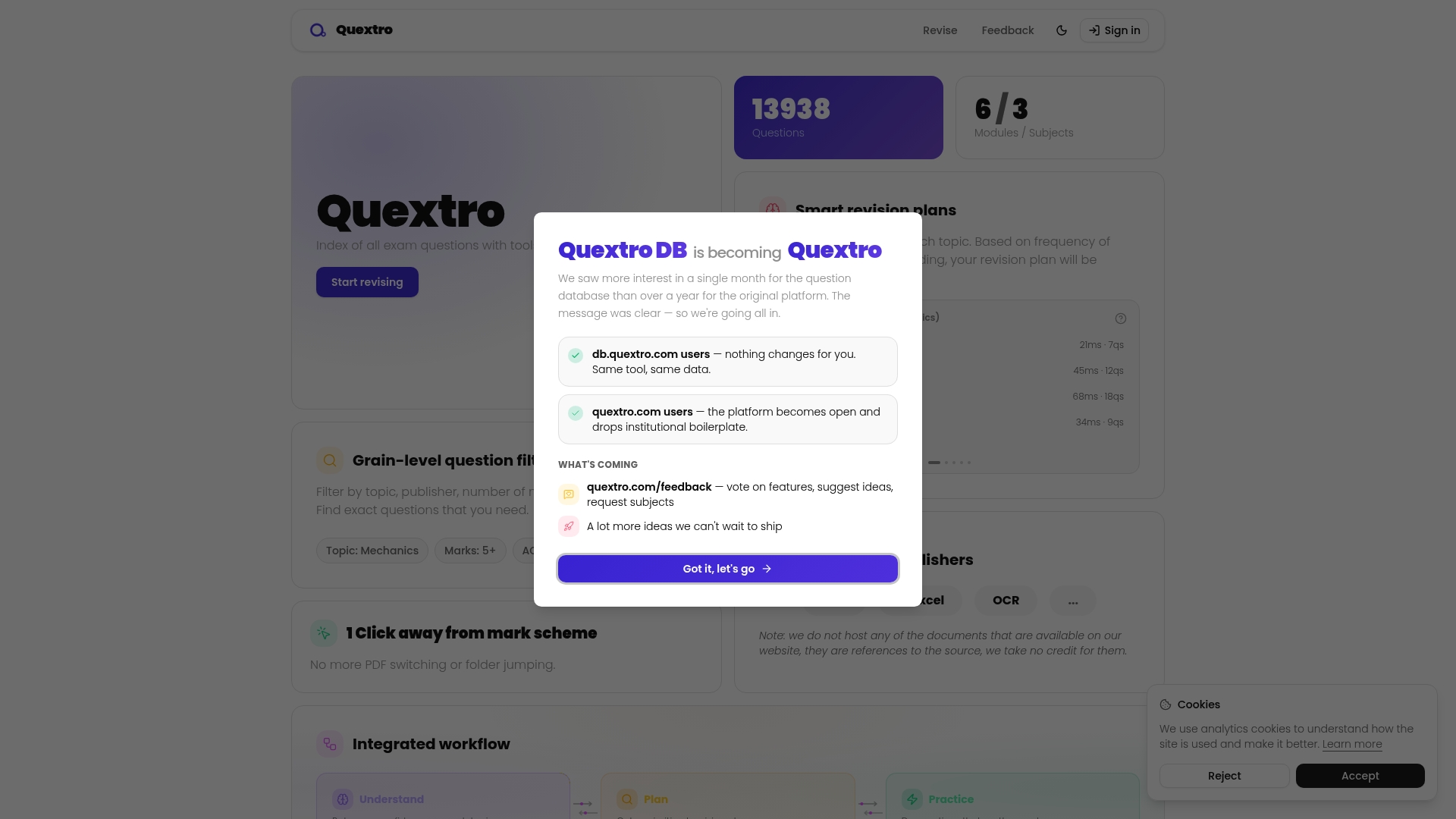
Quextro provides access to over 13,955 past exam questions organised by topic, difficulty, exam board, and mark allocation across AQA, Edexcel, OCR, and CIE. You can practise directly on the platform, rate your confidence in each topic, and track your progress automatically without needing any external PDFs. Whether you are focusing on Pure Mathematics papers and questions or working through Statistics Mathematics papers and questions, Quextro's smart revision tools help you direct your time where it will have the greatest impact on your final grade.
Frequently asked questions
How do online past papers compare to printed ones for maths revision?
Online past papers provide instant mark schemes, are accessible anywhere, and allow you to track completed papers and overall progress over time — advantages that printed versions simply cannot match without significant manual effort.
Is there scientific evidence that practice papers improve memory?
Yes — retrieval practice produces better long-term learning than repeated reading, with studies showing retention improvements of 30 to 50 per cent when students use practice tests compared to passive re-reading of the same material.
What features should I look for in an online past paper platform?
Prioritise platforms offering instant mark schemes, topic and difficulty filtering, progress tracking across completed papers, and coverage of your specific exam board specification.
Do all online past papers follow the current A Level maths syllabus?
Most reputable platforms update their content to reflect the latest specifications, but you should always cross-reference any paper against your exam board's current published syllabus before relying on it for revision.
How often should I use online past papers in my revision plan?
Aim to complete one to two papers per week alongside targeted topic practice, and always review mistakes thoroughly after each session rather than simply noting the score and moving on.