

TL;DR:
- Active revision techniques like spaced repetition and active recall improve long-term understanding and confidence.
- Practising under timed exam conditions reduces anxiety and enhances time management skills.
- Developing a growth mindset and understanding core concepts build resilience and genuine exam confidence.
5 proven strategies to boost A Level maths confidence
Real confidence in A Level maths is not something you stumble upon the night before the exam. It is built deliberately, through the right habits, the right mindset, and the right kind of practice. With hundreds of revision tips floating around online, it is genuinely difficult to know which ones actually make a difference when you are sitting at that desk in the exam hall. This guide cuts through the noise. Each strategy covered here is grounded in evidence and designed specifically for students who want to walk into their A Level maths exam feeling prepared, calm, and capable rather than overwhelmed.
Table of Contents
- Master active revision techniques
- Build exam skills with realistic practice
- Develop a growth mindset and resilience
- Master exam technique for calm and control
- Deepen understanding through concept-based learning
- What most students miss about real exam confidence
- Take your maths confidence further with expert resources
- Frequently asked questions
Key Takeaways
| Point | Details |
|---|---|
| Active techniques win | Active recall and spaced repetition help you remember and apply maths better than reading notes. |
| Simulate exam pressure | Regular timed practice with real past papers builds familiarity and real-world confidence. |
| Mindset matters hugely | A positive, resilient attitude turns mistakes into strengths and keeps anxiety in check. |
| Technique boosts marks | Knowing how to approach questions, show work, and manage your time can gain crucial marks. |
Master active revision techniques
To begin, let's look at how your revision approach can directly impact both your knowledge and your confidence.
Passive revision means reading through your notes, highlighting textbooks, or watching explanations without testing yourself. It feels productive. In reality, it does very little for long-term retention. Active revision, by contrast, forces your brain to retrieve and apply information. That retrieval effort is precisely what strengthens memory and builds genuine understanding.
There are several active revision methods worth knowing:
- Spaced repetition: Instead of cramming a topic in one sitting, revisit it at increasing intervals. Study integration on Monday, return to it on Thursday, then again the following Tuesday. Each return strengthens the memory trace.
- Active recall: Close your notes and try to answer questions from memory. Use flashcards, blank paper, or past questions. This approach forces your brain to work rather than passively absorb.
- Deliberate practice on weak areas: It is tempting to revise what you already know. It feels good. But the real gains come from targeting topics where you consistently lose marks. Track your scores per topic and spend more time where you need it most.
- Interleaving: Mix different topic types in a single revision session rather than blocking one topic per session. Research shows this leads to better long-term retention because your brain must continuously switch strategies.
As experts at Casio Education recommend, use active recall, spaced repetition, and deliberate practice focusing on weak areas rather than passive re-reading to enhance retention and identify gaps.
"Every minute you spend passively re-reading notes is a minute you could have spent actively testing yourself. The second approach builds the confidence the first one never can."
Once you identify your weaker topics, structured exam prep becomes much more efficient because you are directing effort where it genuinely matters, not just covering what is comfortable.
Pro Tip: Build a simple weekly schedule where each day targets one or two specific topics using active recall. After each session, rate how confident you feel on that topic out of five. This gives you a running record of where to return next.
For students who want detailed guidance on applying these methods with real questions, question practice tips can help you structure each session effectively and consistently.
Build exam skills with realistic practice
Once you have the right learning techniques, putting them to the test in exam conditions is the next step.
Practising under timed conditions does something that ordinary revision simply cannot replicate. It builds familiarity with the format, develops your ability to manage time under pressure, and gradually reduces the anxiety that comes from the unknown. The exam stops feeling like an unpredictable event and starts feeling like a familiar routine.

Students who regularly complete timed mock papers consistently outperform those who rely on content review alone. As Casio Education advises, practice past papers and mock exams under timed conditions to build familiarity with the exam format, improve time management, and boost confidence by simulating real exam pressure.
Here is how to simulate proper exam conditions at home:
- Sit at a clear desk with no distractions
- Set a timer for the exact duration of your paper
- Use only the equipment allowed in the real exam
- Complete the paper in one uninterrupted sitting
- Mark it honestly using the mark scheme immediately after
Review your work through exam question practice benefits to understand not just what you got wrong, but why you got it wrong. That distinction matters.
| Factor | Students who practice under timed conditions | Students who do not |
|---|---|---|
| Time management in exam | Strong and consistent | Often poor, questions left incomplete |
| Familiarity with format | High, less likely to be caught out | Low, often surprised by question styles |
| Anxiety levels | Reduced through exposure | Higher due to uncertainty |
| Likelihood of checking work | More likely to budget time for review | Rarely have time to review |
| Confidence on exam day | Notably higher | Often lower |
This is one area where selecting exam questions strategically makes a real difference. Picking questions from specific topics and mark ranges allows you to target exactly the scenarios that stretch you most, rather than repeatedly practising the same comfortable question types.
Develop a growth mindset and resilience
Confidence is not built just through skill alone. It also comes from a resilient mindset.
A growth mindset, a term developed by psychologist Carol Dweck, is the belief that your abilities are not fixed but can be developed through effort and the right strategies. For maths students, this is particularly powerful because many people convince themselves early on that they are simply "not a maths person." That belief becomes a self-fulfilling prophecy.
Building resilience during revision means changing how you respond to difficulty. When you hit a question you cannot solve, the growth mindset response is not to skip it and move on. It is to sit with the discomfort, try different approaches, and treat the struggle itself as the learning.
Some concrete strategies to build this mindset include:
- Reframe errors: When you get a question wrong, ask "What did this teach me?" rather than "Why am I so bad at this?"
- Use positive self-talk: Replace "I can't do vectors" with "I haven't fully understood vectors yet."
- Celebrate small wins: Recognising progress, even incremental progress, keeps motivation alive during long revision periods.
- Set process goals: Focus on completing four active recall sessions this week rather than "get an A." Process goals feel achievable and build momentum.
- Seek feedback actively: Review your marked papers not to feel bad, but to extract information about where to improve.
As the evidence confirms, develop a growth mindset and maths resilience through positive self-talk, affirmations, embracing challenges, and viewing mistakes as learning opportunities to combat maths anxiety.
"Resilience in maths is not about never finding it hard. It is about refusing to let difficulty mean defeat."
Pro Tip: After every revision session, write down one thing you struggled with and one thing you now understand better than before. Over time, this creates a powerful record of genuine growth that you can look back on before exam day.
For a full checklist to ensure your mindset and preparation are aligned, the maths preparation checklist is worth bookmarking as you move through your revision programme.
Master exam technique for calm and control
With a resilient attitude, the final piece is knowing exactly what to do on exam day itself.
Many students lose marks not because they lack knowledge but because they misread questions, run out of time, or forget to show their working. Exam technique is a learnable skill, and it is one that can meaningfully increase your score without requiring any additional content knowledge.
Here is a clear action plan for exam day:
- Read every question fully before you start writing. Underline key words such as "hence," "show that," and "exact value." These words carry specific instructions that change what a correct answer looks like.
- Start with questions you find most accessible. This builds momentum and protects your marks early in the paper.
- Show all working clearly. Even if your final answer is wrong, method marks reward correct steps. A single arithmetic slip should not cost you the entire question.
- Allocate time proportionally. A five-mark question deserves more time than a two-mark question. Be disciplined about moving on.
- Reserve 10 to 15 minutes at the end for review. Check for missing units, arithmetic errors, and questions you may have skipped.
Experts at Casio Education confirm you should read questions carefully, manage time by tackling easy questions first, show all working for method marks, and review answers at the end.
| Time segment | Suggested activity | Duration |
|---|---|---|
| 0 to 5 minutes | Read through all questions, mark the easiest | 5 minutes |
| 5 to 85 minutes | Work through questions in order of confidence | 80 minutes |
| 85 to 110 minutes | Return to skipped or difficult questions | 25 minutes |
| 110 to 120 minutes | Final review, check working and units | 10 minutes |
For broader guidance on preparing yourself mentally and logistically the morning of the exam, exam readiness tips covers everything from what to eat to how to manage pre-exam nerves. And for detailed exam technique advice, there are targeted strategies for each question type you are likely to face on an A Level paper.
Deepen understanding through concept-based learning
To truly excel, it is vital to understand the maths itself, not just the exam routine.
Rote learning means memorising steps without understanding why they work. You might be able to differentiate a function by following a procedure, but if the question is phrased slightly differently, you are stuck. Concept-based learning means understanding the underlying principle so you can apply it flexibly, regardless of how the question is worded.
The difference in outcomes is striking. Research published by ERIC shows that concept-based instruction improves conceptual understanding and performance, with empirical data showing average scores rising from 20.26% to 70.23% post-intervention. That is a gain of over 50 percentage points, which represents a transformation in performance, not an incremental improvement.
Here are some practical strategies for shifting towards concept-based learning:
- Ask "why" at every step. When you learn to complete the square, do not just follow the steps. Ask why it works and what it tells you about the quadratic's graph.
- Connect topics. Recognise that differentiation and integration are inverse operations. See how trigonometric identities relate to the unit circle. These connections build a mental map of mathematics rather than isolated procedures.
- Teach what you have learned. Explain a concept out loud as if teaching someone else. If you cannot explain it simply, you do not yet understand it deeply enough.
- Use varied question types. Practise the same concept through different styles of question so you are not simply recognising patterns but genuinely understanding the idea.
- Work through exam preparation best practices regularly to ensure your conceptual revision stays aligned with what the exam actually asks.
For more targeted support on building conceptual strength across the full A Level syllabus, maths exam success tips covers the most frequently tested concepts and how to approach them with genuine understanding.
What most students miss about real exam confidence
Having explored every core method, it is important to reflect on what actually moves the needle for exam confidence.
Most students assume that confidence is simply a function of hours spent revising. Sit at your desk for long enough and surely confidence will follow. But this is one of the most persistent and damaging myths in exam preparation. You can spend fifty hours passively reading your notes and feel no more confident on exam day than you did at the start. Hours are not the metric. Meaningful progress is.
Cramming the night before is an extreme version of this mistake. It creates a short-term illusion of readiness while simultaneously increasing anxiety and disrupting sleep, both of which actively impair exam performance. The students who walk into exams with genuine calm are not those who revised the hardest in the final 24 hours. They are the ones who built understanding steadily over weeks and months, used real feedback from marked papers to adjust their approach, and prioritised depth over breadth.
The honest truth is this: confidence is a byproduct of competence built the right way. When you have sat enough timed papers to know you can manage the clock, when you have worked through enough weak topics to no longer fear them, and when you genuinely understand the maths rather than just recognising it, confidence arrives naturally. It cannot be rushed or faked.
Using structured exam strategies consistently throughout your revision period, rather than scrambling for last-minute fixes, is what separates students who perform at their best from those who underperform relative to their ability.
Take your maths confidence further with expert resources
Putting these strategies into practice is straightforward when you have access to the right materials.
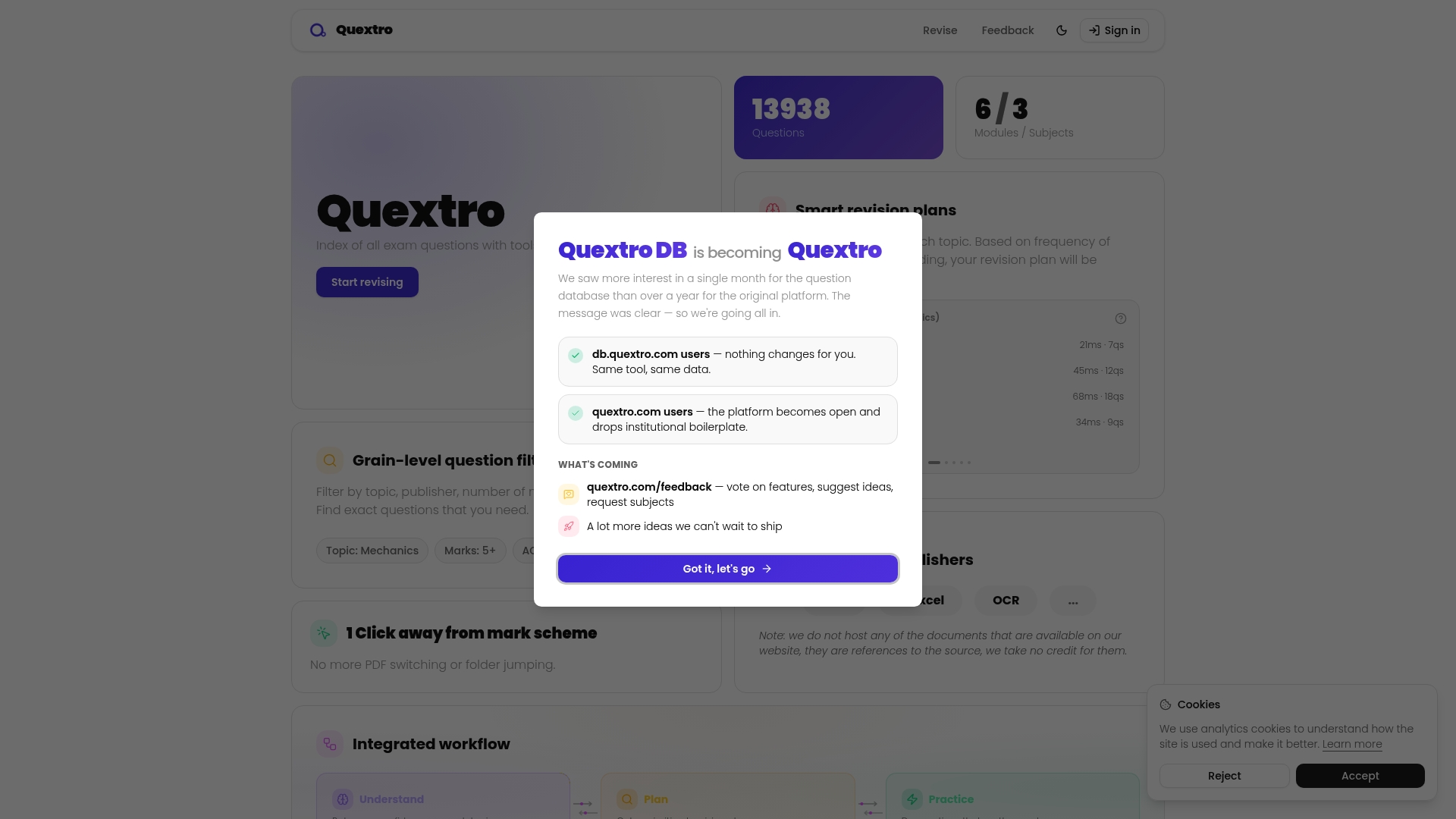
Quextro gives you direct access to over 13,955 past exam questions from AQA, Edexcel, OCR, and CIE, all organised by topic, difficulty, and mark value. You can filter questions to focus exactly on the areas where you need the most practice, build personalised revision sessions, and track your confidence as it grows. There is no need to hunt for A Level past papers across multiple websites. Everything is in one place, ready to use. Whether you are working on concept-based understanding or building timed practice habits, Quextro supports every step of the process described in this guide.
Frequently asked questions
How can I quickly build confidence for my A Level maths exam?
Practise real exam papers under timed conditions and focus on understanding key concepts rather than just memorising procedures. As Casio Education confirms, simulating real exam pressure through timed practice builds both familiarity and confidence.
What should I do if I feel anxious during revision?
Use positive self-talk and treat mistakes as useful feedback rather than evidence of failure. Research shows that positive self-talk and affirmations help combat maths anxiety and build the resilience needed to perform under pressure.
How much time should I spend reviewing my answers in the exam?
Aim to leave at least 10 to 15 minutes at the end of the paper. Use this time to check for arithmetic errors, missing units, and incomplete working. Expert guidance recommends always reviewing answers at the end to protect marks you have already earned.
Is focusing on concepts really better than memorising formulas?
Yes, significantly so. Studies show that concept-based instruction leads to score improvements of over 50 percentage points, far beyond what formula memorisation alone can achieve.