

TL;DR:
- Effective revision combines retrieval practice with immediate, explanatory feedback to enhance long-term understanding.
- Reviewing solutions quickly after practice helps correct mistakes and prevent reinforcement of errors.
- Using targeted, solution-rich resources accelerates mastery and improves exam performance more than passive or exhaustive practice.
Most A Level maths students believe that doing more questions automatically means better results. It feels logical: the more you practise, the more prepared you become. But this assumption misses something critical. Without checking solutions and understanding where your reasoning went wrong, you may be reinforcing the very mistakes you need to eliminate. Research confirms that strategic retrieval practice paired with corrective feedback consistently outperforms repetitive solo practice, and understanding this distinction could be the single most impactful shift you make in your revision this year.
Table of Contents
- Why simple practice often fails
- How retrieval practice and feedback optimise memory
- Why explanations in solutions matter
- Applying solution-focused practice for targeted revision
- Perspective: The mistakes most A Level students make and how to avoid them
- Find solution-rich practice resources for A Level maths
- Frequently asked questions
Key Takeaways
| Point | Details |
|---|---|
| Feedback drives retention | Practising questions with corrective solutions significantly boosts memory compared to restudying. |
| Explanations aid transfer | Detailed solution explanations help students apply learning to new and unfamiliar maths problems. |
| Avoid reinforcing errors | Practising without solutions risks repeating mistakes and limiting exam progress. |
| Immediate review is key | Reviewing solutions right after attempts yields strongest learning outcomes and revision impact. |
Why simple practice often fails
Picture a student who spends three hours working through integration questions every evening for two weeks. They feel productive. They feel prepared. But on exam day, they keep making the same sign error they never caught in week one. This is not an unusual story. It is, in fact, the most common revision trap in A Level maths.
When you practise without reviewing solutions, you receive no signal about whether your method is correct. If your working is flawed but your final answer happens to be close, you assume you understand the concept. Over time, your brain consolidates that flawed method as correct. Cognitive science calls this the "fluency illusion," where familiarity with a topic is mistaken for genuine understanding. You feel confident, but the confidence is built on shaky foundations.
The benefits of exam question practice are only realised when that practice is coupled with feedback. Without it, the learning loop never closes. Errors are not corrected; they are repeated and embedded. In maths, where each topic builds on the last, one uncorrected misconception in differentiation can unravel your understanding of related rates, optimisation, and curve sketching in one go.
Many students also fall into the trap of choosing questions they already find comfortable, which feels productive but does not address genuine weaknesses. This is known as "desirable difficulty avoidance," and it is remarkably common during A Level revision seasons.
"Naïve practice without solutions reinforces errors; deliberate retrieval with feedback builds durable exam skills."
The common pitfalls of solo practice include:
- Repeating familiar question types instead of targeting weak areas
- Skipping mark schemes because checking feels discouraging after getting answers wrong
- Assuming that reaching a numerical answer means the method was correct
- Never distinguishing between a lucky correct answer and a genuinely understood concept
- Failing to track which misconceptions recur across multiple attempts
Structured exam preparation actively addresses each of these pitfalls by building feedback into every stage of the revision process, not as an afterthought but as the central mechanism through which learning actually occurs.
How retrieval practice and feedback optimise memory
There is now substantial evidence that the way you retrieve information matters far more than how many times you review it. Retrieval practice, the act of actively recalling information under exam-like conditions, strengthens memory pathways in ways that passive rereading simply cannot replicate.

But retrieval alone is not the complete picture. A 2026 meta-analysis confirms that retrieval with corrective feedback outperforms restudying or lecture-based learning for long-term memory retention. The combination creates a powerful learning mechanism: your brain attempts to recall, encounters a challenge, receives corrective information, and stores the corrected version more durably than if you had simply read the material passively.
The numbers are striking. Research by Karpicke and Roediger found that retrieval plus feedback yields approximately 80% long-term retention, compared to just 36% for restudying. That is more than double the retention from the same investment of time.
| Revision method | Retention rate | Long-term durability |
|---|---|---|
| Passive rereading | 20 to 30% | Low |
| Restudying notes | 36% | Low to moderate |
| Retrieval practice alone | 60 to 65% | Moderate |
| Retrieval plus corrective feedback | ~80% | High |
| Retrieval plus explanatory feedback | Up to 85% | Very high |
The meta-analytic effect size for feedback-enhanced retrieval is approximately g = 0.50, which is educationally significant and consistent across multiple subject areas, including mathematics. This is not a marginal improvement; it is the difference between genuinely mastering a topic and simply being acquainted with it.
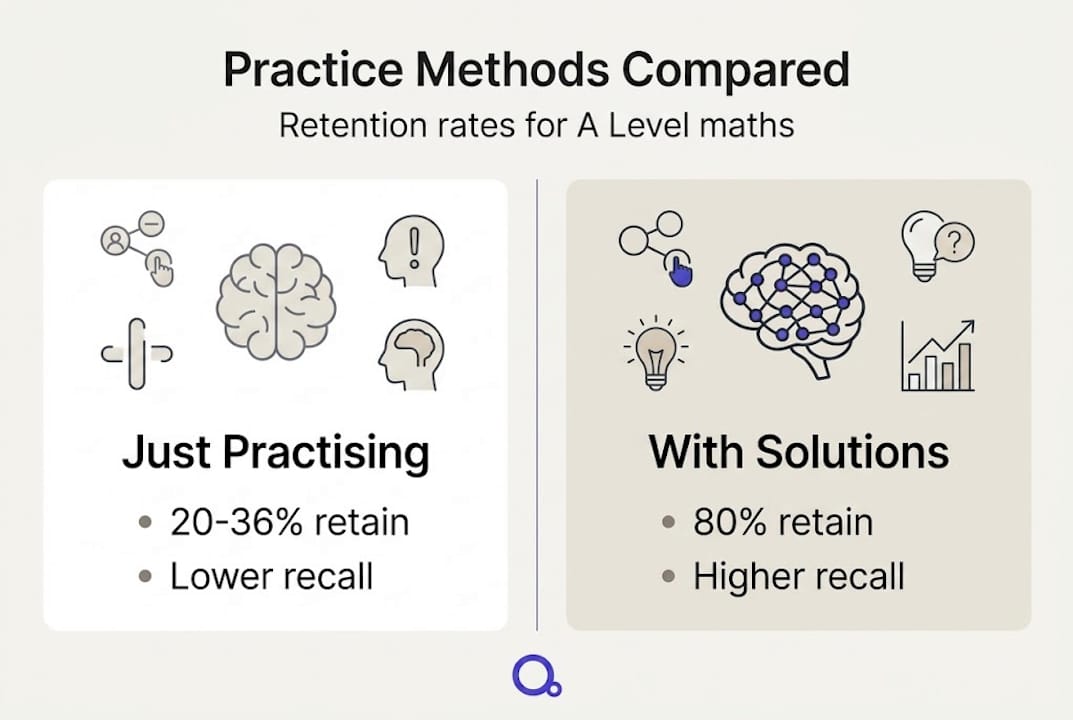
Key insight: retrieval plus feedback yields 80% retention versus 36% for restudying, more than doubling your long-term learning with the same time investment.
Understanding these effective question practice steps is what separates students who revise efficiently from those who put in the hours without seeing proportional improvement in their grades.
Pro Tip: After every practice question, check your solution immediately rather than waiting until the end of a session. The closer the feedback is to your attempt, the stronger the corrective signal your brain receives. Even a quick scan of the mark scheme before moving on makes a measurable difference.
Why explanations in solutions matter
There is an important distinction that many students overlook: the difference between knowing you were wrong and understanding why you were wrong. A simple tick or cross tells you one thing. A step-by-step explanation tells you something far more useful.
Research confirms that explanatory feedback supports generalisation to new problems in ways that mere answer-checking cannot. When you see not just the correct answer but the reasoning behind each step, you build a transferable understanding of the underlying method. This is crucial for A Level maths, where exam boards routinely reframe familiar concepts in unfamiliar contexts to test genuine comprehension.
Contrast the two feedback types in practice:
| Feedback type | What you learn | Transfer to new problems | Suitable for |
|---|---|---|---|
| Simple answer only | Whether you were right or wrong | Minimal | Basic recall tasks |
| Step-by-step explanation | Why each step is correct and why yours was not | Strong | Problem-solving and application |
| Annotated mark scheme | Common errors and examiner expectations | Very strong | Exam-specific preparation |
The contrast is stark. A student who checks only the final answer learns very little about how to approach the next unfamiliar problem. A student who reads the full worked solution understands the logical flow, the choice of technique, and the common errors that cost marks.
It is also worth noting a contrasting research view: without sufficient background knowledge, detailed explanations can overwhelm rather than help. This means that if you are very early in a topic, some direct instruction before attempting questions may be necessary. But for most A Level students deep in revision, the background knowledge is there; the job of solutions is to refine and correct your application of it.
Here are the steps for maximising generalisation with explanatory solutions:
- Attempt the question fully before looking at any solution, even if you feel uncertain partway through.
- Compare your working line by line against the solution, not just the final answer.
- Identify the precise step where your reasoning diverged from the correct approach.
- Write a brief note in your own words explaining why the correct method works.
- Attempt a similar question within 24 hours without referring back to your notes.
Reviewing exam answers with this level of attention transforms a passive mark scheme into an active learning tool. You stop practising at maths and start learning from it.
Pro Tip: When you get a question wrong, do not just correct your answer. Write one sentence explaining the conceptual error you made. This metacognitive step, thinking about your own thinking, is one of the highest-value habits you can build during A Level revision.
Applying solution-focused practice for targeted revision
Knowing that solutions matter is one thing. Building a revision routine that actually uses them effectively is another. The good news is that the structure is straightforward; the challenge is consistency.
The core process is simple: attempt, check, reflect. But each stage has important nuances that determine how much learning you extract from each session.
During the attempt stage, work under timed, exam-like conditions. Resist the urge to check your textbook mid-question. The struggle you experience when retrieving knowledge under pressure is precisely what strengthens memory. A slightly uncomfortable attempt is far more valuable than a smooth, textbook-assisted one.
Research confirms that immediate post-attempt feedback maximises the pretesting effect, the cognitive boost you get from attempting a question before reviewing the answer. Delayed feedback still works, but the effect is smaller. This means your best habit is to check solutions straight after finishing a question, not at the end of a week's practice.
During the reflection stage, go beyond noting your score. Ask yourself: which part of my method was wrong? Is this a procedural error, a conceptual misunderstanding, or a careless slip? Each category requires a different response. Procedural errors often need more targeted repetition. Conceptual gaps may require returning to your notes or a worked example before attempting more questions.
Here is how to structure solution-focused practice effectively:
- Select questions by topic and difficulty using a structured database rather than choosing randomly from past papers
- Attempt each question in full, writing out all working as you would in an exam
- Check the full solution immediately after each attempt, line by line
- Annotate your attempt with corrections in a different colour to make errors visually obvious
- Return to questions you answered incorrectly after a gap of three to five days to test whether your corrected understanding has stuck
Using past paper databases with topic filters allows you to target exactly the areas where your solutions feedback has revealed weakness, rather than working through entire past papers where many questions test topics you already understand well.
Pro Tip: Use a question database to filter by topic so you can batch several questions on the same concept in one session. This concentrated exposure, combined with solution review after each attempt, accelerates your mastery of individual topics far faster than scattered whole-paper practice.
Targeted exam practice strategies that combine question filtering with disciplined solution review represent the most efficient use of the limited revision time available to most A Level students.
Perspective: The mistakes most A Level students make and how to avoid them
From observing how students approach A Level maths revision, one pattern stands out above all others: the relentless accumulation of attempted questions with almost no time spent reviewing what went wrong. Students collect completed past papers like trophies, but the learning stays locked inside the unmarked working.
The uncomfortable truth is that doing 500 questions badly is worse than doing 150 questions well. Every unreviewed error is a lesson missed and a misconception reinforced. The students who improve most rapidly are not those who attempt the most questions; they are those who extract the most insight from each question they attempt.
Teacher exam prep workflows consistently emphasise review over volume, yet students persistently do the opposite, partly because checking solutions after a wrong answer feels discouraging. Reframe this: finding an error before the exam is a win. It is the exam where finding errors costs you marks.
"Retrieval with targeted feedback is the secret to durable learning."
Pro Tip: Keep a misconceptions log. After each revision session, write down the errors you made and the correct reasoning. Reviewing this log before your exam is one of the most concentrated revision activities available to you.
Find solution-rich practice resources for A Level maths
If the evidence has you convinced that solution-based practice is the right approach, the next practical step is finding resources that actually deliver it. That is precisely what Quextro is built for.

Quextro gives you access to over 13,955 past exam questions from AQA, Edexcel, OCR, and CIE, all organised by topic, difficulty, and marks. You can practise directly on the platform and review worked solutions without switching between PDFs or external resources. The Edexcel A Level Economics questions database and the Statistics maths questions database are excellent starting points for targeted, solution-focused practice that puts the strategies in this article into action immediately.
Frequently asked questions
Is practising with solutions better than just practising questions for exam revision?
Yes, research consistently shows that solution-focused practice, especially with explanatory feedback, leads to higher long-term retention and exam performance compared to unaided repetition.
How soon after attempting a question should I review the solution?
Immediate feedback works best; reviewing the solution right after your attempt maximises the pretesting effect and strengthens long-term memory retention significantly.
Do detailed explanations in solutions help me tackle unfamiliar exam problems?
Yes, explanatory feedback supports generalisation to new problems by building transferable understanding, whereas simple correct answers primarily aid basic recall rather than flexible problem-solving.
What is the risk of practising without checking solutions?
Practising without solutions can reinforce errors and misconceptions, embedding incorrect methods into your memory and making them significantly harder to correct as the exam approaches.
Can using a past paper database with solutions improve my revision efficiency?
Yes, databases with detailed solutions allow for targeted practice by topic and difficulty, enabling immediate feedback after each attempt and making your available revision time considerably more productive.