

TL;DR:
- A Level Maths questions are designed to test three core assessment objectives: AO1, AO2, and AO3.
- Understanding the weightings of each AO helps focus revision on techniques, reasoning, and problem-solving skills.
- Effective exam preparation requires targeted practice aligned with AO command words and their respective skills.
You can solve every equation flawlessly and still lose marks. Sounds unfair, but it happens constantly in A Level Maths. The reason is usually not a gap in knowledge but a gap in understanding what examiners actually reward. Every question on every paper is written to test a specific assessment objective, and if you do not know which one you are being asked to demonstrate, you will keep dropping marks in ways that feel mysterious. This article breaks down all three core assessment objectives, shows you exactly how they are weighted, and gives you real strategies to pick up marks across the board.
Table of Contents
- What are assessment objectives (AOs) in A Level maths?
- How are AOs weighted and distributed in A Level maths exams?
- Exam question types and AO mapping: real examples
- Strategies to build high marks across all assessment objectives
- Why understanding AOs frees you from rote revision: our take
- Take the next step: exam resources matched to your assessment objectives
- Frequently asked questions
Key Takeaways
| Point | Details |
|---|---|
| AO basics | Every A Level Maths exam mark scheme divides questions by AO1, AO2, and AO3 skills. |
| Board consistency | Exam boards use the same AO structure and similar weightings as required by government rules. |
| AO3 importance | AO3 (problem solving/modelling) is crucial for achieving top grades, especially an A*. |
| Strategic practice | Tailoring revision to each AO helps you avoid common mistakes and earn more marks. |
What are assessment objectives (AOs) in A Level maths?
An assessment objective is a formally defined category of mathematical skill that exam boards use to structure their questions and mark schemes. Rather than testing maths as one undifferentiated block, boards like AQA, Edexcel, OCR, and CIE divide the skills they assess into distinct categories. This means every mark on your paper is assigned to a specific AO before you even sit down to write.
There are three main AOs in A Level Maths:
- AO1: Use and apply standard techniques. This covers routine procedures, calculations, and algebraic manipulation where the method is clear and familiar.
- AO2: Reason, interpret, and communicate mathematically. This includes constructing logical arguments, making deductions, and interpreting results in context.
- AO3: Solve problems within mathematics and in other contexts. This means tackling unfamiliar or multi-step problems, building mathematical models, and applying judgement.
As the Sample Assessment Material OCR A Level Mathematics confirms, questions target different AOs across the paper, with mark schemes allocating marks per AO rather than purely per answer. Understanding the mark scheme meaning helps you see exactly where each mark sits.
Here is a simplified example of how a mark scheme might look:
| Mark | AO | Skill being rewarded |
|---|---|---|
| M1 | AO1 | Correct method applied to integrate |
| A1 | AO1 | Correct answer obtained |
| B1 | AO2 | Correct interpretation of result in context |
| M1 | AO3 | Setting up a model from the given scenario |
The critical insight here is that each AO rewards a different type of mathematical thinking, not just a correct answer. You might get the final answer wrong and still pick up AO3 marks for correctly setting up the problem. Equally, a correct answer with no shown reasoning might score zero on AO2 marks. This is why understanding AOs changes the way you read every question.
According to AO weightings across boards, these proportions are consistent across the main boards as set by government-defined content, which means this knowledge applies regardless of which specification you are studying.
How are AOs weighted and distributed in A Level maths exams?
Knowing the AOs exist is one thing. Knowing how much each is worth is what should actually shape your revision.

The Department for Education mandates approximate percentage ranges for each AO across all A Level Maths specifications. While boards have small degrees of freedom, the proportions are broadly consistent:
| Exam board | AO1 (%) | AO2 (%) | AO3 (%) |
|---|---|---|---|
| AQA | 40-50 | 25-35 | 25-30 |
| Edexcel | 40-50 | 25-35 | 25-30 |
| OCR | 40-50 | 25-35 | 25-30 |
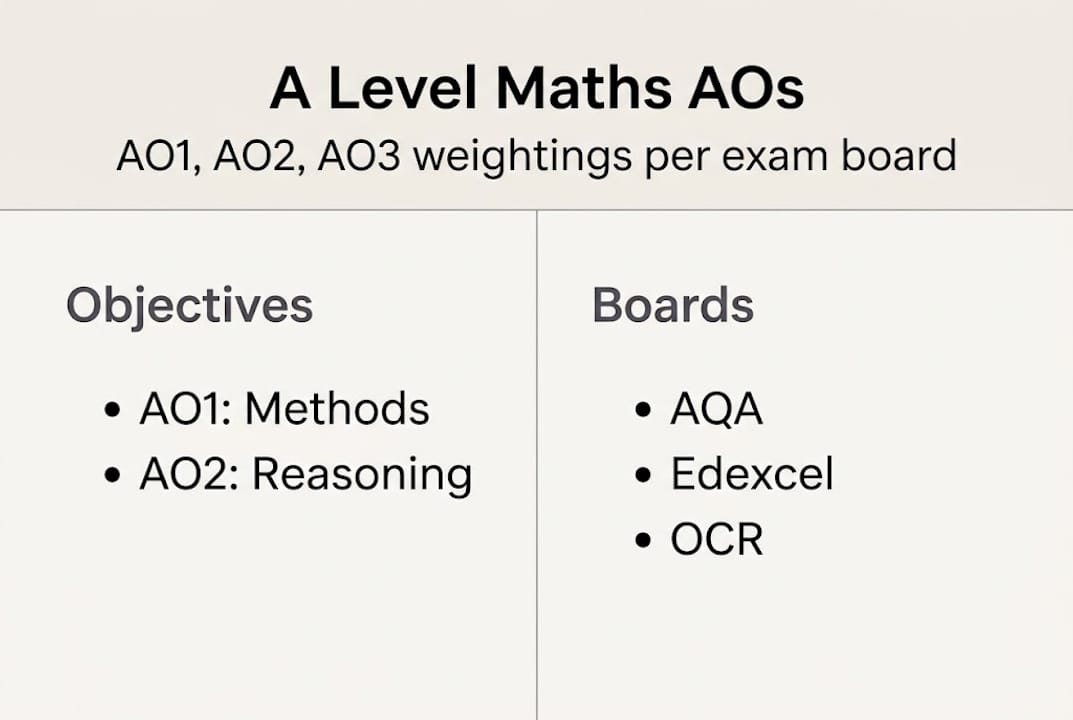
As the A Level Mathematics Qualifications Overview shows, these AO weightings are approximate and consistent across the main boards. AO3, the problem-solving and modelling objective, accounts for 25 to 30 percent of all available marks. That is roughly 45 to 54 marks out of 200 on a typical full A Level paper.
Three practical consequences follow from this for your revision:
- You cannot simply practise procedures. If AO1 covers 40 to 50 percent of marks, you do need solid technique, but spending 80 percent of your revision on routine practice leaves the other 50 to 60 percent of marks severely underprepared.
- AO2 is the silent grade limiter. Many students overlook reasoning and communication because it feels less concrete. But neglecting it means dropping a quarter of available marks in places where a single sentence of explanation would have secured the mark.
- AO3 is where grades separate. The students who reach the top grades are the ones who can approach problems they have not seen before. Consistent exposure to AQA Maths AO breakdown style questions builds this muscle over time.
If you want top exam success tips, the starting point is always understanding where the marks are actually coming from.
Exam question types and AO mapping: real examples
Let us make this concrete. Different command words in questions signal which AO you are being assessed on. Recognising the signal means you know exactly what the examiner wants before you start writing.
| Question type | AO | Command words | Skills required |
|---|---|---|---|
| Differentiate and find turning points | AO1 | Calculate, Find | Apply standard calculus procedure |
| Interpret a statistical result in context | AO2 | Explain, Comment | Justify reasoning in plain language |
| Model a real-world scenario mathematically | AO3 | Model, Predict, Evaluate | Set up and solve a multi-step problem |
The Sample Assessment Material OCR A Level Mathematics shows exactly how questions are structured to target specific AOs, with mark schemes confirming which steps earn which marks.
Common reasons students lose marks include:
- Missing justification on AO2 marks. Writing the answer without explaining why a result is valid or what it means in context.
- Not showing modelling steps for AO3. Jumping straight to the calculation without demonstrating the setup, which is often where the method marks live.
- Misreading command words. Treating "evaluate" as if it means "calculate", when it actually requires judgement and interpretation.
Classic command words to learn by AO:
- AO1: Calculate, Solve, Integrate, Differentiate, Find
- AO2: Prove, Show that, Justify, Explain, Interpret, Deduce
- AO3: Model, Formulate, Predict, Evaluate, Design
Pro Tip: When you sit down to practise, cover the mark scheme and attempt to identify which AO each part of the question is targeting before you answer it. This trains you to read questions the way examiners write them. For more on effective exam question strategies and exam technique strategies, the linked guides go much deeper.
Strategies to build high marks across all assessment objectives
Understanding AOs is only useful if it changes what you do in revision. Here is how to target each one deliberately.
For AO1:
- Practise timed, repetitive drills on core techniques such as integration, differentiation, and algebraic manipulation.
- Use flashcards or timed checklists to build rapid recall of standard results.
- Do not just check if your answer is right; check whether your method is complete and clearly laid out.
For AO2:
- After completing any question, write one sentence explaining what your answer means in context.
- Practise proof questions regularly, as these are pure AO2 and often neglected.
- Read mark scheme comments carefully; examiners often note exactly what phrasing earns the reasoning mark.
For AO3:
- Simulate multi-step problems under timed conditions without notes.
- Work through mechanics modelling and statistics hypothesis testing questions, as these are AO3 grade differentiators at A Level.
- When you get an AO3 question wrong, trace back to which step you lost the thread, not just where the answer went wrong.
Pro Tip: After every past paper session, tally your lost marks by AO. If you consistently lose AO2 marks, that is where your next revision block should go, not more AO1 drilling. For structured approaches, the exam prep best practices guide and the exam preparation checklist offer solid frameworks. When it comes to choosing which questions to attempt during revision, selecting revision questions strategically by AO makes a measurable difference.
Why understanding AOs frees you from rote revision: our take
There is a persistent belief that doing more past papers is the answer to everything in A Level Maths. We disagree, at least when past paper practice is done without a diagnostic lens.
We see students who have worked through ten years of past papers and still plateau at a B because they keep repeating the same AO2 and AO3 mistakes with no framework to catch them. Doing more of the same thing faster is not revision. It is rehearsed underperformance.
The shift that actually works is treating each practice session as intelligence-gathering. Which AO did I drop marks on? Why? What does that tell me about my preparation gaps? This is what exam readiness strategies built around AO literacy look like in practice.
AO literacy is not a shortcut. It is a more accurate map. Once you know the terrain, every question you practise becomes deliberate, targeted, and cumulative. That is the real edge.
Take the next step: exam resources matched to your assessment objectives
Now you understand how AOs shape your marks, the next move is practising under those same conditions with the right questions.

Quextro gives you access to over 13,955 past exam questions from AQA, Edexcel, OCR, and CIE, all filterable by topic, difficulty, and marks. You can practise directly on-site without hunting through PDFs, and your progress is saved automatically. Whether you need Edexcel exam papers to sharpen your technique or Statistics past papers to build your AO3 modelling skills, Quextro organises everything so your revision targets the right AOs from day one.
Frequently asked questions
What are the main assessment objectives (AOs) in A Level maths exams?
The main AOs are AO1 (routine procedures), AO2 (reasoning and interpreting), and AO3 (problem solving and modelling), with each targeting a distinct set of maths skills tested across the paper.
Do all exam boards use the same AO weightings in A Level maths?
Yes, AQA, Edexcel, and OCR follow the same government specifications for AO percentages, with consistent AO proportions and only minor differences in topic emphasis.
How can I improve my marks in AO3 problem-solving questions?
Practise multi-step problems like mechanics modelling and hypothesis testing regularly, as AO3 differentiates top grades and rewards structured, methodical problem setup above all else.
Is it possible to get an A* without mastering all the AOs?
No. Consistent high marks across AO1, AO2, and especially AO3 are required for an A* in A Level Maths, since AO3 alone covers 25 to 30 percent of available marks.