

TL;DR:
- Timed practice under exam conditions develops cognitive resilience and improves scores by 15-25 percent.
- Combining timed practice with structured review and error analysis maximizes exam performance gains.
- Regular, deliberate timing sessions help students understand their pace, weaknesses, and decision-making during exams.
Many students revising for A Level maths spend months perfecting their understanding of calculus, statistics, and mechanics, yet walk into the exam hall and still run out of time. The problem is rarely a lack of knowledge. It is the failure to practise under real exam conditions. Timing is not a side issue you address in the final week. It is a core skill that determines whether your knowledge actually translates into marks. This guide explains exactly why timed practice matters, what the research says, and how to build a routine that turns your preparation into consistent, measurable improvement.
Table of Contents
- The challenge: content mastery vs. real exam pressure
- How timing practice changes your brain and results
- Is timing everything? The real role of feedback and review
- Practical frameworks: build your own timed exam routine
- Why mastering timing is about more than speed
- Ready to transform your maths revision?
- Frequently asked questions
Key Takeaways
| Point | Details |
|---|---|
| Timing reveals knowledge gaps | Simulated exam timing shows where you understand content and where you struggle under time pressure. |
| Practice plus feedback boosts scores | Combining timing with reflection and feedback leads to the greatest performance gains. |
| Consistent timing builds confidence | Regular timed practice develops resilience and reduces anxiety for your real A Level maths exam. |
| Use structured routines | Planning timed practice and review sessions maximises your revision effectiveness. |
The challenge: content mastery vs. real exam pressure
Revising content and performing under exam pressure are two entirely different skills. Most students conflate them. You can work through a textbook chapter, feel confident with the method, and then freeze when the same question appears on a past paper with a clock running. That gap between comfort and performance is where marks are lost.
The typical revision pattern looks like this:
- Reading through notes and worked examples without time pressure
- Completing questions with textbooks open for reference
- Reviewing mark schemes only when stuck
- Saving past papers for the final few weeks
This pattern builds familiarity, not exam readiness. There is an important distinction. Familiarity means you recognise a method when you see it. Exam readiness means you can recall, apply, and communicate that method accurately within a fixed time limit, under pressure, without support.
"Knowing the content is the entry fee. Performing under time pressure is the actual exam."
This is where the testing effect becomes important. The testing effect refers to the well-documented finding that retrieving information from memory through practice testing improves long-term retention far more effectively than simply re-reading or reviewing notes. Meta-analyses confirm that practice testing consistently improves both memory retention and exam scores compared to restudy methods.
The implication is significant. Every time you attempt a timed question from memory, you are doing more for your performance than an hour of passive note review. Practising exam questions regularly, under realistic conditions, is not just good advice. The evidence shows it is the single most effective revision strategy available to you.
The challenge is that timed practice feels uncomfortable. You make mistakes. You run out of time. You realise you do not know something as well as you thought. That discomfort is not a sign that the strategy is failing. It is precisely the signal that it is working.
How timing practice changes your brain and results
Realising that exam conditions affect your performance, let us look at how timing practice actually reshapes your abilities over time.
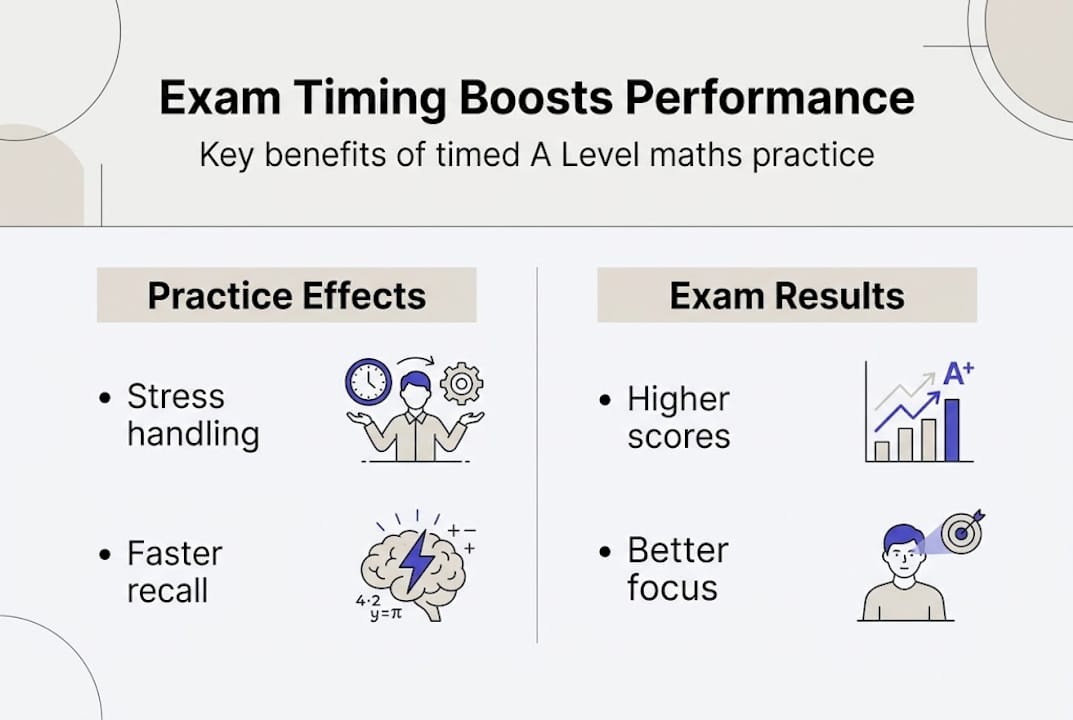
Simulating exam pressure does something that untimed revision cannot. It builds what psychologists call cognitive resilience, which is your ability to think clearly and retrieve information accurately when under stress. Every timed session trains your mind to manage that pressure rather than be overwhelmed by it.

15 to 25% score improvements have been recorded in classroom studies where students used practice testing as a core revision strategy, compared to those using traditional restudy methods. Research consistently shows these gains are not modest or occasional. They are substantial and repeatable across different subjects and year groups.
Beyond the score uplift, timed practice also surfaces problems you would not otherwise notice:
- Pacing issues: You discover which question types slow you down disproportionately.
- Knowledge gaps: Topics you thought you understood reveal themselves under retrieval pressure.
- Careless errors: Rushed arithmetic or misread questions become visible patterns you can correct.
- Confidence calibration: You learn which topics you can trust yourself on and which need more work.
Here is how to integrate timing into your revision effectively:
- Start with individual timed questions before moving to full papers.
- Use the actual mark allocation to set your time. Allow roughly 1.5 to 2 minutes per mark.
- Sit in a quiet space without notes or your phone within reach.
- Mark your work immediately using the official mark scheme.
- Log every question you got wrong or ran out of time on.
Pro Tip: Begin your first timed sessions with topics you feel confident in. This builds the habit of working under pressure without the added stress of unfamiliar content. Once the habit is established, shift to your weaker areas.
Supporting structured exam prep with timed practice is the combination that moves students from predicted grades to actual top scores. Review A Level maths exam preparation strategies to plan your sessions with purpose.
Is timing everything? The real role of feedback and review
Now that you understand the power of timing, it is essential to see what makes that practice truly effective, because timing alone is not enough.
This is a common misconception. Students assume that repeatedly doing timed papers will automatically improve their results. In reality, evidence shows there is no strong case for timed practice improving scores without a structured feedback and review process attached to it. The timing creates the conditions for learning. The review is where the actual learning happens.
Consider how three different approaches compare:
| Approach | Timing used | Review included | Typical impact |
|---|---|---|---|
| Untimed revision | No | Partial | Low to moderate |
| Timed practice only | Yes | No | Moderate |
| Timed practice with review | Yes | Yes | High |
The data is clear. The third approach consistently outperforms the others. Feedback amplifies every timed session by forcing you to confront your errors, understand why they happened, and correct the underlying misconception.
A good feedback loop after each timed session should include:
- Marking every question against the official mark scheme
- Identifying whether errors were due to a knowledge gap, a method error, or a time-pressure mistake
- Revisiting the relevant topic before the next session
- Noting patterns across multiple sessions to prioritise your weakest areas
Pro Tip: Use a simple notebook or spreadsheet to track your errors across sessions. After three or four papers, patterns emerge quickly. You will likely find that a small number of topic areas account for the majority of your lost marks.
Choosing the right exam questions to practise is also part of effective feedback. If you always pick questions from your comfort zone, the review process will not challenge you enough. Strategies for organising practice questions by topic and difficulty will help you structure sessions that genuinely accelerate improvement.
Practical frameworks: build your own timed exam routine
With the right understanding and approach, here is how you can apply timing practice for the greatest exam impact.
A well-designed timed practice routine does not need to be complicated. The structure matters more than the duration. Here is a framework you can implement immediately.
| Session phase | Duration | Activity |
|---|---|---|
| Warm-up | 10 minutes | One untimed question from a recent topic |
| Timed practice | 45 to 90 minutes | Past paper or topic-specific questions |
| Immediate review | 20 minutes | Mark scheme comparison and error logging |
| Reflection | 10 minutes | Identify patterns, plan next session |
Here is a step-by-step routine to follow each week:
- Select your material: Choose questions aligned to your exam board. Focus on topics you find difficult at least 60% of the time.
- Set your timer: Use the official exam time. Do not give yourself extra minutes.
- Attempt the paper without aids: No notes, no calculator unless permitted, no interruptions.
- Mark immediately: Do not wait until the next day. Use the official mark scheme.
- Log your errors: Write down what went wrong and why.
- Plan your next session: Target the topic areas where you lost marks.
Research indicates that overall test preparation shows a meaningful effect size, with structured test prep producing a standardised effect of g=0.26 across studies, which is a reliable and educationally significant gain.
Pro Tip: Treat each timed session as a genuine exam attempt. Sit at a desk, not on a sofa. Remove your phone from the room. These small environmental choices prime your brain to perform as it will on the actual day.
For additional structure, the teacher exam prep workflow offers a professional perspective on sequencing timed practice across a revision calendar. The exam preparation checklist and exam technique strategies are also worth reviewing before you finalise your routine.
Why mastering timing is about more than speed
Most guides on exam timing focus on going faster. They recommend practising more papers, working quicker, and drilling methods until they become automatic. That advice is not wrong, but it misses something important.
High-scoring students do not simply move faster through questions. They use timing as a decision-making tool. They know when to skip a question and return to it. They know how many minutes a six-mark question deserves and when they are spending too long chasing a single approach. That is not speed. That is exam wisdom.
Timing reveals something that no amount of passive revision can show you: how well you actually understand something. When you know a topic deeply, you retrieve it quickly and confidently under pressure. When your understanding is surface-level, pressure exposes it. Timed practice is therefore an honest mirror, not just a training drill.
The students who perform best under exam conditions are rarely the ones who crammed the most. They are the ones who used targeted exam practice to develop judgement alongside speed. They enter the exam knowing their own pace, their own weak spots, and their own decision rules for allocating effort across the paper.
That calibration takes weeks to develop. Start early, and use every timed session as an opportunity to understand yourself as an exam candidate, not just as a mathematician.
Ready to transform your maths revision?
Applying timing strategies is easier when you have the right resources. Quextro is built specifically for A Level maths students who want to practise smarter, not just harder.

With over 13,955 past exam questions filtered by topic, difficulty, and exam board, you can build timed sessions around exactly the areas you need. Whether you are working through past papers for statistics or tackling decision maths practice papers, everything is available in one place without the need to hunt through PDFs. The Quextro revision platform saves your progress automatically and helps you build the review habits that turn timed practice into real grade improvements.
Frequently asked questions
How much can timed practice improve my A Level maths score?
Research shows that timed practice combined with structured review can boost scores by 15 to 25%, making it one of the most impactful revision strategies available.
Is timing practice valuable without reviewing my mistakes?
The biggest gains come when you review errors after each session. Evidence indicates that timed practice without feedback produces only limited improvements compared to the full testing-plus-review approach.
How often should I do timed maths papers?
Aim for at least one full timed paper per week during your final revision phase. Spaced retrieval across regular intervals strengthens the testing effect far more than cramming multiple papers in a single week.
What if I consistently run out of time during practice exams?
Identify which question types or topics slow you down most, improve your pacing on early questions where marks are more accessible, and apply a marks-per-minute rule to allocate your effort more efficiently.
Do exam boards encourage timed practice?
Yes. Exam boards including AQA, Edexcel, OCR, and CIE all recommend practising under realistic exam conditions, including strict timing, to build both confidence and consistent performance on the day.