

TL;DR:
- Most effective A Level maths revision involves question indexing that categorizes exam questions by topic, difficulty, and frequency. This structured approach enables targeted practice, helping students focus on weak areas and improve scores by up to 20%. Implementing a live, updated index maximizes revision efficiency and produces measurable grade improvements.
Sitting down with a stack of past papers and working through them from front to back feels productive. But here is the uncomfortable truth: that approach is one of the least efficient ways to revise for A Level maths. Targeted question practice yields a 15 to 20% score improvement over random past paper attempts, because it forces you to confront your actual weaknesses rather than repeatedly practising what you already know. Question indexing is the method that makes targeted practice possible, and once you understand how it works, you will never approach revision the same way again.
Table of Contents
- What is question indexing and why does it matter?
- Methods for efficient question indexing
- How question indexing enhances exam performance
- Common mistakes and best practices in question indexing
- Why question indexing is still underused by A Level maths students
- Take your revision further with expert resources
- Frequently asked questions
Key Takeaways
| Point | Details |
|---|---|
| Boosts exam scores | By focusing revision on targeted questions, students generally see 15-20% higher results. |
| Saves revision time | Indexing questions eliminates wasted hours on areas you've already mastered. |
| Targets weaknesses | Allocating most practice time to weak topics transforms exam confidence. |
| Tracks exam trends | Indexing helps you spot which topics appear most frequently for smarter planning. |
What is question indexing and why does it matter?
Most students think of revision as a volume game. More papers done equals better results. But quantity without direction is just busy work. Question indexing refers to organising and categorising past exam questions by topic, subtopic, difficulty, and frequency. It turns a chaotic pile of papers into a structured, searchable system you can actually use strategically.
Think of it like a library catalogue versus a random pile of books. You could find what you need in either, but one takes minutes and the other takes hours. The same principle applies to your revision.
Here is what a properly indexed question set covers:
- Topic and subtopic: For example, calculus broken down into differentiation, integration, and related rates of change
- Difficulty level: Questions rated from accessible entry points through to the demanding multi-step problems that separate A from A*
- Mark allocation: Knowing whether a question is worth 2 marks or 12 marks completely changes how you prepare for it
- Frequency: How often a specific question type has appeared across recent exam series
"The real power of question indexing is not just knowing where questions live. It is understanding which questions matter most given your current skill level and the exam's priorities."
When you only practise randomly, you spend time on topics you are already confident in, which feels comfortable but adds little value. The students who consistently outperform their peers are the ones who have learnt the discipline of organising exam questions so they can drill precisely where they are weakest. Understanding high-frequency topics is equally critical, because certain areas like calculus and trigonometry appear in roughly 80% of A Level maths exams.
Methods for efficient question indexing
Knowing why indexing works is one thing. Building a system that actually functions under exam pressure is another. Here is a step-by-step process you can follow to set up your own indexing framework from scratch.
- Collect recent past papers. Gather at least 3 to 5 years of papers from your exam board, whether that is AQA, Edexcel, OCR, or CIE. More recent papers reflect the current mark scheme expectations and style.
- Map each question to a syllabus topic. Go through every question and label it with its primary topic. Be specific. Do not just write "calculus." Write "integration by substitution" or "implicit differentiation."
- Assess your personal confidence. Rate yourself honestly on each topic: weak, moderate, or strong. This is the step most students skip, and it is the most important one.
- Analyse frequency. Count how many times each topic type has appeared across your collected papers. Topics like calculus and trigonometry dominate, appearing in roughly 80% of exams.
- Filter your practice sessions. Allocate roughly 60% of your practice time to weak areas, 30% to moderate topics, and just 10% to strong areas. This rebalancing is where the real score gains come from.
- Prioritise recent papers. Exam boards shift their focus subtly over time. A question style that dominated five years ago may now be rarer. Weight your practice towards the most recent two to three years.
Once you have this foundation, you face a practical choice about how to manage your index. Here is a clear comparison:
| Feature | Spreadsheet-based indexing | App-based or platform indexing |
|---|---|---|
| Setup time | High (2 to 4 hours initially) | Low (pre-built databases available) |
| Customisation | Very flexible | Limited to platform options |
| Filtering speed | Moderate | Fast |
| Progress tracking | Manual | Automatic |
| Cost | Free | Free or subscription-based |
| Risk of outdated data | High (you maintain it) | Low (platform updates it) |
Both approaches work. A spreadsheet gives you full control and is great for students who want to organise revision by topic in their own way. An app or platform saves time and reduces the maintenance burden significantly, which matters enormously during peak revision periods. When selecting exam questions from a platform, look for one that lets you filter by both topic and difficulty simultaneously, because filtering on just one dimension leaves too much noise in your results.
Pro Tip: Build your index in two stages. Spend one weekend creating the initial map, then spend five minutes after each practice session updating your confidence ratings. Small, consistent updates are far more accurate than trying to reassess everything at once during the final week before your exam. Pair this habit with effective study schedules and you will find your revision becomes much more predictable and measurable.
How question indexing enhances exam performance
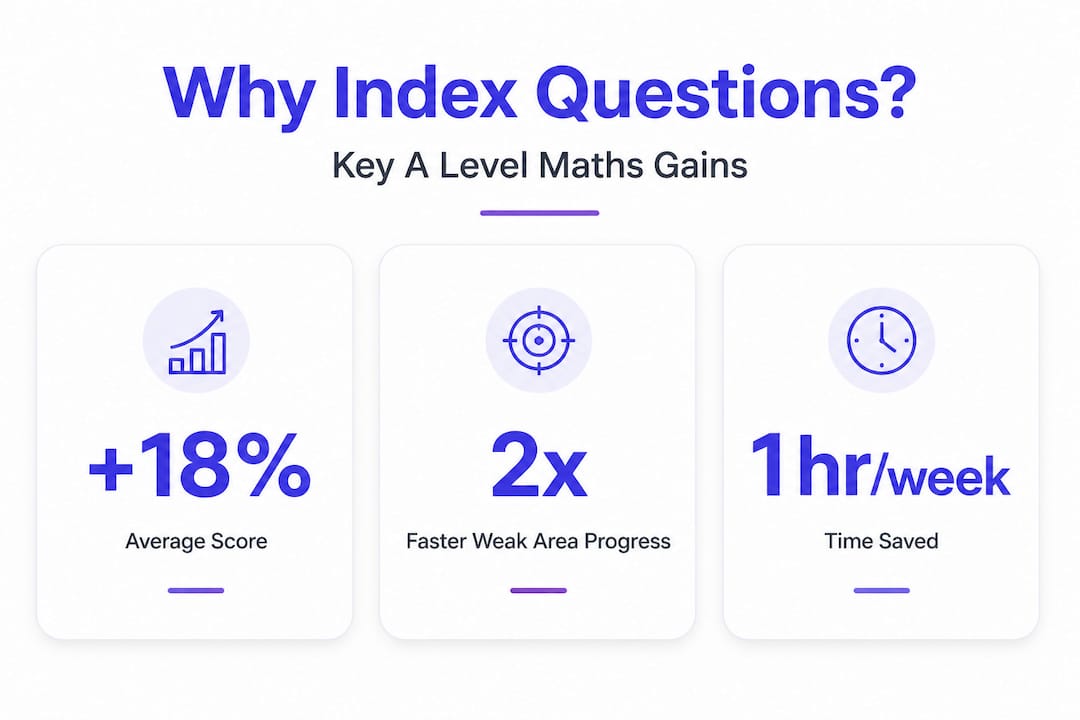
The performance argument for question indexing is not anecdotal. The data is clear. Students using targeted question practice consistently outperform those using random past paper approaches by 15 to 20 percentage points. That gap is the difference between a B and an A, or an A and an A*, for many students.
Here is what the numbers look like in practice:
| Revision approach | Average score improvement | Time efficiency | Weak area coverage |
|---|---|---|---|
| Random past papers | Baseline | Low | Coincidental |
| Topic-list based revision | +5 to 8% | Moderate | Partial |
| Full question indexing | +15 to 20% | High | Systematic |
The reason for the gap comes down to one simple principle: time allocation. When you revise randomly, you naturally gravitate towards questions you can already answer. It feels good. Your brain rewards familiarity. But it adds almost nothing to your exam score. With indexing, you deliberately invert that tendency.
Consider a real scenario. A student is preparing for their Edexcel A Level maths paper. Without indexing, they might spend equal time across all topics, or worse, spend extra time on pure algebra because they find it satisfying. With indexing, they discover that integration by parts has appeared in every single paper for the past four years, but they have only answered three such questions in all their revision. That gap becomes visible and fixable. They spend a focused week on that one subtopic and pick up marks that were previously lost simply through under-preparation.

A second scenario: a student notices through their index that proof by contradiction questions have been relatively rare but are always worth 4 to 6 marks when they appear. Rather than spending hours on it, they practise just three or four targeted questions, nail the technique, and bank those marks efficiently. Good analysis of exam questions turns every revision hour into a deliberate investment rather than a general gesture towards studying.
The key insight here is that question indexing does not just help you study more. It helps you study the right things. That is an entirely different skill, and it is one that university admissions tutors effectively reward every year through the grade boundaries that separate A Level outcomes.
Common mistakes and best practices in question indexing
Even students who embrace question indexing often make errors that undermine its effectiveness. Knowing these pitfalls in advance saves you weeks of misdirected effort.
The three most common mistakes are:
- Over-indexing on organisation. Some students spend so long building and perfecting their index that they never actually practise the questions. The index is a tool, not the end goal. If you are spending more than two hours per week maintaining your system, you have gone too far.
- Ignoring weak areas after identifying them. It takes courage to sit with the topics you find genuinely difficult. Many students identify their weak areas through indexing and then quietly avoid them anyway. This defeats the entire purpose.
- Failing to update the index as you improve. Your confidence ratings from October will be wrong by January. If you do not update them, you will keep drilling topics you have already mastered whilst neglecting new gaps that have emerged.
Pro Tip: Set a calendar reminder every two weeks to reassess your confidence ratings across all topics. Even a five-minute review keeps your index accurate and ensures your practice sessions reflect where you actually stand today, not where you stood a month ago.
"Question indexing transforms inefficient full-paper grinding into precise gap-filling, maximising revision ROI for A Level maths exams."
The best practices come down to flexibility and honesty. Your index should be a living document. If a topic shifts from weak to moderate, reallocate your time immediately. Do not wait until the next "official" review. Also, prioritise recent exam series heavily when analysing question patterns, because the most recent papers give you the clearest signal about what the examiner is currently prioritising.
Finally, practise under timed conditions at least once per week with indexed question sets. Knowing the right technique and being able to execute it under pressure are different skills. Indexed practice sessions should eventually feed into short, targeted timed drills. For a full overview of best maths exam practices, combining indexing with timed drills is the combination that produces the most consistent grade improvements.
Why question indexing is still underused by A Level maths students
Here is something worth saying plainly: most A Level maths students know that targeted revision is better than random revision. They have heard it from teachers, read it in revision guides, and seen it in advice articles. So why do so few of them actually do it?
The honest answer is that question indexing feels like extra work before the real work begins. Setting up the system requires effort that does not immediately produce a practice score to show for itself. Students under time pressure default to what feels immediately productive, which means printing a past paper and starting at question one.
There is also a perception that indexing is something only the most academically advanced students do. That framing is completely backwards. Indexing is most valuable for students in the middle ground, those aiming for a B or A who need to convert their existing knowledge into exam marks. The students already scoring A* naturally tend to revisit weak areas anyway because their overall grasp is strong enough to self-diagnose. It is the B-grade student who has the most to gain from a formal system that forces the issue.
The competitive advantage here is real. If you are in a cohort of 30 students and only three of them are actively indexing their revision, those three students are operating with a fundamentally different level of preparation precision. They are not revising harder. They are revising smarter, and the difference shows up in exactly the mark ranges where competition for university places is fiercest.
The effective ways to organise exam questions are not secret. They are just uncomfortable to implement when you are tired and under pressure. The students who do it anyway are the ones who move up a grade boundary. That is not a dramatic claim. It is a reliable, repeatable pattern.
Take your revision further with expert resources
Building a question index from scratch takes time, and that is time you could be spending actually practising. The most efficient path forward is to use a platform where the indexing has already been done for you.
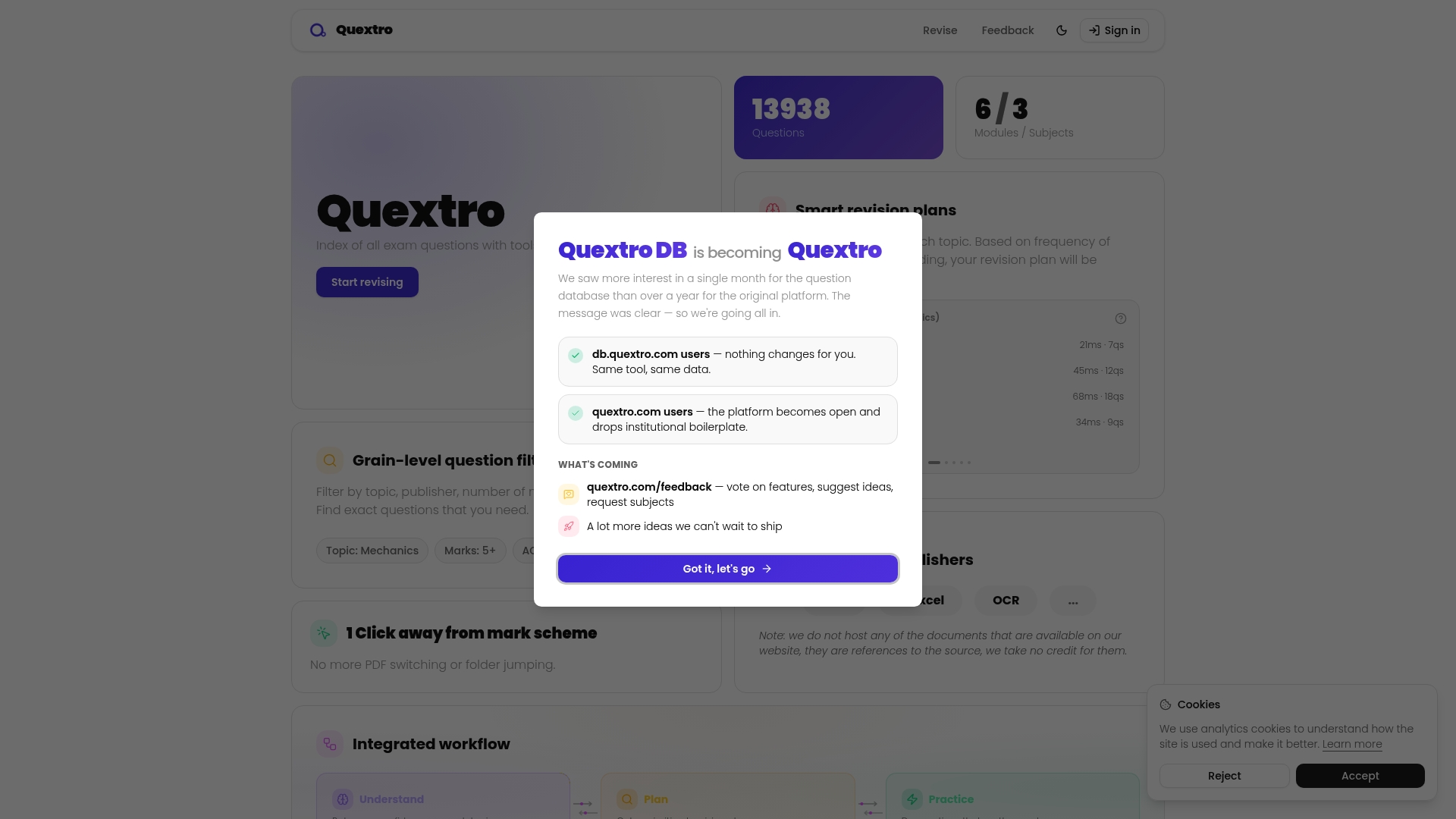
Quextro gives you access to a question database of over 13,955 past exam questions from AQA, Edexcel, OCR, and CIE, all pre-filtered by topic, difficulty, and mark allocation. You can rate your confidence in any topic, answer questions directly on the platform, and track your progress automatically without juggling PDFs and spreadsheets. For students working on statistics, the Further Statistics 1 resources offer a fully indexed set of questions ready to use immediately. Stop building the system and start using it.
Frequently asked questions
How does question indexing differ from just using topic lists?
Question indexing categorises individual exam questions by topic, difficulty, and frequency of appearance, enabling precise targeting, whilst basic topic lists only give broad coverage without telling you which questions to actually practise.
What is the biggest benefit of using question indexing for A Level maths?
Using indexing for targeted practice typically leads to a 15 to 20% score improvement compared to random past paper practice, because your revision time is directed towards genuine weak areas rather than comfortable repetition.
How many years of past papers should I use for effective indexing?
Collect at least 3 to 5 years of past papers to capture reliable question trends, whilst weighting your practice time towards the most recent two or three years for the most accurate signal on current examiner priorities.
Should I focus more on weak or strong topics in my indexed question list?
Prioritise weak areas at 60% of your practice, moderate topics at 30%, and strong topics at just 10%, as this allocation produces the greatest overall score gains and prevents you from wasting revision time on topics you have already mastered.