

TL;DR:
- Strategic tracking of exam performance transforms vague revision into evidence-based, targeted improvement.
- It reveals genuine knowledge gaps, prevents wasted effort, and builds confidence through objective progress data.
Revising for hours and still not seeing the results you expect is one of the most demoralising experiences in A Level maths. You cover the textbook, attempt past papers, and yet something is clearly not clicking. The problem, more often than not, is not effort. It is direction. Without a clear picture of where your marks are actually going, revision becomes guesswork. Strategic tracking of your exam performance changes everything, turning vague preparation into a focused, evidence-based process that consistently unlocks higher grades.
Table of Contents
- Why tracking your exam performance matters
- How to track your exam performance effectively
- What performance tracking reveals and how to use it for smarter revision
- Common challenges and how to overcome them
- The real reason tracking works: our perspective
- Supercharge your results with Quextro
- Frequently asked questions
Key Takeaways
| Point | Details |
|---|---|
| Tracking pinpoints weakness | By closely monitoring your exam results, you can focus revision on what needs it most. |
| Better tracking means better marks | Students in schools that track progress see higher grades and greater confidence in maths. |
| Use tools for quick wins | Digital analysers and data tables make performance tracking both faster and more accurate. |
| Build lasting study habits | Routinely reviewing your performance fosters skills that help throughout education and beyond. |
Why tracking your exam performance matters
Most students approach revision the same way: work through topics, attempt a few past papers, and hope the results improve by exam day. But this approach has a critical flaw. Without recording which questions you got wrong, which topics cost you the most marks, and whether your accuracy is improving over time, you are essentially flying blind. You might spend three evenings on integration when your real weakness is statistical hypothesis testing. You will never know unless you track it.
Structured exam preparation is fundamentally different from unstructured revision. The difference lies in data. When you log your performance question by question and topic by topic, patterns emerge rapidly. You stop guessing and start making informed decisions about where your revision time will have the greatest impact.
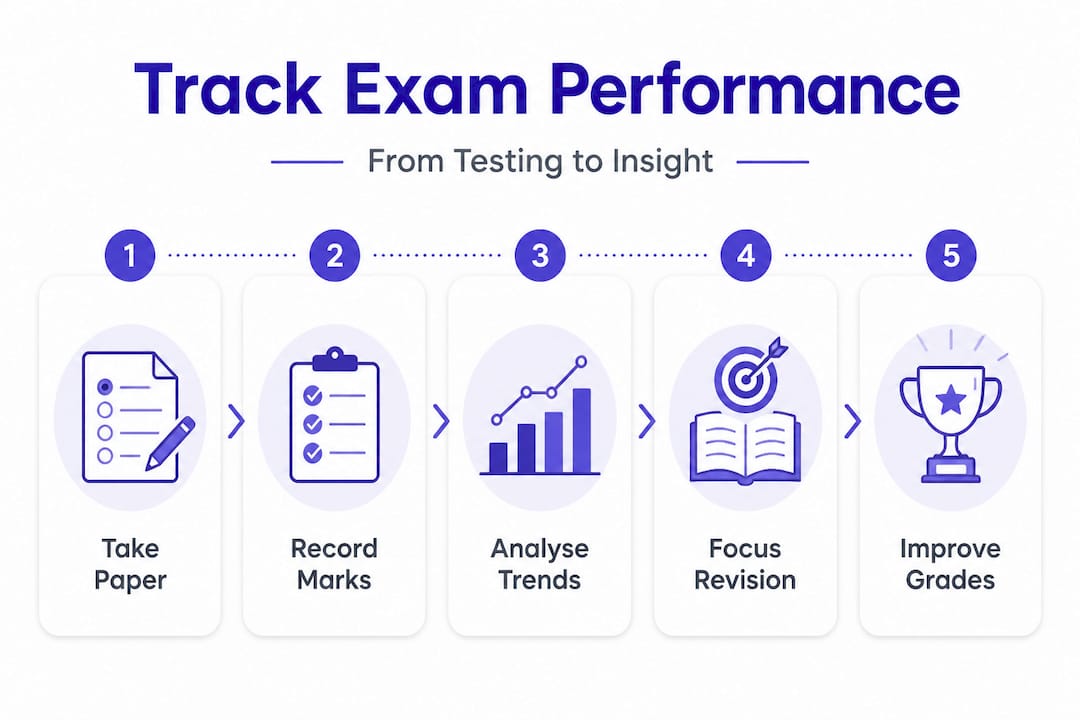
The evidence for tracking is compelling. Research into specialist maths schools in England found that regular progress monitoring is directly associated with a value-added uplift of 0.36 to 0.76 grades, with the greatest gains seen among disadvantaged students. That is a meaningful improvement, and it comes not from longer hours but from smarter, more targeted review of performance data.
Understanding why tracking progress matters goes beyond just better grades. It builds genuine self-awareness about your learning, which is a skill that serves you long after A Levels are over. Here is what consistent tracking protects you from:
- Revising topics you already understand well while neglecting weaker areas
- False confidence after one good paper, without checking if gaps remain
- Random revision that covers everything vaguely instead of targeting specific weaknesses
- Missed marks in low-difficulty questions due to careless errors you have never identified
"Progress monitoring, when done consistently, is one of the most powerful levers for academic improvement available to students at every level of attainment."
Analysing question patterns across multiple papers helps you see not just what you got wrong once, but what you consistently struggle with. That is the insight that changes revision from reactive to proactive.
How to track your exam performance effectively
Understanding its importance, here is how you can start tracking your exam performance right now. You do not need elaborate systems to begin. Clarity and consistency matter far more than complexity.
- Attempt a full past paper under timed conditions. Replicate exam conditions as closely as possible. This gives you the most accurate performance data to work with.
- Mark your paper honestly using the mark scheme. Pay attention to where method marks are lost, not just final answer marks. These reveal procedural gaps.
- Log your results by topic and question type. Record the topic, the number of marks available, how many you scored, and a brief note on why you dropped marks.
- Rate your confidence for each topic after reviewing your answers. Use a simple scale: 1 (struggling), 2 (getting there), 3 (confident). This adds a subjective layer to your objective score data.
- Review your log weekly and adjust your revision focus. Look for topics appearing repeatedly in your weak column and prioritise them in the coming week.
Here is a sample tracking table to get you started:
| Topic | Marks available | Marks scored | Accuracy (%) | Confidence (1-3) | Notes |
|---|---|---|---|---|---|
| Integration | 12 | 10 | 83% | 3 | Lost marks on substitution method |
| Statistical hypothesis testing | 8 | 3 | 38% | 1 | Misunderstood critical region |
| Trigonometric identities | 10 | 7 | 70% | 2 | Forgot double angle formula |
| Binomial distribution | 6 | 6 | 100% | 3 | Solid |
| Proof by contradiction | 5 | 2 | 40% | 1 | Need more practice |
This table tells a story immediately. Two topics, statistical hypothesis testing and proof by contradiction, need urgent attention. Integration and binomial distribution are solid. Without this data, you might have spent another week on integration out of habit.
For a more sophisticated layer of analysis, tools like the AQA Mock Exam Analyser compare your performance to live exam data by question, assessment objective, and topic, providing highly personalised feedback that a spreadsheet alone cannot replicate. This kind of granular analysis shows not just that you struggled with a topic, but whether your weakness is in knowledge recall, application, or reasoning under exam conditions.
Exam topic analysis helps you go a step further by identifying which topics appear most frequently across past papers from your exam board, allowing you to combine frequency data with your personal performance data for maximum prioritisation accuracy.
Pro Tip: Keep your tracking system simple enough to maintain after every single paper. A one-page spreadsheet beats a complex system you abandon after two weeks. Consistency over sophistication, every time.
What performance tracking reveals and how to use it for smarter revision
Once you are tracking your performance, you will start to see patterns. Here is why those patterns are genuinely valuable for your revision.
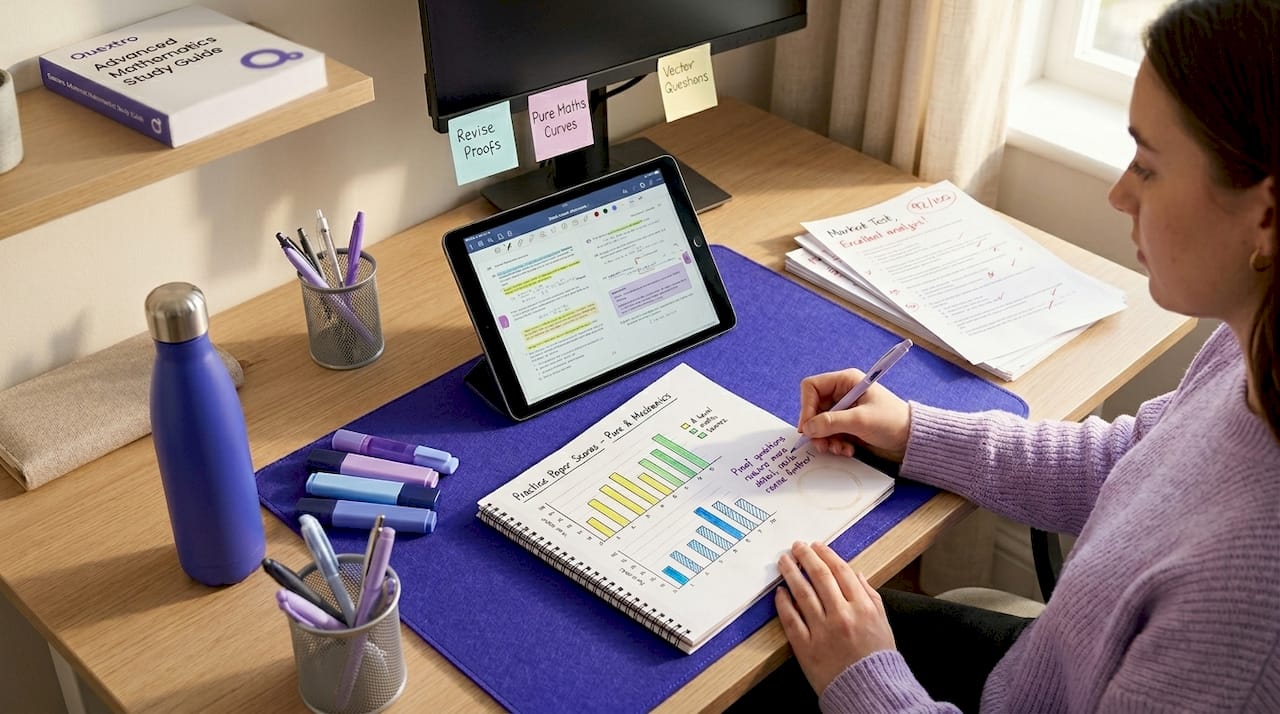
The most immediate insight tracking gives you is the difference between topics where you lose marks occasionally and topics where you lose marks consistently. Occasional errors are often due to exam pressure or minor slips. Consistent errors point to genuine knowledge gaps or procedural misunderstandings that require deliberate practice to fix.
Strong performance tracking also reveals something less obvious: which topics give you easy marks. If you consistently score full marks on sequences and series, you can maintain that knowledge with light touch revision and redirect your energy elsewhere. This reallocation of revision time is where tracked data sets study goals and pays dividends.
Here is how informed revision compares to random revision:
| Revision approach | Time spent | Focus | Outcome |
|---|---|---|---|
| Random revision | High | All topics equally | Marginal improvement across the board |
| Informed (tracked) revision | Moderate | Weakest topics first | Significant improvement where it counts |
| Informed revision with topic frequency data | Targeted | High-frequency weak topics | Maximum mark gain per hour of revision |
The third row is where top-scoring students operate. They combine their personal performance data with knowledge of exam board question patterns to focus effort precisely where marks are most likely to be gained.
Beyond topic selection, tracking helps you build genuine exam confidence. When you can see in your own data that your accuracy on vectors has improved from 45% to 78% over six weeks, you walk into the exam room with evidence of your progress rather than vague reassurance. That is a qualitatively different kind of confidence.
Pro Tip: If a topic appears as a weakness in three consecutive papers, treat it as a priority for that week regardless of how much you dislike it. The discomfort is a signal, not a reason to avoid it. Boosting A Level maths confidence often starts with confronting those uncomfortable gaps directly.
Common performance patterns students discover through tracking include:
- Method errors in multi-step problems, particularly in mechanics and calculus, where early mistakes compound
- Conceptual gaps in newer topics, such as large data sets in statistics, which receive less classroom time
- Inconsistency in algebraic manipulation, causing mark loss even when the broader method is correct
- Time management issues, revealed when papers are not finished despite strong accuracy on completed questions
- Assessment objective weaknesses, particularly in AO2 (reasoning) and AO3 (problem-solving), where students underperform relative to AO1 (recall)
Each of these patterns suggests a different revision strategy. Method errors require structured worked example practice. Conceptual gaps need focused reading and concept mapping. Algebraic manipulation improves with drill exercises. Time management requires timed practice under strict exam conditions.
Common challenges and how to overcome them
Performance tracking yields immense value, but it is not without hurdles. Here is how to overcome the most common ones.
The biggest barrier for most students is inconsistency. It is easy to track performance after the first two papers and then stop when revision intensifies. The fix is to make tracking a non-negotiable part of your post-paper routine, taking no more than fifteen minutes. Attach it to something you already do, like reviewing answers immediately after marking, and it becomes automatic.
Self-marking bias is a genuine problem. Students often give themselves the benefit of the doubt on method marks or misread mark schemes to be more lenient. The result is inflated accuracy data that leads to poor prioritisation. Practising honest self-assessment takes discipline, but it is critical for your data to be useful.
Feeling overwhelmed by data is another common issue, especially if you are tracking across multiple topics and papers simultaneously. Keep your focus on three to five priority topics at any given time. You do not need to fix everything at once.
"The goal is not to collect data for its own sake. The goal is to make better decisions about where your time goes."
Digital tools address many of these challenges. The AQA Mock Exam Analyser automates much of the comparison work, removing the risk of self-marking bias when it comes to identifying patterns across assessment objectives. Platforms designed for A Level maths revision can also surface question-level trends you would miss in a manual spreadsheet.
Here are practical ways to build a sustainable tracking habit:
- Set a fixed time each week, perhaps Sunday evening, to review your tracking data and update your revision plan
- Use a study schedule that reserves specific slots for tracking review, not just content revision
- Celebrate genuine improvements in your data as motivation to continue
- Share your tracking system with a friend or teacher for accountability
The habit does not need to be elaborate. It needs to be consistent.
The real reason tracking works: our perspective
Most guides on exam performance focus on the mechanical benefits of tracking, such as identifying weak topics and allocating time accordingly. That is all true and useful. But it misses the deeper reason why tracking is so transformative for A Level maths students.
Tracking makes you the coach, not just the player. When you sit down after a paper and analyse your own performance, you shift from passive receiver of results to active interpreter of data. That is a fundamentally different relationship with your own learning. You stop asking "why did I do badly?" and start asking "what does this tell me about where I need to go next?" That question is what separates students who improve consistently from those who plateau.
Motivation alone is rarely sufficient. Students who rely on motivation to drive revision typically work hard before exams and coast between them. Students who build tracking habits work more steadily because the data itself creates accountability. There is something psychologically compelling about a spreadsheet that shows you improved from 55% to 72% in differentiation over three weeks. It is evidence of growth, and evidence is a stronger motivator than willpower.
There is also a metacognitive element that most people overlook. Metacognition, which is the ability to think about your own thinking, is one of the strongest predictors of academic success. Tracking is applied metacognition. When you note "I knew the method but set up the equation incorrectly," you are developing an awareness of your own reasoning processes that makes you a more effective learner across every subject.
The students who consistently achieve top grades are not necessarily those who work the most hours. They are the ones who revise with the greatest precision. They know which topics to focus on because they have evidence, not instinct. They know when a topic is genuinely solid because their accuracy data tells them so, not because they feel comfortable with it. Comfort and competence are not the same thing.
Building tracking habits now also pays dividends beyond A Levels. The ability to self-regulate learning, to set objectives, gather performance data, and adjust strategy accordingly, is a core skill for university, professional qualifications, and any context where you need to acquire new knowledge independently. You are not just preparing for an exam. You are training yourself to learn effectively for life. Exam readiness strategies that include self-monitoring build this capability in a way that passive revision simply cannot.
Supercharge your results with Quextro
If you are ready to take performance tracking from concept to practice, Quextro is built exactly for this purpose. With a database of over 13,955 past exam questions from AQA, Edexcel, OCR, and CIE, you can practise questions filtered by topic, difficulty, and marks, and track your progress automatically as you go.
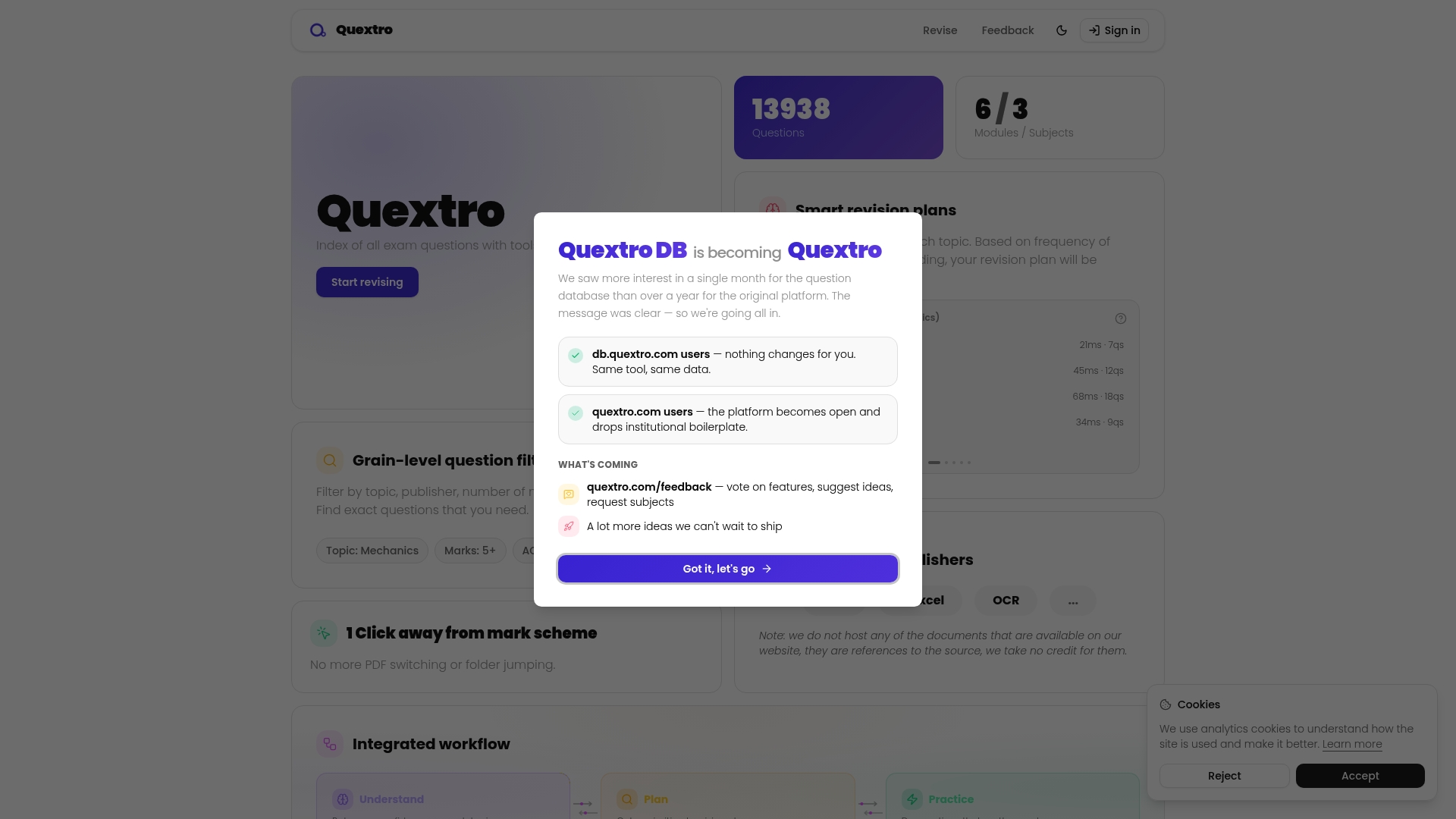
Quextro's smart revision plans adapt based on your confidence ratings and question frequency, so your revision is always guided by evidence rather than habit. You can start with Pure Mathematics practice questions to build a performance baseline across core topics, then move into Statistics papers once you know where your weaker areas lie. Everything is integrated, so you spend less time managing resources and more time actually improving.
Frequently asked questions
What is the easiest way to start tracking my A Level maths performance?
Use a simple table or spreadsheet to log your marks by topic after each mock or practice paper, making reflection a routine step immediately after every test. Even five minutes of honest review per paper builds a valuable performance picture over time.
How often should I review my exam performance data?
The most effective students review their data after every test and set aside time monthly before major mock exams to look for longer-term trends. Regular short reviews beat infrequent marathon analysis sessions.
Do students who track their progress get better results?
Maths schools that regularly monitor student progress see a value-added uplift of 0.36 to 0.76 grades, with the greatest gains among disadvantaged students, demonstrating that tracking consistently drives higher achievement.
Are digital tools better than pen-and-paper for exam tracking?
Digital tools such as the AQA Mock Exam Analyser can compare your performance to live exam data by question, assessment objective, and topic, providing levels of targeted feedback that manual tracking cannot easily replicate.
What if my progress plateaus even with tracking?
Plateaus are normal and usually signal that your current revision method needs changing rather than intensifying. Review your weakest topics in your tracking data and try a different approach, such as teaching the topic aloud or attempting questions from a different exam board.