

TL;DR:
- Effective revision requires tracking performance through timed past papers and structured self-assessment.
- Prioritize calculus and trigonometry as they appear in over 80% of recent exam questions.
- Data-driven monitoring replaces guesswork with evidence, boosting confidence and exam readiness.
Most students revising for A Level maths reach a point where they genuinely cannot tell whether they are ready or simply hoping for the best. That uncertainty is not a character flaw; it is the natural result of revision without a clear measurement system. Core monitoring methods for A Level maths include timed past paper practice, topic tests, self-assessment checklists, and performance spreadsheets tracked by topic, difficulty, and question frequency. This guide walks you through each of those methods in practical detail so you can move from guessing to knowing exactly where you stand.
Table of Contents
- What you need to monitor your exam readiness
- Step-by-step process: Track your revision and performance
- Smart filtering: Target questions and topics that matter
- Avoid common mistakes when assessing exam readiness
- How to review and interpret your progress
- Why tracking your readiness is more important than raw revision hours
- Take your next step: Practice smarter with expert resources
- Frequently asked questions
Key Takeaways
| Point | Details |
|---|---|
| Track by topic | Monitor your exam progress using a checklist or spreadsheet for each maths topic to spot and address weak areas. |
| Prioritise recent trends | Focus practice on question types and topics that appear most often in the last 3-5 years of papers. |
| Timed practice counts | Simulating exam conditions under time pressure is vital for building true readiness and exam confidence. |
| Avoid overconfidence | Don't rely on feeling ready—use tracked data to ensure you cover all specification areas, including statistics and mechanics. |
| Review your results | Use your recorded scores to plan last-minute revision, focusing on low-scoring or slow topics for greatest improvement. |
What you need to monitor your exam readiness
Before you can track anything meaningfully, you need the right materials in place. Think of this as setting up your revision workspace. Without the right tools, even the best intentions produce patchy results.
Here is what you will need to get started:
- Past papers for your specific exam board (AQA, Edexcel, OCR, or CIE), ideally covering the last five years
- Mark schemes for every paper so you can score yourself honestly
- A topic checklist that maps every specification point for your board
- A tracking spreadsheet in Google Sheets or Excel with columns for topic, score, date, and confidence rating
- A digital revision app or platform that allows filtered question practice by topic and difficulty
- A quiet, consistent workspace with timed conditions you can replicate each session
The debate about best preparation practices is worth noting here. Some sources emphasise digital checklists and apps, while others argue that pure past paper loops are sufficient. The reality is that official exam boards consistently prioritise topic tests and timed past papers over any commercial tracker. Digital tools are genuinely useful for organisation, but they should support your paper practice, not replace it.
Good organisation is half the battle. Use organisation tools for students to keep your materials sorted by topic and date so you are never wasting revision time searching for the right paper.
| Tool | Purpose | Format |
|---|---|---|
| Past papers | Simulate real exam conditions | Printed or digital |
| Mark schemes | Accurate self-marking | PDF or online |
| Topic checklist | Map specification coverage | Spreadsheet or printed sheet |
| Tracking spreadsheet | Log scores and confidence over time | Google Sheets or Excel |
| Revision platform | Filtered question practice | Online |
Pro Tip: Create a dedicated folder on your device and a physical folder on your desk. Label each section by topic. When everything has a home, you spend your energy on maths, not on finding materials.
Honest self-assessment is the hardest part of this process. Many students instinctively rate their confidence higher than their actual scores warrant. Commit to marking your work strictly against the mark scheme from the very first session.
Step-by-step process: Track your revision and performance
Once you have the right materials, here is how to build a tracking system that genuinely reflects your readiness. Follow these steps in order and repeat the cycle weekly.
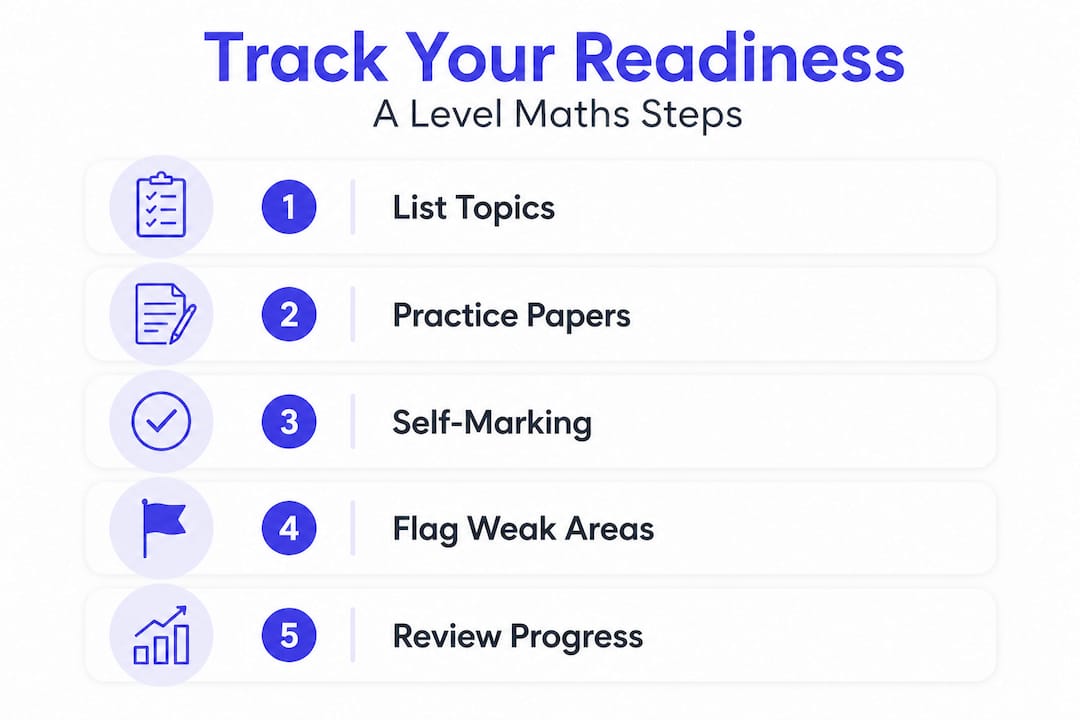
- Attempt a full past paper under timed conditions. Set a timer, remove distractions, and work through the paper exactly as you would in the exam hall. No pausing, no checking notes.
- Mark your paper strictly using the official mark scheme. Award method marks where they are earned, but do not be generous with accuracy marks.
- Log your score by topic in your spreadsheet. Break the paper down into its component topics: algebra, calculus, trigonometry, statistics, mechanics, and so on. Record how many marks you earned versus how many were available in each area.
- Rate your confidence for each topic on a scale of 1 to 5. Be honest. A score of 4 on a topic where you made three errors is not a 5.
- Rotate topic tests between full papers. After each full paper, spend two or three sessions doing targeted topic tests on your weakest areas before attempting the next full paper.
- Update your checklist weekly. Mark each specification point as not started, in progress, or confident. This gives you a visual map of your coverage.
- Review your spreadsheet trends every fortnight. Are your scores in calculus improving? Is your statistics performance stagnant? The data will tell you where to focus next.
Exam readiness strategies that work consistently share one feature: they are data-driven rather than feeling-driven. Using past paper databases to access a broad range of questions across years and topics makes this process significantly more efficient.

Timed past paper practice is the single most reliable method for monitoring A Level maths exam readiness, alongside topic tests and structured checklists.
| Method | Best used when | Key benefit |
|---|---|---|
| Full timed past paper | Weekly, throughout revision | Simulates real exam pressure |
| Topic test | After identifying a weak area | Targeted improvement |
| Self-assessment checklist | Ongoing, updated weekly | Tracks specification coverage |
| Tracking spreadsheet | After every session | Reveals score trends over time |
Pro Tip: Mark your three weakest topics in red on your spreadsheet. Every time you open it, those red cells are your immediate priority. It removes the temptation to practise what you already know.
Smart filtering: Target questions and topics that matter
Now that you are tracking your revision, it is crucial to know which questions and topics to prioritise for maximum impact. Not all topics carry equal weight in the exam, and not all past papers are equally relevant to the 2026 specification.
Calculus and trigonometry appear in over 80% of recent A Level papers, making them the highest-priority topics for any student aiming for a strong grade. Ignoring or underweighting these areas is one of the most costly mistakes you can make.
Here is how to filter your question practice for maximum effect:
- By topic: Focus first on calculus, trigonometry, and algebra, then rotate through statistics and mechanics
- By confidence rating: Always prioritise topics where your self-rating is 2 or below
- By recency: Prioritise papers from the last three to five years to capture current examiner trends and question styles
- By marks available: Target question types that carry the most marks per question, as these offer the greatest return on revision time
- By question frequency: Track which question formats appear repeatedly across papers and practise those formats explicitly
When selecting exam questions for your sessions, resist the urge to cherry-pick topics you enjoy. The filtering criteria above should drive your choices, not personal preference.
If you are sitting AQA exam questions, pay particular attention to how the board frames multi-step problems in calculus and the way statistics questions are worded. Each board has stylistic patterns that become visible once you have worked through enough papers.
Stat callout: Over 80% of A Level maths past papers include at least one substantial calculus or trigonometry question. If you cannot confidently tackle both, your grade ceiling is already limited before you sit down.
Filtering is not about doing less work. It is about ensuring that the work you do is directly connected to what will appear in your exam. Unfocused revision produces diminishing returns very quickly.
Avoid common mistakes when assessing exam readiness
Even with strong tracking methods, it is easy to fall into some classic traps. These mistakes do not just waste time; they actively distort your picture of your own readiness.
- Doing all your practice untimed. Untimed practice builds familiarity with content, but it tells you almost nothing about how you will perform under real exam conditions. Method marks are rewarded in the 2026 specification, which means the process matters as much as the answer. You need to practise showing your working under time pressure.
- Relying on how you feel rather than what your scores show. Feeling confident after a revision session is not evidence of readiness. Your spreadsheet scores are evidence. Many students feel most confident immediately after studying a topic, only to find they cannot reproduce their reasoning a week later under timed conditions.
- Neglecting statistics and mechanics. Pure mathematics tends to receive the most revision attention, but statistics and mechanics together account for roughly one third of the A Level specification. Ignoring them is not a minor oversight; it is a structural gap in your preparation.
- Marking yourself generously. When self-marking, the temptation is to award yourself marks for working that was almost correct. Use the mark scheme strictly. Examiners will not be generous, and neither should you be with yourself during practice.
- Only practising questions you already find manageable. This feels productive but produces no improvement. Deliberately practise questions that make you uncomfortable.
"Only method marks are rewarded in 2026 A Level specifications. If your working is absent or unclear, you lose marks even when your final answer is correct."
Guidance on answering exam questions effectively consistently highlights the importance of clear, structured working. Similarly, reviewing past papers properly means going beyond just checking whether your answer matches. Analyse why you lost marks and what the mark scheme rewarded.
Pro Tip: Always attempt at least one full paper under timed conditions each week, without exception. One timed paper per week, marked strictly, is worth more than five untimed sessions where you pause to check your notes.
How to review and interpret your progress
With everything monitored and common mistakes avoided, it is time to use your results to steer your final revision. Raw data in a spreadsheet only becomes useful when you actually analyse it.
Here is how to interpret what your tracking data is telling you:
- Improving score trend across multiple papers: This is the clearest sign of genuine progress. If your total score has risen by 10 or more marks across three consecutive papers, your revision is working.
- Narrowing topic gaps: If your weakest topic has moved from 30% to 55% over four weeks, you are closing the gap. If it has stayed flat, your revision approach for that topic needs to change.
- Faster working speed: Timing yourself on individual questions reveals whether you are becoming more fluent. Fluency under time pressure is a direct indicator of readiness.
- Consistent confidence ratings above 3: When you can honestly rate most topics at 3 or above, and your scores back that up, you are approaching genuine readiness.
- Fewer careless errors: Track how many marks you lose to arithmetic mistakes versus genuine gaps in understanding. Careless errors decrease with timed practice; conceptual gaps require targeted topic work.
The 2026 A Level maths specification remains paper-based and linear, with method marks playing a significant role. Your tracking system should reflect this by recording not just your final scores but also how many method marks you earned on questions where you did not reach the correct answer.
| Week | Full paper score (%) | Calculus (%) | Statistics (%) | Mechanics (%) |
|---|---|---|---|---|
| Week 1 | 52 | 48 | 44 | 55 |
| Week 3 | 61 | 58 | 52 | 60 |
| Week 5 | 68 | 70 | 61 | 65 |
| Week 7 | 74 | 76 | 69 | 71 |
Use your exam preparation checklist alongside this data. When your checklist shows full specification coverage and your scores show a consistent upward trend, you have moved from hoping to knowing.
Why tracking your readiness is more important than raw revision hours
You might be wondering whether all this tracking effort is really necessary. Here is an uncomfortable truth: the number of hours you spend revising is almost meaningless without evidence of what those hours produced.
We have seen students log eight-hour revision days for weeks and still underperform, not because they lacked effort, but because their effort was invisible to them. They could not tell which topics had improved, which remained weak, or whether their exam technique was actually developing. Hours at a desk feel productive. Proof of progress is productive.
Well-structured monitoring exposes what raw hour-counting conceals. A student who tracks performance by topic knows within two weeks that their integration scores are improving but their hypothesis testing scores are not moving. A student who simply logs hours knows only that they have been busy. Busy is not the same as ready.
Confidence built on tracked improvement is also qualitatively different from confidence built on time spent. When you sit down in the exam hall having seen your scores rise consistently over six weeks, that confidence is grounded in evidence. It does not evaporate when the paper is harder than expected.
Educational apps for learning can support this process, but the core insight remains the same regardless of the tools you use. The question is never "how long did I revise?" It is always "what does my data show?"
Exam readiness strategies that produce consistent results share one feature: they replace subjective feelings with objective measurements. Build your revision around evidence, and the uncertainty that plagues most students simply stops being a problem.
"It is not about hours at your desk. It is about proof of progress and readiness for the paper."
Take your next step: Practice smarter with expert resources
You now have a clear framework for tracking your A Level maths exam readiness. The next step is putting it into action with the right resources behind you.
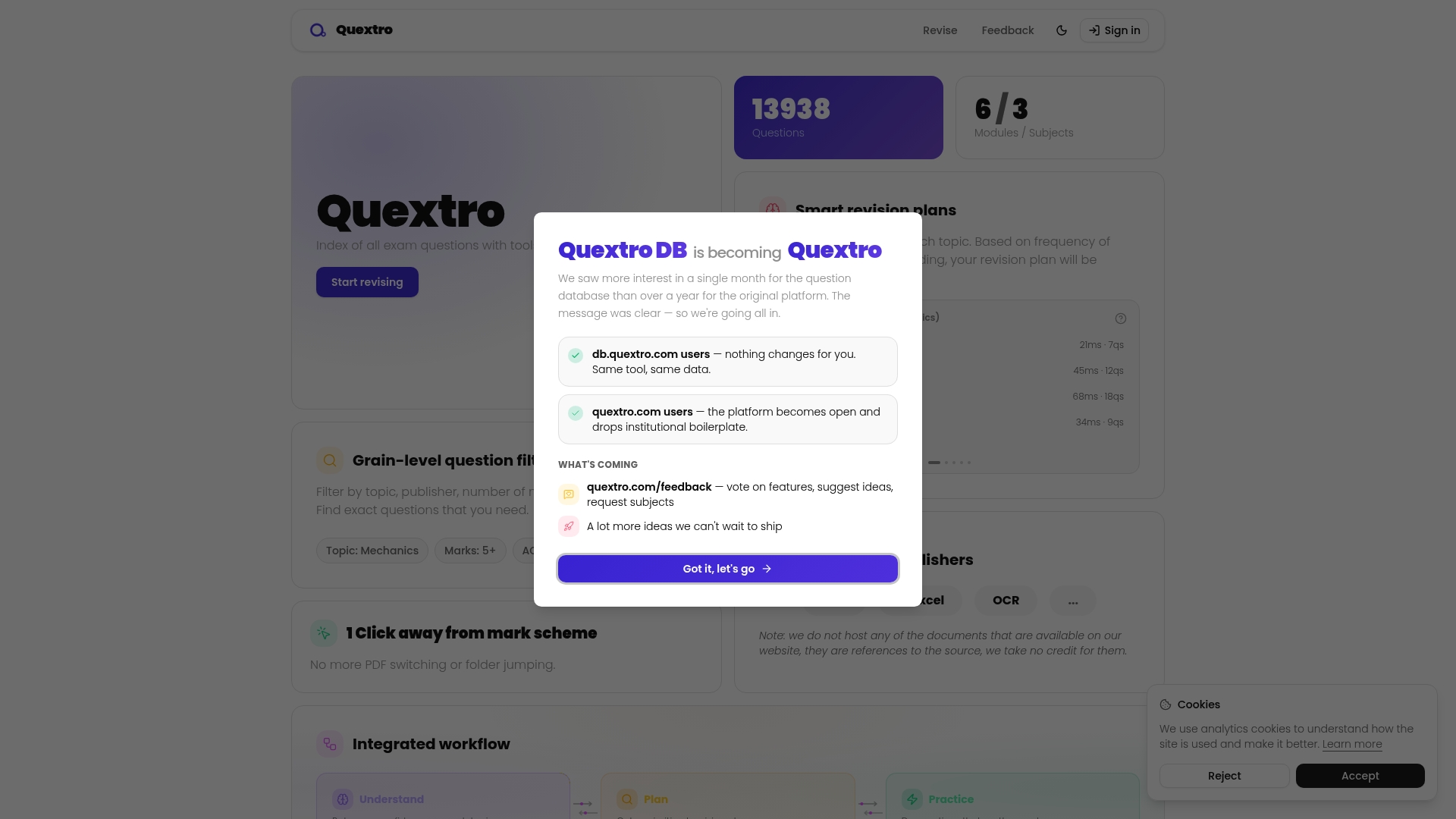
Quextro gives you direct access to over 13,955 past exam questions from AQA, Edexcel, OCR, and CIE, all filterable by topic, difficulty, marks, and year. You can practise questions directly on the platform, rate your confidence after each topic, and track your progress automatically without juggling external PDFs. The smart revision plans adapt based on your confidence ratings and question frequency, so your revision stays targeted rather than generic. Whether you want to close a gap in calculus, build fluency in statistics, or work through a structured checklist for the 2026 specification, Quextro has the tools to make your tracking system genuinely effective. Start your targeted revision at quextro.com.
Frequently asked questions
How many past papers should I complete to be confident for A Level maths in 2026?
Aim for at least 6 to 10 full past papers under timed conditions, spread across different years and covering all paper components, including statistics and mechanics.
Is it essential to track progress by topic for maths exam readiness?
Yes. Tracking by topic reveals hidden gaps, particularly in Statistics and Mechanics, which together carry roughly one third of the total marks and are frequently under-revised.
Which exam question types appear most often in A Level maths?
Calculus and trigonometry feature in over 80% of recent A Level papers, making them the highest-priority topics for targeted revision and filtering.
Can I use digital tools alone for tracking readiness effectively?
Digital tools support organisation but must be combined with regular timed practice. Official boards prioritise topic tests and past papers over commercial trackers as the primary measure of readiness.
What is the risk of only doing untimed practice before exams?
Untimed practice builds content familiarity but does not reveal how you perform under pressure. Only timed practice exposes the real gaps in your exam technique and working speed that matter in 2026 specifications.