

TL;DR:
- Practising OCR A Level Maths past papers enhances understanding of exam-specific command words, question styles, and structure.
- Focusing on OCR papers develops problem-solving skills, builds exam confidence, and improves scores by aligning practice with the actual exam format.
Sitting down to revise for A Level maths without a clear plan is one of the most frustrating experiences a student can have. You cover a topic, feel confident, then open a past paper and find questions that seem to use a completely different language. That disconnect is not a sign you've failed to learn the content. It often means you haven't yet learned how OCR asks questions. Using OCR past papers strategically is the single most effective way to close that gap, build genuine exam confidence, and convert your knowledge into the marks you actually deserve.
Table of Contents
- What makes OCR past papers unique?
- How OCR past papers boost your maths scores
- Common mistakes students make with OCR past papers
- How to make OCR past papers work for you: a step-by-step guide
- A different take: what most students miss about OCR past papers
- Getting more from your OCR past paper practice
- Frequently asked questions
Key Takeaways
| Point | Details |
|---|---|
| Exam format familiarity | Working with OCR past papers helps you understand real exam layouts and question types. |
| Improved problem-solving | Regular practice with past papers boosts your problem-solving skills in maths. |
| Confidence under pressure | Simulating exam conditions with past papers builds confidence and reduces anxiety. |
| Avoid common pitfalls | Knowing the biggest mistakes with past papers saves you time and effort in revision. |
What makes OCR past papers unique?
With the stage set, let's clarify what makes OCR past papers so effective for revision.
OCR A Level Maths has a very specific character. Its papers use precise command words such as "show that," "prove," "hence," and "verify," and each word carries a distinct expectation about what an acceptable answer looks like. Writing a full proof when a question says "verify" will cost you time without gaining marks. Understanding that "hence" means you must use the result from the previous part rather than a fresh method is exactly the kind of examiner knowledge that separates a B from an A.
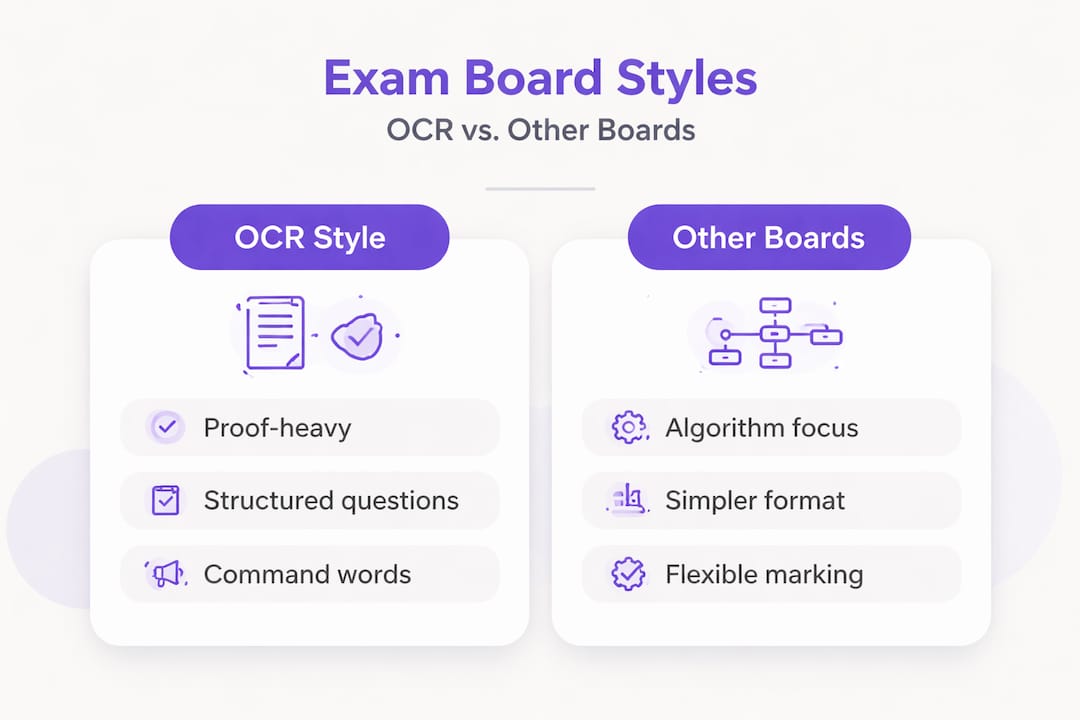
Past papers familiarise students with the exact exam format, question styles, and command words used in OCR A Level Maths exams. That familiarity is something no textbook summary can replicate. OCR also structures its papers differently from other boards, weaving together pure maths, mechanics, and statistics into integrated question sequences rather than keeping them in completely isolated sections. Knowing this structure beforehand means there are no surprises on exam day.
To appreciate what you're working with, it helps to compare A Level exam boards side by side:
| Feature | OCR | Edexcel | AQA |
|---|---|---|---|
| Question style | Structured, proof-heavy | Accessible, algorithm-focused | Contextual, real-world scenarios |
| Command word emphasis | Very high | Moderate | Moderate |
| Mixed-topic questions | Yes, frequently | Occasionally | Occasionally |
| Statistics integration | Mandatory in all papers | Mandatory | Mandatory |
| Marking style | Method marks prioritised | Full method expected | Method marks prioritised |
The differences are meaningful. A student who has only practised Edexcel papers will struggle with OCR's expectation of rigorous proof and logical sequencing. This is why reading about examples of exam boards early in your revision cycle allows you to tailor your strategy from day one rather than discovering the mismatch two weeks before the exam.
Key benefits of focusing on OCR-specific papers include:
- Mastering the exact command words used by OCR examiners
- Becoming comfortable with the specific layout and paper structure
- Practising integrated questions that combine pure and applied topics
- Understanding how OCR awards method marks versus accuracy marks
- Reducing exam-day anxiety through genuine familiarity with the format
How OCR past papers boost your maths scores
Now that you know why OCR's format matters, let's examine precisely how past papers deliver results.
Using past papers applies theory practically, improves problem-solving, and boosts confidence for A Level Maths including pure, mechanics, and statistics. That is not just anecdotal wisdom. It reflects how retrieval practice works cognitively. When you attempt a question, retrieve relevant methods, and then check your approach against a mark scheme, you encode that knowledge far more effectively than rereading notes ever would.
Different modules benefit in different ways:
| Module | Key benefit from past paper practice | Typical improvement area |
|---|---|---|
| Pure maths | Recognising proof structures and algebraic manipulation techniques | Integration, trigonometric identities |
| Mechanics | Applying Newton's laws and kinematics in multi-step problems | Force diagrams, connected particles |
| Statistics | Interpreting data correctly and understanding hypothesis testing | Normal distribution, probability |
The progression across modules is clear. Pure maths questions reward students who have seen enough varied examples to recognise what technique a question is calling for. Mechanics rewards systematic method. Statistics rewards careful interpretation, and only past papers teach you what "careful interpretation" actually means in practice.
Here is a step-by-step process for using past papers to build real skill:
- Select a specific module rather than attempting a full paper at first. Start with pure maths if that is where your weakest topics sit.
- Work through five to ten questions on a single topic, such as integration by parts, before moving on.
- Attempt questions without looking at solutions first, even if you feel uncertain. Productive struggle builds memory.
- Mark your own work using the official mark scheme immediately after completing each question.
- Identify every mark you missed and understand precisely why. Was it a method error, an arithmetic slip, or a misunderstanding of a command word?
- Repeat the process for mechanics and statistics, making note of question types that appear frequently.
Pro Tip: Start with easier questions within a topic to build your confidence, then move to harder ones. Tackling only difficult questions from the start discourages students and slows progress. A gradual build creates momentum.
To boost your grades consistently, you need to treat each marking session as a lesson rather than an assessment. The moment you find a missed mark, you've identified exactly where to direct your next revision session. That is the kind of targeted, efficient work that past paper revision makes possible.

Common mistakes students make with OCR past papers
Of course, not all past paper practice is created equal. What trips up most students?
The biggest error is using past papers purely as a test rather than as a learning tool. Students sit a paper, mark it, feel either relieved or deflated, and then move on without any real analysis. That cycle wastes time. The paper has told you something valuable, but you've ignored the message.
Here are the most common mistakes and why each one undermines your preparation:
- Not timing yourself. Sitting a paper without time pressure feels manageable, but it creates false confidence. The real exam does not give you the luxury of pausing to think indefinitely. Practising under timed conditions from early in your revision builds the mental stamina you will need.
- Skipping the mark scheme. Many students check only whether their final answer matches, ignoring the method marks. OCR awards partial credit for correct working even when the final answer is wrong. Learning to read a mark scheme teaches you to show your working in ways that maximise marks.
- Ignoring command words. This is perhaps the most costly mistake. "Find" and "hence find" are entirely different instructions. Responding to both in the same way loses marks and misses the examiner's point entirely.
- Only practising recent papers. Older OCR papers cover the same specification topics and offer an enormous range of question styles. Limiting yourself to the last two or three years means you miss a vast bank of useful practice.
- Failing to review errors systematically. Circling a wrong answer and moving on achieves nothing. You need to understand why you made the error, whether it was conceptual, procedural, or a misread of the question.
"Understanding command words is not optional in OCR A Level Maths. It is the difference between writing what you know and writing what the examiner is actually asking for."
Past papers familiarise students with the exact format and command words OCR uses, which is precisely why ignoring those command words defeats the purpose of practising at all.
Pro Tip: Always mark your scripts using official OCR mark schemes rather than unofficial solutions. Unofficial resources sometimes use correct methods that OCR would not award full marks for, because they do not match the specific marking instructions.
To genuinely review past papers effectively, build a simple error log. Each time you lose a mark, note the topic, question type, and reason. After three or four papers, patterns become visible and your revision targets become obvious. This approach aligns with exam preparation best practices used by students who consistently achieve top grades.
How to make OCR past papers work for you: a step-by-step guide
Avoiding mistakes is half the battle. Here's how to get the most out of every past paper session.
A repeatable, structured process turns past paper practice from a vague activity into a precision revision tool. The following approach works best when you follow it consistently throughout your revision period rather than cramming it all in at the end.
- Choose your paper deliberately. Select OCR papers from the last five to eight years that match your current specification. Check the OCR website or a trusted database to confirm the paper is from the correct version of the course.
- Schedule your attempt like a real exam. Sit at a clear desk, set a timer, put your phone away, and work in silence. This is not optional if you want the practice to reflect real conditions.
- Attempt the full paper or a targeted section depending on your revision stage. Early in revision, topic-focused practice works best. As exams approach, full papers under timed conditions build stamina.
- Mark your paper immediately after finishing. Memory of your thought process is freshest right after the attempt, making it easier to pinpoint exactly where you went wrong.
- Review every error with purpose. For each lost mark, go back to your notes or a textbook, revise the relevant method, then find a similar question and attempt it again.
- Record your scores over time to track improvement and identify which modules or topic areas need more work.
Using past papers builds problem-solving skills and real confidence across pure maths, mechanics, and statistics because the process forces you to apply knowledge rather than simply recall it.
Pro Tip: Rotate between modules across your practice sessions rather than spending entire weeks on pure maths alone. This mirrors the integrated nature of the actual OCR papers and prevents the frustration of feeling strong in one area while letting another go rusty.
Strong exam technique strategies go hand in hand with content knowledge. The students who score highest are not always those who know the most maths. They are the ones who know how to express that maths in the way OCR rewards. Practising exam questions regularly is how that technique becomes second nature rather than something you consciously have to think about during the exam itself.
A different take: what most students miss about OCR past papers
You've got a practical method. Now let's look at what most guides miss entirely.
Most advice about past papers focuses on doing more of them. Do a paper every week. Practise under timed conditions. Mark your work. These are all sensible recommendations, and they do work. But there is a deeper level of engagement that the majority of students never reach, and it is that level where the real gains are hiding.
The goal should not be to answer questions correctly. It should be to understand how the examiner constructed the question in the first place. When you read an OCR question and ask yourself, "What topic is being tested here, and how has the examiner disguised it?" you begin to think like an examiner rather than a student. That shift in perspective is genuinely transformative.
Consider a question that starts with a geometric proof and ends with an applied trigonometry calculation. The student who sees two separate things will hesitate and possibly miss the connection. The student who has trained themselves to see the thread running through a question will follow it instinctively. That skill only develops through conscious, reflective practice. Not passive repetition.
There is also the question of resilience. A Level maths exams are designed to include questions that most students will not finish. Encountering a question you cannot solve is part of the experience, not a failure. Students who have practised with enough past papers learn to stay calm when they hit a wall, move on, and return with fresh eyes. That is a skill in itself, and it is one that past paper databases can accelerate enormously by giving you access to a far wider range of question types than any single paper provides.
The students who consistently outperform their predicted grades are almost always the ones who have used past papers not just for knowledge recall, but for building a mental model of how OCR thinks. That is the real secret, and it is available to anyone willing to engage at that level.
Getting more from your OCR past paper practice
Ready to take the next step? Here's how Quextro makes past paper revision easier and smarter.
If you've been scrolling through PDFs, printing mark schemes, and trying to track your progress in a notebook, there is a far more efficient way to work. Quextro brings together over 13,955 past exam questions from OCR, AQA, Edexcel, and CIE into a single, searchable platform built specifically for A Level students.
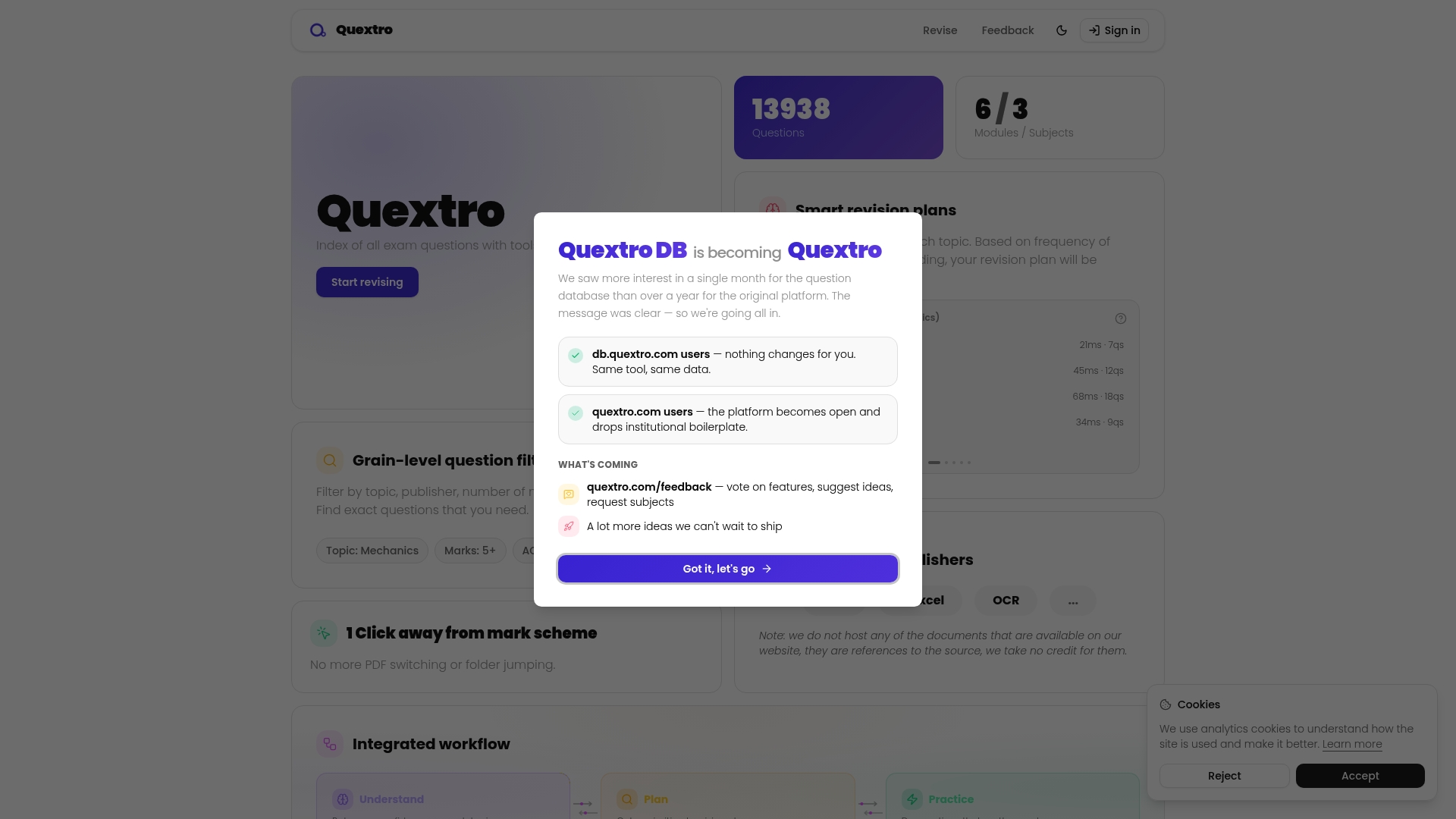
You can filter questions by topic, difficulty, exam board, and number of marks, which means you can target exactly the areas your error log tells you to prioritise. Smart revision plans adapt based on your confidence ratings and question frequency, so the platform actively guides you towards the work that will make the biggest difference. You answer questions directly on the site, track your progress automatically, and never have to wrestle with a PDF again. Explore the full A Level maths question bank and see how targeted, organised practice changes your results.
Frequently asked questions
Why are OCR past papers better than revision guides?
OCR past papers provide real exam formats and command words that revision guides cannot replicate, making your practice directly transferable to the actual exam.
How often should I use OCR past papers in my revision?
Aim for at least one full past paper per week, as regular past paper use builds problem-solving skills and helps you spot gaps across pure, mechanics, and statistics.
Should I time myself when practising OCR past papers?
Yes, always practise under timed conditions because exam format familiarity only translates into real exam performance when you train yourself to work at the required pace.
How do I check my answers for OCR maths past papers?
Use the official OCR mark schemes rather than unofficial solutions, as they show exactly which methods gain credit and how partial marks are awarded.
Is it better to practise OCR or other boards' past papers?
Focus primarily on OCR papers to master the specific command words and structure, but use other boards' papers for additional variety once your OCR technique is solid.