

TL;DR:
- Edexcel A Level maths is divided into Pure Mathematics, Statistics, and Mechanics, with Pure Maths carrying about two-thirds of the marks.
- Prioritize high-weighted topics like calculus, algebra, and normal distribution for more effective revision.
- Use a structured topics list to focus your revision, identify weaknesses, and practice with targeted past exam questions.
Knowing exactly which topics to revise for Edexcel A Level maths is one of the biggest challenges students face. Without a clear list, revision becomes scattered, time gets wasted on low-priority areas, and confidence takes a hit right before exams. The good news is that Edexcel publishes a well-defined specification, meaning every topic you could be tested on is already mapped out. This article walks you through the full Edexcel exam topics list, explains how topics are weighted, compares which areas deserve the most attention, and gives you practical strategies to revise each one efficiently.
Table of Contents
- How Edexcel structures A Level maths topics
- The full Edexcel exam topics list for A Level maths
- Comparison of topic importance and weightings
- Smart strategies for revising each Edexcel maths topic
- A fresh perspective on mastering Edexcel maths topics
- Turn your Edexcel topics list into actionable revision with Quextro
- Frequently asked questions
Key Takeaways
| Point | Details |
|---|---|
| Understand exam structure | Edexcel A Level maths splits its content into Pure, Statistics, and Mechanics, each with defined topics. |
| Prioritise high-weighted topics | Some topics appear more often and carry more marks, making them essential for targeted revision. |
| Use topic lists for planning | Mapping your revision to the official topics list ensures coverage and makes progress trackable. |
| Check question databases | Online resources with questions sorted by topic can make revision precise and effective. |
How Edexcel structures A Level maths topics
Before you can revise effectively, you need to understand how Edexcel organises its A Level maths content. The exam is not one single block of mathematics. Instead, it is divided into three clearly defined areas, each tested across different papers.
Edexcel A Level maths is divided into Pure Mathematics, Statistics, and Mechanics. Pure Maths forms the largest portion and is tested across Papers 1 and 2. Statistics and Mechanics are both covered in Paper 3, split into two sections. Understanding this layout immediately tells you where to focus the bulk of your time.
Here is a quick breakdown of what each area covers:
- Pure Mathematics: Algebra, calculus, trigonometry, vectors, proof, exponentials and logarithms, sequences and series, numerical methods
- Statistics: Data presentation, probability, statistical distributions, hypothesis testing, regression and correlation
- Mechanics: Kinematics, forces and Newton's laws, moments, projectiles, variable acceleration
This three-part structure matters for revision planning. If you treat all topics as equally important, you will likely under-prepare for Pure Maths, which carries roughly two-thirds of the total marks. Knowing the divisions means you can allocate your revision hours in proportion to the actual exam weighting. Adopting best revision practices from the start helps you build a study schedule that reflects this structure rather than one that feels balanced but actually leaves gaps.
Many students also find it useful to think of Pure Maths as the foundation. Topics like algebra and calculus appear not just in their own right but as tools within Statistics and Mechanics questions too. Strengthening your Pure Maths base has a multiplying effect across the whole exam.
The full Edexcel exam topics list for A Level maths
With the structure outlined, let's take a closer look at the actual topics you need to cover. Edexcel provides a detailed breakdown of exam topics for structured revision, and using this as your starting point is far more reliable than relying on notes alone.

| Section | Topics covered |
|---|---|
| Pure Maths | Algebra and functions, coordinate geometry, sequences and series, trigonometry, exponentials and logarithms, differentiation, integration, numerical methods, vectors, proof |
| Statistics | Statistical sampling, data presentation and interpretation, probability, statistical distributions, hypothesis testing |
| Mechanics | Quantities and units, kinematics, forces and Newton's laws, moments, projectiles, variable acceleration |
Some topics within Pure Maths are particularly broad. Calculus alone splits into differentiation and integration, each with multiple sub-techniques including chain rule, product rule, integration by parts, and differential equations. Trigonometry covers identities, radians, and inverse functions. These are not quick wins. They require sustained practice over several weeks.
Here are the topics most worth prioritising early in your revision:
- Differentiation and integration (Pure)
- Algebraic manipulation and proof (Pure)
- Normal distribution and hypothesis testing (Statistics)
- Kinematics and Newton's laws (Mechanics)
Pro Tip: Cross-reference your topic list with a boosting A Level revision resource to identify which topics appear most frequently in past Edexcel papers. Recurring topics deserve more practice sessions, not just a single read-through. A solid revision checklist built around this list will keep you on track throughout your preparation.
Comparison of topic importance and weightings
Knowing the list is just the start. Next, compare which areas deserve the most attention for maximum results. Certain Edexcel topics appear more frequently across past papers, affecting revision priorities significantly.
| Topic area | Approximate weighting | Frequency in past papers |
|---|---|---|
| Calculus (differentiation and integration) | High | Very frequent |
| Algebra and functions | High | Very frequent |
| Trigonometry | Medium-high | Frequent |
| Vectors | Medium | Moderate |
| Normal distribution | Medium | Frequent |
| Hypothesis testing | Medium | Moderate |
| Kinematics | Medium | Frequent |
| Newton's laws | Medium | Moderate |
| Moments | Lower | Occasional |
| Numerical methods | Lower | Occasional |
Based on this comparison, here are the top three priority topics in each section:
- Pure Maths: Calculus, algebra and functions, trigonometry
- Statistics: Normal distribution, hypothesis testing, probability
- Mechanics: Kinematics, Newton's laws, variable acceleration
It is tempting to skip lower-weighted topics like moments or numerical methods entirely. Resist that temptation. These topics often appear as shorter questions worth 3 to 5 marks, and they are far more predictable than the harder calculus questions. Picking up those marks consistently can be the difference between a B and an A. Learning to write effective maths answers for these accessible questions is a skill that pays off quickly.
Building exam readiness strategies around this weighting data means you stop revising by instinct and start revising by evidence. That shift alone tends to improve results.
Smart strategies for revising each Edexcel maths topic
Once you know which topics matter, the next step is revising them effectively. Here's how to approach each area of the list.
The most common mistake is reading through notes and thinking that counts as revision. It does not. Active recall, where you attempt to retrieve information without looking at your notes, is far more effective for retaining mathematical methods. For each topic on the list, aim to attempt questions before reviewing theory, not after.
- Plan by topic, not by date: Build your timetable around the topics list rather than working through a textbook chapter by chapter
- Use targeted question banks: Filter past paper questions by specific topic so every session has a clear focus
- Practise spaced repetition: Return to topics you found difficult after a gap of a few days rather than cramming them once
- Track your confidence: Rate each topic after every session so you can see progress and spot persistent weak areas
- Mix question types: Alternate between short-answer and multi-step problems to build both speed and depth
Pro Tip: A revision plan resource mapped to your specific exam topics is far more useful than a generic study timetable. When your plan names the exact topic you are revising each day, it removes the daily decision of what to study and replaces it with focused action.
"Using a revision plan mapped to exam topics leads to more effective results than open-ended study sessions."
For Pure Maths, the priority is building fluency with calculus techniques through repeated practice. For Statistics, focus on understanding when and why to apply each test, not just how. For Mechanics, draw diagrams for every problem. Visualising forces and motion before writing equations catches errors early. Combining these approaches with top revision tips gives your preparation a clear direction from the first session to the last.
A fresh perspective on mastering Edexcel maths topics
Here is something most revision guides will not tell you. The students who score highest in Edexcel A Level maths are rarely those who cover the most content. They are the ones who go deepest on the topics that matter most.
There is a widespread belief that ticking every topic off a list equals thorough preparation. In practice, shallow coverage of 30 topics is far less valuable than genuine mastery of 15. Calculus questions in particular reward students who have practised enough variations to recognise patterns quickly under exam pressure. A student who has attempted 40 integration questions will outperform one who has read about integration twice, every time.
The smarter approach is to use the topics list not as a checklist to rush through, but as a diagnostic tool. Identify your three weakest areas. Spend twice as long on those as on your strongest topics. Then return to the high-weighted areas with fresh eyes. Following exam preparation best practices built around the specification means your revision is always grounded in what Edexcel actually tests, not what feels comfortable to study.
Revision guided by a clear specification list, combined with honest self-assessment, is the most reliable path to a top grade.
Turn your Edexcel topics list into actionable revision with Quextro
Ready to put your topic list into action and focus your revision efforts? Here is how Quextro makes the process simple.
Quextro gives you instant access to a searchable database of over 13,955 past exam questions, all mapped to specific Edexcel topics. Instead of hunting through PDF papers, you can filter directly by topic, difficulty, and marks to build a targeted practice session in seconds.
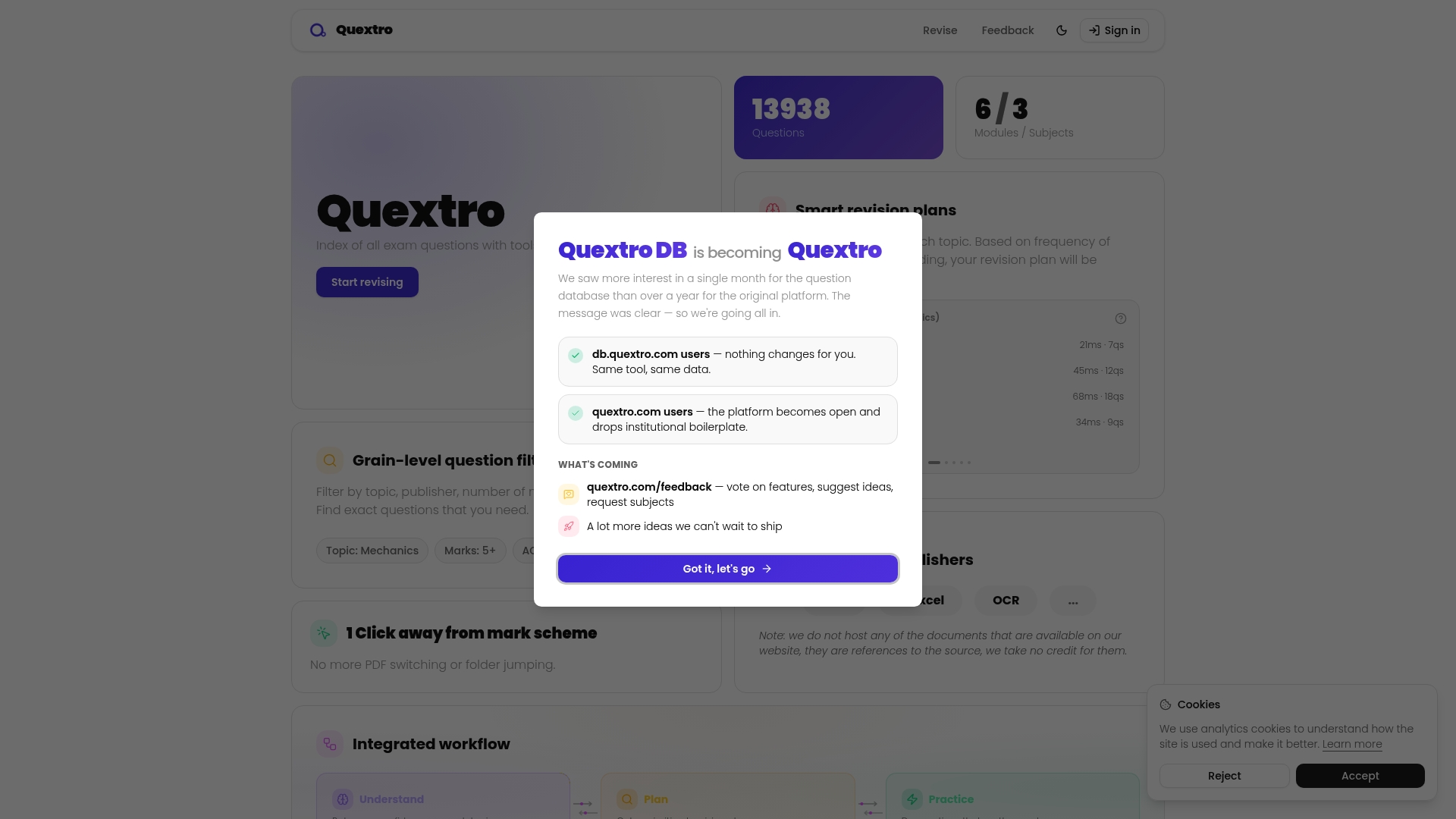
Whether you need to drill Pure Maths questions on calculus and algebra, or work through Statistics questions on hypothesis testing and normal distribution, Quextro has the questions ready and organised. Your progress saves automatically, so every session builds on the last. Explore all maths databases and start practising by topic today.
Frequently asked questions
How many topics are covered in Edexcel A Level maths?
Edexcel A Level maths covers around 25 to 30 main topics, split across Pure Mathematics, Statistics, and Mechanics sections.
Which Edexcel maths topics are most important for exams?
Certain exam topics appear more frequently than others, with calculus, algebra, probability, and kinematics carrying the most marks across nearly every paper.
Can I find past questions by specific Edexcel topic?
Yes. Resources like Quextro offer searchable question databases of past questions mapped directly to individual Edexcel topics for targeted practice.
How should I use the Edexcel topics list in my revision?
Use the list to build your timetable, identify weak areas, and track progress. A revision plan tailored to the specification topic list consistently leads to better outcomes than general studying.